Film cameras
Exakta Guide Reference guide
Reference guide for Exakta Guide. 27 pages in English. Read the original PDF, download or print a copy without registration.
27 pagesEnglish3.1 MB PDF
Loading your manual…Open PDF directly
Document details
- Brand
- Exakta
- Model / document
- Exakta Guide
- Document type
- Reference guide
- Language
- English
- Pages
- 27
- File size
- 3.1 MB
- Category
- Film cameras
- Document date
- Not specified in catalog
Search available document text
Find a term, then jump to its page in the original PDF. Image-only pages may not be searchable; check the PDF for exact wording and diagrams.
Page 5 · Read text
Page                           Page                THE 35 mm. EXAKTA MODELS
Coe of the Canera         77   Flash with the Exakta       84                    The 35 mm. Exakta is a single-lensreflex camera. The
  Storage                77   How to Use Flash       84                       actual taking lens servesboth for focusing and taking the  Exercise               77         Flash Exposures     85  Running test after storage 77                                                      picture and is used to form the image on the film as well as
  Keeping the interior clean  78                                                          to reflect the picture to be taken on to a ground-glass
  Treating the camera with                               Exakta Accessories        86                      focusing screen.Film and focusing screenare for all intents    care                 7g                                           and purposes at the same distance from the lens, but in  Coping          with tropical
    conditions                       78                                                         different positions and at right angles to each other. The
                                     Convercion  of Feet and Inches                               film runs along the back of the camera while the focusing
                                                 into Metic   Units           90                     screenis on the top of it. Thus, the light entering through
Close-up Work             80                                                   the lens has to go alternatelyin two directions: once to the  Supplementary              Lenses                        80                                                                            focusing screenand once to the film. This two-way traffic is      Close-upFocusing                      Table                                     Slwtter                                  Speedsto Anest                                                                                 controlled by a mirror on point-duty. By settingthe shutter,          for Supplementary                             Movement                                                                 9l       Lenses           82                                                   the mirror  is introduced into the path of the light-rays
  ExtensionTubes         82                                            betweenlens and film, thus reflecting the image on to the      Close-up              Focusing                      Table
                  Tubes                        83  How to . . . llthat is where?  92                       focusing screen,showing exactly the same outlines, defini-          for Extension                                                                                            tion, depth of field and relative brightnessof the subject as
                                                                                                     will appear on the negative.The screenis a plano-convex         @ 1979Focal PressLimited                                                                              lensground on the underside,and showsthe imagemagnified
                     ISBN  (excl. USA) 0 240 44780 8                                  and brilliant all over. It  is the right way up and permits
                     ISBN (USA only) 0 8038 1943 9                                                  critical focusing (aided by a built-in magnifier), as well as
                                                                        adiustment of the extent of definition towards both the
              AII  rights reserved. No part  of  this publication                                foieground and background and, lastly, composition of the
         may be reproduced,  stored  in a retrieval  system,                              photograph before the negativeis exposed.With the release
             or  tansmitted,    in any form  or by any means,                                     of the shutter for exposure,the mirror first snaps upwards                                   photocopying,                                                   recording             electronic,                      mechanical,                                                                 and coversthe focusing screen.Then the shutter goesacross        or other wis                                               ion of the                             e'''                                 p.er mi ss
                               l!?;i #,';;i:,                                        and the image is recordedon the fi.Im.
                                                                   The shutter of the Exakta is a self-cappingfocal plane
    Some items of equipment or certain materials mentioned in this                           shutter (except RTLI000, seepage 10) travelling from right                                                                                      "Self-capping"                                                                             means that  it remains closed while   book may not be .fieely  available  in every eountry. Import and                             to left.                                                                                                        "focal                                                                                                   plane" means that  it moves right   marketing  conditions vary widely, and are outside the control  of                         being wound up;
    the photographic  dealer.                                                                    in front of the negativematerial, thus ensuring full protec-
                                                                                        tion to  it. With this type of shutter, Iensescan be changed
      This         book is sold                        suhject                                   the Standard                                                                    of                                                                sale                                    to                                               Conditions                                                                            of                          while the camera is loaded. The Exakta shutter has the                                                                        price.   Net       Books'and               may                                resold                                            below the                         not be                                                             net                                              in the UK                                                                           widest possible range of speeds.Besidesthe instantaneous
                                                                   speedsfrom l/30 (early ll25) to l/1000 sec.,automatic time
     Printcd snd bound  in Grcat  Britaio by Maund & Irvinc  Ltd., Tring,  Hcrts.                        exposures from  1/8 (early 1/10) to 12 secs. can be set.
                     3
View original page 5Page 9 · Read text
EXAKTA VAREX  IIa (1957). This model follows in general the                     EXA IIa (1963),similar to II, but has detachableback and improved
above description. Its main differencescompared with the earter                                 film transport.
models are three co-axial flash sncker. /X. M and F). a speciallysilent                     EXA IIb (1965),similar to IIa, but with instant retum. mirror (the
shutter mechanismand an improved film indicator. The 196l model of                        imase-viewfindorcan bd vieived before and after exposure),a warning signal in
the Varex IIa is fitted with an improved reflex hood (with one-fnger                            the         when the film has not been advanced, and general
closing) which also acceptsthe interchangeableground-glassscreens                         mechanical improvements.
for specialpurposes,e.g. with split image rangefinder(up to now only                     EXA 500 (1967) is an improved version of the-Exa IIb with fully
available for the pentaprism). This hood has no direct vision frame                          automatic diiphragm lens, pentaprism with fresnel screenand micro-
finder. The standard lenseshave fully automatic preset iris.                                   prism rangefuider,-shutterspeedsll2  sec.and 1/500 sec. and B, and
  EXAKTA  IIb (1964)is similar to the model IIa of 1961,but has                 XM flash synchronization.
geometricalspeedscales(1130,1160,lll25, 11250,1/500,U1000 sec.).                    EXA  I (iSS:) has a shutter of different design with speedsof -1125,
The rewind kndb has a crank. The catch to securethe finder is not                            1/50. l/100, l/i50  sec. and B only, two flash contacts,no delayed
needed.                                                                                                       abti6n.'filrir wind is by a transport knob; the film cutting deviceis
  EXAKTA  VX1000 (1967) is as the Exakta IIb, but with instan                             omitted. Long focus lensesbeyond 100 mm. are not usable (with-out
return mirror and minor mechanicalimprovements.                                    undue cut-off)and similarly close-upswith longer extensiontubes than
  EXAKTA VAREX VX500 (1969) is a scaled-downversion of the                        2 in. 6 cm.) cannot be made.
VXl000, with shutter speedsof l/30 to U500 sec. and B only.                         EXA  I (1961),as I 1953with improved reflexhood.  EXAKTA VAREX VX (1950 is similar to the model IIa, but has                    EXA  I (tgefi-nas improvedstyling,shutterspeeds1130,1160,lll25.
only two flash sockets.                                                              1/175 sec.,B, single flash contact with symbol setting for electronic
  EXAKTA VAREX VX (1951) has flash socketsfor a two-pin flash                              flash and bulbs.                                                                                                                                                      transport.                                                                                                                                                                film                                                                                                                             but with lever                                                                                                                            to                                                                                EXA I (1963),                                                                EXA                                                                                                           Ia (1965),similar                        sockets.     instead of              concentricplug-                                                                                                                                     as the                                                                                                                                                      the-                                                                                                              same                                                                                                                       are substantially                                                                                          Exa                                                                                                 cameras                                                                                                         In handiing,-ihe               V (1950),                             the predecessorof the VX is similar to        VAREX  EXAKTA
it except that it has no film type or transport indicators, it does not                           Exakta. Whert differencesoccur which are not self-evident,these are
permit-      working from cassetteto cassetteand the back is not hinged.                             pointed out in the text.
  EXAKTA   II (1949)is as Exakta V but has no interchangeablereflex
finder, so that the pentaprism attachment is not usable (but a special
prismatic attachment can be placed on top of the reflex hood,- see
page84). The flash contact is for flash bulbs only, and there is a minor
change in the mechanicalconstruction of the film transport.
  EXAKTA   I (1936), the original pre-war Kine Exakta, is similar to
Exakta II with quite minor mechanicaldifferenceswhich do not affect
its manipulation.                                         "Kine  The Exakta camerasusing 35 rnm. film were originally called
Exakta" to distinguish them from the roll  film Exaktas then also
produced. The prefix "Kine" was dropped in 1950,however.

Exa Models
  The Exas are simplified versionsof the Exakta. They retain many of
its features, in particular the reflex focusing-viewingsystem and the
interchangeablelens system. In addition to the lenseslisted for the
Exakta, an inexpensivestandard lens,f2.9 50 mm. Meritar, 3 element
with pre-set diaphragm, is available for the Exa models.
 EXA  II (1959) has shutter speedsfrom ll2  to 11250sec. and.B,
single flash contact, but no delayed action. The eye-levelpentaprism
finder is permanently fitted. Most Exakta accessories,including all
lenses,may be used in it.
                                         t l                                                                                                                         t 2
View original page 9Page 10 · Read text
back, HANDLING THE EXAKTA makeholdingsureit stillthat withthe perforationsone finger. ofBeforethe filmclosingengagethe incamerathe teeth of
the film transport sprockets.
To start with, we take it for granted that we have our On RTL1000, pull the beginning of the film to the green mark push perforation it with its lower from above under the filmExakta, together with a cassetteof film, in front of us. Our and over the film transport rest and sprocket. The wire frame onfirst task is to load the camera with fi.Im. take-up spool must not poir^t upwards (but in any other position).the
On the Exa I (1961) camcra, remove the take-up spool from its
Loading chamber and push the film end under the spring of the take-up
The fi.lm should be loaded into the camera in subdued spool.side outwardsThe film exceptis woundon onExato Ithe(1963)take-upandspoollater,withwherethe emulsionit winds
daylight, or at least in the shadow of your body. The inwards. Now insert the take-up spool into its chamber, ensuring
procedure is as follows: that its top engages in the shaft of the film transport knob, and the
perforation of the film in the film transport sprockets.
1. Open camera-back. VX500WhenandworkingVXl000,withtrimtwothecassettesfree film withend square.the ExaktaOpen VX,the take-upIIa, b,
2. Insert film. cassette (page 37), remove any cut-off film end from the centre
3. Fix film on take-up spool. spool and attach the end of the fresh film to the centre spool of the
4. Close camera. take-up cassette (No. 4, page 37). Assemble the take-up cassette,
5. Open finder hooil. and.insertmust point ittowardsin the take-upthe filmchamber.aperture Theof theslitcamera.of the take-upMake surecassettethat
6. Transport film twice and release. the perforations of the film engage in the teeth of the film transport
7. Wind film-winder once more and set picture-counter. sprockets, and close the camera back.
8. Set fiIm indicator. To work from cassette to cassette on Exa I (1961) cameras, simply
replace the take-up spool by an empty cassette and adopt otherwise
1. Open qamera back by pulling downwards and turning the milled the same loading procedure as described for use of the take-up spool.
camera opening knob on the camera base. On earlier models and 4. Cfose the camera back. With the Kine Exakta I and II, take care
some Exa models, press camera back lock. On RTLI@0, pull up that the circular peg inside the camera connected to the rewind key
the rewind knob as far as it will go. is pushedfirmly into the interior of the camera. This is best done with
the ball of the left thumb. The camera back, held in the right hand
2. The rewind key is pulled out as far as it will go, then place loaded with its locking-key upwards, is hooked with its lower end into the
film cassette into right-hand side film chamber (below slow speed groove on the body of the camera, and the back itself pressed lightly
and delayed action knob) with its hollow part towards rewind key. towards the body until the locking-key snaps into position. The
The mouth of the cassette with the film end has to point towards rewind key must be allowed to catch in the camera back so that it
the take-up spool. The rewind knob is now fully pushed back, is clanrped to the camera and cannot be pulled out when the back
taking care that its centre plate is not pushed upwards. is closed.
The film chamber of the Exa has a cassette guide (a metal sheath On RTLI000 just press back gently home; it will lock automatic-
which projects from the roller towards the chamber). The loaded ally. Transport and release the film transport lever and repeat until
cassette is inserted from beneath the camera, so that the mouth of the automatic frame counter points to No. l. Igaore the points
the cassette lies againstView original page 10Page 14 · Read text
PENTAPRISM FINDER. This is for the Exakta RTL 1000.VXS00.                 T{OIDING-REFLEX  FINDER
 lfi)0, rla, b, VX, V and EXA  I;  it is interchangeableagainstth6 normai
reflex finder and is an extremely valuable alternativelocusing-viewinc
method. To change from the rbflex to the ey+level finder, ihe findei
housing is lifted up bodily and replacedby the other findbr housine,
while on EXAKTA  VXl0(n,  IIa,VX  or V the sliding catch on thl
front plate is depressed.
  With the pentaprism in position, the image is viewed and focusedat
eye_leveland see-nupight and the right way round. The bright image
makes accurate focusing easy, and changrng from the horizontal to the
vertical position is straightfonvard.
 _ The base of the pentaprism finder consistsof a plano<onvex lens,
the flat side of which is a ground screen.This basels interchangeabld
for special ones, with split-image rangefinders available eithei on a
normal ground-glass screen or on an extra-bright fresnel lens screen
giving uniform bqghtness edge to edge. They give split-image range-
finder focusing, in addition to normal screbn focusing. Two small
prisms are mounted in a clear spot in the centre of the screen,and the
image_inthe s,pot_appearsdisrupted; on turning the focusing ring, the
two disrupted halves are brought into line so that one c-ontinuous
image is seen,and in this position one has focusedaccurately.
  For more specialisedtypes of work, in particular for macrophoto-
glaphy and qhotomicrography, the ground-glass condensermay be
changedfor clear glass(to permit focusing on the more brilliant a-erial
image),or for ground-glasswith a centrespot of 3 or 10 mm.
  Prism finders combined with exposure meter are available: see                       Theimage,standardbut  it  isreflexreversedscreenright-to-left.shows an  uorirht
page 65.
 FRAME FINDER. The Exakta modelsprior to 1961werefitted with
a direct vision frame finder. This is brought into position by pressing
inwards themagnifyingglassin front of thefinder hood. The reciangular
aperture in the back wall of the finder hood, together with the open
frame in the front wall, form a direct vision frame finder for eye level.
  To use the frame finder of Exakta IIa, VX. V, II,  lift up the magnifier
and also the protective cover. The frame when viewed through the
sight w_illdefine the outlines of the picture aimed at. When using the
frame-finder, one must not attempt to turn the camera to the right or
the left, away from the eye,nor must the eye be moved from the centre
of  the back frame to find the limitations ofthe field of view. This spying"round       the corner" is deceptive,as only the section seen in the findel
when holding the eye close to and in the centre of the opening while
looking straight ahead, will appear on the negative.The-frame finder
gives the correct field only for the standard 5 cm. lenses,and it cannot
be expectedto be free of parallax.                                                                               Using  the-reflex    finder,   the  Exakta  is.held   firmly   against  the  chest;  the   right  hand
  The frame finder cannot be usedfor focusing, apart from guessingthe                               operates  the  helical focusing while  the  left hand grips  the camera. the index  hnser  on
                                                                                                                                   thereleasebutton(left),                                                                                                                                                       Themagnifierinthehoodisusedtoobtaincriticafocus(cintre).distance         of           the               subject                   as                     based                          on the                                       size                                                   oflts                                         appearance                                                                                                                                                                        pictures,                                                                                                                                             obtain                                                                                                                                                                      vertical                                                              within                              To                                                                                                                                                                            the                                                                                                                                                                          operator                                                                                                                                               may                                                                                                                                                                                     stand                                                                                                                                                                                   sideways,and   hold  the  cainera  atthe frame        and             then                    setting                         the                            focusing                                     scale                                               of                                             the lens                                            mount accord.                                                                                                                                                               leycl  (right);                                                                                                                         €ye                                                                                                                                                                                               in                                                                                                                                                                                         this  position                                                                                                                                                                                 the                                                                                                                                                          image                                                                                                                                                                                                                                                    is upside                                                                                                                                                                             down.
                          2l                                                           22
View original page 14Page 17 · Read text
has beenloaded with firnr, as instructed on page 13, proceed                    DELAYED ACTION RELEASE FOR SPEEDS FROM  II3O TO
as follows:                                                                       r11000sEC.:
                                                                                                           (a) Set sh':tter-speedknob to actual exposuretime required.
    I. Wind film transport.                                                                    (D) Wind slow-speedknob as far as it will possibly turn in a clock.
   2. Set shutter speed.                                                                   wise direction.
   3. Focus and determinepicture frame                                                                 (c)  Lift slow-speedknob up, tum  it so that any red figure comes to
   4. Set stop.                                                                                             (d) lieReleaseagainstsmoothly.the mark on the knob and let knob drop back.*    3. Release.
 1. Wind film transport lever as far as it will go and let  it spring back                    DELAYED ACTION RELEASE FOR SPEEDS FROM TI8 TO
   wilh brake. If the camera has been reloaded with new film,-it has                          6 SEC.:
   already been wound for the first exposure.                                                              (a) Set shutter-speedknob to B (or Z).
      ,. On.the Exa I (1961)and Ia, turn the film transport knob in the                                (D) Wind slow-speedl<nob asfar as it will tzrz clockwise.
   direction of its engravedarrow as far as it will go. On the Exa II                                       (c)  Lift  slow-speed knob up, turn   it so that the exposure time
  move the transport lever as far as it will go.                                                           required in red comes to lie against the ma.rk on the knob centre
2. Theshutter.speedsof Exakta and Varex models from 1/30 to 1/1000                            and let knob drop back.*
   sec., as well as B (brief time) and T or Z (time), are set on the                                    (d) Releasesmoothly.
   shutter-speedknob (besidethe film transport lever) by lifting it up,                              The delayedaction time in all casesis about 12 sec.
   turning the speedrequired opposite to the index mark on tht fixCd                          The Exa Ia, b shutter speedsare set with the lever or ring moving
   centre of the speedknob and letting it down again. The numbers                              past a scale of engraved shutter speedson the top between the
   given on the knob indicatefractionsofseconds,so that 30,60,125,                            rewind knob and finder. The speedfigures engraved(B) 30, @,125,
   etc., mean 1130,1160,lll25 sec.Short time exposuresare made by                         175 representfractions of a second, namely 1130, 1160, lll25,
   setting B opposite the indicator, when the shutter will remain opeit                          175 sec. The mark on the lever has to point to the mark on the
  as long as the releasebutton is pressed.Long time exposuresare                          speed scale. At the B setting the shutter remains open as long as
  made by setting T (Z in early cameras)to the indicator when a first                               the shutter releaseis depressed.
  pressue on the releasebutton will open the shutter, and a second                          The Exa IIa, b and 500 shutter is set by tuming its milled outer
   pressurewill close it again.                                                                          ring until the desiredspeedpoints to the triangular mark.
    The slow speed and delayed action knob allows for automatic                           The RTLI000 delayed action works with the speedsfrom 1 to
  exposureof slow speedsfrom ll4 to 12 seconds(on older models                           1/1000sec.only:
  from U10 sec.) and use of a delayed action releasefor all shutter                                    (c) Turn the shutter speedrequired to the orange triangular mark.  speedsfrom l/1000 to 6 seconds.Its handlingis slightlycomplicated                                  (6) Turn the slow-speedtensioning lever clockwise to its stop.
  and should be carefully studiedand exercised.                                                         (c) Releaseon the preset timing device and the exposurewill take
    The RTL1000 shutter speed dial carries the range from  I  to                                 place 8 sec.after release.
  1/1000sec. and B. It is set by turning the required speed to point                                3. Focusingis accomplishedby turning the secondmilled ring on the
   to the orange triangle mark.                                                                   lens mount which bears the distance markings either until the
TO OPERATE THE SLOW SPEEDS:                                                        distance required is opposite the distance mark, or by the usual                                                                                                          reflex image control (page 18) until the subject appearsfully sharp.   (a) Set shutter-speedknob to B (or T).
   (6) Wind slow-speedknob asfar as it will possiblytarz in a clockwise                               4. The stop is set on the lens mount, where the milled front ring with
       direction.                                                                                the indication mark can be turned in line with the aperture figure                                                                                    engraved on the lens. The purpose of the diaphragm is to adjust   (c) Lift slow-speedknob up, then turn  it so that required time in
      black figures comes to lie opposite mark on knob and let knob                                *The slow-speedknob of the earlier 35 mm. Exakta models
     drop back.* On the RTL1000 the slow-speedknob is turned                              has a black and a red mark. In this case,the red figures (when
       until the required speed (2-8 sec.) points to the mark on its                                working with delayedaction) have to be placed against the red
      tensioninglever.                                                                       mark, and the black figures(when using the slow shutter speeds)
   (d) Releasesmoothly.                                                                           against the black mark.
                    27                                                          28
View original page 17Page 18 · Read text
the effective opening of the lens. The smaller this opening, the greater                                                         l.  After  all exposures have been taken, press the rewind pin on RTLI000
   the depth of field (page 52). At the same time, as less light can pass                                         in camera bottom  plate;   it  will  stay automatically  depressed. On
  through the lens in any given time, the exposuretime must be longer                                       earlier models, press the pin situated on the camera top plate between
  (page 52). The reduction in light means obviously a reduction in                                  the exposure counter and shutter-speed knob and keep  it depressed
   brightness of the reflex image with an increase of depth of field.                                 while rewinding (No.2). On the original 35 mm. Exakta models is a
  Both /oss of lieht and inueased depth of field make the accurate                                   lever  in  this  position  which  has to be folded  up and  left  in  this
  focusing on the ground-glass more diftcult,  therefore reflex focusing                                    position  while rewinding;  while the original Exaktas have a reversing
  should always be done at full  aperture.                                                                  lever which has to be pushed sideways so that the letter R is visible.
    To facilitate focusing at full aperture with subsequentquick and                          On the Exa  I (1961) and Exa 500 the rewind pin is behind the film
   correct stopping down, the later lenseshave preselectiveaperture                                  counter. On Exa  I, keep  it depressed while rewinding.
   setting-those of the 196l Exakta, the IIa, IIb, YX500, VXl000 and
  RTL1000 have fully automatic iris preset.                                                               2. Press the centre of the film rewind knob as far inwards towards  the
    Sorneof the early lenseshave behind the aperture scalea milled                            camera body as it will go; this engages the rewind key on the centre
   ring, and this is pushed backwardstowards the camera and turned                               spool of the cassette. Then  turn  the rewind knob  in a clockwise
   until its index mark points to the aperture one wants to use. It is                                   direction  until the film  is completely wound back into  its cassette.
  then releasedto spring back into its original position.                                               Correct  rewinding  can be observed by the movement  of  the film
    Having focusedat full aperture, the aperture ring is turned, until                                  transport  indicator beside the slow-speed knob.
     it stops at the preselectedsetting. The exposure is then made                                        Incidentally,  the centre screw securing the  film  transport  lever
   without  it being necessaryto move the camera from the taking                                  turns in the opposite direction to the lever itself.
   position.                                                                                     Exakta VX and RTLI000  rewind knob has a fold-over handle
     Later lenses have an automatic iris preselectingmount. After                               which  has to be turned  in the direction  of the engraved arrow  to
   selectingthe aperture required, a tensioning lever on the mount is                               rewind film.
   set, and when the shutter releaseis depressedthe diaphragm is                          On earlier Exakta models, raise the rewinding  key on the camera
   automatically set to the selectedapertue just before the shutter                             bottom and turn  it clockwise with the thumb and index finger. On
   starts moving.                                                                                           the Exa,  turn  in  the  direction  of  the arrow.  Turn   until  a slight
    The lensesof the 196l Exakta, IIa,IIb, VX500, VXIOU), Exa 500                                  resistance  is  felt, wind  over  this resistance and give two  or  three
  and RTLI000 do not require tensioning. The iris opens up again                            more turns. The  film end now comes off the spring  of the take-up
   automatically when the shutter is released.                                                    spool and is wound back into the cassette.
5. Releaseby pressingthe shutter-releaseknob gently, without shaking
   the camera.The releaseknob is blocked as long as the finder hood                                   3. Open the camera back (see page 13, No.  1).   is closed, to protect against accidental release.A releaselock is
   fitted to the models with interchangeablefinder hood in the form                                                                                                                      4. The cassette of exposed film  is taken out by pulling  the rewind key   of a releaseknob cover-and on the RTLI000 a locking disc for                                                                                         downwards  as far as it  will  go.   the right-hand release.
Unloading                                                                                                         5. Before closing the camera back, push the rewind knob back into  its
  After   all exposures on the film have been made,  it has to                                     original  position. While  the rewind pin  of the RTLI000,   IIa,  IIb
be removed  from  the camera and replaced with a new one.                             andposition,VX  andon theExaearlierwill  springmodelsautomaticallythe rewind leverback hasintoto itsbenormalfolded
When working from cassette to take-up spool, the procedure                              down, and on the original models turned sideways so that the letter
is as follows:                                                                   V is visible.
   1. Depress rewind pin.
   2. Rewind  film  into cassette                                  Unloading without Rewinding
   3. Open camera-back.                                          When working from cassetteto cassette,the procedure
   4. Remove cassette.                                                                   for unloading the Exakta VX, IIa, IIb, VX500 and VXl000
   5. Close camera-back  or reload with  film.                                               is as follows:
                    29                                                        30
View original page 18Page 22 · Read text
m_4kesure, while winding on, to hold the film only by its                          4. If the centrespoolis fitted with a film catch,threadthe tapered
 edges.                                                               endof the film into it. In caseswherethe centrespoolis fittedwith
  When winding the film on and off, care must be taken that                      a spring,threadthe end underit and fold it sharplyback.If the
 no great pressureis put on the film, and that the film-ends                         centrebeenprovedspoolisbestwithoutto windanyasuitable1* in. (4fittingcm.)topieceholdofthecellulosefilm, it tapehas
 are not squeezedwhen drawing through the hand. Failure                       round the centrespool,so that on eithersideabout* in. tapeis
 to take the first precaution may result in fogging, while                      usedto securethefilm (seepage35).
                    precaution         of           the latter                                    give                       may                                              rise to leglect                                                 peculiar                         7. Where                                                                                    both                                                                                             top and                                                                                          bottom                                                                                                    covers                                                                                                            are loose,                                                                                                                                                                                                                             it is essential                                                                                                                                                   to                                                                                                                                                                                        fix                                        "lightningkinds        of         exposure                     effects                                                                                                   preferably                     known                              as                                                  flashes".                                                                     themto                                                                                         theshell,                                                                                                             with                                                                                              a length                                                                                                                                 of adhesive                                                                                                                                    cellulose                                                                                                                                         tape.
These are due to electrical discharges,and appear as dark,
zigzag lines running from the edge of the film towards the
centreof the picture.                                                         Cassetteswith Daylight Refills
                                                                                            1. No darkroom is necessary.
Loading Cassettes                                                                         2. Remove film wrappings and label of refill.
  The majority of cassettesconsistof a centrespool which                            3. Open cassette.
is in a shellwith top and bottom cover.The film leavesthe                            4. Introduce refill into shell of cassette; the first 2 in. of
shell by a light-trapped slot (the cassettemouth). The centre                         paper leader has to project from light-trap.
spo-olcan be,removedfrom the shell by rernoving either top                             5. Close cassette.
or bottom of the cassette,according to the construction oT                            6. Pull out paper leader and 2 in. of fiIm.
the particular container.                                                                7. Cut off paper leader.
  Most  of the cassettesare actually intended by  their
makers to be used once only, and rviih the film originally                          4. The actualcentrespoolof thecartridgeis not needed.
supplied in   it. However, fiovided  they are reasSnably                         5. SeeNo. 7 above.
robustly made and the light-trapping velvet slot is in good
condition, these cassettescan be reloaded many times, and
will give perfectly satisfactoryresults-z/ handledcarefutly.                   The Choice of Black-and-White Material
                                                                                                               "best"                                                                      There is no such thing as a         film for any or every
Cassetteswith Bulk Filrn or Darkroom Refills                                      kind of picture. Each type of film has certain characteristics,
   1. Work in the darkroom in appropriate safelight.                               especiallywith regard to colour sensitivity,speed,gradation,
   2. Prepare film.                                                                    latitude and, more particularly, grain.
   3. Open cassette.                                         COLOUR  SENSITIVITY.  Practically all 35 mm. films
   4. Fix film on centre spool.                                                         that can be used in the Exakta are sensitive to all colours.
   5. Wind film on centre spool.                                          They are what is known as panchromatic.
   6. Insert centre spool into shell; the first 2 in. of film has                    INFRA-RED FILM. Infra-red film is a negativematerialwhich,
      to project from the light-trap.                                                  unlike the panchromaticfilms, is madesensitiveto infra-redrays,
   7. Close cassette.                                                       which are not visibleto the humaneye.Specialapplicationsof this                                                                                  material: black-outphotography.long-distanceshots,mistpenetration,2.  As     described           on page34.                                                                       scientificcopyingandresearchwork. It mustbe usedwith an infra-red  As3.      described above.                                                                                                                   filter to cut out bluelight, to whichit is alsoverysensitive.
                   37                                                       38
View original page 22Page 26 · Read text
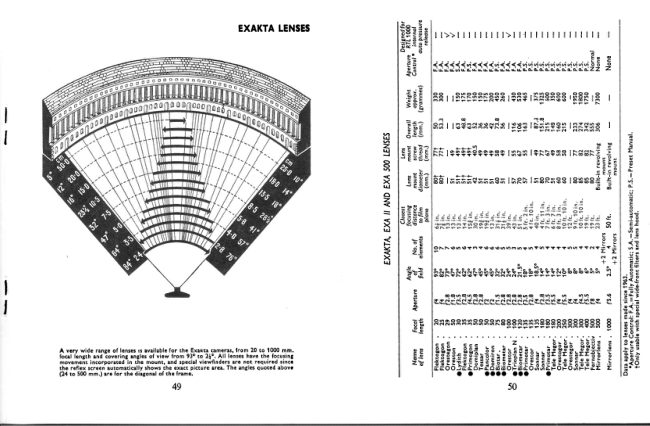
EXAKTA LENSES                                       The focusing mount bears a distancescale,as a rule in feet. some-                                                                                         times in metres, with an index indicating the distance to which the
                                                                                                 lens has been set.
                                                                            To remove the lens, it has to be held firmly in the left hand. while
  A wide range of lenseshas beenmounted for the 35 mm.                               at the same time pressing the lens catch liglitly with the right hand
Exakta cameras.The standard lensesarc 2 in. (5 cm.) or                        and simultaneouslyturning the lens firmly to the left. After iurning a
2l in. (5.8 crn.).                                                                  few degrees,it will be found that the lens disengagesand can be lifled                                                                                     from the camera body.
  Some of theselenseswei'e,or are, marketed by the manu-                        To insert a lens, this procedureis reversed.The lens is held into the
facturersof the camera,some quite independentlyof them.                          tubularmount of the camera body, care being taken that the red dot
For that reason one mav find Exaktas r.vithlensesnot listed                       on the lens comes to lie opposite the red dot on the camera body.
in this book.                                                       Now the lens and mount are turned firmly to the right until the lens                                                                                         catch is heard and seen to slip into the catch on the lens mount.
  Lensesof any focal lengthfrom 20 mm. to 1000mm. and                     A depth of field calcuhtor is engravedon the lens mount. On either
of apertures up to .f1.5 can be interchangedwith the                            sideof the distanceindicator the aperturevalueswill be found engraved."standard"           lens in any of the 35 mm. Exakta cameras.                                 After focusing with the mirror reflex arrangement or by setting the
                                                                                         index mark to the distance required, one can read off bpposit6 the
  A most important feature of the construction of the                             left-hand -stopthe -depthof field to the foreground and the right-handExaktasis that, whateverlens may be employed,the correct                          stop the depth offield to the background (seepage 53).
imageand accuratefocusingis obtainedin the mirror reflex
housing. Consequently,no special finders are needed,as                        The treatment and care of lenses is a matter of importance.
this at the same time does away with parallax, no matter                   On account  of  its chemical composition,  optical  glass of
how short or how long the focal length of the lens.                                  high quality  is susceptible to the influence of moisture, and
  This does not hold good for the auxiliary .frantefnder                                foravoided.this reasonWhen touchingnot  in use,the theglasslenswithshouldthe fingersbe protectedshould bybedevice. The frame finder is correct only for the standard                                                                                             putting bn the lens cover or at least by a lined case. Sincblenses.                                                                                complete protection  is impossible,  the lens surface should  The diaphragmon the Exaktasis adjustedby meansof a                                                                            be cleaned occasionally with a clean, soft chamois leather.milled ring engravedwith the aperturefigureson the lens
mount. Pre-set or automatic aperture setting lenses are
suppliedwith recentmodels;their manipulationis described                      The Choice of Lenses
on page29, No.4.                                                                            The  Domiplan  f2.8  50 mm.,  Tessar f2.8  50 mm.  and
  The mounts of the lensesare arrangedso that accessories                       Oreston  fl.8  50 mm  can be regarded as "standard"   Ienses(filters, supplementaries,lens hood) can be slipped on or                                                                                                            for  the Exakta  and the most suitable for  general use.
screwedin.                                                                                                                                  It is wrong to assume that the high correction  of the large
                                                                                      aperture lenses enables one to use them invariably  at their
                                                                                                                           full  opening.  It  will be appreciated that the depth  of  field
Setting and Changing Lenscs                                                   can only be comparatively  small, so that more often than
 The35 rnm.Exaktasuselensesin a focusingmount.That is to say,                          not stopping down becomes necessary. Large apertures are,
the    lens            itself                   is                     fitted                        with a                                   helical focusing ntount. When screwed                          however,  useful  in adverse  lighting  conditions  and they also                                 position.right     back,                     it is                    in                   the infinity
  Focusing  for nearer distanccs rs done simply by tuming  the lens                          ensure a bright focusing  image on the ground-glass.
mount  to screw  it forward.                                                       The possession of one or more of the longer focal length
                    45                                                         46
View original page 26Related documents and language editions

From the M. Butkus archive. Original publisher and archive notices are retained.
Check the model and edition against your equipment.
PDF verified 2026-10-10.