Light meters
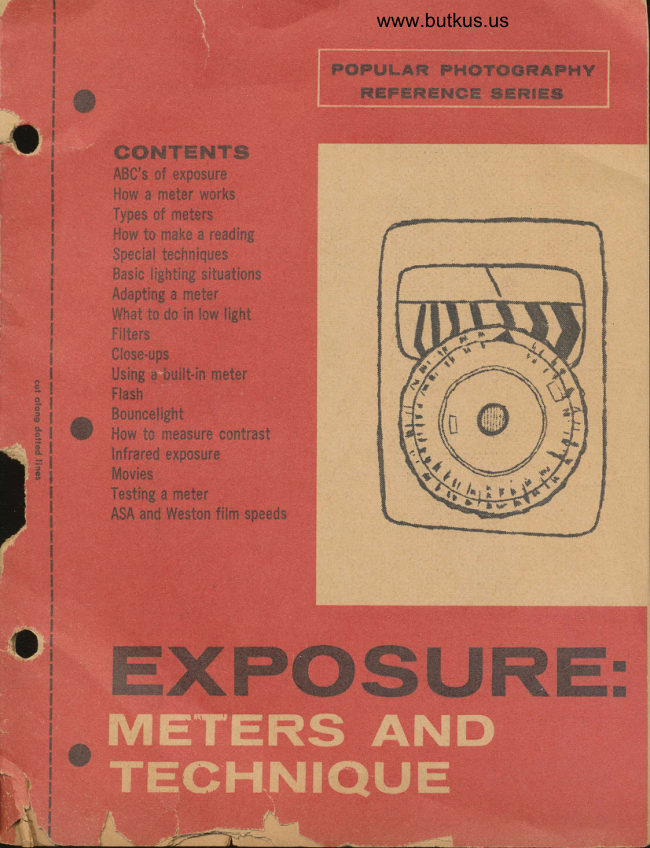
Exposure: Meters and Techniques User manual
User manual for Exposure: Meters and Techniques. 15 pages in English. Read the original PDF, download or print a copy without registration.
15 pagesEnglish2.5 MB PDF
Loading your manual…Open PDF directly
Document details
- Brand
- Various brands
- Model / document
- Exposure: Meters and Techniques
- Document type
- User manual
- Language
- English
- Pages
- 15
- File size
- 2.5 MB
- Category
- Light meters
- Document date
- Not specified in catalog
Search available document text
Find a term, then jump to its page in the original PDF. Image-only pages may not be searchable; check the PDF for exact wording and diagrams.
Page 4 · Read text
www.butkus.us
  Moving to the next larger full l-number      at  f /8, and U3A at l/11. Your choice should
(see full-stop differences, below) closes    be based 0n the speed reguired to handle
down the opening and halves the amount of     action, or the depth of field needed for the
light reaching the film. Opening up one fuf  l    scene. lf both aspects are important, you
                                                         compromise, or use a fasterstop (from say l/l!  to l/81 doubles the   may have to
amount.                                            film that will permit combining a high speed
   Equally important is the way depth of    with small lens opening.
field (the zone of apparent sharpness before
and behind the point of focus) varies with  EVSthe l-number chosen. In general, closing       Exposure can also be stated in other ways.
down the lens increases the depth of field;    The popular EVS (Exposure Value Scale) sys-
so does using a larger focusing distance.   tem uses numbers from 0 to 18, and ex-
You may need a deep zone for landscapes,     presses equivalent exposures by a single
but a narrow one to throw a distracting    number. EV 12, for example, describes the
background out of focus in outdoor por-      light-passing power of equivalent exposures
traiture. When choosing the proper /-number    given in the previous paragraph.
for a particular distance, check the depth-      Once the correct EV number is set, moving
of-f ield scale found 0n most adjustable    to a different shutter speed also changes
cameras.                                the /-number (or vice versa) to maintain
                                       the same exposure value. This brings an
WHICH G()MBINATION?     added measure of useful automation, which
  For any exposure pair, there are always    can be discarded when necessary if the EV
a number of other shutter-speed,  lens-open-     scale can be completely uncoupfed to allow
ing combinations which allow the same     using the camera in the more conventional
amount of light to strike the film. Such    way. Following the rise of the systern, EV
equivalent exposures might be, l/500 at    scales have been added to more meters,
l/2.8, l/250 at  f /4, l/125 at I/5.6, l/60   and on some, it is the only scale used.
 HXPEDSURE GONTROLS AT A ffifuAhdffiffi
        SHUTTER-SPEED SYSTEMS

 0lder        Scale            r/2  L/5 r/r0 uzs r/50 L/no v200 1/500 1/1000  (in    seconds)

 Linear        Scale      r/z r/4 r/8 r/r5 r/30 ua\ r/r25 r/250 1/s00 1/1000 (in    seconds)

                 F.STOPS
 Full stops I       r.4     2        2.8    4       5.6     8   11  16     22    32
 Third stops 1.1 1.3 1.5 1.8 2.2 2.5 3.2 3.5 4.5 5 6.3 7 9 10 l2-7 14 18 20 25 29


                                                                        *#c
View original page 4Page 6 · Read text
www.butkus.us
        TYPES OF METERS          to make accurate readings, one may be
                      There are two basic kinds of photoelectric    more advantageous than the other under
                  exposure meters-reflected.light  and inci.      certain specific lighting conditions. 0nfy you
                       dent-light types. Though either can be used     can decide on which to use.


                                                                                                                                                                                  Digitally signed by mike butkus
                                                                                                                                      DN: cn=mike butkus, o=orphancameras,
                                                                                                                                                       email=mike@butkus.org,                                                                                                                                                      c=US                             mike butkus ou=29,Date: 2019.08.20                                                                                                                                                                             19:28:43 -04'00'
         REFLEGTANGE TVPE     INCIDENT TYPE
                    These meters only measure light that is         Incident meters; on the other hand, meas-
                      reflected from the subject toward the meter      ure the amount of light falling on the sub-
                 and provide an average of the ilfumination      ject, and are usually characte rized by a
                    received. Results; change as you shift the      hemispherical light collector with a wide
r'*>..                meter from a light area and point the celf      (l80-degree) angle of acceptance. This cre-
                  at a darker spot. Here, depending on your     ates an artificial highlight whose brightness
                   point of view, is the advantage 0r disad-      is measured by the meter. Such meters as-
                  vantage of this meter type.               sume that the scene has a normaf range
            A fairly narrow angle of acceptance is     of tones, and are calibrated to produce an
                     desirable. To achieve this, the cell is re-     exposure reading at a mid point.
                    cessed, or covered by a plastic, lenticufar      Many photographers favor the incident
                      grid, which controls the angle and amount     meter because it provides a uniform reading
                   of light received. A baffle may be used for     that disregards the color of the subject
                        light controf; as well. The result is that the     matter, and is also preferable for movies
                   angle of acceptance 0n a number of units    and side- 0r backlighted subjects. 0thers
                        is about the same as the angle of view on a     find it awkward when camera and subject
                  normal lens.                                are not in the same kind of light (see next
                    Most separate meters, as well as all those     pages) and when the main subject is darker
                     buift into cameras, are of the reflectance    or lighter than noimal.
                     type. In some, the needle indicates exposure      To control the amount of light reaching
                      directly, in others a dial must be turned     the cell beneath the collector, slides are
               0r set. The "match pointer" system  is     often inserted and act as baffles in bright
               common in semi-automatic,  built-in meters.      fight; one meter, however, has a variable
                   Conversion to incident readings is done by      light valve. Most of these meters can be
                means of a special opal plate.                 converted for reflectance readings.


                                                                                                                                                                                                                                                                                                                                                                                                                                                                   ,l

                                                                                                                                                                                                                                                                                                                                                                                               --
View original page 6Page 7 · Read text
F,ISW TO NfiAKffi A FIEAIDING

\^/ITH REFLEGTED.
LIGHT METERS
AT THE CAMERA The usual method for dis-
tant scenes, 0r when you do not want to
move in closer. lt provides an over-all aver'
age of the scene. Always point the meter
slightly downwards to exclude excess sky-
light which can inf late the reading and
cause you to underexpose nonsky areas.
Where shadow detail is important in face or
scene, open up one stop for black'and-white
and negative color, a half stop for reversal
color.

AT THE SUBTECT For greater accu racy, move
in close and take a reading as shown at right. Hold the meter cell about 6-8 inches     r#           f\
from the subject, so no shadows are cast                         sj#by your hand or meter on areas being meas-
ured. This method is particularly suitable                               .\\f:l r*rA*   K
for relatively small main subject areas
(faces for example) set against a much
darker or lighter background, when full ex-
posure of the main subject only is important.

THE SUBSTITUTE HAND METH0D When a
close-up reading would disturb the subject,
try a substitute reading with a similar ob-
ject, lighted identically. Professionals often
use their hand, holding the meter 6-8 inches
away s0 n0 shadows of meter or hand are
cast on the palm. Use the reading for bright
landscapes, 0r where light and middle tones
                            'detail in faceonly are important. For
shadows or darker main objects, open up one
stop with negative color and black-and-white,
a half stop with reversal color.
View original page 7Page 8 · Read text
www.butkus.us


             \^/ITH INGIDENT-LIGHT
        METERS
               AT THE CAMERA You can make a reading at
                                                                                         isr               shooting position if illumination there
                    the same as on y0ur subject. Hold the meter
                  out with light collector aimed at the lens,
                    along a line from the subject. The exposure
                   is full, but with lighter-than-normal main
                    subjects you need to close down one stop
                   for black-and-white, half to 0ne stop for
                   color. With darker-than-normal  subjects,
                  open up similar amounts.

             AT THE SUBJECT Whenever light 0n the
                camera and 0n the subiect are not alike,
                 you must move in close enough to measure
                the kind of light actually falling 0n the
                  scene, often found only at the subiect it-
                     self. Hold the meter as shown, with the
                      light collector aimed back at camera posi-
                    tion (except with sidelighted subjects dis-
                  cussed on the next page). The modifications,
                    given above, for lighter and darker subjects,
                  apply equally here, with both -;olor and
                     black-and-white  films.


                                                                                                                                at         SPEGTAL TECHNICIUES         lighter- or darker-than-normal areas are
              WHEN T0 TAKE TWtl READINGS lt is often     some distance from each other in the scene,
                    best to take high and low close-up readings     and light falling on each is different.
                  with a reflectance meter, and average the
                     results by setting exposure at their mid      lF Y(lU CAN'T C(IMPR0MISE When the tone
                       point. This will generally give you detail in     range is too great to fit within the scale
                 both light and dark picture areas, if no     of black-and-white paper or color film, you
                 more than a six-stop difference exists with     must shift exposure from the high-low mid
                      black-and-white, or a three-stop one in color.       point, to favor lighter or darker areas. The
                        Incident readings provide an average for     decision is generatty a pictorial one. In
                 scenes with a normal range of tones, but      color, however, the rule is not to wash out
                 two readings can be useful when important       significant light areas through overexposure.
View original page 8Page 9 · Read text
,^\


                                                                                                                                                                                                                                                                                                                                                                                                                                                                                                                                                                                                                                                                                                                                                                                                                                                                                                                               I        ffiASgffi LIGI.{THNffi S*TUJITTSruS

FRONTLIGHT, ANGLE-       as at noon, toplighr falls on your subject.
                                                                                     can LIGHT, TOPLIGHT             Any of the reflected-meter techniques
   These three lighting situations follow the    be used if shadows produced by angle- and
 sun. When it is behind the camera and low     toplight are taken into account. (See H9w
 in the sky, fro ntlighting is present; a sun     to Moke o Reoding.) lncident readings can
 higher in the sky (often somewhat to one    be used "as is" excepting when the main
 side of the camera) signals onglelighting;     subject is much lighter or darker than nor-
 finally, when the sun is directly overhead     mal. (See previous page.)


SIDELIGHTING
   Just as the term implies, the sun is al-    With black-and-white, and negative color,
 most directly to one side of the subject,    open up one stop more than the reading
 casting deep shadows and creating bright     indicates; with reversal color, a half stop.
 highlights. An incident reading is preferable      For highlight detail only, in portraiture,
 for full detail in both highlight and shadow    use the reflected-meter highlight reading,
 areas. Hold the meter in the middle of the    or hold the incident meter at the highlight
 subject's face, making sure the collector     side of the subject's face and point the light
 receives some of the light falling 0n the      cof lector directly ot the light source.
 highlight side as well as on shadow areas.
 When readings for landscapes and views are
 made at the camera, aim the light collector
 back at a spot halfway between the sun
, and camera position. In either case, open
 up half to one stop more than the reading
 indicates, if the subject is darker than
 normal.
    ldeally, two readings should be made
 close up with a reffectance meter to find the
 mid point for full detail in both shadow and
 highlight areas (see Speciol fechniques on
 the previous page). Because this is often
 impossible or impractical, a substitute read-
 ing can be made from a sidefighted hand.
View original page 9Page 10 · Read text
www.butkus.us


                                                                                                                                                                                                                                                                                                                                                                                    I
           BAGl(LIGHTING
                         Striking effects can be obtained when     of an incident meter directly at the sun.
                    the sun is behind your subject. The first of     These readings will provide a full silhouette;-f-                  these calls for full exposure of shaded      opening up one stop more will give a partial
                      areas, and an incident reading is always      one. For various other effects between full
                       preferable. Simply use one of the appro-     exposure and  f ull silhouette, change the
                     priate methods already described--at-the'-       reading for either situation further. But re.
                  camera or at-the-subject techniques-and     member that the brightness range is usually                                                                                        "'you                   aim the light collector back at the camera     too great for     to record both ends of
                        position. As usual, with darker-than-normal      the tone scale fulty.
                      compfexions, or :landscapes with important
                   dark areas, open up half to one stop.
                                 It is possible to take reflected.light read-
                    ings if you measure only the shaded area,                              :{                  and shield the light-sensitive cell from all

                                                                                                                                                                                                                                                                                                                                                                                                                                             I       *                 -'..                        backlight. A substitute hand reading is also
                      feasible if the hand is held s0 that it is                                                                                                                                                           f:-E     Lr!
                                                                                                                                                                                                                      a                      backlighted, and you open up half to one  ffi
                   stop more whenever you want detail in                                                                                                                                                                                                                                                  '      -'t-    ,*"7
                         darke                             r-than-normal                                             subjects.
                   At                        the other extreme                                               is the silhouette,                                                                     e,r''. ijr'r"
                 where no detail appears in shaded areas.
                     Either type of reading can be used. Point
                    the cell of the reflected meter at the sky,
                     but not at the sun; 0r aim the light collector

               ADAFTING A TVIETHR
                                  It's a great advantage to be able to adapt       :using your adapted meter for important pic-
              a reflectance meter for incident readings,      tures. Test results will show if you need
                     and vice versa. Conversion to incident opera-     to compensate in srt wa)r for your equip.
                     tion is usually done by attaching an opal     ment or methods.
                      plate 0r unit over the light-sensitive  cell.                              f ncident meters are converted to reflec-
                    However, not all incident attachments are     tance use by removing the light collector
                   as efficient as the hemispherical lig:ht col-     and substituting a grid. There is some loss
                        lectors on most incident meters, with their     in sensitivity, which may be annoying in
                    l8O-degree acceptance angle. lt's wise to       low-light situations. Again, tests should be
                   run some tests with sidelighted and back-     run to determine if any over-all compensa.
                      fighted subjects of avetage color, before      tion in ;your exposure is needed.


                                                                                                                                                                                                                                   -it !:..   .:  ,'
View original page 10Page 12 · Read text
www.butkus.us

                                     ffif;L"Fffiffis

           All filters hold back some of the light,     or as the amount to open up the lens.
        so exposure must be increased according to      ln block-ond-white, the increase  is
        the filter used. 0nly a few, like the Skylight,     stated as a filter factor. The chart below
        haze, and UV, have so little effect that no      translates these into the number of /-stops
        exposure change is required.                    to open up the lens. You can also divide the
          ln color, the increase is usually givgn as      factor into the exposure index, and reset the
        a new exposure index to use with your meter,     meter before taking a reading.
            Filter Factor    t.2 1.5 t.7    2    2.5    3    4    5    6     8    t2    16   25

                                                               2/g        Amount to open  r/s    Tg                                                          I   lr/s l2/s 2  2Yz 22/g- 3 3Vs 4  4Vt
              up, by /-stops


                                ffiff-*ffiffim*L"$ps
o   WHEN T0 INCREASE EXP0SURE No increase       With a 50-mm lens at l/8, and a 200-mm
        is required if you use a simple supplemen-      distance from film plane to lens diaphragm,
         tary    f ens, marked in diopters (* l, + 2, +3,     the effective l-number would be:
          etc.), even if your lens is only inches away
                                                                  1 '2.' four1^   stops from       from the subject.                                                                      f /8 x 200-mm orA, l/32;          Additional exposure must be given if you      5g-**                                                            l/8.        extend the lens-to-film distance (with a bel-
        fows, tubes, or any other means) in order   HOW T0 TAKE A READING There are two
        to focus closer than about 8 times the focal      schools of thought here. Some professionals
        length of the lens. Light must now travel a      strongly prefer an incident reading, while
        longer distancei the intensity of illumination     others favor a reflected reading with a
      0n the film is reduced; and /-numbers no    Kodak Neutral Test Card. lf the gray side
        longer express light-passing powers of the      (with l8-percent reflectivity) is held over the
          lens.                                                  subject, parallel to the film plane, the meter
         All this is corrected by using a new     reading applies. When the white side (with
       "working value"-the effective /-number-      90-percent reflectivity)  is used, the exposure
       with your meter. You can find it with one      index should be divided by 5 before making
       of the special calculator dials available, or    a reading. Whether you take a regular inci-
      by applying this formula:                      dent reading or select one of the reflected
                 l-number
         Effective               on lens "o, filmdiaphragmplane todistance     bemethodsincreaseddescribedslightlyabove,for darker-than-normalexposure should
      l-number:                                     objects, decreased for lighter ones. Try a
                                                            .,
                                                                                                                                      .:l-n   ,,..  '
View original page 12Page 13 · Read text
number for one by 1.4 and use this newMULTTPLE FLASH
  More interesting effects can be obtained     number for figuring exposure; similarly, if
by using several   f lashbulbs 0r electronic      three lights form the main light, multiply
flash lights at the same time. ln most cases,     the guide number for one by L.7. Special
there is only one main light, while others      notes: Recommendations given above apply
act as fill, lighten the background, or provide       to electronic flash if each light is separately
hair or rim lighting. Exposure, then, is based     powered. When the power of one unit is
on the guide number for the main light only.      fired through several heads, however, the
Should there be some overlapping of lights      total light output is divided between them,
in front of the subject, try closing down     and revised guide numbers, often given by
about one-third stop for color, and somewhat     the manufacturer, must be used.
more for black-and-white.                       Unless you have worked with a specific
  When two bulbs are aimed at the same      lighting setup before, always bracket ex-
 area from the same distance, and act to-     posures-by half stops with color and full
gether as the main light, multiply the guide     stops with black-and-white.


                            ffiffiqJ  ffi#ffiffi e-"$ffi *-frY

                                                 . For softer illumination than with direct
                                                    flash or flood, bounce your light by aiming
                                            the reflector directly at the ceiling, angling
                                                                      it (as shown), or reflecting light off a light-
                                               colored wall. Surfaces must, of course, be
                                            pure white if you shoot in color, otherwise
                                   an unpleasant color cast may show up in
                                      your pictures; €ven a slightly y.ellowed
                                               white, or somewhat bluish gray can spoil
                                                   color shots.
                                               Exposure for bounced floods is naturally
                                   by meter. With flash, guide numbers are
                                                used, but in a slightly different-than-hormal
                                              way. First, find the total distance from bulb
                                       to ceiling (or wall), and from ceiling (or
                                                     wall) to subject. Then divide this figure into
                                     the guide number used for direct flash.
                                                    Finally, open the lens an additional stop
                                              to take care of illumination loss due to re-
                                                    flecting the light off a white surface. For
                                              darker ceilings and walls, open up the lens
                                               aperture a half to one full stop"
View original page 13Page 14 · Read text
\                                     www.butkus.usI
                  F"HffiW Tffi MEffiAS{-SSEH CCIhITRAST
                        It's often usef ul to measure contrast     then check the new setup in the same way.
              when you're working with floods, s0 you       The high-low reflected-light technique can
                  can alter the ratio of tones according to the      also be used outdoors when you lower con-
                     limits of the color film, 0r the paper 0n      trast by means of a reflector. The incident
                which a picture will be printed.              method outdoors, however, is as follows:
                     This is done by taking two readings. With     take one reading for light falling on high-
            a reflected meter, measure highlight and       light portions, another for  ilf urninalion reach-
                  shadow values; with an incident meter, point     ing shadow areas. In each case, ,point the
                   the collector at the main light for one read-      incident-light collector back at the camera.
                     ing, at the fill light for the other. A good       This incident technique is particularly
                 maximum for color is a three-stop difference     good for outdoor movies, when contrast  is
                  between readings (an 8-to-1 contrast range);     high. Place ref lectors s0 highlights and
                in black-and-white, a six-stop difference     shadows are in a 4'(or 3) to-l ratio with
                     (contrast range of 64 to 1). lf contrast is      black-and-white, and about 3-(or ? to-l with
                   too great, simply move the lights till a more     color. Keep measuring contrast till the                                        -tones                    suitable relationship of        is achieved;     proper ratio is reached.

                                     frtuTffiro&ffiffiffi  ffiKSPffiSUFRH

  I                    Unusual effects are obtained by using a     about l/25 at l/8. Generally, a photoflood
                 red filter and infrared film: blue skies g0     exposure table is also included, along with
                  nearly black, green foliage a near white.     guide numbers for infrared flashbulbs (no
                 Your meter, which responds only to visible       filter is required and clear flash. Stop down
                      light, however, will be of little help with    as much as possible, since infrared rays
                      invisible infrared rays. Use the recommenda-      don't come to the same focus as visible
                    tions found in the film leaflet. The basic        ' fight. lf your camera has an infrared focus-
                 exposure for bright, sunny landscapes is     ing mark, be sure to use it.I
                                         ffiww$ffiffi

                    Meters are used as much for movies as      light tones should seem to be equally bright I                 for still photography, but preference changes       in successive scenes. The artificial highlight,
                    considerably. Incident meters, for example,     measured by the incident meter (see fypes
                are generally best for all movie work be-     of Mefers) makes this possible, while results
                  cause they permit balancing exposures for     witlr a reflected meter are less standard,  in
                     different scenes so there will be a consist-     this respect, because they depend on where
                  ent density for light tones throughout. This    the cell is aimed. 0therwise the reffected-
                        is particularly important when films will be      light meter readings should prove to be quite
                    edited and spliced. Even-in unedited reels,     satisfactory for movie work.
View original page 14Page 15 · Read text
lf floods are used, incident readings    and reduce the highlight shadow ratio.
should be mUde at sublect position, with the     Placement of the ref lectors depends on
light collector aimed back at camera.        maximum contrast desired. See also How
  When contrast is high outdoors, it is tiest    fo Meosure Confrosf, where ratios for
to lighten shadows by means of a reflector,     movie film are discussed with greater detail.

         TESTING A IWHTffifiN

  To make sure your meter is functioning       play. A slight amount of movement is normal,
properly:                                     but it should not be excessive.

   1. Cover the light-sensitive cell with your       4. Finally, test your meter under con-
hand; then see if the needle goes back      trolled lconditions against a, similar meter
quickly and smoothly to zero position. Make      that is known to be reliable in both bright
this test at least several times. Needle    and low light. Check  ref lectance meters
should not stick or jerk.                      with an evenly illuminated, smooth, matte-
                                               white, 16x20 mounting board, holding each
  2. lf the needfe does not return exactly     meter cell about a foot away from the sur-
to zero position, look for the zero set-screw      face, so n0 shadows are cast. With incident
on the meter, and turn it till the needle is     meters, make sure collectors are positioned
directly over the zero mark when the cell is     side by side, and are aimed at the same
covered, so no light can enter.                     point.
                                                Meters check out if readings are n0 more
  3. Still covering the light-sensitive  cell,     than one third of a stop away from results
shake the meter gently and check for needle     with reliable equipment of the same type.

    A$A AND WESTON SF3HHMS

  Film ratings are given in the ASA scale      rated at 50. Unit increases are by one-third-
system, where higher numbers stand for     stop values. All this is also true of the
faster film. Moving over three boxes on the     discarded Weston system. Equivalents are
scale doubles any value; thus a film rated     for the numerous users of older Weston
at 100 is said to be twice as fast as o'ne     meters, featuring Weston ratings.-+F

 ASA I  t.2 1.6 2  2.5   3    4    5    6    8   10  t2 16 20 25 32
 Weston 0.75 I  1.2 1.6 2    2.5   3   4    5    6    8  10 12 16 20 25

 ASA 40 50 64 80 100 rzs 160 200 250 320 400 500 650 800 1000
 Weston 32 40 50 64 80 100 125 160 200 25A 320 400 500 65,0 800
                                           f.L,,uF-r
View original page 15Related documents and language editions
From the M. Butkus archive. Original publisher and archive notices are retained.
Check the model and edition against your equipment.
PDF verified 2026-10-10.