Photography reference
Photo Miniature - Stereophotography magazine — part 1 Product booklet
Product booklet for Photo Miniature - Stereophotography magazine — part 1. 38 pages in English. Read the original PDF, download or print a copy without registration.
38 pagesEnglish3.3 MB PDF
Loading your manual…Open PDF directly
Document details
- Brand
- Various brands
- Model / document
- Photo Miniature - Stereophotography magazine — part 1
- Document type
- Product booklet
- Language
- English
- Pages
- 38
- File size
- 3.3 MB
- Category
- Photography reference
- Document date
- Not specified in catalog
Search available document text
Find a term, then jump to its page in the original PDF. Image-only pages may not be searchable; check the PDF for exact wording and diagrams.
Page 2 · Read text
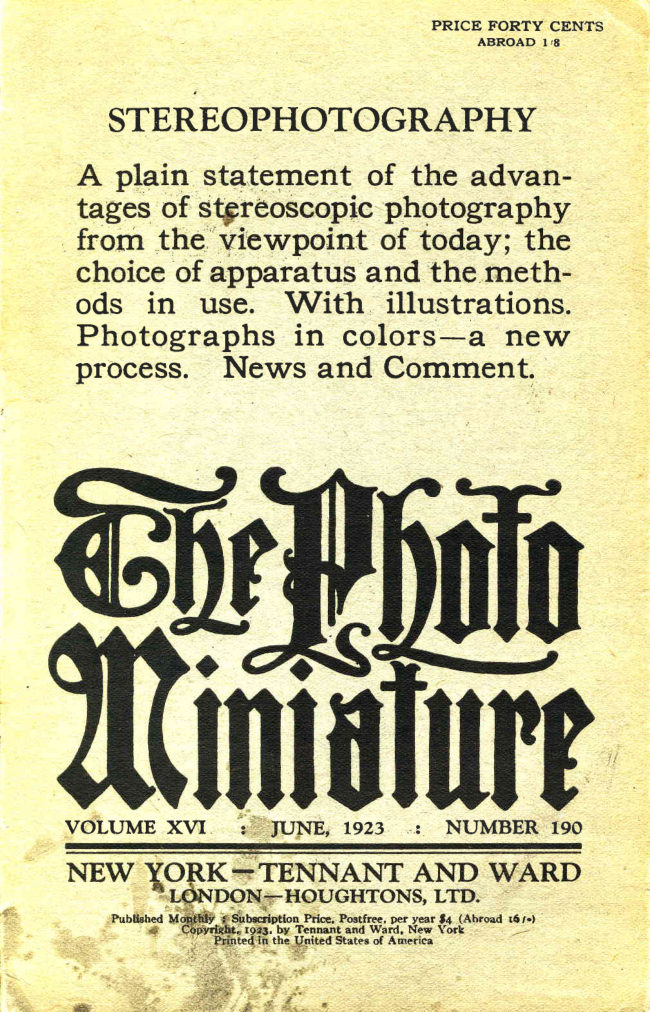
PRICE FORTY CENTS
                                                 ABROAD   1'8

  STEREOPHOTOGRAPHY


 ods in  use. With   illustrations.
 Photographs in colors-a new
 process. News and Comment,


VOLUME  XVI              1923    .,t NUMBER,19O
View original page 2Page 3 · Read text
The Photo-Mlniaturc:  No. 174    The Photo-Miniaturc:  No. 142
   Home         Profitable
 a nd Garden   Photographic
 Po rtra itu re     Processes
The only handbook.to  this     A  collection  of minor
fascinating  field ,of  work,     processes, not   availablein which  the  amateur  can                                elsewhere, which   photog-excel th€  best professional
                                raphers can turn  to  pgof-work-, and the  professional
can find a gold-mine of new      itable account as side lines
business.                           to  the  regular  business of
                                 the studio.Plain  and  practical   infor-
mation,  from  beginning       Original   information,
to  end, giving  working      with  practical  working  in-
methods and discussing the      structions and formulas.
possibilities from the view-
point of experience.         PHOTOGRAPHSON WATCH
                               DIALS, CAPS, SFOONS,
 rne rrelD EourpMENT             j     colNs, ETc.
     LIMITATIONS OF         The carbon transfer and
 .    HAND CAMEHAS           c o l l o d i o n s t r i p p i n g p a p e r
 _IENSES ANq THETR USE       methods-complete,
 INDOOR ILLUMINATION      PRTNTS ON S|LK, SATEEN
   ROOMS, STA| RWAYS,           AND FAtsRICS
 DOORWAY, AND WINDOW        IMITATfON ENAMELS
       PORTRAITS                                  (Pseudo Photo Ceramics)
      REFLECTORS,           ON CHINAWARE AND
      BIICKGROT.|NDS                              METAL SURFACES
  LIGHT TONE EFFECTS                                         BI RD'S.EYE PHOTO.
  M I RROR PORTRAITS                          GRAPHS FOR NOVELTY
   DE MEYER EFFECTS              SPECIALTI ES
   PORCH PORTRAITS                            ENLARGEMENTS ON
 GARDEN PORTRAITURE        SATEEN AND OTHER
              I LLUSTRATED                  FABRICS
Price 40 cents postfree    Price 40 cents postfree
TENNANT AND WARD  TENNANT AND WARD
103PARK AVE.,              YORK    103PAFK AVE., NEW YORK             ryEW
                           Kindly mention Tse Psoro-MrNtATr/RE                        I

                     www.orphancameras.com                                        [,
                                                                                                                                             t,A.
View original page 3Page 4 · Read text
The No. 3 Ansco Junior
      Forpictures 3% x44


                                           r\  brancl-new  ,A.nsco rnodel  for
                          the  discriminating    arntrteur  rvha
                           u'ants  Ansco   qualit;'   ancl  Per-
                                                               l orrnance    at   a  popular   Price"
                         U.  S" 1  R.;rpid  Rectilinear    lens,
                              speci:rl   I)eltax    shutter--sPeeds
                                                   I  ;t 25,   I   i 50,    I  / 100,  Buib,  and
                              ll-ime.  Getruine  leather  covering,
                            leather  bellor,.ts, nici<el tr:imrnings,
                             ar-rd the farmous Atrsco  Auttlrnertic
                               Finclr:r.
              Price $18.50

The I{o. 3 Folding Ansco
       For pictur es 3% x 4%
                                Tire  iogical  ctroice  fc,r aclvatrced
                          ;rmateur  photographers   who  cle*
                              sire   a   high-grade    all-purPose
                      camera  of this  size at a moclerate
                            cost.   Clear-cutting   Ansco   tr7" 5
                        Anastigmat    in new  Iles Universal
                             s l r u t t e r - s p e e d s         l ,   L l 2 ,         l l 5 ,
                      1 i 1 0 , L 1 2 5 , l / 5 0 ,  1 / 1 0 0 , R u l l r
                    and Time. An instrunrent of pre-
                           cision;   beautii'ull3'   {inisheil   in
                     genuine leather and nickel, *'ith
                      thumb-lever  ftrcusing and Ansco
                     Automatic Finder. Combination
                      Baclc for  plates  ancl {ihnpack
                         olrtain;rble at anv tirne.
                Price $30

                 Catul0g,ue   on  Request
   AT{SCO COMPANY
            Binghamton,    I\T. Y-


          Kindly   nrentitltr'I'iru  Prtoro-\[rnrrATL RT.
View original page 4Page 5 · Read text
PllofuMnla    tf A monthly  magazine of photographic  information,  edited.
  by John A. Tennant,  for the man who wants the plain  facts
  about one thing  at  a  time.     It   is unique among  photo-
  graphic journals  in the following  vital  points.
   J[ Each number  is a complete book  in  itself.  Each number
  deals with a different subject and tells all worth knowing about
   its subject.
    fl  Its information  is fresh and original, simply written; without
  waste of words or space, by practical workers from actual ex-
  perience.  Always  clear and to the point, comprehensive, not
  long-winded.
    fl  rt  is carefully edited, well printed and linen-stitched  so that
    it opens flat  iike a book  for easy reading.   Its pages are com-
  pactly  filled, giving as much information  as the average dollar
  book, in flexible form, fitting the coat-pocket.
  1l Sold by dealers everywhere  at 40 cents per copy  [or   I /S
  abroad].  Subscription, postfree $4 per year.  [Abroad  16l-.]
  Jf A complete set of all the numbers published: Volumes  I to
  XVI  offers the most comprehensive library  of photographic  in,
  formation  in the language.  Apply  to American publishers for
  price of sets or out-of-print  issues needed to complete your set.
 PUBLISHED  BY TENNANT AND WARD
 AT  103 PARK  AVENUE,  NEW YORK                                             "
 C h i c a g o W h o l e s a l e A g e n t s : B u r k e  a n d J a m e s ,  I n c .
 Agents for Great  Britain:  Iloughton's,  Ltd.,  London
 Agents  for Australasia: Kodak  (Australasia) Ltd., Sydney
                               Kindly mention Thn Psoro-MrNrATunE                                *


                         www.orphancameras.com
View original page 5Page 6 · Read text
The Photo-Miniature  Series
      OF PRACTICAL HANDBOOI(S ON PHOTOGRAPHY
               A List  of Numbers  Obtainable from  Most  Dealers:
               No. 190. STEREOSCOPIC PHOTOGRAPHY.    (Ready in June.) A  practical hand-
            book to this fascinating  field, by an expert.  40 cents.
               No. 189.  MAKING  AN ENLARGER.   Complete instructions, with working drawings,
                 for  the construction  of an auto-focus eniarger  for  miniature  camera negativss. Illustrated,
            40 Cents.
               No. 188. THE  EXHIBITION  PRINT.   Wherein  a successful exhibitor  tells how  to
           make pictures (instead of mere photographs).   Illustrated.   40 cents.
               No. 187. PHOTOGRAPHIC   LENSES-IN   USE.   Practical  information  about the
             choice and use of lenses for different purposes.  40 cents.
               No. 186. BROMOI L PRINTS AND BROMOT L TRANSFERS.  Simple instructionsin
              the working of these popular pictorial printing methods. Fully illustrated,with  formulas. 40cents.
               No. 185.  KALLITYPE  AND  ALLI ED PROCESSES.   For home prepared papers giv-
               ing black, brown, sepia, red and blue prints.  Reliable formulas.  40 cents.
               No. 184. SOFT FOCUS EFFECTS  lN PHOTOGRAPHY.    By lenses,disks, screens,
 rt          and other devices.  Describes all soft-focus lenses,  Illustrated.   40 cents.
                No. 183.  COLOR  PHOTOGRAPHY.     The best statement  of the problem  to date.
            By C. E. Kenneth Mees, D.Sc. of the Eastman Research Laboratory.   40 cents.
               No. 182. THE PHOTOGRAPHIC   STUDIO.    Its Construction and Equipment.   Illus-
                trated.  40 cents. A practical guide for all intending  to build or refit.
               No. 181.  THE  AIR BRUSH AND THE  PHOTOGRAPHER.   A practical working
            manual for all the uses of the air brush in photography.   Illustrated.   4cl cents.
                No. 178.  PHOTOGRAPHY   AS A CRAFT.    Practical and pointed methods of varying
tl            begin.the resultIllustrated.obtained 40in cents.negatives and  prints, for those who know what they want before they
 t           amateursNo. 174.and professionals.HOME AND CoversGARDENthe wholePORTRAITURE.field.  Illustrated.Plain40andcents.practical methods for
               No. 173.  FIcURES,  FACTS AND  FORMULAS  OF PHOTOGRAPHY.    Second
              Series, r9r4-r9r8.  A reference book.  4o cents.
                No. 169. PHOTOGRAPHIC  WORDS AND PHRASES.  A pocket dictionary forin-
               stant reference. 40 cents.
               No. 168. HOW TO DEVELOP THE  NEGATIVE.   Apracticalhandbooktothetwelve
              best methods.  40 cents.
                No. 151.  REFLEX  Cl\MERAS  AND FOCAL PLANE SHUTTERS.   The only guide
                to photography with  Graflex and similar  reflex camera equipments.   By an expert.    Illus-
                trated.  40 cents.
                No. 142.  PROFITABLE  PHOTOGRAPHIC  PROCESSES.   Printing on fabrics,silk,
                 etc.;  watch  dials and  caps;  imitation  enamels, enlarging on  fabrics;  pictures on metal,
            charms, etc.  40 cents.
                No. 115.  PLATINUM  PRINTING.   A handy guide to the making of all sorts of plati-
          num prints.  40 cents.
                No. 60. WHO DISCOVERED  PHOTOGRAPHY   ?  The most interestins account of
             che beginnings of photoSraphy and the men who made the 6rst photographs.    Illustrated'
            40 C.ents.
    SOLD BY DEALERS  EVERY\ryHERE
       TENNANT AND WARD     ::  PUBLISHERS   NEW YORK

                                              Kindly mention Tsn Psoro-MTMATUTE
View original page 6Page 7 · Read text
IFor Amateurs and ProfessionalsSeefung
lnstruction in the U se of Art Principles
              in Photography
A SPECIAL  COURSE OF ILLUSTRATED   LESSONS ON
THE APPRECIATION  OF
 THE  FTNE ARTS
            has been prepared by
                 F. C. TILNEY
the  English   painter   and  art   critic,  whose  books  and  papers  on  art  subjects,  and
     critiques of the Londonj*i#j,**;                      are lavorably
                                                      "".Jf:lf"ns
This course, the only one of its kind,  is designed to meet
the needs of those who seek a better understanding  of
the principles of art expression-so  essential in picture
making.
It  affords, in six clear and enjoyable lessons, a valuable
and rapid  training  in the formation  of judgment  and
taste, giving the ground-work  of a complete education
in art matters.
It directly stimulates the student's powerof expression in
his work, by the creation of feelinS andthe development
of his pictorial sense,based on knowledge.
        (fnreservedly  praised by eminent  artists,  art teachers,
             students and the art and photographic  pcess

The  Course:   Comprises   six booklets   of from  32 to 64 pages  each,  with   test  papers                                                   I
by  which   the  student   can  check  his  progress  and  six Postal  Lessons,  given  upon
the  student's   answers   to  the  Test  Papers   accompanying     the   booklets.   These                                          l
Lessons  are  individually     written    to  meet   the  needs   of  the  student,   extending
and  supplementing     the  booklets,   but   full  and  complete    in themselves.    The  fee                                 I
for  the  complete   service  including    the  Lessons,  Test  Papers  and  Answers    is $25.                                                 I
This  course  is open  to groups  of 20 persons  (clubs,  etc.).                                                                                                i

   Correspondence and Remittances  (International  Money  Orders
                at any Post Office) should be addressed to
         Mr. F. C. TILNEY
        "Walden," CHEAM,  Surrey, England
             A  circular    fully   describing   the   course  can  be  had  on
                application    to   the   Editor   of  The   Photo-Miniature
                       Kindl_v mentionTur Pnoro- Mrxrarunn                      tI


                   www.orphancameras.com                                                                                              IiI
View original page 7Page 8 · Read text
@belFbots=frliniuture
  A Magazi,neof Photographi,cInformat'i,on
  E D I T E D   B Y  J O H N  A .  T E N N A N T
 Volume XVI         June, 1923       Number 190
    bttrtopUotogrnpb?

  Perfect photographic records. This,  in three words,
is the unique accomplishment of stereoscopicphotog-
raphy or stereophotography as it  is called today.  The
ttriee words mean just what they say.  In  the stereo-
photograph we have the perfect,  i. e. complete repre-
ientation  of the object photographed, as it appeared
to the eyes when the record was made. Not the partial
and incbmplete record given by the ordinary,  single-
lens camera in general use, but a real, honest-to-gooll-
ness, height, briadth  and depth reproduction, which,
when seett for the  first  time, amazes those who haye
never before come into touch with  this sort of photo-
graph.  The  ordinary   flat-print   photograph,  made
with one lens, gives us the subject as it would appear
if viewed with one eye only:  it cannot do otherwise.
The  stereophotograph, which  is a photograph  com-
bining  the two  itigtrtty  different  picture  image-s ob-
tained by photographing  the subject with  two lenses
separated 6y the diitance between the two eyes with
which we ourselves see it,  gives us a complete and
truthful  record of the subject as we see it-with   two
eyes. There can be no comparison between the two
records. No other photographic method can give the
marvellous illusion of  reality,  the depth, roundness,
 relief and  perspective  effects which  constitute  the
outstanding features of the stereophotograph. It  is as
View original page 8Page 9 · Read text
454           THE PHOTO-MII{IATURE
  if we viewed the subject itself, so perfect is its realism.
 Especially is_ this so  if we vi"*'a   color_stereografin,
 such.as can be produced by the Autochrom"--%ffia
 descnbed on later pages, for then we have not only the
 mass, lighting  and ptrspective,  but  also the  coli,r- of
             reproduced with  all the unapproachable 1h,",:rrbJ"St,.
 hdelrty of the photographic process. Such'a method
 oI photography_is                     surely of  special                                           interest                                                      to  the                                                                        d.              'r'sn pnoro-nlrlirATuRE reacrers          ot                              and                                           well worthy                                                           of
 their careful consideration.
   The "how"  and ,,*hy,,  or theory and practice of
                       al9, very simple ind  as i"i"r..ii"g 1t_ergonhotog{ap\y as they are simple. The method offers no difficultv  t<.r
 anyone who understands the handling of .the ordirlary
 hand camera.  In  this discussion oi  tf,e sulj;.;-i;;y
 geep t9 go into minute detail; but this shouid not mis_
 lead the reader into. thinkin!   that  there  i;-.;yt;i;g
 myst-erious or difficult about                                                 !t, *y  intention  U*lrrg io
 enable the reader to rearize that siereophotosraph-v is
 merely an additional method  of picto.iut   ."ir"i.itu-
 tion, by which he can obtain  bettir   pr.t,tr.s'tt   u.r lt
 singleJerrs camera can give him.                                "
  The.Jhqop   of  It.  When we look with one eye at
 any solid object, we perceive it in two dimen.io"i"o"t"
 viz.,-its-lengrh and breadth. The third dimen;i;;.i;'
 its. thick,ess, depth, soliclity, or relief, thrs by looking_with one eye centrally "..up",at fhe face"r.'t#of a              Ij
cube or an ordinary round  bottle.  Similarly,  looking
with one eye at several solid objects in  u'g.oro   o.
scene, \r'e are unable to perce-ivetheir separition by
planes of distance or  thejr  relative  positibn  i"  ,p".;
with regard to each other. Thus near and far obiects
appear, as in a picture, to be flat and piled up or pasted
against each other, instead of standing out separately
in reliff as-they actually do in the group or scene. It  is
tyg.!|rat, Uy th" associationof ideas, by our experience
of differencesin th-e size and shape of oflects,'u"Att
illumination or light and shade effects, tle  brain-teils"
us that the cube has depth and solidity', that the bottle
has thickness and roundness, and  ihat   tte  se"eraf
obje.cts in thc gro-up or scene are separated by  pt"";;
of distance. But the fact remains thai  this third  .ii-""-


                                                                                                                                                                                                                                                                                                                                                                                iIIIt\            www.orphancameras.com                                                                                              I
View original page 9Page 10 · Read text
STEREOPHOTOGRAPHY            455
sion is not perceived bY normal, unaided monocular
vision.
  Binocular  Vision.   If, however, we look with our two
eyes at a solid object or group of objects, at .wqnormally
o-br"t.t" them,  tle  third  dimension is added-, and we
actually  perceive  the  depth,  solidity,  and. natural
relief oi  th"  objects, together with  their relative-posi-
tions and. sepaiation by planes of  distance.  This  is
the effect of binocular or stereoscopic vision, -the word
stereoscopic being  derived  from  two  Greek words:
stereos,solid, and- scopeo, I  vie-w. The- explanation. of
this differenie between monocular and binocular vision
is simple. As the eyes are set horizontally   il  the head
and separated by a distance of about L% inches' so our
       r"" two  diitinct  and slightly  iJfferent pictures of
."it"ry"y".    object  to which  they  are directe{-  the object
bein! viewed from two different- points. Thus the left
e,re J".t more of the left side of the object and the right
       ...r  more of the right side of the object. These two
"y.similar but slightly different picture-images arebleldgd
or fused in  tf,e 6rain  to form a single record of the
subject in all its three dimensions, so-that, in.addition
 to perceiving the length and breadth of objects,. we
can estimatJ  their  aepttr or  solidity, and appreciate
 their separation in sPace_.
  The Stereodcopic Method.  Stereophotggrqply'  then,
 is simply a metEod of photogr.aPhy which follows the
 natural way of seeing tfiings with.two- eyes, and^which
 therefore gives us alhree-dimensional  record of what
we see, as"the eyes see it.  The stereo camera is fitted
 with two lenses, set horizontally side by side and sepa-
 rated as our eyes are. Such a camera naturally  giY.gs
 two  pictut".   oi the subject, each from a slightly  dif-
 ferenl viewpoint becaussof the separation of the lenses'
 Placed side by side in the form of positives on glass or
 paper, these two slightly dissimil.ar pictures are viewed
 itt  i  st.t"oscope or viewing box, in which the two views
 are merged oi combined tb form a single record of ,the
 subject,lust-ttre as the two retinal images are blended or
 fused in      brain, with  the result that we obtain  in
 the stereophotograph an exact reproduction of the sub-
 ject-as   tie  eyei siw  it when the record was made'
View original page 10Page 11 · Read text
456           THE PHOTO-MII{IATURE
   -L-eqsSeparation. On your mother's or grandmother's
 table in the-old parlor was, years ago, the stereoscope-
 an object of childish awe-with    its collection of pape.-
 p_lints (o{ c.o-urseon cardboard mounts) of " Niagara in
 Win-ter," "Leaning Tower  of Pisa," ',Pyramids and
 Sphinx" and other world-known views. fhe  pictures,
 set between the wire brackets of the cross-arm of the
 stereoscope, were moved back and forth  until  they
 came into correct focus when viewed through the lenses
 oJ the stereoscope-whereupon  they  fused  into  one
 three-dimensional                   _imags-"-tereo-d,1, we say, today,
 for short. Those first pictures of this type were made
 with cameras having lens-separations of 3 to g)/  inches
 (usually the latter  figure) and this separation is used
 today on American-made stereoscopiCcameras. The
 pictures,_themselves,are 3ft inches wide and 3a/,0-Overseas,inches
 \igh.  This size is the American standard.
 the standard size is radically  different-there   are, in
 fact, two stindard  sizes. The smaller, and more popular,
 is, over  aLl, 45 x ro7 mm.  (t%  x +%  inches)l  the
 larger, over all, is 6 x 13 cm. ("/s   t !2C inches).' fle
 American  standard   size  is  not  manufactured   in
 Europel  the  European  standard  sizes  are  not
 manufactured  in America-an   unfortunate  situation,
 as both sizes have their good points.  The principai
 American  makers,  however,  market  film-packs  ior
 the smaller European standard size (45 x io7 mm.),
which has done much to add to the popularity  of that
 size in this countrv.-sheer     '
  As a matter  of        optical fact, some eye-strain is
-required to  view  any  stereophotograph taken  with
lenses separated more than onb-quaitef inch (approxi-
mately) more or less tha!  the separation of youi eyes.
fn  the case of a normal man, the  eye-sep-aration is
 (for  all practical purposes) z/   inches, so the  stereo-
photographs which are most comfortable for the eves
are those made with cameras having lens separations
between zrr( andzsry' inches. With a properlylbalanced
stereoscope, however, having  lenses suited  in  both
focal length and separation to the size picture being                   t
viewed,  al_y of                  -the standard  sizes malie acceptable
pictures. Naturally the American standard size cdmera.


                                                                                                                                                                      iftrn

                                                                                                                                                                                                                                                                                                                      l
                                                                                                                                                                                                                                                        I
                                                                                                                                                                                 l
                                                                                                                                                                                                                                                                                                                                          I

            www.orphancameras.com
View original page 11Page 12 · Read text
l


        STEREOPHOTOGRAPHY              457
              being  larger  than  the  European  standard  sizes, is
              equifped *ith  lenses of greater focal length and, con-
                 seqrr^eittly,produces larger images than  the imported
               insi.uments-a   point very much in favor of the large
                size and  rapidly  becoming more- so as the value  of
              stereophotofraphy  in  commercial work  is becoming
                better understood.
                Viewing the Picture.  Naturally,  since two- pictures
              are taken] as has been described, it follows that both
               oictures'the    must be viewed at the same time to produce
                  three-dimensional effect which  is the purpose of
              stereophotography.  Either  the old-fashioned stereo-
             scope br thJ mbd-ern viewing box is available. To give
               the best results, the stereoscope (or viewing box), for
               the viewing boi  is merely the most modern form  of
               the stereoscope) should be equipped with  lenses of
               approximately the same focal length as the lenses used
                          iri iaking  the pictures to be viewed. This is not such a
               task as itight^ut  first be thought, for each of the three
               standard size cameras (American and European), uses
              lenses of approximately standar$ focal.Iength.and any
               reasonable^deviation from  this length  is readily taken
                iare of by the focusing device of the stereoscope'.The
              average stereoscopeliklwise has standard .separation-
              StoSi6 inches for the American standard size;z)Ato z/6
                inchls (58 mm. to 65 mm.) for- the smaller European
               standard size; and  z/,  to  zy't inches (62 to 7z mm')
                  for the largei European standard size. Thus every-
                thing  is arianged to duplicate in viewing .(as far.as
                duplication be-possible) thos-e optical conditions undcr
              which t""r" *ude the original exposuresfor the pictures
                 to be viewed.
               The  mind,  accustomed to  makils   otte composite
             image from  the two actual and different images. seen
              bv lhe two eves, does the same thing  automatically
               #th  the two piciures of the stereoscopi-c-print and-
               behold! we hive,  through the slightly- different Yig*-
                points and slightly different images, in the superposition
                  topiicutty)'           of"thi  two images, the actual reproduction                 of oerspective-not  becauie a three-dimensional- pic-
                       i"ri    t ul actually been produced (for this has not been
                 ao".)  but becalse the mind has received all  that   i't
View original page 12Page 13 · Read text
458           THE PHOTO-MINIATURE

needs to visualize perspective.  Mentally,  the stereo-
photograph  creates perspective.  'What
       Makes a Good Stereophotograph.  Because the
stereophotograph has, as its basis, perspective as the
human  eyes visualize   it,  this  type  of  photography
makes a marked increase in the number  of available
photographic  subjects.  Not every scene makes a good
ordinary   (single-lens) picture.   In  many  cases the
photographer  views a scene that   in  color,  lighting,
perspective and mass combined is pictorially  effective.
When reduced to a one-plane monochrome, as in the
ordinary  print, much of the effectiveness and beauty
have gone because, between scene and  print,  both
color and perspective have disappeared. The  stereo-
photograph  restores perspective, leaving  color, alone,
lacking  in  depicting  the scene as  it  actually  existed
when exposure was made. The use of the autochrome
plate naturally  restores the element of color so that
the  stereo-autochrome  actually  reproduces  all  the
elements-color,   lighting, mass and perspective-that
made up the beauty  of the scene when photographed.
   Briefly,  then: any scene that  in lighting, mass and
perspective is effective to the eye will make an accept-
able stereophotograph.
  Foreground Necessary.  fn  taking  into account the
making  of a stereophotograph,there is one point  that
it is impossible to emphasize too strongly: an acceptable
stereophotograph  must  have  a  strongly-accentec
foreground  or  object  in  the  foreground-foliage,   a
human figure, portion of a building, or something of
the kind. Some such object is necessary to bring out
perspective fully.  So necessary,in fact, that a stereo-
photograph without  at least one strongly-emphasizec
foreground object will be flat and entirely uninteresting.
This is particularly  noticeable in such pictures as shore-
views  in which  there are neither  waves, rocks nor
vessels in  the  immediate  foreground-beautiful    as
the eyes see the view, but miserably flat and unimpres-
sive in the stereoscope. Incidentally,   it may be added
that   the  stereophotograph   (for  reasons explained
fully.  later, herein) does not permit  of the making  of
" f.uzzy "prints.


                                                                                                                                                                                                               a, a


                                                                                                                                                                                                                                                                                                                                                                                                                                                                                                       I
                                                                                                                               lr           www.orphancameras.com                                                1
                                                                                                                                                                                                   I
View original page 13Page 15 · Read text
46o           THE PHOTO-MINIATURE
   Cornmercial Possibilities.  Business has just begun
 to appreciate the fact  that a distinct  field-is cove-recl
 by  stereophotography.  One general commercial  as-
 pgct of the work  will be taken up in some detail in an
 addendum  hereto, because of-  its  presentation  of
 problems of technique that are largely 6ased on mathe-
 matical optics.  Suffice it  to say,-now, that the same
 principles  which make  possible a  three-dimensional
 photograph of an outdoor scene likewise make possibie
 a three-dimensional photograph of a piece of lewelry
 a chair, a-frock or a motor car. So much for the ge.reril
 theory of stereophotography.
   Problems  in  Practice.   In  the  actual  practice  of
 stereophotography,  four  main  divisions  of  the  field
 present themselvesas-problemsof equipment or manip-
 ulation.  In  order, they  are:  (r)-tlie   camera, with
 its mechanical and                       .optical equipment; (z)-the  nega-
 tive, including  details of choice of emulsion, exposire
 and development; (3)-printing - the positive, inciuding
 the         important  matter  of  transposition and  the       ?ll
 questions. involved  in making  positive transparencies
 on glass (most satisfactory of piesent day -ethods)  or
         or ordinary-prints on plper; and,-(4)-viewing, 9".fiI1,
 including  ty.pes of                   _ stereoscopes and viewing boxJs
 and the handling of them.
   This  is, of                         . course, the same list  of problems  that .
 is- presented in  considering the practic6  of any kind
'of  photography-plus    the problems  that  arise from
 the use of two lenses, instead of one. The practice of
 stereophotography  is not any more  difficul[  than the
 practice  of  ordinary,   single-lens photography;  nor
 is the additional slight tediousnessinlidenito  lengthen_-dra*-
ing-of  the-printing  process by  transposition a
back  worthy  of  serious consideration.  The  results.
where completeness of record is desirable, are so much
more  s.atisfactory                         t!rq"  in  single-lens photography,
that  with  the  simplification  of modern ptrotographic
methods and equipment it seems reasonabieto sirppose--o.ethat stereophotography  will  continue  to make                   *
and more converts as time passes.
  The Camera.  In  general, the stereoscopic-two camera
consists of a box holding, in its front wall,      lenses,


           www.orphancameras.com
View original page 15Page 16 · Read text
STEREOPHOTOGRAPHY                         46t

           and in  its back wall a sensitive plate or  film; some-
           where between lenses and plate a device to regulate*r          the exposure (the shutter); and a division of the box,
            from fiont  to back, midway between the lenses. (This
              division prevents the right edge of the left image. from
             overlapping  the  left edge of the  right  irnage, inside
             the camera and on the plate.) This is, of course,nothing
           more or less than the simplest form of ordinary camera'
            except for  the additional  lens and the box  division.
            Camera Types.  As in ordinary  cameras, there are
            two general types of stereoscopic cameras-box  form
           and collapsible- Each has its strong points-likewise
                 its weak points. Each type has its ardent advocates
           and its violent opponents.'
             The  usual box  form  stereoscopic cameras are  of
             metal construction to avoid warping due to temperature
           and humidity  variations.  Most  instruments  of  this
             type have b-een non-focusing up  to  the time  of  the
             war, but,  since the war, focusing devices have been
           added to practically  all the higher class box form cam-
             eras.  All-of  these instruments are made abroad (the
           American made  stereoscopic cameras are both  of
             bellows-type construction) and  are  of  the  smaller
           European standard size, for the most part, carrying
            Iensesof such short focal lengths that everything from
            about twelve feet onward  is in  visually  sharp focus,
           even at a lens aperture of F /4.5, making focusing devices
               really unnecessary, generally speaking.
            Two models of box form type, of German manufac-
               ture, are fitted with a metal light chamber increasing
                in  size from  lens board  to camera back, giving  to
             the instruments much  the appearance of a  pair  of
             binoculars.  For  the most  part, however, the  box
            form  stereoscopic carrieras are of  rigid,  rectangular
             construction throughout, and  will  stand much hard
           wear and jolting-which   is not true of all the collapsible
             type-    instruments.
             The collapsibie-of    type is, of course, based on the use of
          some form     betlows, supporting arms and focusing
             device.  In  the small instruments of  this  type, im-
             ported from Europe, there is naturally some-sacrifice
               bt .igiaity  to permit the use of a bellows. And rigidity
View original page 16Page 17 · Read text
462           THE PHOTO-MINIATURE

is most important  because the rigid camera front  as-
sures both  lenses being  'in the sarne plane and pro-
ducing  sharp images.  A  blurred 'i,mage is  fatal  in
stereophotography. The addition  of a rising front  to a
a  stereoscopic camera  naturally   detracts  from  the
 rigidity  of .a collapsible type instrument,  but has no
appreciable effect on a box form instrument-a   point
that can not be overlooked in buying a camera, unless                       a* I
the purchaser is willing to take a chance.
  Arnerican  Stereo Cameras.   Only  two  stereoscopic
cameras of  American  manufacture  are now on  the
market-both   Eastman products.  The Stereo Kodak
comes equipped with F 17.7 Kodak  anastigmat lenses
and with a shutter giving exposures of. t f 25, r /5o and
 r/roo  second, in  addition  to  "time"  and "bulb"
exposures. There  is a rising front and focusing is by
scale or rack and pinion movement.  The instrument
uses a standard size of film, obtainable everywhere, and
is unquestionably  the most popular stereo camera on
the American market.   It takes pictures of the standard
American size-each S%by  3t/tuinches.
  The Stereo Auto  Graflex is the  " siege gun "  of the
clan.   lt comes equipped with a pair o[ F 16.Sanastig-
mats of 6/   inch focal length; has ample rising frontl
the Graflex focal plane shutter; and takes S x Z plates
or films.  Each picture  is, therefore, 33/roinches wide,
but  5 inches high-thus   allowing  for  cutting  off un-
necessary foreground  or  sky.  A  peculiarity  of  this
instrument  is the incorporation,  in the focusing hood,
of a pair of prisms, making virtually a stereoscopeof the
hood, so that in focusing only one image is observed-
just as in viewing the finished picture.
  European Cameras.  Unfortunately,  the American
line of stereoscopic cameras ends with the two already
mentioned, and if the operator desires to use the smaller
sizes of instruments he must, of necessity, purchase a
camera made in Europe. Before the war, the European
stereoscopid cameras had gained a fairly good foothold
in America.  During  the war, importation was almost
stopped. Today, most of the pre-war models are again
available-practically    all of them with improvements
in manufacture.


          www.orphancameras.com
View original page 17Page 18 · Read text
STEREOPHOTOGRAPHY               463

          From  France comes the Verascope, of  Richard-
          probably best known  of aII European makes.   It  is of
          the nott-focusing metal box form and, in  its complete
         model, carries alt possible equipment  for  ail kinds  of
          stereoscopic work.  The 6 x 13 cm. model now comes
          with foculing device-a  post-war development.
          The Gaumont Spido, Stereo Bloc-Notes, Verographe,
         Ontoscope and Nil Melior are other French instruments
        now finding  their way on the American  market-all
           quite similalr in general instrumental  capability and all
            of the rigid box form type; some with focusing device-
        some wiihout  it.  Both-European standard sizes can be
         had in most of the instruments named.  All of them are
         equipped for plates or filmpacks, or both, the Verascope
          Ueing^ttreonly one for whiih  rollfilm holders can be ob-
           tained.
           Of  the German instruments  on  this  market,  the
         Polyscope   (itt  both  European  standard  sizes),  !!t"
           Steieolette and Stereofix, of the Ica line, are favorably#         known. The Polyscope is of rigid box form construction
          with  focusing-front;-the  Stereolette is of  collaPsible
           type,  with  siparate  bellows  for each lens; and. the
           Siereofix is of- fixed focus construction.  The Voight-#          lander reflecting stereoscope (in the smaller size) and
          Stereoflectoscope;the Goeiz Stereo-Tenax (of the well-
        known Tenax-construction); the Duchessa-Stereo (in
          the  smaller  size), Contessa-Nettel Stereax (in  only
           the larger European standard  size) and Steroco-the
           Stereaf a focal-plane shutter instrument  of abnormal
          bellows capacity and unique focusing adjustment, and
           the Steroco the lightest weight, fixed focus stereoscopic
         camera made;the Ernemann Bob XV, with self erecting
            front .and  strictly  a  rollfilm  model  (of  the  smalle-r
         European  standard  size) with  the  Heidoscope:-all
          these German made stereoscopic cameras are imported
            into  America  today  as  regularly  established  lines.
          Catalogues of the various importers give detailed de-
           scriptions of the instruments and accessories. All  of
           thoie mentioned have been tried out in actual use and
         have proved sound in  principle and  in  construction.
          With  each make of camera is a line of accessories-
            printing  frame,  viewing  box,  developing  tank  and
View original page 18Page 19 · Read text
'THE+6+               PHOTO-MINIATURE

various other devices, all of value in making easier the
taking of stereoscopicpictures.
   Shutters.   In   all  of these cameras, American and
European, five types of shutter are to be found: the T-B
type with added automatic speeds of. r f 25, r /5o and
 r /roo secondl the guillotine type; the Compound type;
the Compur type; and the focal plane type.  Each of
these shutters will do certain things and each has its
limitations.  Certain  of these limitations  are of  far
more importance in stereophotography than when the
same limitations  show up  in  ordinary  photography.
This  will be pointed out as the various shutter-types
are discussedin some detail.
  The T-B  type  of  shutter, with  added automatic
speedsof"t fz5, r/5o and r/roo secondwill be found on
the Stereo Kodak, the Ica Stereofix, Contessa-Nettel
Steroco  and  other  not-so-well-known   stereoscopic
cameras. It  is a fair shutter. In most casesthe marked
r/25  second will prove  to be about an  actual  r f zo
secondl the  r /5o and  r f roo second each about  r l4o
second in reality.  The use of the " B " marking for slow
instantaneous speeds (a good % to  ft  second is always
possible in this way)  is of great importance and in the
hands of a skilled operator a shutter of this type can
produce  thoroughly   satisfactory  work.   With   this
shutter,   it  is a mistake  to  try  to stop rapid motion
nearer the camera than  fifty  feet-very   rapid motion
nearer than one hundred feet.
  The guillotine type shutter  is found only  in instru-
ments of French make, having been discarded by  all
other makers years ago. Tests have proved with scien-
tific accuracy that  this type of shutter  is exactly  fifty
per cent. efficient in light-transmission. For example:
if an exposure of 1/rosecond is made with a guiilotine                                                                               'trshutter, the light transmitted by that same t"nr     r/ro
second without any shutter would be just twice as great
as the light transmitted through the guillotine shu"tter.
The guillotine type shutter has two good points, as far
as stereoscopicphotography is concerned. It  is exceed-
ingly accurate as to timing and, therefore, is well fitted
to handle problems of stopping motion.   It  is, too, of
excr.eedinglysimple construction and quite  durable-


         www.orphancameras.com
View original page 19Page 21 · Read text
466           THE PHOTO-MINIATURE
 not likely to "go bad" when far from an expert shutter-
 reparrer.
  The Compound shutter is so well-known as to require
 merely  passing reference as  the  best  between-lens
 shutter heretofore obtainable.  In  the smaller sizes of
 stereoscopic cameras, the  Compound  shutter  gives
instantaneous speeds up  to   r f goo second-ample   to
handle any motion-stopping problem that may present
 itself.
_ The Compound shutter has had one weak point-it
has depended for its timing  of instantaneous speeds on
 the action of an air-cylinder" This is, at best, pioblema-
 tical. The Compur shutter, which has recently made
its appearance, may be non-technically described as a
near-Compound shutter operated (as to timing) by  a.
set of gear-wheels instead of by an air-cylinder.  The
theory of the Compur shutter  is right because it sub-
stitutes  for the problematic  action  of an air-cylinder
the positive action of a set of gear-wheels. Just after
the war, Compur shutters reaching this country were
made of inferior material and came in for severe cen-
sure. That  condition has been entirely remedied and
we can expect to see the Compur shutt-er take its place
as the best obtainable between-lens shutter, from  this
time on.  It has the same range of shutter-speeds as the
Compound.
  The Stereo Auto Graflex, Mentor Stereo and Voight-
lander reflecting stereoscopic camera, of those available
in this country, are equipped with focal-plane shutters
as is the Nettel-Stereax. The Graflex naturallv  carries
the multi-slit  Graflex shutter, while the European in-
struments carry the usual European type, with only one
slit which can be varied in width  for different exposure
times.  It  is now well established that  the 1oga|-plane
shutter, when properly constructed, is the most efficient,
as to transmission of light from lens to sensitive emul-
sion, that has ever been commercially practical.
  The same exceliencies that  place the  focal-plane
shutter  at  the head of the  list^'in  single-lens-ca'-eta
work, likewise are points of strength for the same type
of shutter in stereoscopic work. As between the two
kinds of photography, there is no difference in handling


                                                                   ?

                                                                                        :.

         www.orphancameras.com                                            Ir
View original page 21Page 22 · Read text
i$  STEREOPHOTOGRAPHY               467
             the shutter. By reason of its high exposure speeds, the
             focal-plane shutter enables the operator to obtain un-
            usual^pictures of arrested m.otion; by  reason of  its
              efficiency (ability  to pass light)  at low exposure speeds,
            enables ihe  opeiatof  to make pictures under unfavor-
            able light  coriditions. The focal-plane shutter has, of
            course, the one objection  of no automatic  -expol\r1e
            speed.s'slowerthan an approximate  r/ro.second.   This
                          ii a distinct disadvantage for stereoscopic work because,
               for many types of subject,  it  is absolutely necessary to
            stop down ib  obtain detail and to--give a-n 9xp99u1eoj
                          r/r second.  Correct handling of the "time"           %'to
              b"por.t.e mechanism will accomplish this, but in making
             snlh  e*posures great  care must  be taken  to  avoioti              vibration  of the camera.
           No piece of-mechanism is called on to do, so conlinu-
             ously,^for so many years, such accurate work as a high
             g.ud" camera shutt-er, w'ithout lubri,cat'ion Oil is death
               io u.u.t..a  shutter becauseit "gums the works." The
             shutter made of poor material can not stand this strain.
         A good shutter  ii worth  all  it costs, from the standpoint
              of Jreedom from worry and repairs, as well as from the
             standpoint of accuracy in rated shutter-spee-ds.
            The market affordi several devices to add automatic
            shutter-speeds to most types of shutteF, .by the use of
                air valvei  of various kindJ. One such device consists of
           a valve set into the rubber tube running from an ordin-
             ary bulb  to the shutter-trip.  -Whgn the shutter  is set
               otr  " brrlb "  the valvb holds the shutter open for the
             indicated length  of time, by  permitting  slow, escape-
           ment of air from the valve cylinder.  Another device of
               this kind holds a cable releasefor the indicated time, so
              that  the release, in  turn,  holds the  shuttel  (set on
             "bulb")  open. fhese valves both work with indicated
                                                  and,  in  fact,plffiFitrspeedssecond,oftfius3 seconds,addingz seconds,a very  desirabler seco-nd,%,-%.an! %
            almost necessary range of speeds to most  shutters'
            Both these valv-es are of British  manufacture and are
            exceedingly moderate in cost.
               Stoppiig Motion.  Detail and sharpness are essential
                in a gobd itereophotograph.   It  is, therefore, sometimes
            conv6nient to know  just how far to go, in making an
View original page 22Page 23 · Read text
468          THE PHOTO-MI*IOtU*U
exposure, to be certain  that  motion  of the principal
objects has been stopped.  Here  is a simple formula
for finding this:
  Let D  :  Distance of principal  object from  lens, in
inches.  S : Speed of object  in  motion, inches per
second.  F  :  Focal length  of lenses, in inches.  E  :
Exposure necessary to stop motion.
    It can be readily shown that E  :              in which                                           *Lr.*
formula, movement  of the ,image during exposure has
been held to  r f zoo inch which, in the average stereo-
photograph seen through a stereoscope or  viewing
box,  will be inappreciable.  Should even this motion
prove too much, however, when the positive  print  is
viewed, the formula can be changed to allow for an
image-movement  of   r /3oo  inch  or   r f 4oo inch  by
substituting,  in  the denominator of the formula,  the
figure 3oo, or 4oo, respectively, for the figure zoo in
the formula as given.  In this connection, the following
table will allow rapid calculation of the general formula,,
as the table gives the number  of inches pdr second
(S,  in  the  general formula)  equivalent  to  various
speeds usually expressed in miles per hour.
Mi. per hr.   Ins. per sec.  Mi. per hr.   Ins. per sec.
                 I           r8                r 8         317
         2         36              2 0          352
     3               5 J           2 5          440
     4          7o          3o         528
     5          88                   J J            6t6
     6                 . ro6                +v          7o4
     7          1 2 3         45         792
     8             r4r         5o         88o
     9                 r 5 8                        J J          968
              I O          r76          6o         ro56
 .             I I            r94          65         rr44
              I 2            2 T I          7o                         I 2 3 2
    r3           2 2 9                                             / J                 r 3 2 o
     7 4           246          8o         r4o8
      r 5          264          9o                r 584
    r6             z 8 z             IOO          r76o


          www.orphancameras.com
View original page 23Related documents and language editions
From the M. Butkus archive. Original publisher and archive notices are retained.
Check the model and edition against your equipment.
PDF verified 2026-10-10.