Photography reference
Photo Miniature - Stereophotography magazine — part 2 Product booklet
Product booklet for Photo Miniature - Stereophotography magazine — part 2. 56 pages in English. Read the original PDF, download or print a copy without registration.
56 pagesEnglish5.1 MB PDF
Loading your manual…Open PDF directly
Document details
- Brand
- Various brands
- Model / document
- Photo Miniature - Stereophotography magazine — part 2
- Document type
- Product booklet
- Language
- English
- Pages
- 56
- File size
- 5.1 MB
- Category
- Photography reference
- Document date
- Not specified in catalog
Search available document text
Find a term, then jump to its page in the original PDF. Image-only pages may not be searchable; check the PDF for exact wording and diagrams.
Page 2 · Read text
+8+          THE PHOTO-MII\IATURE
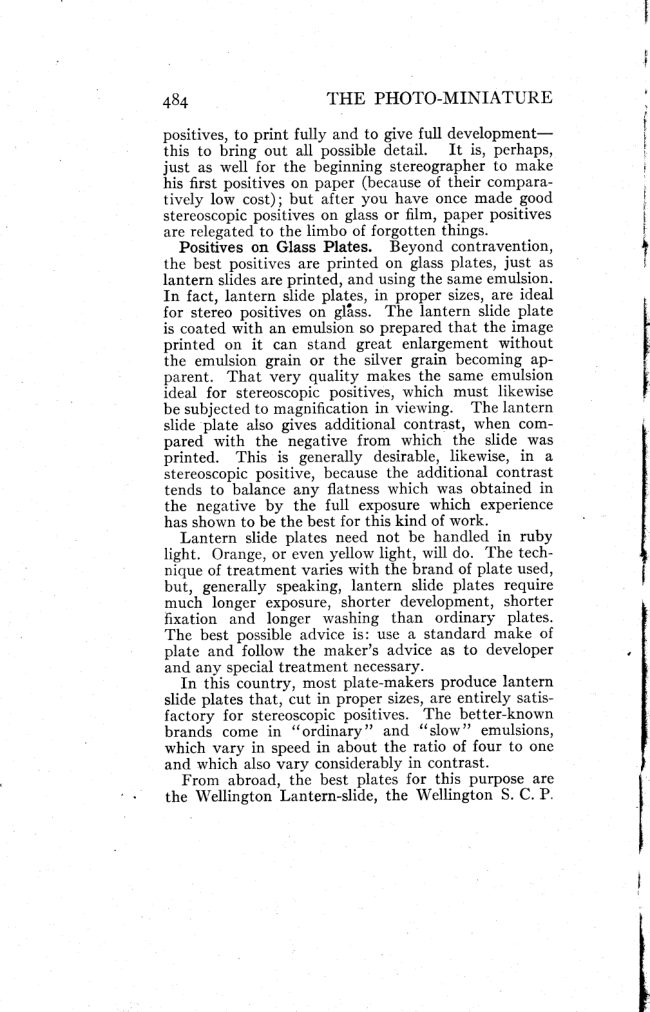
positives, to print  fully and to give full development-
this  to bring  out  all possible detail.     It  is, perhaps,
just as well  for the beginning stereographer to make
his first positives on paper (because of their compara-
tively low cost); but  after you have once made good
stereoscopic positives on glass or film, paper positives
are relegated to the limbo of forgotten things.
  Positives on Glass Plates.  Beyond contravention,
the best positives are printed on glass plates, just as
lantern slides are printed, and using the same emulsion.
In  fact, lantern  slide plat-es, in proper sizes, are ideal
for stereo positives on gl'ass. The lantern  slide plate
is coated with an emulsion so prepared that the image
printed  on   it  can stand  great enlargement without
the emulsion grain  or the  silver grain becoming ap-
parent.  That very quality makes the same emulsion
ideal  for  stereoscopic positives, which must  likewise
be subjected to magnification  in viewing.  The lantern
slide plate also gives additional  contrast, when com-
pared  with  the  negative from  which  the  slide was             'Ihisprinted.           is  generally  desirable, Iikewise,  in  a
itereoscopic positive, because the additional contrast
tends to balance any flatness which was obtained  in
the negative by  the  full  exposure which  experience
has shown to be the best for this kind of work.
  Lantern  slide plates need not be handled  in ruby
light.  Orange, or even yeliow light,  will do. The tech-
nique of treatment varies with the brand of plate used,
but,  generally speaking, lantern  slide plates require
much longer exposure, shorter development,  shorter
fxation  and  longer  washing  than  ordinary  plates.
The best possible advice is: use a standard make of
plate and follow  the maker's advice as to developer
and any special treatment necessary.
   In  this country, most plate-makers produce lantern
slide plates that, cut in proper sizes, are entirely satis-
factoiy  for stereoscopic positives. The better-known                                      ttslow"brandl come in  "ordinary"  and         emulsions,
which vary  in speed in about the ratio of four  to one
and which also vary considerably in contrast.
  From abroad, the best plates for  this purpose are
the Wellington  Lantern-slide, the Wellington  S. C. P.
View original page 2
Page 3 · Read text
STEREOPHOTOGRAPHY             485
         and the Ilford  Lantern-best,   that  is, until you reach
          the  Ilford  Alpha, which  is, in my  opinion,  the best
           plate in the world today  for stereoscopic transparen-
             iies.  This  is true because the plate is readily handled
            in strong yellow  light,  develops and fixes rapidly,  is
          not sensitive to handling, gives brown and red tones
         by  direct development, handles  all problems of con-
            trast without  difficulty and-last  and most important-
        seems to be absolutely free from  grain of any kind.
                  I  have enlarged positives printed  on  Ilford  Alphas
            to a limit  entirely beyond the realms of commonsense
            in an attempt to see just what the plates would stand-
         and  I havef as yet, found absolutely no trace of grain.
          Directions  for  using  Ilford  Alphas  are contained  in
          every package and  if those directions are carried out
            in detail, results are certain.
              In making positives on glass, the same general pro-
         cedure should be followed that has been outlined  for
         making of negatives: clean travsr fresh solutions, tem-
          perature kept between 6o and 65 degrees, Fahre,nheit,
         and care eiercised  to avoid scratches, dirt  and  lint.
           In the end, it will pay.
             Positives  on  F'ilm.  Recent  developments  in  the
         manufacture  of  commercial  film  have  resulted  in
           greatly  decreasing the  size of  the  emulsion  g.r?il,
           -onsequetttly  this- type  of  film  is now being widely
         used fbr printing  stereoscopic positives. The emulsion
             is unusually satisfactory to handle, being tough, quick
            to develop- and to  fix, and having much less than the
          usual  susteptibility   to  scratches. Exposure  of 9om-
          mercial film  is readily  controllable and the emulsion
         has much the same tendency to increase contrast as
             is shown by the lantern-slide emulsions. Incidentally,
         commerciai  fitm  is the cheapest medium  obtainable
            for printing  stereoscopic positives in transparent form-
            .q.swittr  gliss, films shouid be handled with  care and
          the same general treatment given as outlined in the
         second preceding paragraph.
            Binding  the Positive.  The surest way  to preserve
          one's pef positives-even   those printed  on  glass-is
         by binding. A scratched positive, when viewed in the
          siereoscope, is one  of  the  most  unpleasant  sights,


*


                               www.orphancameras.com
View original page 3Page 4 · Read text
486           THE PHOTO-MINIATURE

optically, known  to photography.  And scratches are
absolutely  certain  to accumulate on positives  if  the
surface of each is not protected by a cover glass. Otdplates, from  which  the emulsion has been stripped,                   If
make the best possiblecovers. Cloth passe-partoutbind-
ing is recommended for fastening the edges together.
Incidentallv,   in  binding,  the operator can mask the
edges of his positive  to any given extent,  either by
varying  the  width  of  the  binding  or by  cutting  a
black paper mask and slipping  it between the posi[ive
and the cover-glass as a permanent part  of the bound
positive.  Stereophotographs that  are worth  keeping
at  all are worth keeping properly.  Granted there has
been proper development, fixation, washing and dry-
ing  (all of which, together,  will  eliminate staining or
fading) binding  will do more than any one thing  to
ensure the preservation of valued pictures.   It  is more
than worth while.                                                                        :
    If,  however, one of  the modern magazine stereo-
scopes-the Taxiphote, of Richard, or the Multiplast,
of Ica-is  to be used, positives cannot be bound because
the bound positive is too thick  to be handled by the
magazine of such an instrument.  In  that  case, the
surface of the emulsion of the positive can be protected
by a coat of negative varnish,  carefully  applied and
properly dried.
  Viewing  the  Positive.  The completed stereoscopic
positive is, to the unaided eye, merely two pictures,
portraying the same objects, with a little more of one
side of the view showing in one picture than  in the
other and with a little more of the other side of the
view showing in the second picture than in the first.
the two pi;dr;r   sepaiated, o"  tt   positive, ty  u Uu"ti
of clear glass, film or paper (according"      to the printing
medium) from  '/ro to sA inch wide.  Put  the positive,
emulsion-side toward. the lenses, into  the stereoscope
or viewing box, focus the lenses,and-presto!  The two
pictures are optically superposed, mental synchroniza-
tion  starts, and there is visualizecl a three-dimensional
picture of the subject photographed, with  proper per-
spective.  The  stereoscope is an absolute necessity
to the completion of the process of stereophotography.
View original page 4Page 5 · Read text
STEREOPHOTOGRAPHY               487

  For correct or perfect viewing, the stereoscope (and
by  this term we include the viewing box) should be
equipped with a pair of lenses of focal length identical
with  that  of the lenses which were used in taking the
picture  to be viewedl and the viewing lenses should
(theoreticalty) be anastigmatic.   It would be impossible
to construct such a stereoscope except as a companion
for one certain camera (because of the focal length of
lenses involved)  and the proposition  would  then be
commercially impractical.  In practice, cheap, ordinary
"spectacle lenses" of the proper focal-length to handle
the size picture to be viewed, are used.
  Tlryes of Stereoscopes. The stereoscope of today  is
not the type which was first used for viewing.  Invent-
ed by  Sir Charles Wheatstone, in 1838, for viewing
geometrical  drawings  of  solid  bodies,  the  original
stereoscope was  of  mirror  construction,  instead  of
lens construction.    It  is not used, today,  in ordinary
stereophotography.  The Wheatstone stereoscope was
followed, some years later, by the first lens stereoscope-
the invention  of  Sir David  Brewster.  The Brewster
stereoscope was modified, in the mid-sixties, bI  Oliver
Wendell Holmes, into  the form which  is in common
use  today.   Various  modifications  of  the  Holmes
stereoscopeare to be had, the most desirable of which
are the various  folding models produced  in Europe.
For  the small European, standard  size stereophoto-
graphs, these folding models (of practically  all-metal
construction)  are so small they can conveniently be
carried in the coat pocket.
  The viewing box of today is merely a special form of
the  ordinary  stereoscope-a  wooden box, having  a
pair of lenses (working on a focusing-rack) in one side
and, in the opposite side, a ground glass panel. The
positive transparency  is inserted in a slot in one side
of the box, just  in  front  of the ground glass panel,
and the lenses then focused as in using a pair of opera
glasses. Richard manufactures a viewing box equipped
with a pair of reversing prisms, working on the same
principle  as photo-engraving  prisms.  These prisms
perform the left-to-right  reversal and make unneces-
sary the usual transposition in  printing.  This  type


                      www.orphancameras.com
View original page 5Page 6 · Read text
488           THE PHOTO-MTNIATURE

of box  is, of course, unusually  desirable in handling
stereo-autochromes,as it does away with  cutting  the
autochrome, transposing the  halves, and  rebinding.
  Many  stereoscopes and viewing boxes are equippec
with  attachments  to  vary  the lens separation, the
better  to accomodate different pairs of eyes. Such an
attachment  is, of course, highly desirable because it
lessens eye strain  in the case of an individual  whose
eyes are set nearer together or further  apart than
normal.
  Just here it may be said with emphasis that glass or
film-positives,  viewed      transmitted   light,  are  far                       ^-by
superior, in leneral  effect produced and in richness,
to paper positives, which can be viewed, of course,
only by  reflected light.  Paper positives are, on the
other. hand, much cheape-r and  in making them less
care is necessary. Also, they are somewhat easier to
keep than other positives and, of course, much lighter
in weight.   It  is entirely a matter of choice with  the
maker, there being no other advantages to speak of,
one way or the other. The autochrome is to be viewed,
of course, only by transmitted light,  if any real color
value is to be obtained.
  Magazine  Stereoscopes.  Mention  has  heretofore
been made of the two standard magazine stereoscopes-
the Taxiphote, made by Richard, and the Multiplast,
of the Ica line. Both machines work on practicaily the
same principle.  The machine carries a number  of
metal trays, each tray containing twenty-five positives.
When a tray  is in position, a lever motion  will  carry
 into viewing position  (a stereoscope, proper,  is incor-
porated into the machine, at the top of the cabinet) one
 after another of the positives. The instruments are
 beautifully made-also  quite expensive.
   General Statement.   It may be said, in general, that
 the stereophotograph can be artistic  or pictorial  only
 as the subject is artistic or pictorial  at the time  of
photographing.  As  a  record  picture,  however,  the
 stereophotograph is without  even a near rival.   Its
 three-dimensional effect makes petty any two-dimen-
 sional attempt to compare, in the matter of exactness
 of a recorded scene. Consequently, any xtbiect of which


                       ?
View original page 6Page 7 · Read text
STEREOPHOTOGRAPHY               489
a good reczrd picttue can be maile is a good subject for
a stereophotograph. The  field  is infinitely  wider than
either  the  record  picture  or  pictorial   field, using a
single-lenscamera.
  Interiors can be beautifully recorded with the stereo-
scopic camera.  Full  value of distances can be shown
to advantage, with  furnishings occupying their proper
places in  the scheme of decoration or  utility.  The
field  of  stereoscopic portraiture,  with   its  visualized
roundness and solidity  of the sitter,  is fertile:  such a  .
portrait  is a thing never to be forgotten or laid aside,
once properly made and viewed.
  Out-of-doors stereoscopic opportunities and subjects
are limitless.   All landscapes furnish countless oppor-                         \
tunities.  Outdoor portraits, giving  all the animation
and vividness of the living model, are readily obtained.
Genre subjects abound everywhere. Sooner or later,
the  stereoscopic camera  will  be used  for  wildJife
photography and the pictures produced will be wonder-
fully interesting.
  Commercial  Stereophotography.   Already,  the value
of stereophotography in commerce is beginning to be
known.  For  the three-dimensional representation of
various objects which cannot conveniently be carried
from place to place by the salesman the modern stereo-
photograph  is  invaluable.   Furniture,  gowns, hats,
jewelry-many   lines of  articles, in  fact-are  photo-
graphed stereoscopically and the salesman in  his line
starts out with his set of positive prints and his stereo-
scope, in  addition  to  his catalogue descriptions and
his price lists.  Colors can be shown, where necessary,
by the use of autochrome plates, thus adding to the
finishing touch to the record picture, for sales purposes.
Shape, iolor and size visualized before the prospect's
eyes. What more can the salesman do, or the prospect
require? From  being,  first, a theory,  then a hobby,
stereophotography is rapidly developing into a serious
line of commercial work.    It  will become increasingly
popular as the years pass. Its possibilities are limited
only by the limit  of development of general business.
  Pointers'Worth  Remembering.  These things are to
be remembered-and  practiced-in  stereophotography,


                       www.orphancameras.com
View original page 7Page 8 · Read text
4go           THE PHOTO-MINIATURE

 if trouble is to be avoided:  t. Use a Tripod.  Instan-
 tal_eous exposures of longer than  r /25 second duration,
 with the camera held in the hands. are almost certain
 to be accompanied by motion of the hands or body,
 resulting in a slight general blurring  of outlines which,
 in the stereoscopeand under magnification, is ruinous.
 z. Use a Leoel. Unless a stereoscopic camera is held
 practically  level, irregularities  of horizontal  lines are
introduced into the positive.   It  is possible to trim a
 single-lens picture  to overcome such a defect but  it  is
scarcely possible to trim a stereoscopicpicture to over-
come this defect.   (It  is, of course, p-ossible,but  the
work required  is so great the result is not worth  the
 effort.)  3. Use a Meter. A  direct-vision instrument,
such as the Ica Diaphot,  reqtdres very  little  time  to
read.  Such a meter as the Wvnne.'sensitiveor  Watkins-
requiring  the  tinting   of a piece of           paper
exposed to the light-source-takes  more time  to read
than does the other type, but is more accurate. Milner's
Light Meter  is useful. A good exposure table, such as
the Harvey,  will serve admirably  in place of a meter.
A few plates, or fi-lms, correctly exposed in accordance
with meter readings, but which would have been in-
correctly exposed by "instinct",   will soon pay for the
meter. Even more important, the use of a meter makes
certain that a picture will not be lost through incorrect
exposure, with no chance for a retake.  4. Use Clean
Trays and. Fresh Solut'ions. What  is the use of good
judgment in selection of subject, proper handling of the
camera, correct exposure and possession of high-class
equipment,  if  dirty  trays or tanks, or old solutions, in
the darkroom,  cause the  loss of  negatives through
stain,  fog, or emulsion marks?  Such things can be
avoided by  scrupulous  cleanliness and  freshness of
solutions. One picture lost in the darkroom  is more
than suffrcient price to pay for carelessness. 5. Accent
the Foreground. To give the right basis for visualized
perspective, a strongly accented foreground object is
absolutely  essential.  Carrying  this  thought  a  bit
further-it    is well  (in outdoor stereophotographs) to
have the horizon line nearer the top of the picture than
the bottom.  6. Be Care.ful. Care costs nothing and takes
View original page 8
Page 9 · Read text
STEREOI'}HOTOGRAPHY                4sr

            but  little  time.  It means length of life to instruments,
            less drain on pocketbooks, fewer strains on dispositions
          and more successful results.  In other words, it pays-
         and pays big.
           By  following these pointers and working along the
             time-tried  lines herein  laid down, success in  stereo-
           photography  is as certain as anything human can be.
                     if you have read thus far, you have discovered that
           stereophotography is only a specialized form of making
            record pictures  that  are more  lifelike and more real
           than pictures of any other kind.  There is an attraction
           about  the stereophotograph that  never lessens, once
                     it has been felt..  If you have never tried it-change
           your ways; try  it and seehow "good"   it is.
             Using a Single-lens  C4.rnera. Not  having any place
              in a discussion of practical stereography per se, but yet
           so closely allied to the subject that a discussion of its
              possibilities is entirely  in place as an addendum, is the
            matter of obtaining stereoscopic results by the use of a
            single-lens camera. Such results can be obtained with
            very little  trouble. BUT-the   kind of subject available
              for such work can be set out  briefly and completely
              in few words: a subject in which there is absolutely no
            mol.ion.
            The reason is this: to make a stereoscopicpicture with
           a single-lens camera,  it  is necessary to make one ex-
           posure, move the camera, and make a second exposure,
           using the two negatives thus obtained as halves of a
            stereoscopic negative and printing  a positive as usual
              in stereophotography.    If,  during  the time  taken  to
          change position of the camera during the two exposures,
            there is any motion in the subject, there will be blurred
             outlines,  loss  of  detail  and-no   stereophotograph.
           For subjects with  life or movement  then, there is no
           such thing as successful stereophotography without  a
            stereoscopic camera which takes both negatives at the
         same time.
             For still-life subjects, th6 situation is entirely changed.ffi     Stereophotographs of  still-Iife  subjects can be taken,
            using only a single-lens camera.  The method  is,  in
               brief: Make one exposure. Move  the camera directly
             to the right or left (as you face the subject) z% inches-

l
F
                              www.orphancameras.com Ft&&
View original page 9Page 10 · Read text
492           THE PHOTO-MII\IATURE

for the average subject at, say, ten feet or more-then
make the second exposure. Develop the two negatives
at the same time,  in  identical manner, and use the
n_egatives_as halves of a stereoscopic negative, printing
the usual transposed positive.    If  the work h-as been
correctly  done, the  result  will  be  a. perfect  stereo-
photograph.
  Some time ago a device was put on the market to be
used as a tripod-head,  into which the ordinary  small
camera was set, at one side of the device. Its construc-
tion was such that,  after the  first exposure was made,
the camera was moved to the other side of the deviceand locked, while the second exposure was made, the                   I,
device, itself, measuring the proper distance the camera
should be moved between exposures.  Unfortunately,                                                                                    IIthe maker had overlooked the taboo of motion under
such  circumstances-and   his device has never metwith  much  popularity.                                                                                                  IIt
  An  Interesting  Use.  Commercially,  however,  the
matter  of producing stereophotographs with a single-
Iens camera brings out some exceedingly interesting
points.
  Thus  it  is frequently  desirable to bring before one's
prospects, for  close observation, a three-dimehsional
reproduction of some object that can not be successfully
photographed from a reasonably short distance.  For
instance: it  is at times desirable to produce a stereo-
scopic reproduction  of an automobile  in such a way
that  the image  is apparently  an absolutely  detaileh
model of the large machine, but set only two feet from
the eyes of the viewer-so  that  all detail can be seen.
It  is manifestly impossible to photograph an automobile
from a distance of two feet and get the entire machine
in  the  picture.    It   is likewise manifestly  impossible
to produce an absolutely perfect machine in such minia-
ture that   it could be photographed from a distance of
two feet.   Stereoscopic photography solves the prob-
lem-with   the aid of a one-lens camera, if you please,
or with the stereoscopic camera used'lhall  at a time",
as it were.
  With  one lens of a stereoscopic camera capped, so
that only one-half of a complete stereoscopicnegative
View original page 10
Page 11 · Read text
STEREOPHOTOGRAPHY                493

can be made (or with a single-lens camera) an exposure
is made through the uncapped lens, directly toward the
object being photographed.  The entire camera is then
moved to the right or left (according as the first picture
has been made to correspond to a left-eye or right-eye
view of the subject), and another picture taken (using
the second lens of the stereoscopiccamera and capping
the lens used in the previous exposure) with  the lens
pointing  in a line absolutely parallel to the li,ne oJ taking
of the f,rst p,icture. The two pictures thus obtained are
used as the halves of a stereoscopicnegative.
  By the use of the following table, showing how Jar to
mooethe carnero,,under different conditions shown in the
table headings, betweenerposures,the two negatives thus
obtained will, when printed and transposed, be found
to produce a positive that, when viewed, will give the
desired stereoscopic effect.
   In the table, the first column represents, 'in feet, the
distance from the camera to the object being photo-
graphed. The top line of the table represents, in feet,
the distance from the viewer (the visual distance) to
which   it  is desired to bring  the object  aisually. The
intersection of each column and horizontal  line repre-
sents, in inches, the correct distance to move the camera,
between exposures, for  production  of  the  particular
stereoscopic effect desired.
                r r % 2 2 ) 4 3
 roo    2So      166.6    r2S      roo    8S.S
 75     r87.S    r2S       93.7     75     6z.5
 50    12S       8g.S     6z.5     50     4r.6
  2 S      6z.5      4r.6      3r.7      2 S     zo.8
  ro      2 S        t6.6      r2.S      ro      8.3
  As an example: to photograph an automobile, at a
 distance of seventy-five feet, so that, in the stereoscopic
 positive, the machine shall appear to be at a distance of
 two feet (appearing, of course, in miniature), we find,
 in the second line of the table above, under the selected
 viewing-distance (topJine)  z, the figures g3.7.  This
means that after the first picture of the automobile has
been taken, at the selected distance of seventy-five feet
 from the machine, the camera must be moved directly
 to one side or the other gj.7 inches before the second


                   www.orphancameras.com
View original page 11Page 12 · Read text
Il

4s4          THE PHOTO-MTNIATURE
picture is taken, in order to get a pair of negatives-       that
will produce the desired stereoscopic effect.
  The Formula.  The entire proposition,  for any com-
bination  of  actual distance and  visual distance. is
covered by the following formula,  in which S is'the
separation between lens positions  in  taking  the two
pictures to be used as a stereoscopicpair (in other words,
the distance the camera must be moved between the
first and second cxposures), D is the visual distance to
which the object photographed is apparently  to be
brought, and D'  is the actual distance of the object
photographed: S :  "%!.        It need not be explained
how the formula is developed, further than to point out
that  it  is a purely trigonometrical problem of the most
simple kind.  The point  is that the formula expressesa
general law, and may be depended upon to cover every
case.
  A very simple proof of the accuracy of the formula  is
given      -by e"pressing, in terms of the formula, the prob-
lem of any ord,inarl landscape stereophotograph: what
lens-separation is correqt in  order  io  reploduce any
object in the landscape at its actual distance (as far as
viewing is concerned)? In such a case,D and D, would,
of course, be identical, (since we are to view the object
at  its actual distance) and the formula would become
S : 2%, which we know to be correct in the ordinary
stereoscopic case, because z/z inches is the normal eye-
pair  separation in  the human head and  is the ideal
distance for lens-separation in a stereoscopic camera for
general landscape-work.
                      Der,B JonN CnnrrNsERcER
View original page 12Page 13 · Read text
lFbotogrspUI in @olorg
            The  word  photograph,  used  alone and  without
             qualification, has always meant and  still means a
             positive, photographic print  on paper, made from a
            negative image on  glass, film  or  other  transparent
             support.  Every other sort of photographic positive  is,
             or should be, distinguished by a descriptive name, e. 9.,
           photographs  on  wood,  photographic  transparencies
            (on  glass or  film),  ferrotypes   (o.r  metal),  ceramic
           photographs (enamels), and so on.  This explains why
            the world has always refused to recognize as photo-
           graphs in colors even such beautiful  color renderings
           as those given by the Kromskop, or the Autochrome,
            Agfa, Paget and other color transparencies so generally
          used today where a color record is needed for projection
             or reproduction work.  They are not color prints on
            paper, and so not photographs in colors according to
            the generally accepted meaning of the word photograph.
              This much by way of introduction to a brief account
              of Raylo  Color  Photography,  a new process which
            gives photographs in colors, i. e., color prints on paper
            from a photographic  negative.  This process has been
           developed by Mr. Hiram C. J. Deeks, of the American
           Raylo  Corporation, New  York,  and embodies the
             results of some ten years research and experiment.
          The frontispiece of this issue of Tnn Pnoro-MrNrerunn
                is a process color reproduction  of a portrait made by
            the method.   ft  gives a fairly close approximation to
             the coloring of the original  print,  the latter, however,
           being softer and more delicate in coloring and effects.
            As most readers of Tnr  PuoIo-MTNTATURE know,
         many processes for producing direct color prints by
           photographic methods have been introduced during
            the past few years. Some of them, e. g., the Hicro,
            Pinatype, Utocolor, Raydex and the tri-color carbon
F              littleand alliedto be methodsdesired onhavethe scoreyieldedof qualitycolor printsand interest.leaving
           But they all failed to come into popular use, either as
r
                              www.orphancameras.com
View original page 13Page 14 · Read text
4e6           THE PHOTO-MINIATURE

 being impracticable or tedious in manipulation and
 uncertain in result. The direct color print method of
 Henrietta Hudson, patented a few months ago, is not
 yet commercially available.
  The  principles  underlying  these methods may  be
 generally stated as follows. The  first and most im-
 portant  requisite  is a  set of  three color-separation
 negatives, recording respectively the redness, green-            4
 ness and blueness of the subject photographed. From
 these negatives positive prints  are made, either on
 pigmented  tissues or  films which  are later  dyed, so
 that a bluish-green positive  is obtained from the red-
 ness negative, a pink-magenta positive from the green-
ness negative, and a yellow positive from the blueness
 negative.  These color films are then superimposed in
 exact register on the white paper support, the com-
 bined image giving a photograph of the subject in  its
 natural  colors. A  clearly  detailed account  of  the
manipulation followed in this class of methods may befound in TnB PgoIo-MTNTATURE:No. rz8.                    i
   In practice the obtaining of the three color-separation                  ,jf
negatives, so that  they  accurately  record  the  color                       r{1:luminosities and color contrasts of the subject, offers
many   difficulties,  correct  color  representation  here                                                                                                                                                                      .tli4epending upon the precise adjustment of the relation
between the sensitive emulsion used. the three color
filters and the timing of the exposures. It  is essential
that these three factors shall be so coordinated that
the component colors of the subject are recorded in
the separation set in  the same scale, so that when
recombined in the final color print a true reproduction
of the colors of the subject will appear. Th-ere is also
the problem of speeding up the making of the negatives
so that  tlre total period of the three iuccessive lxpos-
ures shall be sufficiently  brief  to permit  the photo-
graphing oJ different classes of  subjects,  i. e.,- land-
scapes with  clouds,  children,  flowers, excepting,  of
course, subjects with rapid movement
   Similarly  the making of the color positives, whether _-
direct pigment prints  or dyed films, transferring them
from  their  temporary  supports  and  superimposing            r
them in exact register so as to recombine-the picturi               ir
View original page 14Page 15 · Read text
PHOTOGRAPHS    IN COLORS               4g7
image in  its proper coloring, involves much. patience
and"skill and is, ipart  from the Raylo method, beyond
the capacity of the average worker.  There is also the
problem  of  obtaining  colbr  tissues or dyes of such
irat spa.ettcy and brilliance as to.preclude any heavi-
ness or loss of brightness in the print.
   In the Raylo Color Process or system these difficui-
ties have been eliminated, and the method so simplified
and system atized as to be, in large part, automatic  in
manipulation and certain in  result.   I use the word
system ad,visedly, because the years of research and
experiment devoted to the process by Mr. Deeks have
reiulted  in a specially designed camera, and developing
and printing  methods, so cleverly co-ordinated in a
series of intirlocked  steps or operations' as to enable
anyone of average intelligence to produce photograPhs
in iolors almost as easily as one makes black and white
^photographs of the ordinarY kild.
  The" daylo  camera resembles the  familiar   reflex
camera typ", measures about 6 x 6 x ro inches, and is
operated at ot" uses a! ordinary camera-except that  it
is pivoted  in a special lrolder -and usqd on a -tripod.
It  is equipped with  a Goerz Hypar  F:-3.5, the dia-
phragms being controlled from the top- oj. the camera,
*fr"re also we find the focusing scale and dial for setting
the shutter.   It has a deep set finder giving a brilliant
image even in bright sunlight. Exposure is effected by
cabl"erelease, a single pressure of the release giving the
 triple  exposure needed for  the three color-separation
negativeJ.  The  exposures are automatic  and range
 frim % second to exceeding 30 seconds for the total
exposure of the three color records, giving three, negg-
 tives, each r x r%  inches, on a single plate t% x S%
inches.
  The special panchromatic  plates used .in the Raylo
camera are carrred in a magazine containing six plates,
 which fits into the top of the camera. By turning a \ey,
 after focusing and adjusting  the diaPhragm, a plate
 drops into  place  in  the camera ready  for  exposure.
 The  handlirig  of the camera, focusing, cJrlnglng the
 -numerous plate  after  &posure,  etc',  are -fully  explained., wi,th
            diagirams,'in the booklet published by the


                  www.orphancameras.com
View original page 15Page 17 · Read text
PHOTOGRAPHSIN COLORS          4eg

ing,  I  think, Mr. Deeks intends to convey the sugges-
tion  that  picture making  in colors (by any method)
calls for caieful consideration in the choice of the point
of view, arrangement or composition and lighting  of
the subject from  the standpoint  of  color.  fn  other
words, now that we have a practical method of color
photography, photographers will have to learn to think
of and handlg their subjects in terms of color, just as
the painter does. Looked at from  this angle photog-
raphy  in colors is something very  different from  the
black and  white  photography we know.  But  the
ability  to add the charm of color to one's camera work
will  abundantly  repay  the  obligation  to  study  and
understand the difference between the methods.


                     www.orphancameras.com
View original page 17Page 18 · Read text
fr.eb,gsn! G,omment
  The Cine-Kodak.  Surely we are living  in wonderful
 times. On other pages of this issue the happy reader
 will find news of a method which means photographs
 in color for everybody-the  Raylo procesi. And here
we announce the coming of the Cine-Kodak, which
means motion pictures for everybody.  I have seen the
 Cine-Kodak displayed in several dealers' windows, and
 Dr.  C. E. Kenneth Mees, who, by  the way, sailed,
 with his family, a few weeks ago, for a visit to London,
showed me some excellent work done with  this latest
addition  to  the  far  flung Kodak  line.  Dr. Mees is
convinced that  the Cine-Kodak, because of  its out-
standing  efficiency and extreme simplicity  in use,  is
going to make a stir  in the world.  Meanwhile  I hear
 that the Kodak  people cannot hope to supply  all the
Cine-Kodaks ordered before next Spring. You can get
the  descriptive booklet and possibiy see the Cine-
Kodak, as the advertisements say "at your dealers."
- "The-Complete Photographer," by R.Child  Bayley,
has reached its seventh edition, jusl published heie, it
$S.  I hope to make room for a more extended notice
of  the book  in  a forthcoming  issue, having always
legarded it as the most interesting and useful book ln
English gbou! photography.  Meanwhile,  congratula-
tions to Mr. Bayley on his appointment as a director
of  Iliffe  and Sons, Ltd.  of London and  Coventry.
 _ " 4gfu."  Mr.  George Barrows who, as President of
the Sagamore Chemical Co., has for some years past
handled  the- "Agfa"   line  of  developers, chemiials,
plates and films in this country, advises me that these
famous specialties wili hereafter be imported and dis-
tributed  in the United States by Agfa Products, fnc.
which succeedsto the Sagamore concern. The line is
being largely augmented by the addition  of Agfa color
plates, a new filmpack, X-ray  plates and films, etc.
Mr. Barrows will continue to head the business.
View original page 18
Page 19 · Read text
C O N T E S S A . N E T T E L  S T E R E O C A M E R A S
        make stereoscopic photo$raPhY
      as simple as snap-shot photo$raphy


   The Steroco Camera
has done more to popularrze stereoscopicphgtog*
raphy that any other stereo camera" Very light in
thb hand; very simple in use; alwavs ready. The
best camerafor beginners.
F itted with matched Teronar F tS.+anastigmatsl Stereo Derval
shutter for bulb, time and inst. exposuresuP to u/roosec"' with a
mirror finder for close-up work as well as the fuil-size direct
findernthe Steroco is well equipped for success.
FORPLATES"FILMPACKSAND AUTOCHROMES,45xToTmm. Complete
with hooded focusing screen,3 plate hr:lders and filmpack adapter. _ PRI-CE $35.
or with Carl Zeiss Tessar, IIb;F:6.3                                                     .  . Complete $6q.
VERY  SPECIAL.   Purchasers of this outfit mentioning this advt. will receive
free of charge a handsome stereo viewing box for 45 x I<>7pictures.   This ofrer
expiresSeptember30, r923.
             Write  today' fur  Contessa-l{ettel Calalogue

     G. GEI\I{ERT,    Distributor
  NEW YORK       CHICAGO       LOS AI{GEIES      SEATTLE
 24-26 E. lgth  Sr.   139 N. Wabash  Ave.   917 Maple  Ave"   2LAZ First  Ave.

                          Kindly  mention  Tsn  Pno:ro-MrNrerlrRE


                      www.orphancameras.com
View original page 19Page 20 · Read text
C O I { T E S S A - N E T T B , L S T E R E O C A M E R A S
             are unequaled in quality
       of workmanship, moterials and precision


       -D                 -N  Stereo           eckrullo                         ettel
A  universal cam era of the highest order for the
advanced amateur or specialist,for large stereosor
palgramic pictures,ro x r5 cnr"or 4 x 6 ii.  F'or plates
or filmpacks. Extrernely compact, with extenriotrof
3 to I in" for long focus lensesor telephoto work.
Fitted with matched pairs of Carl ZeissTessars,IIb, F:6.3, or
I., Ft4.5, or Double Amatars F:6.8. F'ocalPlane shutter *ittt
speedsto  r f tzoo sec. special lens plate for panoramic work; 3
double plate holders and filmpack adapter.
Regular and Tropical Models from $r9o to $z6o according to
optical equipment.  f'ully described in Contessa-Nettel*to-
logue-free on request.

     G. GE I{I{E RT,  Distributor
 NEW YORK       CHICAGO       LOS ANGELES      SEATTLE
24-26 E. lSth  St.   139 N. Wabash  Ave.   917 Maple  Ave.    Zl0Z First  Ave.

                         Kindly  ment.ion THn Pnoro-Mrwrnr{rRE
View original page 20Page 21 · Read text
C O N T E S S A . N E T T E L  S T E R E O C A M E R A S
  are dependable,smooth working and effieient


    Duchessa Stereo Camera
'I'he     smallest and most con-rpact of stereo camerAs, with  lazy tones focusing
movement, rigid, precise. For plates and filmpacks, 45 x r07 mm.   F-itted with
matched Teronar anastigmats, F:5.4, Compur shutter, $9o; with Carl ZeissllIb,
F:6.r, $rr9; or with Carl Zeiss Tessar, Ic, F:4.5,$r25.  Three plate holders,
hooded focusing screen and filmpack aclapter.


     The Stereax Camera
For plates, filmpacks and autochromes 6 x 13 cm.  Comvertible for panorams"
Fitted  only with matched Carl Zeiss Tessar fcu F:+.5 and self-capping focai
plane shutter for the most rapid and difficult work.  Compact,  light  weight; a
splendid instrument.  Prices $r55 tc, $r82.5o. See Contessa-Nettel catalogue.

     G. GEI{INERT,  Distributor
 NEW YORK       CHICAGO       LOS ANGELES      SEATTLE
24-26 E. l3th  St.   139 N. Wabash  Ave.   917 Maple Ave.    2102 First Ave.

                      Kinclly mention Tun Pnoro-MrxrarrrRE


                    www.orphancameras.com
View original page 21Page 22 · Read text
ME,I{TOR-STE,REO
  REFLEX CAMETTA
The finest eamera of its type, ancl the best invest-
ment for thosewho seekcertainty in results combined
with simplicity in operation in  their srereoscopic
work.  Extremeh' eompact, smooth working and
precise in movements, equipped to meet every
possiblerequirement.
           A COMPLETEOUTT{'IT
Fitted with two matched CARL ZEISS  Ic. F:4"5 lenses with  lris eonnected;
Mentor Focal Plane shutter-speedst /rth to I /iacothsecondl silver surfaced mirror;
3 double plate holders and filmpack adapter; solid leather sling strap ease.
            F O R P I A T E S . F I L M P A C K A N D A U T O C H R O M E S
                                    I n  t w o s i z e s : 4 5x  I o T m m . a n d 6 x 1 3 e m .
      r n*o'i i j'"iTPricesffit,';::z    $I9o.oc:n ;'fi:and:H',:[*Hf$ero.oe  ii *",r.
         Send today_fo, Mentor booklet
     G. GEI{I{ERT*    Distributor
NEW YORK      CHICAGO       LOS ANGELES        SEA'TTLE
   24 26             r39-L41               977                 2t02
East 13th St.       N" Wabash   Ave.           Nlaple Ave"            First Ave"


                          Kindly  mention  Tsn  Piroro-MrurarlrRE
View original page 22Related documents and language editions
From the M. Butkus archive. Original publisher and archive notices are retained.
Check the model and edition against your equipment.
PDF verified 2026-10-10.