Film cameras
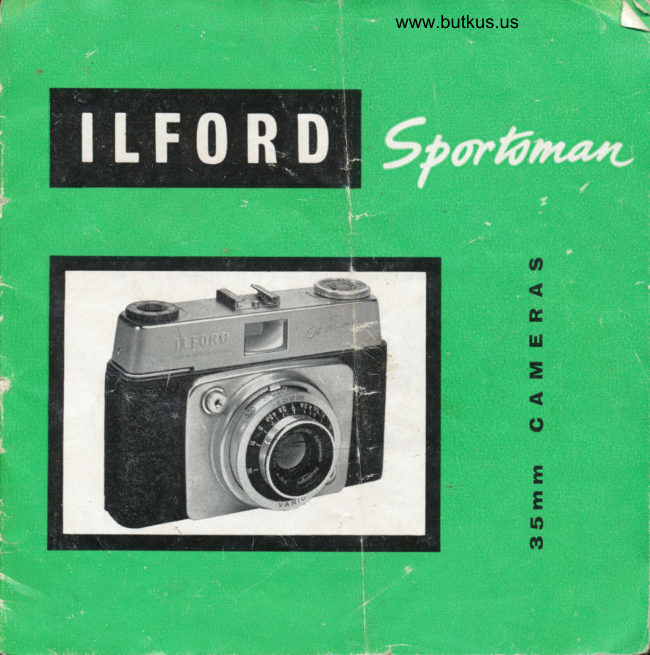
Ilford Sportsman User manual
User manual for Ilford Sportsman. 16 pages in English. Read the original PDF, download or print a copy without registration.
16 pagesEnglish2.5 MB PDF
Loading your manual…Open PDF directly
Document details
- Brand
- Ilford
- Model / document
- Ilford Sportsman
- Document type
- User manual
- Language
- English
- Pages
- 16
- File size
- 2.5 MB
- Category
- Film cameras
- Document date
- Not specified in catalog
Search available document text
Find a term, then jump to its page in the original PDF. Image-only pages may not be searchable; check the PDF for exact wording and diagrams.
Page 4 · Read text
IIFORD S7onb,ro*u Cameras
The Ilford Sportsman cameras are designed for quick, easy
operation and take brilliant pictures in either colour or black-and-
white.
  T'o get the most out of your Sportsman, read through these
instructions carefully with the camera in front of you before you
start taking any pictures, noting especially those sections that deal
with your own particular model.
  Every Ilford camera is carefully constructed, thoroughly tested
and guaranteed for one year from the date of purchase, so do not
forget to complete the guar:antee card and post it to Ilford Limited,
Ilford, Essex, without delay.
                     GEIlERAL lDETAlts
The sportsman vanio
The Sportsman Vario takes 35 mm. film in a standard cassette-
that is, the light-tight metal container in which the film is sold and
into which you must rewind the film after you have exposed it before
opening the camera back. This is all explained in "TAKING OUTTHE FILM"-page 12. The picture size you will obtain is
24x36 mm.
  The camera is fitted with a rapid lever-wind (4) and has a three-
elementlenswith a focal length of 45 mm. with a maximum aperture
                                                                                                                                                                                                                                                  ,,.1iof f12.8. The lens is coated and gives excellent results when
using both colour and black-and-white  films.                                                                                               I
                                                                                                                                             ,),
                                                                                                                                                                                   j
                                                                                                                                                                                                                                                                                                                   I
                                                                                                                                                                                                                      II
                                                                                                             - r,, #.:  *6r*d.   S*;;r.ri-,,--        .                                            I)
View original page 4Page 5 · Read text
www.butkus.us
 A single movement of the film lever-wind (4) performs three
operations-the  film is advanced, the shutter is set, and the exposure
counter is adjusted to show the number of exposures that are left
in the camera. The film wind and the shutter release are interlocked
to make double exposures impossible and to ensure that the film
cannot be wound on until an exposure has been made.
  The shutter on the Sportsman Vario has three speeds-l/zs,ll50
and 11200 sec. plus a "B'o setting for brief time exposures. It is
also synchronised for flash (14) with "X" type synchronisation.This means that electronic flash units inay be used at all shutter
speeds, and expendable flashbulbs at a shutter speed of 1/25 sec.
  To release the shutter, press the large shutter release button (5).
This is placed conveniently on the front of the camera to obviate
the risk of camera shake as it is pressed. The centre of this button
is threaded to accept a cable release.
The Sportsman Pronto
The Sportsman Pronto shutter has four speeds-l/30, 1160, lll25
andll25D sec. plus a"B" setting. In all other details it is identical
with the Sportsman Vario except thar you can take delayed
action pictures with the Sportsman Pronto. This mechanism  is
operated by moving the small red lever rt the bottom of the lens
mount (not illustrated) over to the right as you hold the camera in
the taking position. Then, once you have pressed the shutter
release buttort, there is an interval of 10-12 seconds before the
shutter opens, allowing you time to take up your own position in
the scene to be photographed.
The $portsman Rangefinder
The Ilford Sportsman Rangefinder is the same in all details as
the Sportsman Pronto except for the addition of a rangefinder. For
details of how to use the rangefinder on your Sportsman, see the
section on "FOCUSING"-page 9.


                                                                                                                                                                                                                                                        ,.:  l,*
                                                                                                                                                                                                                                                  ' l:lxi#
View original page 5Page 7 · Read text
www.butkus.us

                  OPENIIIG THE GAMERA
The back of the camera is opened by sliding the small button on the    locking-catch                        (l                          l) towards                              the base                                        of                                    thjcamera.                                                    This                                                         button-- is  on      the left-hand                    side                         of the camera                                     as                                                                it is                                            held ieidv for                                             use.
                LOADIilG YOUR SPORTSMA]I
The camera should. always^ be loaded and unloaded in the shade,
out of direct sunshine. After the camera back has been openea,
the-rewind knob (9) should be pulled olt to the maximum exteni
and the cassette of film placed in the camera. The free end of the
filmJhat projects from the cassette should now bi-eitending utorrg
the film track in the direction of the tal..e-up spool. Fush back the
rewind knr9 gently and turn until it engages^with the core of the
cassette. Then-operate the lever-wind once, but do not press the
shutter release button.
  The leading edge of the fiLn can now be taken along the film
track and slippep into the slit of the taae-up spool. If tlie d6;tspool is not in the correct-position and the slii cannot ue seen, ttispool can be rotated with the thumb on the lower                                                  -ii.a:6a1.!an-ge. lr4ake sure that the small tooth at the lowei Lnd                                                         of the siit
in-the take-up-spool is engaging with a perforation in the film.
  Now turn the take-up spoof with thi thumb so that the iongue
of film winds on to it; turn just sufficiently to talie      ttr. slack-in
the film until the full width nart of the film is just prdtruding"o      riom
the mouth of the cassette. The camera back can now be clos-ed.
  Next, release the s.l.ry!te.r (5) and ope_rate the film lever-wind (4) -three times. This will bringihe third frame on tni ruu width piri
gf thlfiIm.into position and clear any fibn which miy trave 6een
t9gseo during loadin_g. The camera is now ready to t-ake the firstpicture by pressing the shutter release.

                                    7

                                               .         .i.:,t.-                                                                         -,,,:,#
View original page 7Page 8 · Read text
.\' et  t i ttg   I ht' e.rposure
             c0unter


.S e t t i trg  t |rc./t  I r t ts:pe etl
        rerttirtcler cli.rc
View original page 8Page 9 · Read text
www.butkus.us

        The rewind knob (9) should turn anticlockwise when the film
       wind is operated and this indicates that the film is passing through
        the camera correctly. Always check that the rewind knob turns
         as the film is wound on.
         The exposure counter (2) should next be set to 20 or 36, depend-
         ing on whether a 20-exposure or 36-exposure cassette was loaded.
       The exposure counter indicates the number of exposures remaining
        in the cassette.
            Lastly, the film speed reminder disc (8) on the top of the rewind
       knob should be set to indicate the type of film in the camera.

                               FOGU SII{G
       The $portsman Vario and $portsman Pronto
      The lens is focused by rotating the focusing ring (6) until the
         distance of the principal subject, measurcd in feet, lies against the
       diamond shaped index mark on the front plate of the shutter. The
         aperture markings on either side of thisi index show the zone of
        sharpness which extends on either side of the focused distance, at
,f        different lens apertures.          In setting the focusing scale, distances up to 12 feet should be
                   measured accurately, but greater distances can bei       estimatedestimated approximately.or
        The Spontsman Rangefinden
      The built-in, coupled rangefinder on the Ilford Sportsman
         rangefinder model takes all the guesswork out of focusing. Instead
        of estimating or measuring the distance from camera to subject,
         the rangefinder does it all for you. This is how you operate it.
         Hold the viewfinder (3) to your eye in the normal way, and
         holding the camera in the left hand, rotate the focusing ring (6)
                                                 I

                                                                -^
View original page 9Page 11 · Read text
www.butkus.us

  sp.g9d. l/30, l160,.-11,125,                            .11250 sec. or'6]f"-is set by rotating the                    (12) milled outer.              ring                          until ttre                              red index -urk ;; i6p;f iffril; appears          against                  the                       selected                               speed.
   To control the. aperture setiing, move the milled lever (10) until the selected apertuie s-ettin-g to tlie rigtrt oT th"6;   liis'op'posii" the black dot on top of the lens mount.
                    TAKI NG T}IE PIGTURE
 The Spontsman Uario
 After the lens has been..focusgd, the shutter speed set, and the correct                  chosen, the         -aperture                                              is viewed through tti" optilui                               -subject viewfinder. The vieudnder (3) ii of trr. ait""t-uirioi type and is used at eye-level.                    _Jt                       gives a'brilriant i*ueu *ith-irr. piit*J;.*
 $o*n by a bright line, and the centre of t[E piiiirr.-*d bfid;rs" Two marks at the side of the bright tine frimji"itdt.;h-" t"t;lti'; picture when the came-ra is beinE used for ii;;6;i;tures  at about
 a distance of 6 feet or less. A similar amcunt *itt uiJo uppet i; ah; negative on the bottom of the picture although thi;ls not markedon the finder.
                             camera firmly with both hands and ,, To take the picture, hold thethen squeeze-don't jab-the shutter release, with the rorenngii?
the right ha-nd. when using a shutter speo ;i ilzi or illd Jr".,take_ up as firm a stance                              possible, teairing iguiitri anv avaita-ulti                       ?s                                                 -solid object such as a wall oi similar support.
                         been made, tn6 mn tever-wind shourd be   Aftgr Jle expgpure has
operated immediately so that the cimera is at once ready iJr-u
further.expos_'re. The rever should at*uvJ-ui--6"Jotfrry unJ
smoothly to the end of its travel. This is ihportuni,'G*.rr.  if thefull movement                 is                not made,                           the                                   shutter                                          noi                                            will                                                       set                                            and no                                     b"qxposure             made          will be                  when                            the                                   shutter                                           release                                                                 pressed.                                                       is                                               next
The lever-wind should not be alloweo to inup uact unoer the

                                      11
View original page 11Page 12 · Read text
be controlled                                         by the                                                rhumb,                                                             so                                                                   that ,qr::l*:rt moves 9fbackifs smoothlyspring butandshouldgently                                    to its position                                                 ready                                                               for the                                                              next operation.
 The Sportsman pronto
 For.taking.normal  pictures                               _with your Spbrtsman pronto, follow
 the.instructions given above for th6 sportiman viii".   rr vbu-wisli to take a delayed action picture and so include- yourself in the
 ptcture' mount the camera on a tripod, and after you have selected
 y,-oy r!u1ter. sO99d, the.required aperture, and foiused the ;il;;;,tnen operate thg delayed action lever and finally press ttre
 shutter release. But do hrst make sure that nothing_such as the
flap of-your ever-ready case-is likely tol-piJ.  tir8 r.t.rrn of the
delayed action lever once the shutier release button has beenpressed.          You'll                then                            10-12                  have                               seconds in whicha; iake;p t;;;     positionown                in front                       of                        the                           camera.
The $por"tsman Rangefinder
         pictures with the                             _Ilford sportsman Rangefinder modelIonows"l?ling         -exacfly the proecdure given for the Spoitsman prontoexcept             -that,. as mentioned before, when vou I'ook-itiougt-iti            insteadyiqryfinje1,                        o-f                      seeing                    a                                                  centre                                                                    the                                                  of                               cross -urfitrg ihefield of view,                     see                           yelrowish-;d;?                                 ti'e           vou will                                                                    wrricn                                                p"it".r                                           uvthe camera is focused.

                     TAI(I1{G OUT THE FILfUI
when you have exposed all the 20 or 36 exposures on the film,it must be completely rewound into the cassitt-e-b;i;;" the camera
back rs- opened. The film is rewound by depressing the rewind
release button (7) in the baseprate of the cam6i;-;;; at the same

                                   12
View original page 12Page 13 · Read text
www.butkus.us

time turning the rewind knob in a clockwise direction as shown
by the arrow. Rewinding should be continued with the rewind
release button held depressed until the film pulls away from the
take-up spool. If the film was properly attached to the take-up
spool when the camera was loaded, some resistance will be felt at
this point. When the film has been completely rewound the camera
back can be opened and the cassette removed from the camera
by lifting the rewind knob.
                  SilAPSHOT $ETTiii$$
On an average sunny day in summer and with a medium-speed
film such as Ilford FP3, the camera can be set so that it is ready
for use at all times without further adjustrnent. The aperture should
be set to flll and the shutter speed to l/50 or 1/60sec.; the focusingscale should then be set to 14 feet. It will be seen that the depth of field
scale extends from about 7 fent to infinity and the Sportsman can
be used as a simple snapshot camera.
              FLASH 8YI{ GH RO 1{ ISATI O1{
A small flashgun, such as the llford Sp;rtslite, can be fitted into
the accessory shoe (1) on the top of the camera above the view-
finder. The synchronising lead of the flashgun is connected to the
camera by the standard 3 mm co-axial contact at the base of the lens
panel. Make sure that the connector is plished firmly home before
using the camera.
  The shutters on all the Sportsman cameras have "X" t5pe
synchronisation so that either electronic flash units or expendable
flashbulbs may be used. Electronic flash units may be used at any
shutter speed and the expendable flashbulbs at a shutter speed of
ll25 or 1/30 sec.

                                                     1:t
View original page 13Page 14 · Read text
GHOOSIl{G THE RIGHT FI[M
    Now that yoq'ye g^gt to know the Ilford Sportsman you,lr want      to try                   it out with                     a firm.                      Make sure                                             of .ucoi! ut                                                           tdid,r;i;itJiiiiii     bv         following                       al! the                            instructions                                     carifrlt-;a                                          by                                              making a habit     of alw-ays loading ypt11                          fnortsman wittr an-ilf;r;--fl--h;;;;-vou
    made for each othei! Tak6 all the pi.l**      want, ind;;  ;;     9ut' summer. or winter,, with any oi these suplrhtive rr_Fono     films.             There's an                         Ilford 35                                                           subject                                                             and                               ryn'n--to-ruii'"u"ry     eyery          exposur€                      congition,                         and                               remember-the sportsmin                                                                        is-;;     simple that colour picturei are as easy to take as u'racr.-ano-*Ht"I
     IIFORD Gotour Fito D
    The ideal film.for making growing corour transparencies of any     daylight subject.
'.    lLFORD Gotour Fitm F
                                   use with clearflashbulbs.i    The colour film that is balanced for
     IIF0RD Pan F
     Jh^e glpost grainless, rhin-emulsion film for negatives of unmatched     definition and enlarging quality.
    ILFORD FP3
    The fine grain film with balanced colour response and ample speed     for general use.
    ITFORD HP5
   The high-speed fitm that is famous for its superb all-round per-    formance.
    IIFORD HPS
   An extremely fast film, for successful photographi bv any light.'

                                        14
View original page 14Related documents and language editions

From the M. Butkus archive. Original publisher and archive notices are retained.
Check the model and edition against your equipment.
PDF verified 2026-10-10.