Film cameras
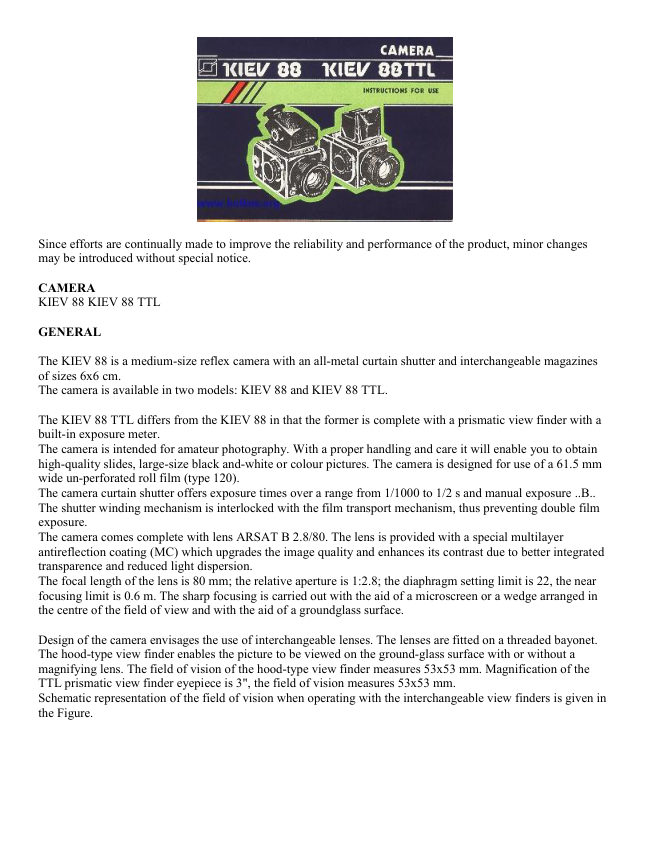
Kiev 88 / Kiev 88 TTL instructions for use User manual
User manual for Kiev 88 / Kiev 88 TTL instructions for use. 17 pages in English. Read the original PDF, download or print a copy without registration.
17 pagesEnglish1.0 MB PDF

Loading your manual…Open PDF directly
Document details
- Brand
- Kiev
- Model / document
- Kiev 88 / Kiev 88 TTL instructions for use
- Document type
- User manual
- Language
- English
- Pages
- 17
- File size
- 1.0 MB
- Category
- Film cameras
- Document date
- Not specified in catalog
Search available document text
Find a term, then jump to its page in the original PDF. Image-only pages may not be searchable; check the PDF for exact wording and diagrams.
Page 2 · Read text
7


CameraKiev-\8, 688TTL
        Instructionfor use


                www.orphancameras.com
View original page 2Page 3 · Read text
l. GcncralNotcs

  TheKIEV 88 is a medium-sizereflexcamerawith an all-metal(VRNKiev 88,88Cbody)or light-
   tight rubberisedfabric(VRN Kiev88m,88Cm,688body)curtainshutterandinterchangeable
  magazinesof sizes6x6or 6x4.5cm.

  Basicdeliverykit include.camerabody,MC Arsat80mm/2.8lensu'ithrubberlensshade,UV-l and
  YG-l.4 filters,frontlenscap, TTl-meteredprismfinder,rubbereyecupfor prismfinder,folding
  waistlevelfinder,.plasticcapfor bottomof finder,whennoton camera,two 6x6 cm 120fpe film
  ba'cks(old type;,camerastrap,nyloncameracase.

  Thecamerais intendedfor amateurphotography.
  with a properhandlingandcareit will enableyou to obtainhigh-qualityslides,large-sizeblack-and-  whiteor colourpictures.
 Thecamerais designedfor useof a 61.5-mmwide unperforatedroll film (type120).
 The camera             curtainshutteroffersexposuretimesovera rangefrom l/1000to llzs andmanual           "B". exposure
 The shuttercockingmechanismis interlockedwith the film transportmechanism,thuspreventing doublefilm exposure.
 The cameracomescompletewith lensM-c-Y-q,!na:3-.The lensis providedwith a specialmultilayer
  antireflectioncoating(MC) whichupgraoestG i*ugr quality""'J;;;.",      ill""n"st  dueto bener-  integratedbansparencyandreduced'li ght dispersionl
 The focal lengthof the lensis 80 mm,the relativeapertureis l:2.8,the diaphragnsettinglimit is 22, the nearfocusinglimit is 0.6m.
 The sharpfocusingis caniedout with the aid of a microrasteror a rangefinderwedgearrangedin the centreof the field of viewandwith the aid of a ground-glur.su.fur".
 Designof the cameraenvisagesthe useof inlerylargga$.clenses.Thelensesarefittedon a threaded
 bayonet'The hood-typeviewhnderenabtesme piciil  to-G uie*eo on the ground-glasssurfacewith
 g wit$ut a magnifringlens.rne neta orvision of the Uqad$pquendndErmeasures53x53mm.
 Magnificationof theTllpnrmjlder   eyepieceir:*,  tnEto  of visionmeasures53x53mm.
 schematicrepresentationof the field of visionwhenoperatingwith the interchangeableviewfinders is givenin the Figure:


The camerais complet-e-(basickit) with two rnlarahatggab-L-e-roag4ztlqt                                                                  of sizes6x6 cm, whichallowto obtain12 picturesof film type iZO.
The.camerais providedwith a slnchroniserfor photographingwith electroniccableandcablelessflashlamps'Thecameraloadingconsists                                        in fittingthJ;;g;;".   rviththefilm in thecamera.                                           www.orphancameras.com
View original page 3
Page 4 · Read text
I he tntcrchangeablemagazlnesotier trreopportunrtytbr qurck changern the processol'
 photographingfrom a black-and-whiteto a colour film or to a more or lesssensitivefilm. The
 magazinemay be removedfrom the camerainespectiveof the numberof the picturestaken.Each
 magazineis providedwith an automaticpicturecounterand a film speedsettingscaleof the loaded
 film.

                                                                  "C.The cameraoperatesin the temperatureintervalfrom minus l5 to plus 45

 Beforestartingthe photographing,pleaseget acquaintedin detail with theseInstructionsandyou will
know all the peculiaritiesof useof the camera.


2. List of StandardEquipment

 Camerabody                                                                I
 LensMC Volna-32.8180(MC Arsat2.8/80)
 TTl-metered prismatic viewfinder 45 deg,                  I
 Foldingwaist level hood-typefinder                            I
 Magazineand spool (set) 6x6 cm old type        2
 LightfiltersYG-I.4xandUV-lx (set)                         I
 Frontcapoflens                                                     I
 Lensrubberhood
 Eyecapfor TTL viewfinder                                      I
 Shoulderstrap
 Case                                                                     I
 Batteries(G13/ A76 lLR44 type)for TTL viewfinderJ
 nstructionfor use                                                       I

3. Main Units and Parts
         I - lens
    2 - lensfocusingring
    3 - distancescale
    4 - depth-of-fieldscale
    5 - diaphragmanddistancescaleindex
    6 - diaphragmscale
    7 - reddot for lensfitting
    8 - lensfixing screw
    9 - depth-of-fieldvisualchecklever
      l0 - finderhood
         I I - time exposurescaleindex
    12- shuttercockingandexposuretime settingknob


                                        www.orphancameras.com
View original page 4Page 5 · Read text
l3 - reddoton cam€rafor lensfittine
   l4 - exposurescale
   l5 'shutterall-metal(VRN Kiev 88,88Cbody)or lighrtightrubberisedfabric(VRN
  Kiev 88m,88Cm,688body)curtain
  16- camerabody
     | 7 - releasebunon(VRN Kiev 88 body)
   l8 - lensretainerbutton(VRN Kiev gg,ggmbodv)
  19- finderhoodbutton
  20 - flashlampyoke
  2l - sinchroniserplugsocket
  22 - shoulderstrapattachmentbutton
      - *Wa socket(2 holeswith 3/g,'or l/4,,thread_optional)  T.  24 - magazine
 25 - film rewindingknob
 26 - film exposureindicatorwindow
 27 - pictwecounterwindow
 28 - film transportmechanismlock handle
 29 - shutter
 30 - magazinelock button
  3l - take-upspool
 32 - film sp€edsettingscale
 33 - magazinetransportmechanism
 34 - feedspoolsupport


  2                                                      www.orphancameras.com
  3
  4
  5
  6
   ,


to
 f 1
.r2
t3
t4


                                    www.orphancameras.com
View original page 5Page 6 · Read text
2 1                         32
                                  33
                                             34
        2 3 -   -

 4. OperatingProcedure

 4.1. Preparing the Camerafor Loading

 Take the camereout of the case.

 Insertshutter29 asfar as it will go.

 Having displacedbutton 30 in direction of the arrow and havingturned magazine24 as shown in the
 Figure, removethe magazinefrom the camera.

 fire magazinelock will open only with the shutterpushedhome.


4.2. MagazineLoading

CAI]TION:
Whenloadingthemagazinewith a film takecarethatthe numberon the paperlabelof the transport
mechanismcomplieswith thenumberon the labelgluedon themagazinebody.
The magazinecanbe loadedwith the fitm in daylight(preferablyin a shade).
Removeshutter29 from themagazine,lift handle28, turn it fully counter-clockwiseandwithdraw
transportmechanism33.


                                          www.orphancameras.com
View original page 6Page 7 · Read text
Tearoffthe paperlabelfromthe leaderend.
 Shiftptate35 through90 deg.,placethespoolwith thefilm intotheseatandresettheplateto the
 initialposition.In thiscasetheprotrudingcentreof plate35 shouldenterthespoolhole.
 Tum handle28 fully clockwise,shift plate37 through90 deg.andinsertthe take-upspoolinto the
 seat.Resetplate37 to the initial positionsothatits driverwouldenterthespoolendfaceslit.
 Passthefilm leaderon the guideroller,threadit underpressureplate36, passit on the secondguide
 roller,fit the leaderendin thetake-upspoolandwind the leaderby rotatingthe take-upspool.In so
 doing,seeto it thattheleaderwouldbe woundwithoutskewingor crumplingof its edges.
 Tum handle28 counter-clockwise.In this casepressureplate36 will pressthe leaderto thetable.
 Whenthemagazineis properlyloaded,the film leaderdarksideshouldfacethe lens.Lift oneof
 halvesof.kngb25 by turningthrough90 deg.andsetfigurenI " in picturecounterwindorv27 by
 rotatingthe knobin the directionreverseto thearrow.


Insertbansportmechanism33 into the magazinehousingasfar asit will go, slightlyturningknob25
in the directionof the arrow.Resetknob25 to the initiarposition.
Turn handle28 fully clockwiseandaftermakingsurethatthe lock hasfixed thetransport
mechanism,resetthe handleto the initial position.Insertshutter29 home.
4.3. Preparingthe Magazinefor Shootirtg

Openwindow38.
Lift knob25 androtateit in the directionof thearrowuntil the figure"1" appearsin window3g,


                                         www.orphancameras.com
View original page 7Page 8 · Read text
whichconesponds,to the first picturein thefilm.
 Setthe loadedfilm sensitivityvalueon film speedsettingscale32.Forthispurposeturnthedisk
 wrththescaleuntil thesensitivityvaluecoincideswith theindex.

 CALTION:
                                                     "1"      loadinga magazinewith a film makesurethatfigure   is setin windows27 and38.If you lhen
  fail to meettherequirements,the shotswill go superimposedin shooting.


 4.4. Preparing the Camerafor Shootirtg

 poc.t<          shutterby tuming knob 12 fully in the directionof the arrow available on its body. Fit        ltre
 loaded magazine24on the cameracatchesand, turning the magazinein the direction of th! arro%
 attach it to the camerauntil the lock has operated
                         30I


CAUTION:
Installthe newlyloadedmagazineon the cameraonlywith the camerashuttercockedandmagazine
shutter29 pushedhome.
Wheninstallingthe magazinewith a partiallyexposedfilm, seeto it thatthe colourof signatsin
windows26 and39 shouldbe similar,otherwisea doubleexposureor a pictureomission-mayoccur.
Thestateof film andcamerashutteris determineddependingon the colourof signalsin theie
windows(ref. to the Table).


                                         www.orphancameras.com
View original page 8Page 9 · Read text
Film in the pictureaperture                                                                  Shuttercocked                             hasnot beenexposed  r
                              Film in the pictureaperture                                                            Shutterreleased         I                             hasbeenexposed                                                                                                                                                                                                                      I                                                                                                    IFI


 4.5.Shooting

 Theprocessof photographingconsistsof the followingjobs:
        - shuttercockingandfilm transporting;
        - exposuresetting;
        - diaphragmsetting;
        - viewing;
        - focusing;
       shutterreleasing.

Cockthe shutterandtrans-portthe film by turningknob l2 fully. At the beginningof cockingthe
shuttera slightincreaseof the forceappliedto the knobis posiible.


Whenthe shutteris beingcocked:


                                         www.orphancameras.com
View original page 9Page 10 · Read text
pressingsmoothlyon releasebutton l7 as tbr as it will go.

 When the camerashutteris beingreleased:

          - the minor automaticallyswingsto the upperposition;
          - the diaphragmapertureclosesto the pre-setvalue;
          - the film is exposed;
          - the red signalsare set in windows 26 and39.

 At the exposuretimes over l/30 s it is recommendedto carry out the photographingfrom a bipod.
 With the useof exposuretimesfrom l/8 to l/2 s the releasebuttonis to be releasedafter the
 completeoperationof the shutter.Tripod sockets23 in the cameraare providedwith thread3/8" (or
 with ll4'-  optional).

 The camerashuttercan be releasedwith the aid of a straightthread,which is screwedinto the
 threadedhole of releasebutton 17.

 The shootingover, fold the finder hood. For this purposepressthe viervfindermagnifying lens to cap-
 40 until it is fixed, fold the sidewalls, thenthe rear wall and, while holdingthe rear wall, closecap
i::::1"::T::'i':'l
 5. Determiningthe ExposureTimewith the Aid of PrismaticViewfinderTTL
 With the useof cameraKiev 88 TTL you candeterminethe exposuretime andthediaphragn
 aperturewith the aid of an exposuremeterbuilt into the prismaticviewfinder.
Advantageandconvenienceof the TTL measurementsystemlies in the automaticcontrolof alt
 factorsaflectingthe valueof theexposuretime. The field of measurementof theexposuretime
meteris in the centralpartof theviewfinderfield of visionandhasan ovalshape1ref.to the Figure).


The exposuretime meterensuresmeasurementsin the rangeof brightnessof 2 to 16000cd/m2,in
this casethe film-in-usesensitivityvalueis takeninto account.Voltageof thepowersupplysourceis
4.5V.

Whenprepanngthe prismaticviewfinderTTL for operationsetthe film sensitivityon its calculator
by turninghandle42 until the film speedvaluein ISO unitsappea$in window4j.
Seton the calculatorthe valueof the lensspeedby turningscale45 until theappropriatevalue
coincideswith index46.


                                          www.orphancameras.com
View original page 10Page 11 · Read text
By the lens speedis meantthe numbercorrespondingto the maximumrelativeaperture,e.g. for lens
 MC Volna-32.8180-2.8.


 Turn on the exposuretime meterhavingdepressedbutton44. Uponits turning-on,releasethe button.
 Theexposuretime meterwill operatefor l5 s, thenit will automaticallyturnoff. Forits repeated
 turning-ondepressthebuttonagain.Whileviewingin viewfindereyepiece47, aimthecameraon the
 objectso that its imagewouldbe arrangedwithin the field of view bfin. viewfinder.Dependingon
 thebrightnessof theobjectbeingphotographed,in the upperpartof thefield of viewof the
 viewfinderyouwill seetheluminescenceof oneof the signals:
MMru
ffiggfr*r"=E#F*ffir
            "Little Shouldthe       light"redsignal(Fig.No.l), locatedon theleft in thefield of view of the
 viewfinder,be seen,slowlyturncalculatorring 48 counter-clockwiseuntil the "Sufficientlighf"
secondredsignalappears.
        "MuchShouldthe        light" redsignal(Fig.No.2),locatedon the right,be seen,turn ring 48 clockwise
 until the secondredsignalappears.With the calculatorin this position(two red signils light up, Fig.              "exposure-diaphragm"No.3),choosethe                     pair requiredfor photographingby using-the.*ioru.. *i.
andthe diaphragmscale,e.g.exposurel/30 s is oppositediaphragpvatie i.g lreito the Figure),
 l/15 s is opposite4, l/8 s is opposite5.6,ll2 s is oppositeI t.


Setthe valuesof exposureanddiaphragm,chosenfor photographing,on thecameraexposurescale


                                         www.orphancameras.com
View original page 11Page 12 · Read text
andon the lensdiaphragmscale.


 6. Replacementof Power Supply Source .

 Thebatteryratedfor 4.5 V andsizingdiameterll.6xl6.2 mm servesasa powersupplysource(we
 areusingGl3 I A76lLR44 cell type).

 Theserviceabilityof thepowersupplysourceis controlledby meansof lightingsignals,whichlight
 up in thefieldof viewof theviewfindereyepiece.Theabsenceof signalswith button44 depressedis
 indicativeof thenecessityof replacementof the powersupplysource.
 To replaceor installthe powersupplysource,unscrewcap49 and,observingthe polarity("+nof the
 powersupplysourceshouldbe arrangedfromtheendof thecapon whichthe "+" symbolis
 engraved),installit into the seat.


 7. UnloadingtheCamera
                              nl2"Theshootingcanlastuntil figure   appearsin thepicturecounterwindow,indicatingthatthefilm
hasbeenfully used.After this fully insertmagazineshutter29 andremovethe magazinefrom the
camera.Lift knob25 androtateit in the directionof thearrowuntil the film hasbeenrewoundon the
take-upspool.Therewindingshouldbe carriedout smoothly,withoutseizure.Otherwiseit is
essentialto stoptherewinding,extractthe transportmechanismas it is indicatedbelowand
eliminatethecauseof thefilm seizure.Checkthatthefilm rewindingis overby lookingintowindow
38. Lift andturnhandle29 fully clockwise,
Removetransportmechanism33 from the magazine.Turn plate37,removethe spoolwith exposed
film andgluetheleaderwith a paperlabel.
Resetthe spoolinto the seatandreturnplate37 to the initial position,Installthe transport
mechanismintothemagazineandclosethe magazinelock.


8. Replacementof Lens
Designof thecameraenvisagestheuseof interchangeablelensel.


                                         www.orphancameras.com
View original page 12Page 13 · Read text
To removethelens,depressbutton18,turnthelensfully counter-clockwiseanddetachit. When
  fittingthelenson thecamera,matchreddot 7 on its basewith reddot | 3 on thecameraring,Insert
 thelensandturnit clockwiseuntil it is locked.


 The interchangeablelensesreleasedfor the cameraareasfoilows:
     Zodiak-8(MC Zodiak-8)- 3.5/30superwide-angle(l80 deg.)
     Mir-26(MC Mir-26)- 3.5/45wide-angle(83deg)
     Mir-38(MC Mir-38)- 3.5/65wide-angle(66 deg.)
   MC Vega-28-2.8/120tong-focus(36deg.)
      Kaleinar-3(MC Kaleinar-3)- 2.gll50long-focus(2Sdeg.)
   MC Telear-s- 5.61250long-focus(18deg.)
      Jupiter-36(MC Jupiter-36)- 3.Sl2S0long-focus(19 deg.)
   MC ArsatMacro- 5.6/500superlong-focus,non-mirror(g deg.)
    PCSHartbleiShift- 3.5145architectural,PCS/ perspectiveconectionsystem
   MC PCSArsatShift '4.5155architectural,PCSi perspectivecorrectiorsystem(69-84
     deg.)
    PCSHartbleiShift - 3.5/65architectural,PCS/ perspectivecorrectionsystem


 9. FlashPhotography
Thecameraincorporatesa synchroniser,whichensuresa synchronousoperationof the shutterwith
electr-onic_flashlamps.                   caseof photographingwith a cablelessflashlampit shouldbe mountedin                       -In
yoke20. Connectionof the flashlampwith cableis effectedvia plug sockit 21.


When photographingwith elecffonic flash lamps,the synchronisationis ensuredat the exposureof


                                          www.orphancameras.com
View original page 13Page 14 · Read text
l/30 s andover.
 The photographingwith flashlampsis to be caniedout in accordancewith thedirectionsfor use
 suppliedwith them.
 Whenthe flashlampis connectedvia plugsocket21, insertthe screw-plate(availablein theset)into
 yoke20.


 10.Applicationof Light Filters

 The cameraset includesthe light filters with a M62x0.7Sthreadusedas attachmentsscrervedinto
 the front part of the lensmount

 The UV-lx light filter is colourlessand is usedfor weakeningthe effect of ultravioletrays,e.g.when
 photographingin high mountainsor whenusinga colour film.

 The YG-1.4x light filter is yellow-green,light one, improvesthe reproductionof tonal valuesof
 multicolouredobjectson the highly sensitivephotographicmaterialswith only insignificantlossof
 their sensitivity.On the medium-sensitivephotographicmaterialsthe practicallyconect reproduction            "1'::::l::t:'::::::i:::::1":::I::'li:::
  l l. Care

Protectthe camerafrom dust,moisture,snow,harmfulvapours,jerks,jolting, impactsandsharp
temperafurevariations.

Handlethe camerawith care,do not exertthe excessiveeflortsin handlingit, keepthe cameraclean..
Do not removethe lenswithoutan utmostnecessitysincethis mayresultin dirt anddustgettinginto
the camera.

Cleanthe cameraregularly.Removethedustfrom its externalandinternalsurfaceswith a softbrush
or blow offthe dustwith the aid of a rubberbulb.Thoroughlyprotecttheopticalcornponentsfrom
gettingdustyor dirty, try to avoidtouchingthemwith fingers.Protectthe camerashuttercurtains
from mechanicaldamageastheyaremadeof verythin metailicfoil.
Storethe camerain the case,closethe lenswith a cap.
Havingbroughtthe camerafrom the frostyweatherinto the wann premises,do not openit
immediately,let it becomegraduallywarmedup in the casefor z-ia. "T"":::Tt:_::::ti:'::T:_'_:::l':t:::i::::Tr::::"  T:::


                                         www.orphancameras.com
View original page 14Related documents and language editions

From the M. Butkus archive. Original publisher and archive notices are retained.
Check the model and edition against your equipment.
PDF verified 2026-10-10.