Film cameras
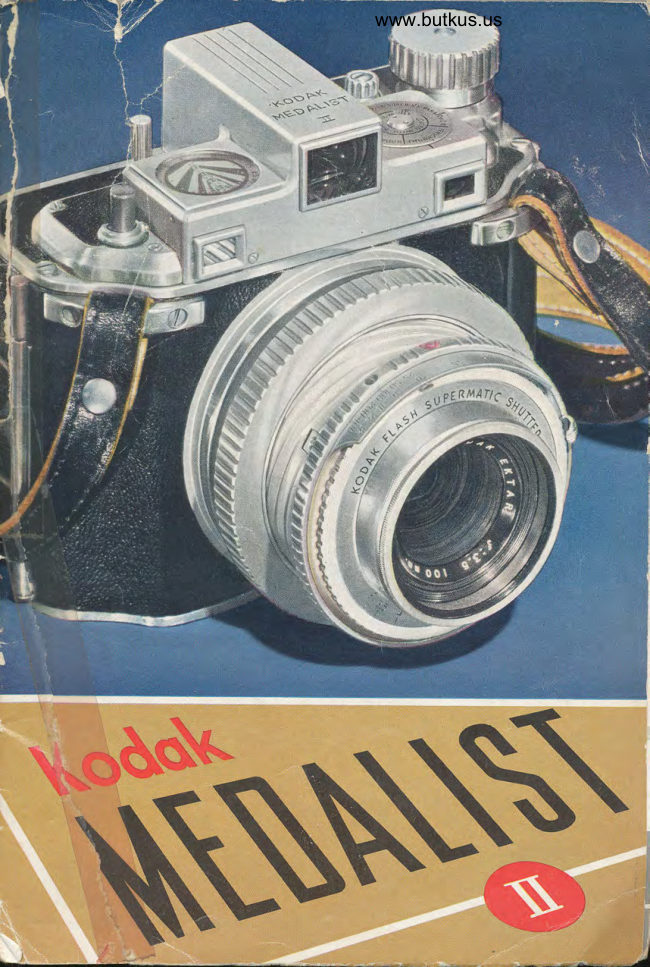
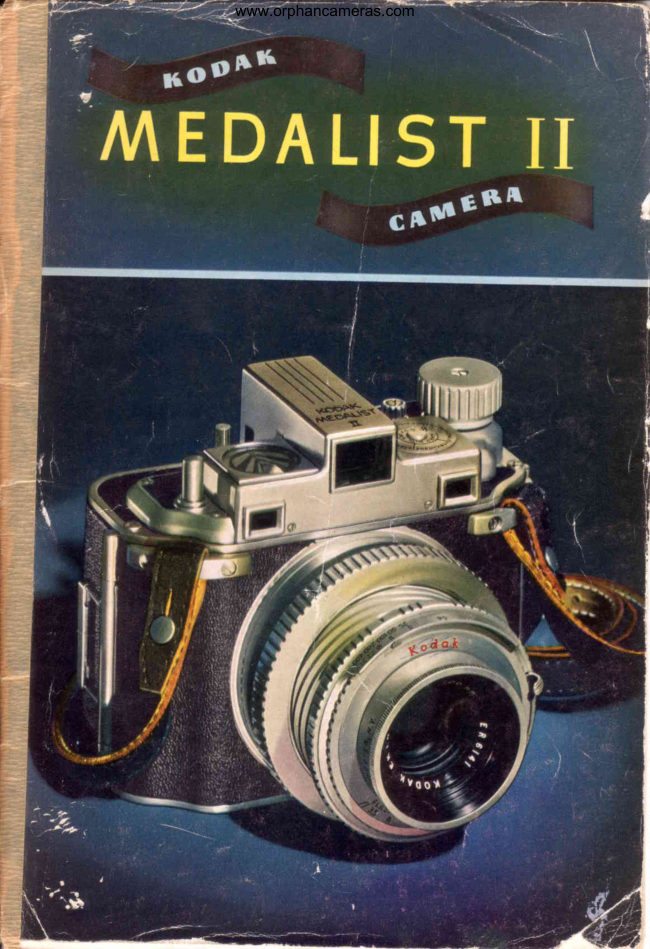
Kodak Medalist II booklet Product booklet
Product booklet for Kodak Medalist II booklet. 23 pages in English. Read the original PDF, download or print a copy without registration.
23 pagesEnglish3.1 MB PDF
Loading your manual…Open PDF directly
Document details
- Brand
- Kodak
- Model / document
- Kodak Medalist II booklet
- Document type
- Product booklet
- Language
- English
- Pages
- 23
- File size
- 3.1 MB
- Category
- Film cameras
- Document date
- Not specified in catalog
Search available document text
Find a term, then jump to its page in the original PDF. Image-only pages may not be searchable; check the PDF for exact wording and diagrams.
Page 4 · Read text
www.butkus.us
MEDALIST tr

 A
n  RADICAL departure in camera design-the original Kodak Medal-
 ist, unlike any other 212 x 3rZ camera, demonstrated the practicability
 of combining, in one compact, integrated assembly, the convenience of
 roll film . . . easy adaptability to the back extensions, ground-glass
 focusing, and negative-material range of a view camera . . . and the
 scope, accuracy, and operating refinements of a precision miniature.
This had never been done before.
   Now Kodak Medalist II, with even further refinements, is on
the way. It is designed and built to anticipate the demands of the
most critical workers-news, commercial, and scientific photographers
who must produce consistently good results  . . . advanced amateurs
and pictorialists who compete on the basis of quality  . . . and enthusi-
asts, generally, who want the finest equipment available.
       If your own interest in photography is in one of these fields-or is
some special application that similarly requires unapproached negative
quality, and unequaled accuracy and convenience-you will un-
doubtedly choose Kodak Medalist II as your next camera.
      Its features, design, and operation . . . how it can be used . . . what
it will do . . . are described on the following pages. But, as you will
certainly want to handle the camera itself at your dealer's-and inspect
samples of its work-this booklet is planned to supplement such an
examination.


                  TASTTVIAN KODAK COfNPANY
                                            ROCHESTTR 4, N. Y.
View original page 4Page 5 · Read text
The most popular negatiue size com,m,on to professional
and amateur photography is 2'/o x St/o inches. .  .


   THE 2/+ x 3Y+ size is popular because it is large enough for detail in nega-
     tives and contact prints . . . for critical focusing in a ground glass . . . and
     for enlarging to almost any size. And because, at the same time, it is small
    enough to make possible compactness in the camera . . . high speed and
     great depth of field in the lens . . . and convenience in handling, processing,
    and enlarging the negatives.
      This particular shape is popular because its proportion, approximately
    the ideal dimensional relation of classic composition, is generally pleasing
     in both horizontal and vertical pictures. Kodak Medalist II produces 2rA x
    3%. negatives on 620 roll film; with accessory back, on 520 film packs, and
    6.5 x 9cm. and 2% x 3%"-inch sheet films and plates.
       4
View original page 5Page 6 · Read text
www.butkus.us
A grea,t rnany photographers want to be able to
         a wide uariety of emalsions  . .  . choose from


                                                                                            t*aa ' Z.
                                                                                                                        'i'i:;*;*o,


THE basic Medalist II with its roll-film back uses Kodak Plus,X Film (620)
for general all-ro_u1d p_anchromatic picture taking; Kodak Super-XX for
extreme speed; Kodak Verichrome for orthochromatic results; Kodacolor
Film for beautiful full-color prints on paper, and Kodak Infrared for
dramatic effects. With its accessory back and the proper holder or adapter,
it takes 6.5 x 9cm. and 2rA x 3Y+-inch sheet films-Kodak super panchro-
Press,            B, for high speed and rapid developing; Kodak Super panchro-      Typ"
Press, Sports Typ", the newest and fastest sheet-film made, about double
the speed of Type B; Kodak Tri-X, which combines extreme speed with
long scale and moderate contrast; Kodak Super Ortho press, a high-speed
ortho film; and 24 other types of sheet films, including Professio"ut flau-
chrome and Ektachrome, Kodak's new color film which the user processes
himself ...  five Kodak Films available in packs..  . and a wide variety of
6.5 x 9cm. and 2rZ x 3rA-inch Kodak plates.

                                                                         5
View original page 6Page 7 · Read text
Contemporary, critical photography requires a                                                 fast,
highly corrected lens . .  .


KODAK MEDALIST II'S l00mm. Kodak Ektary'3.Slens more than meets
these specifications-it is, unreservedly, the finest lens ever available in
the 2% x 3% field. It consists of five elements (shown in the background)
. . . like all Ektars, it is focused as a unit . . . and its formula is a new one
computed especially for the Medalist. All glass-air surfaces are Lumenized
(hard-coated), which, together with special mount and shutter surfaces,
reduces reflections to a minimum and produces negatives with more
brilliant contrast-full-color transparencies with greater color purity.
Its technical characteristics include an angle of coverage of 54 degrees
. . . flat field . . . greatly improved color correction longitudinally and
exact register laterally  . . . no measurable coma or linear distortion  . .  .
exceptional light transmission  . . . and superior definition.
   Its new formula, based on new glasses and latest knowledg. . . . its
surface treatment . . . and the critically tested assembling of the lens
elements in the precision mounts . . . all contribute to the unmatched
performance of Kodak Medalist II's great lens.
   6
View original page 7
Page 9 · Read text
Precision photography deman ds arl clccura,te po-
sitional relation, betuteen lens and          . .  .                                           .fih*


FOR critical focus, the distance between lens and film plane must be ac-
curately determined and maintained; for critical definition throughout the
negative, the focal plane of the lens and the plane of the film must exactly
coincide when the lens is in focus. Kodak Medalist II's radically new lens
support meets these requirements and is an important advance in precision
camera design. Instead of the bed and bellows of the conventional larger-
negative camera, the Medalist II has two helically interthreaded tubular
members, tooled to extremely low tolerance, which support the lens-at
any position-with over thirty inches of metal-to-metal bearing. The lens
is extended and retracted by the focusing ring-always on axis . . . parallel
with the film plane . . . without twisting or turning.
  This results in lens positioning of new accuracy and dependability  . .  .
exact coincidence between focal and film planes . . . and makes possible the
,direct cam-and-lever coupled mechanisms described on the following pages.

   B
View original page 9
Page 10 · Read text
www.butkus.us
  Couplings betweert,      ad,uance and, shutter haae                    f,tm
  demonstrated, their ualue . .  .


 Plunger Shutter Releose                    Monuol Shutter-            Exposure-Counter Knob           Film-Winding &
                                             Cocking Lever                                                   Sh utter-Cocking Shutter-Cocking Signol                                                                                                      --      Knob                                                          6
Exposure-Counter Diol

Shutter-Control Mechonism Plote


Double-Exposure Prevention Coupling

Shutter-Operoting Arm

Connection with
Shutter-Control Ring


                                                                                                                                                                                                  Digitally signed by mike
                                                                                                                                                            butkus
                                                                                                                                                  DN: cn=mike butkus,                            mike        o=orphancameras, ou=29,
                                                                                                                                                              email=mike@butkus.org,
                                                                                                                                        c=US
                                                                                                                                                                          Date: 2019.06.19 00:18:03                              butkus -04'00'


                                                                                     Film Toke-Up Spool
                                                                      Flosh-Winding  Lever
                                                                                   SI' Film-Meosuring Spindle
                                                                 Synchronizer Scole Nut

 KODAK MEDALIST II'S shutter is connected try a single arm with the
  body controls-the film-winding knob which automatically cocks the shut-
  ter as film is advanced  . . . a manual_cocking lever used for the accessory
  back and for making_intentional double exposures  . . . a visible signal which
  shows whether the shutter is cocked  . . . and a body plunger shufier release
  providing double-exposure prevention. The pl""g"t is lJcked against acci-
  dental release when the lens is retracted.
   The film-winding knob is controlled by a measuring device which auto-
  matically prevents further winding after the proper leigth of film has been
  advanced. Exposures are automatically countld a"d shown on an indicator.
    The9g_Positive couplings were -ud" possible by the fixed relative posi-
  tion of Kodak Medalist II's shutt"r und body-they are a convenience in
  5rge1a_tion                 . . . permit pictures in rapid succession  . . . and allow the
  Medalist II user to concentrate upon his subject.
View original page 10Page 11 · Read text
Modern, photography requires quick2 accu,rate f,eld
                                                                                     .  and focus determination,


Focusin! Diol                         Porollox-Correcting  Frome                               View-Finder Eyepiece Lens
Depth-of-Field Scole                                                                                             Seporoting  Boffle
Infrored Focusing Index                                                                                         Ronge-Finder Eyepiece Lens
Trionguloting End Prism
                                                                                                   incidence ond Erecting Prisms
Ronge-Finder Obiective Lens
Ronge-Finder Window
View-Finder Front Lens
Porollox-Compensoting  Co


                                                                                               Stotionory End Prism
                                                                                           Ronge-Finder Objective Lens
                                                                                           Ronge-Finder Window

                                                                                                                                   l-{elicol Focusing Threods

                                                                                                   Focusing Ring


                                                                                 Flosh-Winding  lever

                                                                                  Synchronizer Scole Nut


  THE special lens support of Kodak Medalist II makes possible positive cam-
   and-lever couplings of the lens with a split-field, military-type range finder
     . . . with a focusing scale? indexed for visible and infrared light, and coupled
   with a depth-of-field scale . . . andwith the vertical parallax-correction  of the
   view finder. (This finder is centered above the lens-there is no horizontal
   displacement.) Finders and scales are also accurate with the accessory back
          difference in film planes is automatically compensated. The rear  -the   elements of both range and view systems are brought together in a twin
   eyepiece. A shift in the angle of vision-without moving the eye-shows
   both field and range-finder images.
    Both systems are exceptionally accurate and contribute importantly to
   the Medalist II's precision and ease of operation. For direct focusing and
   viewing, on tripod or stand, the accessory sheet film back has a hooded
   ground-glass panel with magnifier.
      t0
View original page 11Page 12 · Read text
www.butkus.us
Lens mount, couplings; precisiort,, and rigidity
dictated a rlew constrLLction...


THE construction of Kodak Medalist II represents another basic departure
in 2% x 3% camera design. The absence of the usual bellows and bellows
opening and, instead, the necessity of positive connection of the lens
mount and camera proper . . . the type and number of its couplings . .  .
the compactness desired in the camera . . . and the over-all rigidity, durabil-
ity, and precision required, were all determining factors.
  The result, shown here stripped of all parts, is composed entirely of in-
teriocking, light-trapped die-castings of special alloys. Some of these cast-
ings provide bases for the various mechanisms-others provide excep-
tionally sturdy housings and protection. One casting, for example, acts as
part of the film track and is also the base plate for the focusing and shutter
couplings. This unique construction-with no wood, sheet metal, or unsup-
ported parts-contributes importantly to the operation and accuracy of
Kodak Medalist II.

                                                                        11
View original page 12Page 13 · Read text
Iftd,ak Med,alis;t II-Your lYext Camera?


 HERE IS THE KODAK MEDALIST II, complete-a really different kind
  of 2% x3% camera-with  built-in roll-film convenience, and instant adapt-
  ability for film packs, sheet film,'and plates. It gives you the finest lens ever
  available in the field, in the world's most accurate between-the-lens flash
 shutter . . . with a construction which provides precise lens positioning,
 and makes possible new couplings between lens and body controls-and
 shutter and film system . . . all housed in a sturdy die-cast case.
   Kodak Medalist II, like its illustrious predecessor, will be interesting to
 almost everyone seriously engaged in photography-simply as an im-
 portant camera achievement, providing all these features. Its principal
 interest to you, however, is whether it is to be your next camera . .  .
    First, visualize yourself with a Medalist Il-loading  it with your "pet"
  film, or with any of the different negative materials you can use with its ac-
 cessory back. Using it to make the pictures you want-the kinds of pictures
 possible with an flS.S Iens and 1/400-second shutter . . . pictures with un-
 equaled brilliance, definition, contrast, and general quality. Visualize using
  it, with its accessory back, as a sheet-film or film-pack camera with built-in
 accurate range- and view-finding equipment  . . . or with the ground-glass
 panel and back extension units on tripod or stand . . . and, with a lamp-
 house and stand, as an enlarger for its negatives.
   Should you select the Kodak Medalist II as your next camera, real
 pleasure awaits you from the time you first hold it in a picture-taking posi-
 tion. As you "rack" the lens in and out, you will immediately sense the
 Medalist II's balance and "feel," characteristic of all really fine precision in-
 struments. You will look through its twin eyepiece at the brilliant, parallax-
 corrected field, and its magnified split range-finder images. You will ad-
 vance the film, which stops automatically, cocks the shutter, and records
 the exposure, and you will appreciate its simplicity of operation. In its
 over-all handling, the Kodak Medalist II has the quick, accurate operating
 ease of a fine miniature.
   Kodak Medalist pictures, in black-and-white and color, are illustrated
 in this booklet-to indicate typical results obtainable rvith a variety of
 negative materials. However, only originals, and particularly those in
 color, can show you their unexcelled quality.
     I2
View original page 13Page 14 · Read text
www.butkus.us


t


t


          Consider the Kodak Medalist II as your next camera. The answer depends
        entirely upon your present and planned picture taking. If your own needs
       are modest, some other camera may be all you want. But, if you want
        2rZ x 3rZ pictures, on a variety of emulsions, with first-quality results, and
      made with utmost convenience and precision, there is, literally, no other
       answer but the Kodak Medalist II.

           I{odak Medalist  II in use is shooun on thefollouing pages.

                                                                                13
View original page 14Page 16 · Read text
www.butkus.us


A$
  t.


   I
 i


      Kodak Medalist II is operated like a precision miniature. You hold and focus  it with the left hand  . .  .
       check composition and focus through the twin view- and range-finder eyepiece (see below). T'he right
      hand advances roll film, automatically cocking the shutter (or changes film holders, pulls film-pack
        tabs, and cocks the shutter with the rear lever)  . . . then operates the body plunger release.


       Below: the twin eyepiece framing the rear
       lenses of both range- and view-finder sys-
       tems. The large rectangle (right) represents
       the field as seen in the view finder.  . . the
       central area, indicated here by the white
        outline, is magnified in the split-field range
        finder (as illustrated below) for critical rvork.
View original page 16Page 17 · Read text
Belorv: the unique hinge latch rvith
rvhich Kodak Medalist II's standard
back may be swung open at either
end for loading or unloading roll
film, or temoved, and replaced v-ith
the Accessory Back for Sheet Film,
Film Packs, and Plates.


                                The Accessory Back, shown above with film pack and
                                           adapter, also accepts film and plate holders. . . and ex-
                                           tension units for positioning film at greater distances from
                                               lens. Below: Kodak Medalist II, with Accessory Back and
                                            ground-glass panel.
View original page 17Page 18 · Read text
www.butkus.us


 Above, left-the sturdy leather field
 case not only protects Medalist II
 but permits operation of the camera
 without removing it from the case.
Neck strap has protective plastic
 lining.


Above, right-with Kodak Flash-
 older, Kodak Medalist II is quickly
adapted for Photoflash. An external
socket provides direct connection  to
the internally synchronized Flash
Supermatic shutter.


Right-with Kodak Precision En-
larger Stand Assembly and Copying
Lights, Kodak Medalist II with its
Accessory Back becomes a copying
camera. Back-extension units may
be used singly or in combination,
for various maqnifications.
View original page 18
Page 20 · Read text
www.butkus.us

   PHOTOGRAPHY WITH
   KODAK MEDALISI II

                                                      and 1/400 Kodak     WITH Kodak Medalist II's unequaled f 3.5 Ektar lens,
       Flash Supermatic shutter, you can make the kinds of pictures you rvant.
            Its scope can only be indicated by the representative results reproduced
       here from negatives made by Medalist II and its predecessor, the original
        Medalist.
       The quality of Medalist results, however, can be evaluated only by
       examination of original prints at your dealer's.


                                             SYNCHRONIZED FTASH

                                                                            19
I
View original page 20Related documents and language editions

From the M. Butkus Camera Manual Library. Original publisher and archive notices are retained.
Check the model and edition against your equipment.
PDF verified 2026-10-10.