Film cameras
Mamiya press standard Product booklet
Product booklet for Mamiya press standard. 36 pages in English. Read the original PDF, download or print a copy without registration.
36 pagesEnglish8.4 MB PDF
Loading your manual…Open PDF directly
Document details
- Brand
- Mamiya
- Model / document
- Mamiya press standard
- Document type
- Product booklet
- Language
- English
- Pages
- 36
- File size
- 8.4 MB
- Category
- Film cameras
- Document date
- Not specified in catalog
Search available document text
Find a term, then jump to its page in the original PDF. Image-only pages may not be searchable; check the PDF for exact wording and diagrams.
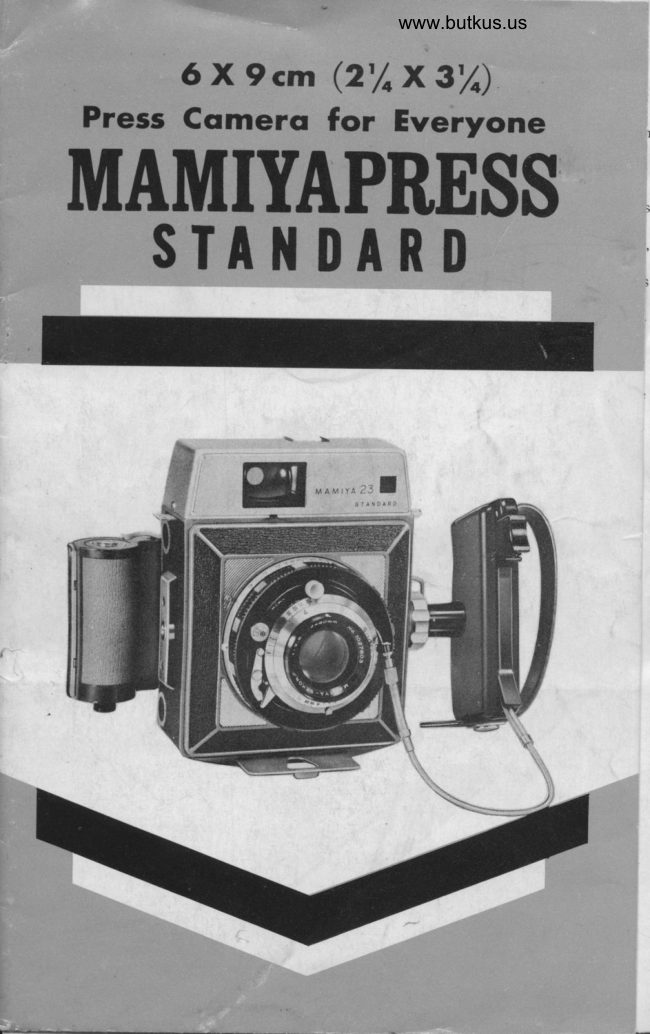
Page 1 · Read text
www.butkus.us
      6 X 9cm (2'/oX 3'/.)
 Press Comercr for Everyone
MAMIYAPRESS
   STAI{l|ARD
View original page 1Page 2 · Read text
.ENERAT DEscRrprfoN            r                                                        il
         . Srondord Lens r MAMIYA sEKoR f/3.5, r:90 mm, with rens hood
       Shutter: SEIKOSHA S (8, and I to l/500 second in equidistant
             steps of powers of 2), M and X settings for synchroflash,  tinre
            exposure lever, manuar shutter cocking, cable release socket
             (for gripholder shutter button), manual shutter lever
         Inferchongeobre  rens-shutter ossembfies: Lens, shutter and focusing
         mount form a single unit which mounts on the camera body
          by means of a 60 turn bayonet flange coupling
       Focusing: All lenses are focused by non-turning helicoid focusing
          mount. I-ens nr'vement is coupled to the buitt-in rangefincrer
              (single eyepiece, doubre-image focusing spot, 60 mm triangula-
            tion base, .66x magnification), or by ground glass back for
           direct viewing and focusing. Focus adjustment by distance
           measuring and adjustment on the distance scale is also possible.
       viewflnder: Reverse Galireo terescope, with sliding masks for long
             foqal length lens, reduced negative size, &c. wide angle viewer
            is mounted on the accessory clip. parallax compensation   i"^
          by adjustment of the eyepiece barrel.
        Adfusrobte swing back: Not provided in the MAMIYA pRllss
          S'IANDART)
        Phororensirive Moreriqr Horderc & Bocks: Full set of ground grass
           back, rollfilm horder, firm pack horder, prate horder and bacr<,
          and cut film adaptor is avairabre for fuil choice of firm and
           other photosensitive  material
       Gripholder: Easily detachabre gripholder for picture-taking and
             t'arrying, provided with shutter button
        Dlmensionr r  6                       /0" xg d, xS )X,
                            (including


        MA'YTIYA CAIAERA CO., LTD.
              No. 7, l-chomer Hongo, Bunkyo-ku, fokyo, Joponffie
                                                                              t*'*l:o
View original page 2Page 4 · Read text
www.butkus.us
          TIAIN FEATUR.ES
**The :tondord lenr ond Inlerchongeoblc lenrer of the ilAillYA
  PRESS SIANDARD qre oll mAtlYA SEKOR lenres' dedgned and
  monufcclutcd bY itAillYA.
   The lenses for the MAMIYA PRESS and MAMIYA PRESS
STANDARD are carefully designed and painstakingly fabricated for
maximum resolving power and high pictorial performance with all
types of film. These superb MAMIYA SEKOR objectives give
satisfaction to even the most exacting professional'
   The focusing mechanism is a high-precision, non-turning heli-
coid adjustment. The movemettt of the lens barrel is accurately
coupled to the rangefinder for easy and precise focusing.


Lens Interchongeoblllty
   Three different lens-shutter assemblies are available for quick
and easy change of focal length without the least trouble. The
standsrd lens is a MAMIYA SEKOR F3.5, f:90mm; the wide-
angle lens is a MAMIYA SEKOR F6.3, f:65mm; and the long-
focal-length lens is a MAMIYA SEKOR F5.6, f :150 mm. All lenses
couple precisely with the built-in rangefinder for accurate and easy
focusing by center focusing spot in the viewfinder field.
   Lens Portlculors
   Each interchangeable lens assembly consists of a full-coated
    I\{AMIYA SEKOR lens, a SEIKOSHA S shatter, and a helicoid
    focusing lens mount.
    Stsndord Lenr F3.5,  f :90 mm, four elements in three groups'
    distance scale graduated from 3.5 feet 1e oo (infinity), takes
     40.5 mm screw-in filters, aperture scale graduated from 3.5 to
     45.
    Wldc-Ange lcnt F6.3,  f :65 mm, four elements in four groups,
     distance scale graduated from 3.5 feet to c'o, special viewfinder
     supplied for mounting on accessory clip, takes 43 mm screw-in
      filters, aperture scale graduated from 6.3 to 32.
     Long-f63q;-tcngth Lenr F5.6, f :150mm, four elements in three
     grcups, Cist:nc: :ca'le graduateC frenn ? feo'i to    takes 40'5 nn                                                    -,    screw-in filters, aperture scale graduated from 5.6 to 45.
                 Plcture Angle Tcrble
  (MAMIYA SEKOR LENSES FOR THE MAMIYA PRESS STANDARD)
                                   Negative Size
     Type of Lens                   6x9 cm   6x7 cm  6x6cm  6x4.5cm
   Standard lens         58030'       5l o50'       50"        42"
   Long Focal Length     37"10'      320301       32"        26"
   Wide Angle            75"40'       67"50',       63"       56010'

    Comporlson wlth 35-mm Lenses
      To give an idea  of the above picture angles in terms of
View original page 4Page 5 · Read text
\

     3S-millimeter miniature camera photography, a conversion table
     is subjoined below. For instance, for 6x9 cm negative size,
    the MAMIYA PRESS STANDARD wide-angle,  f :65 mm lens
     is the equivalent of the super-wide-angle of :28 mm lens for
    the 35-mm miniature camera.
                                      Negative Size
               Lens
                     6x9cm    6x7 cm    6x4.5 cm
             Standard          39 mm     45mm       56 mm
      Long Focal Length     64 mm     74mm       94 mm
         Wide Angle        28 mm       32 mm     41mm

**Coupled          Ronge-Vlewfnder
   The range-viewfinder of the MAMIYA PRESS STANDARD  is
a single-eyepiece combination with a double-image focusing spot
in the center of the field. Coupling with the lens is automatic and
is accurate for all interchangeable lens assemblies. Compensation
for parallax is quickly and reliably effected by adjustment of the
eyepiece.
**Convenlent              Grlpholder for Gcrrylng ond plcture-
  Toklng
  An easily detachable gripholder is avilable as an accessory.
Picture-taking is greatly facilitated by a thumb-operated shutter
button which is coupled to the shutter by a flexible cable which
is uncoupled for convenient carrying of the camera.


                    www.butkus.us


**Fllm       Pock
   The 520 size film pack can be used in conjunction with the
 special film pack holder available as a special accessory.
 **tdeol         Flotness of Rollfilm Surfoce
    In the past, rollfilm presented difficulties due to the tendency
 to curl at the film gate inside the camera. The MAMIYA PRESS
 rollfilm holder eliminates such trouble, and gives a perfectly flat
 surface for accurate focusing. MAMIYA PRESS rollfilm holders
 are available in two negative (frame) sizes: 6x9 cm (2%x3%")
 for 8 exposures per roll of. 120 film: and 6xZ cm (2%x2fi') for
 10 exposures.
View original page 5Page 6 · Read text
www.butkus.us

              Rollfilm Holder Porllculors
                  Both 8-exposure and 1O-exposure rollfilm holders incorporate
                  start mark loading and automatic filmwind stop with film coun-
                  ter indication, eliminating the need for watching the red window.
            Both a fitted with back pressure plate for ensuring absolute
                 flatness of the film.
             By using film frame and viewfinder masks, both rollfilm
               holders can be modified to yield 6x6 cm (2lx2l/'t)  and 6x
                  4.5 cm (2%x 1/i'l) negatives. However, in this case, the auto-
             matic filmwind stop cannot be used, and film advance must be
             done while watching the indications through the red window.


         Wlde Cholce of Fllm Moterlol
               Extreme versatility is offered by the MAMIYA PRESS
          STANDARD because in addition to all types of size rollfilm
              used in conjunction with the rollfilm holder, film pack (520 size)
             can be used with the film pack holder, cut film or photographic
              plate of all types can be used with the cut film holders and
               back, while all backs can be replaced by a ground-glass viewing
            and focusing screen for seeing the subject as it appears on the
                  film.
            Photosensitive Mqterlol cnd Holders
                Roflfrfn of. l2O size (JIS, K7512) is loaded in the special rollfilm
              holder of the MAMIYA PRESS STANDARD.
           Dry Plotcr of 2r/" x3%' (J) size are loaded singly in plate
              holders and fitted to the plate holder back.
             Cur Fffm of one-fourth a)ix6%o(JS) size is mounted on a cut
                film adaptor and loaded singly in plate holders, and used in the
           same way as photographic dry plate.


l',=-


I


       **Hondsome,                       functlonol deslgn
             Special care has been taken in creating a camera of  dis-
          tinguished appearance without sacrifice of operational ease. The
         rough and stark look of professional equipment has given way to
         smooth lines of exquisite beauty, a notable feature of the MAMIYA
       PRESS. Further refinement has produced in the MAMIYA PRESS
      STANDARD a camera of great distinction with an appearance
         worthy of its versatile and superb performance.
View original page 6Page 7 · Read text
WITH the popularization of color film and color photography,
the professionals have turned tc large negative size for precision
picture-taking with maximum effectiveness.
   The MAMIYA PRESS professional camera, with its handiness
and versatility, is now world-renowned among press cameramen,
graphic arts experts, and other professional photographers as
the best lens-shutter camera for commercial, educational and scien-
tific photography.
   The new MAMIYA PRESS STANDARD for more popular use
in an exact replica of the superb MAMIYA PRESS, simplified by
elimination of the swinging back and retractable lens barrel for

easy operation using standard rollfilm.
   Use the MAMIYA PRESS STANDARD and its full assortment
  ;
of interchangeable lenses for high-grade photographs of professional

quality.                                                                                                                                                                                                                                                                   It
                                                                                                                                                                                                                                                                                                                                               I
                                                                                                    -f


          -w
View original page 7Page 12 · Read text
PREGAUTIONS:    www.butkus.us
Mount and dismount the pressure plate as shown in
the drawing, and do not depress the roller  by  the
fingers when the pressure plate is  neither  mounted
nor dismounted. If  strong pressure is applied to the
roller, accuracy may become disturbed and failure  in
 f il m winding may result.
Make adjustment for  the type of  film  which contacts
the  face of the pressure plate.
:"tif;
IlEti trfya  rli L I*.]IJ t b z I )v a a ffi\F,t:                                            (> )'-rl < -F 3  t,. "
                                    < alt';-   trrfiti+EB, E)a J ) l:t  - <-fillilL (-F5 u'"
   t  -- E+ t'3< <,   I-sjftr tE o>)Elllt t L t' v. J ) i: : iI€:--F3v'" u*7                                t) *i-L.   71)v/'-)a                -l:B&v,lA-fih:JJllb
                                                            t) *t. t) l:qPg t ? t:f  ,FEq L /i b t; < tth't>
View original page 12Page 13 · Read text
PRESS     ROLL HOLDER. for mAtnffA
         Gomblned Use for l2O and 22O tllm Slzes
  There are two types of roll holders for MAMIYA PRESS Cameras (6 x 9 or 6 x 7) which permit
simple use of both 120 and 220 films. Furthermore, since the winding system employs a lever arm,
speedier photography is accomplished compared to cotrventional roll film holders.
  PARTS NOMENCTATURE
 1. Take-up lever
 2. Wind-stop release lever
 3. Counter change-over knob
 4. Film size indicator window
                                                                             www.butkus.us     (indicates 120 or 220)
 5.  Film counter
 6.  ASA film speed reminder dial
 7.  Winding spool chamber
 8.  Spool exchange knob
 9.  Back cover latch
10.  Film chamber
11.  Starting mark
L2.  Film pressure plate
13.   Slide cover
View original page 13Page 14 · Read text
www.butkus.us

Number of Photographs Produced by Eaeh Holder           it crosswise while pressing it lightly. When
                     Roll Film                  remounting,  fit in a manner that the numerals
                                                     (L20 and 220) indicated on the pressure plate
                                            do not be turned up-side-down,
                 8 pictures   16 pictures                                             3. The film speed reminder dial (6) is set as a
                    10 pictures  20 pictures        memo. Adjust it so that the red dot is aligned
                                               with the numeral coinciding with the speed
   PR|OR. TO FILM LOADING            of inserted film.
1. By turning the counter change-over knob                           METHOD OF FILM LOADING  (3) either to the right or left' the number
  corresponding to the inserted film (either 120     1.  Insert a new roll of film in the film chamber
  or 220) is visable from the fiIm size indicator       (10) after pulling out the spool exchange
  window (4). Turn the knob completely until      knob (8); then return the knob to its original
                                                                            end of the leader   it stops. With this action, the automatic wind-         position. Slowly pull out the
                                                                         groove of the wind-  ing device is changed over to accomodate the        paper, inserting it in the
                                                                                        end.  respective film.                                   ing spool on the opposite
                                                                        spool exchange knob2. The back cover is opened by pulling down     *  By pulling out the
  the back cover metal latch (9).  Since one        (8) and turning it either to the right or left,
  side of the pressure plate is for 120 film and        the knob can be left remaining in that condi-
   its reverse side is for 220 film, be sure that       tion. The knob retracts with a click as it is
  the film used is inserted on the proper side.       turned back to its original position.
                                                               spool is not tightly inserted into the  The pressure plate can be removed by sliding     *   If a
View original page 14Page 15 · Read text
receptacle, or the leader paper is not correctly
  fitted into the winding spool, it causes the
  film to be wound one-sidedly; consequently,
  care must be exercised when inserting a roll
  film in the camera.
2. By winding the take-up lever (1) little by
   little, the arrow on the leader paper which
  indicates the starting mark will soon appear.
  Close the back cover when this arrow correct
  ly coincides with the starting mark (11) of
  the holder. (See Fig. 1)                               avoided.
*  There have been instances in which                                                the     3. Wind the take.up lever fully until it stops.
  specified number of photographs could not be     By repeating this operation several times, a
  taken because the starting mark was not         click is audible; further lever take-up becomes
  aligned correctly.                                                     impossible. Simultaneously, the numeral " 1 "
*  No problem arises if                          th€ starti4g mark posi-       appears in the counter window (5) and pre-
  tion slips a trifle when the bpck cover is       parations for taking the first photo are com-
  closed.                                                    pleted.
                                                                    before the " 1 " appears in the*  Light          leakage is caused by car'elessly pull-     *   Occasionally,
  ing out an excess amount of leader paper or                ' counter window, take-up lever action feels
  by loading or unloading a roll film in direct      somewhat heavy; however, attempt take-up
  sunlight. These actions should be definitely        action until it stops.
View original page 15Page 16 · Read text
www.butkus.us

                                                                                                     not  TAKING PHOTOGRAPHS             *  Be careful that the take-up lever is
                                                      operated extremely fast, otherwise bad effects
1. Attach the prepared holder in which film                                        may result through uneveness of the film,
  insertion has been completed on the camera,                                             3. After taking the specified number of photo-
  taking the first photo after pulling out the                                                 graphs, the take-up lever no longer locks,
  slide cover. Concerning the method of attach-                                                   permitting continuous winding without stop-  ing on the camera, refer to the MAMIYA                                              ping. Take-up action of the lever becomes
  PRESS instruction manual.                                                                             ,                                                     light when the leader paper is completely
2. Upcin taking one photo, wind up the take-up       wound; this indicates that the back cover may
  lever (1) after pushing the wind-stop release                                             be opened for removing the exposed film.
  lever (2) slightly toward the right, permitting                                                *  When desiring to remove the holder from
  the next photo to be taken immediately.        a camera in which an amount of film is still
*  Mechanism of the take-up lever does not       unexposed, remove it after completely insert-
  completely advance the film for the following       ing the slide cover (13).
  photo in one operation. Accordingly, always -                                                         case no film has been loaded, the film                                                *   In
I perform lever wind-up action two times. Also,        countep will not advance even though winding
   if the film is advanced.little by little, through                                                              is performed by the take-up lever, and  '( S "
  short strokes of the take-up lever, always wind         is indicated. When an indication other than
  completely until the lever stops.                                                                       " S "  appears, it indicates that film has been
                                          one      loaded.                                               '*  When a flash gun is mounted, since
  frame can not be advanced by two winding
  operations, perform take-up little by little.          MATIIYA CAMERA CO., LTD.

                                                                                                                         Printed in Jopon
View original page 16Page 19 · Read text
www.butkus.us


cArvrERA BODY PARTS (B)       B 10 Flashgun Mount           rENS-SHUTTER ASSEMBLY (R)
                               B 11 Tripod Socket
B 1 Lens Barrel Lock Button       B L2 Tripod Socket         R  I  Focusing Ring
B 2 Lens Coupling Mark           B 13 Strap Eyelets (2)       R 2 Depth of Field Scale
B 3 Viewfinder Window            B 14 Cable Release Holder     R 3 Distance Scale
B 4 Viewfinder Window Mask                       R 4 Shutter Cocking Lever
      Lever (for 150 mm lens)                       R 5 Shutter Release Lever
B 5 Focusing Screen and Rollfilm                                                                                       Lever                               F|AND GRIP (c)     R 6 Time
      Holder Lock Knobs (2)                        R 7 Shutterspeed Dial
B 6 Support Plate           G1  Hand Grip          R 8 Aperture Control
B 7 Hand Grip Lock Ring       G2   Shutter Release Button on  R 9 M-X Selector
B 8 Eyepiece     t                      the Hand Grip         R 10 Synchroflash Terminal
B 9 Accessory Clip         G3  Cable Release          R 11 Cable Release Socket
                                                -2-
View original page 19Page 20 · Read text
www.butkus.us


         ROLrFrLrn HOTDER (K)
K1   Filmwind Stop Release Lever
K2  Filmwind Knob
K3   Backlid Catch
K4   Safety Catch
K5   Insert Slide Cover
K6  Red Window

                                                   3
View original page 20Page 21 · Read text
FUNCTIONS AND OPERATION
 NEGATIVE SIZE                          PHOTOSENSITIVE N,IATERIAIS
     Nominal Rating...6x9                 A and B.  Rollfilm... Rollfilm 120 is loaded in
                                                          either of the two rollfilm holders available. TheActual Picture Sizes . .  .
                                                            rollfilm holder is secured on the back mount of A. Rollfilm 120
                                                       the camera.
      in 6x9 holder                                             C. Dry Plate . . . Dry plate (6.5 x 9 cm) is placed
     a. 6x9                   ...56x84 mm      in plate holder, which is inserted in front of the
     b. 6x6                    ...56x56 mm      focusing screen of the focusing screen holder from
     c. 6x4.5               ...56x42mm      the side.
 B. Rollfilm 120                                D. Cut Film ... Cut film is placed in a cut film
                                                clamp for fitting in the regular plate holder. The      in 6x7 holder
                                                           plate holder is then inserted in the focusing screen
     a. bx/                   ...56x67 mm                                                       holder in the normal way.
     b. 6x6                   ...56x56 mm     When cut film of. 27/zx3lz' size is available for
     c. 6x4.5                 ...56x.42mm      use, load in plate holder using a discarded plate
                                                   as backing.   Dry Plate (ASA 6. 5 x 9 cm)     ...57 x84 mm
                                                E. Film Pack... Film pack is placed in the film
D.  Cut Film (ASA 2t/+x37/a')     ,..52x80 mm                                           pack holder, which in turn is inserted in  the
E.  Film Pack (ASA 2t7nx3/a')      ...57 x80 mm      focusing scleen holder.
                                             *4-
View original page 21Page 22 · Read text
www.butkus.us

 CHANGE OF NEGATIVE SIZE
  When changing picture size from 6 x 9 or 6 >.7 to
6 x 6 or 6 x 4.5 on rollfilm,  it is necessary to fit the
rollfilm holder with the appropriate picture mask.
When taking substandard size pictures, the
exposures must be counted through the red window
at the back of the rollfilm holder. The automatic
filmwind stop and exposure counter cannot be used.
  Also do not fail to fit the appropriate finder win-
dow masks; the viewfinder masks coming with the
filmholder in the case of the standard lens (f :90
mm), the masks coming with the lens in the case
of the long focal length lens (f :150mm), and the
separate viewfinder for mounting on the accessory
clip in the case of the wide angle lens (f :65mm).
ftIAiIIYA PRESS INTERCHANGEABLE LENSES
  Standard (F 3.5, f :90 mm), wide angle (F 6.3, f :
65mm), and long focal length (F 5.6, f :150mm)
lenses are easily and quickly interchangeable, and
each unit couples accurately with the rangefinder.

                                                -5-
View original page 22Page 23 · Read text
s[.-EZ


 The MAMIYA-SEKOR lenses for the MAMIYA      precision helicoid mount, with coupled rangefinder;
PRESS are specially designed anastigmats of high      or by means of the ground glass focusing screen
resolving power for needle-sharp reproductions on      available as an accessorv.
large negative areas.   Focusing is by high

                     Speed     Focal     Construction               Picture Angles
                         (F/number',  . Length      (element-    6x9     6x7        6;..6     6; 4.5                                                     (f   mm)    group)                                                                              '
    Standard                 3.5          90        4-3     58030,  51050'    50"       42'
   Long Focal Length           5.6          150        4-3     37010,  32030,    32"       26'
   Wide Angle                  6.3           o)        4-4     75"40'  67050'       63"       560 10'

                                               -6-
View original page 23Page 28 · Read text
www.butkus.us
      moved by pressing lens barrel lock button (B 1)      marks, then turn the barrel Clockwise about 60 de-
       toward the lower right corner of the camera body,     grees. Slight resistance will be felt before the
       as seen from the front, and by turning the lens-      catch holds and the barrel is locked in position.
        shutter assembly counterclockwise about G0 degrees,     When changing lenses, be sure to uncouple re-
       gripping the barrel by means of the two protrusions      lease cable (G 3) leading from grip handle (G 1).
 I      provided on the depth of field scale ring (R2). The      The rangefinder can be used, without any adjust-
       assembly can be lifted out when the red triangle      ment, with any of the interchangeable  lenses.t     mark on the barrel matches the red dot lens      CAUTION: With the lens-shutter assembly re-
       coupling mark (B 2) on the upper left hand corner     moved, the interior of the camera body is exposed,
       of the camera front.                                     revealing a pin protruding from above. This is
       To mount lens on camera, match the two coupling      the coupling pin for the rangefinder.
                                               Do not tamper with this delicately adjusted part.
                      www.butkus.us                SHUTTER (SEIKOSHA-S, ZERO S!ZE)
                                                              Shutterspeed Settings: B (bulb, manual operation),
I                                                                                                l, Llz, rl+, Lle, Llts, rlso, Lf ao, rltz,, Lfz;o, and l/soo
                                                                secondI                                                            Aperture                                                                         Settings (scale markings)  :
                                                                  Standard              3.5, 4, 5.6, g, 11, 16, 22, 32, 45
                                                     Long Focal Length 5.6, 8, 11, 16, 22,32, 45  ffin'€                                            Wide Angle          6.3, 8, 11, 16, 22,32
                                                                  Flash Synchronization;M and X synchroflash settings.

                                                                        -tt-
View original page 28Page 29 · Read text
Time Exposures; Time lever (R 6) is provided so
                                                           that when shutterspeed dial (R 7) is set at " B "
                                                        operation of time lever (R 6) will cause shutter to
                                                 open and remain open until th6 lever is released.
                                                      Shutter Operation by Cable Release: Cable release
                                                      socket (R 11) is provided.
                                         VIEWFINDER
                                             The optical viewfinder of the MAMIYA PRESS is
                                                   of the reverse telescope type, and is combined with
                                                         the rangefinder in the upper part of the camera body.
                                                     Sighting and picture composition can also be done

                    VIEWFINDER, WINDOW TIASKING TABLE
                                          Negative Size

 Standard        no mask       I 6x7 standard mask   6x6 standard mask    6 x 4.5 standard mask                                           I     over window
Long Focal    built-in sliding mask                             6xZ long mask      6xO long mask       6x4.5 long mask  Length          (B 4)
               special accessory I  indicated in field of                 finder         I     special finder

                                     -12-
View original page 29Page 30 · Read text
www.butkus.us
with the ground glass focusing screen mounted on     FOCUSING METHODS
the back of the camera or with a sports type frame                                              The helicoid mounts of the lens-shutter assemblies
finder mounted on the accessory clip. Reduction of                                                    permit back and forth movement of the lens barrel
subject size by means of the reverse telescope view-                                                        in relation to the camera body, 3/8t' for the standard
finder is to 66 per cent of life size. Correction of                                                                lens, 12" for the long focal length, and3lrc" for thethe viewfinder field for various negative sizes is ef-                                                  wide angle.
fected by use of masks over the viewfinder window                                                 Focus adjusrment may be effected e'ither by the
(B 3). When using the wide angle lens-shutter  as-                                                      coupled rangefinder, by tape measure or sight judg-
sembly, a separate viewfinder (reverse telescope type)                                         ment and distance scale, or by the ground glass
is used mounted on the accessory clip.  Viewfinder                                                       focusing screen.
correction for parallax at close ranges is effected,
when using standard and long focal length lenses,      SHUTTER OPERATION
by moving the eyepiece (B 8).                                           To cock shutter mechanism, push cocking lever (R
 COUPTED RANGEFINDER                           4) over toward left side of the camera (as seen from
  The rangefinder is combined with the viewfinder,      rear). The shutter is released as a general rirle by
and is of the double image focusing spot type. The      the left index finger through the button (G 2) and
length of the triangulation base is 60 mm, and the      cable release of the hand grip. However, it is also
magnification is x 0.66. Accurate coupling ranges       possible to trip the shutter by means of the shutter
are: for standard lens, 3.5 feet to oo; f.;r long focal       release lever (R5) operated by the right index finger.
length, 7 f.eet to oo ; and for wide angle, 3.5 feet       For focusing and sighting by means of the rear
to co.                                                  focusing screen, set shutterspeed dial (R7) at"B",
                                                                              | 3-                                                  -
View original page 30Page 31 · Read text
cock shutter, and pull outward the knob of time       flange. Push into upper groove, the press down firm
lever (R 6). Shutter will remain open.                  ly. Lock by turning the lock knobs over 90 degrees.
  R,OLLFII'YI HOTDERS                        The focusing screen holder is secured in the
 Two types of rollfilm holders for the MAMIYA     same way.
PRESS are available  : for 8 exposures of 6 x 9 cm ne-
gative size from a roll of.I20 film, or for 10 exposures
of 6 x 7 cm negative size. Both holders can be used
for taking pictures of 6 x 6 cm or 6 x 4.5 cm size:.
holever filmwind stop and exposure counter cannot
be used in this case, the red window must be used
for visual check of film advance.
 OPERATION OF ROLLFILM HOTDER
  The rollfilm holder is secured to the camera back
mount by means of tlo  securing knobs (B 5). To
remove rollfilm holder, turn knobs (B 5) so that
holding flanges are turned up and the  straight
edges are parallel to the back mount, clear of the
roll6lm holder. Lift up the lower side of the rollfilm
holder and pull out of top groove. To attach roll-
film holder, reverse this procedure, making sure that
the lock knobs (B 5) are turned clear of the locking

                                                                  -lf-
View original page 31Related documents and language editions
From the M. Butkus archive. Original publisher and archive notices are retained.
Check the model and edition against your equipment.
PDF verified 2026-10-10.