Light meters
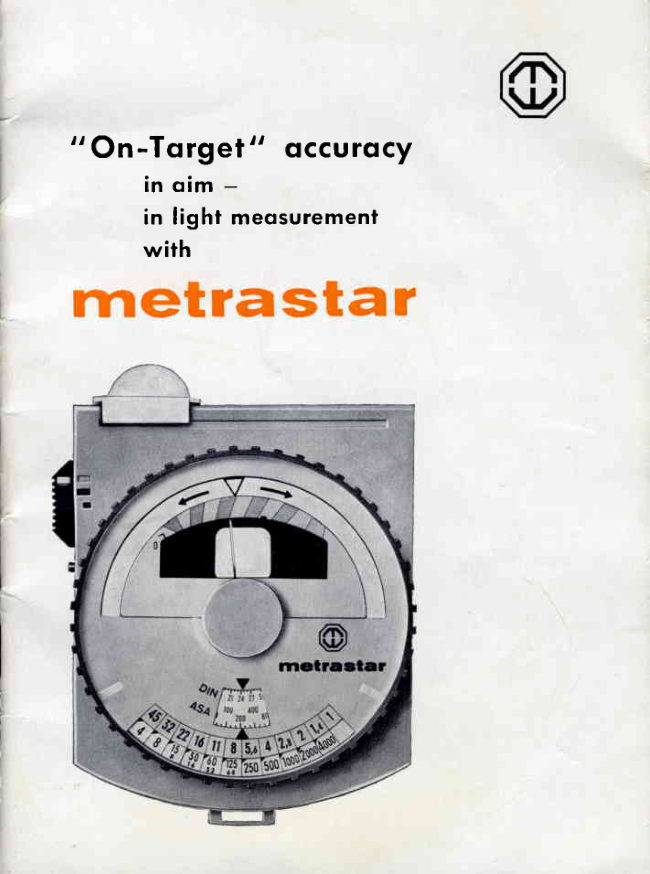
Metrastar Light Meter User manual
User manual for Metrastar Light Meter. 32 pages in English. Read the original PDF, download or print a copy without registration.
32 pagesEnglish2.4 MB PDF
Loading your manual…Open PDF directly
Document details
- Brand
- Metrastar
- Model / document
- Metrastar Light Meter
- Document type
- User manual
- Language
- English
- Pages
- 32
- File size
- 2.4 MB
- Category
- Light meters
- Document date
- Not specified in catalog
Search available document text
Find a term, then jump to its page in the original PDF. Image-only pages may not be searchable; check the PDF for exact wording and diagrams.
Page 3 · Read text
You will find on poges


                   l o n d     l l  T h e m o i n f e o t u r e s o f y o u r m e t r q s t q r

              1  Detoiled description

              2     Setting the film speed

              3    Choice  of meosuring ronge

              4     Selective oreo meosurement

              5     Operoting the meter
              7     lncident light reoding
              8    Checking zero odjustment ond bottery voltoge

             1 0   C o l i b r o t i n gt h e m e t r q s t o r   w i t h  f i l m o n d
                 comero
        1 1- 1 2   B o s i c m e o s u r i n g m e t h o d s

        13-20      Reflected light methods
       21 -23      lncident light methods

            24  Technicol doto


                         www.orphancameras.com
View original page 3Page 5 · Read text
Brief inslruclions  for use


Sef film speed by turning tronsporent cover  [ 5 ] with the finger-
grips, until film speed scole  [ 7 ] shows the desired speed.

Set to correct meosuring lqnge  by  turning knurled ring  t4  I  in
either woy (direction indicotors t11 l). Use white triongulor index
m o r k   l 1 2 l     i n b r i g h t   l i g h t ,  t h e b l q c k m o r k  ( n o t v i s i b l e  i n  r h e
illustrotion)in poor light. Alwoys use the white mork for outdoor
shots.


Seleclive oreq meqsurement by selecting the desired subject oreo
w i t h v i e w f i n d e r [ 8 ] .

T h e m e t r o s t o r           i s s w i t c h e d o n b y  s l i d i n g s w i t c h t 1 ]  d o w n                                                                                                                                              ,t o s t o p [ 2 ] .

Hold lhe reoding by slowly letting go of switch [1 ], which locks
the pointer.
Reoding of operture ond shutter speed on scoles [5  ] ofter od-           \
j u s t m e n t o f   i n d e x m o r k  [ 1 2 ] o n d p o i n t e l  [ 9 ]   t o  t h e s o m e z o n e
of zoned scole 1141.

Set for incident light reoding by sliding inregroting sphere [1J ]
over photo resistor lens  [ 15 ].


c h e c k z e r o o d j u s t m e n t q n d b o t t e r y v o t t o g e b y s l i d i n g s w i t c h [ 1 ]
beyond stop  [ 2 ], ofter pressing in the stop. Zeroing  is checked
in the poor  light meosuring ronge; the bottery voltoge  in the
bright  light ronge; pointer   [ 9 ] must point to red bottery check
m o r k  [ 1 0 ] .  ( S e e o l s o  i n d i c o t i o n s [ 1 7 ] . )


                          www.orphancameras.com
View original page 5Page 6 · Read text
Your  metrostor


precise               by controlled measurementwith viewfinder
                    and narrow measuring angle of only 180


highly sensitive       because  it has a cadmium sulphide (CdS)
                           cell


dependoble          even in poor  light, because of the large
                                    .    measurement range extending over two
                      scales


cleorly orronged      because of automatic switching from low
                           to intense light conditions


simple trnd eosy      because of single-handed operation and
                        pointer locking


verrolile              because  the  meter can be  used  tor 6
                          different methods of  light measurement


sofely protected         in the ever-ready case


                                         *.        ";&!a*ilie"
View original page 6Page 7 · Read text
Detqiled description


W i t h t h e m e t r q s t q r    y o u w i l l h o v e r e c e i v e dt h e c o r r y i n gc h o i n
ond the'ever-reody  cose, which protects the instrument from
s h o c k s o n d  o t h e r m e c h o n i c q l d q m o g e . T h e m e t r q s t q r            i s
placed in the ever-ready case by sliding it from behind under the
l at c h i nt o t h e ca se .Th e chain is hooked into ring t5l.Y o u c a n h a n g
t h e m e t r o s t o r   a r o u n d y o u r n e c k ; t h u s i t w i l l a l w a y sb e r e a d y f o r
immediate use without being in the way when taking pictures. All
that is necessaryto use the meter is to  lift the lid of the case.
l f y o u  r a t h e r u s e y o u r m e t r q s f  q r w i t h o u t t h e c h a i n y o u  l e a v e
the broad snap hook with the attached ring in the ring t5I  to
protect the meter from dropping out of the case.
Should you, however, prefer to carry the meter on the camera
carrying stldp, it is easily attached by means of the two slits in the
back of the ever-ready case and by slipping the strap through the
chainringon the broad snap hook.

1                        www.orphancameras.com
View original page 7
Page 8 · Read text
Setting the film speed

The speed of your film is set on scole [7 ], in ASA or DlN. Two
finger-grips on  tronsporent cover  I5]  qre  provided  for    t h i s
purpose.


Filter fqctors (should you occosionolly use o filter) ore token into
occount by multiplying the meosured shutter speed by the filter
foctor. For exomple, o. filter with q 5X  foctor  will chonge o
meosured shutter speed ol 1l'tzssecond lo  llzs second.

lf o certoin filter is left on the lens more or less permonently, it
is eosier to moke the necessory odjustment on film speed scole
[7 ]. The ASA speed is then divided by the filter foctor, ond the
new volue set on the ASA scole.


Note. Only the ASA scole con be used for this purpose, not the
     DIN scole. Do not omit to return the film speed setting to
      the originol number when the filter is removed.
View original page 8Page 9 · Read text
Choice  of meosuring  ronge

Y o u r m e t r q s t o r     h o s  t w o m e o s u r i n g r o n g e s , o n e  f o r b r i g h t
light ond one for poor  light. Switching from one ronge to the
other is done outomoticolly when you turn knurled ring [4 ] until
index mork l12l  of the other meosuring ronge comes opposite
zoned scole 114j. lt is immoteriol in which direction you turn, os
 i s m o d e c l e o r b y   t h e  t w o o r r o w s  [ 1 1 ] . W h i t e m o r k  [ 1 2 ]    i s  f o r
bright light, the block mork (not visible in the  illustrotion) for
poor  light. When the pointer deflects in the bright light ronge
to just below the second zone of the zoned scole, you should
switch over to the poor  light ronge.

Out of doors, the white ronge should olwoys be used in order
             'saturating'to  prevent               of  the photo  resistor. Avoid  pointing
t h e m e t r o s t c r        t o  t h e s u n . T h e s o f e s tw o y   i s t o  f o r m t h e h o b i t
of closing the ever-reody cose between meosurements.


                      www.orphancameras.com
View original page 9Page 10 · Read text
Seleclive oreq meqsuremenl


Viewfinder window t8l shows the exact subject area measured by
t h e m e t r o s t o r .    T h e  l e n s i n  f r o n t o f  t h e p h o t o r e s i s t o r[ 1 5 ] a s
w el l as t h e vie wf in d e r lens [15], are selected so that t h e m e a s u r i n g
angle corresponds almost with the angle of view of a 155mm lens
of miniature cameras. The angle of measurement is therefore so
small that you can select for measurementthe most important part
of the subject, which thus becomes decisive for the exposure. The
m e t ro  st o   r o f f e rs t he advantageof selectivearea m e a s u r e m e n t .


                                  m i n i a t u r e f o r m a t 2 4 x 3 6 ( t   5 0 m m )

                                                                             r   a r e a m e a s u r e db y m e l r o s l q r
           *ffi


        f ormot 21lax 21lt in.  (t  75 mm)
    1 5 5m m   l e n s
I    a r e a m e a s u r e d b y m e t r o s t o r
View original page 10Page 11 · Read text
O p e r o t i n g   t h e m e t r o  s l q  r

To toke o reoding, slide switch [1  ] ogoinst stop  [ 2 ]. This frees
the pointer ond switches on the bottery. The index line on switch
[ 1 ] i s   t h e n   l i n e d u p w i t h   t h e g r e e n m o r k o n   t h e h o u s i n g . T h e
colourless mork denotes the "off" position.
A s s o o n o s p o i n t e r [ 9 ] c o m e s   t o q s t o n d s t i l l ,l e t t h e s w i t c h r e t u r n
slowly. This locks the pointer in position. Now odjust (with knurled
r i n g  t 4 1 )    t h e w h i t e  ( o r b l o c k )  i n d e x m o r k   l 1 2 l  o p p o s i t e  t h e
zone indicoted by pointer [9 ]. Scoles [ 5 ] on the opposite side
then show the correct combinotions of lens operture ond shutter
speed you con choose from.


                       www.orphancameras.com
View original page 11Page 12 · Read text
I
                                                     iltrs       tsr


                                                                         \
                                                       \,1
                                  $ry                                  fr $,9
                             irs4 4 ?$$

                            f:;


The operture scole extends from (/1 to ll45; the shutter speeC scole
in  t he w h it e me o su rin g ronge frorn 1 minute to'loooos e c o n d , o n d
in  t h e blq ck me o su rin g ronge from 8 hours to tl,ooose c o n d . l f y o u
wcnt to know the lens operiure for o eine cqffi?erq,just reod off
the f/nvmber opposite the shutter speed corresponding with the
n u mb e r o f f ro me s p e r second (lltsfor 8 f. p. s. r/sofor 15 f . p . s . , e t c ) . ) .

Wi t h v e ry h ig h  f ilm sp eeds cnd pointer cleflections ( i n  t h e   l o s t
zo n e o f   t h e zo n e d scole) the shutter speeds of the m e q s u r i n g
r o n g e n o t  i n u s e w i l l b e v i s i b l e . B u t  i t   i s  i m p o s s i b l et o m o k e o
mi s t ok e, sin ce t h e sh u tter speeds of the other meo s u r i r r gr q n g e
o re p ri nt e d o n o  b o ckground of  different colour. F u r t h e r m o r e ,
th e y s ho w ve ry g re o t differences compored with   t h e  s h u t t e r
sp e e d s of  t h e me o su ri ng rqnge in use, e.g. B hours o d j o c e n t  t o
'lrcoo     second.
View original page 12Page 13 · Read text
Incident  light reqding


I nc i d e n t lig h t re o d in gs ore obtoined by sliding integ r o t i n g s p h e r e
[ 15 ] o ve r  t h e  p h o t o  resistor lens, until  it click s i n t o p o s i t i o n .
With this method -   in controst with the reflected light method -
the reoding is token from the position of the subject, pointing the
meter towords the comero. The viewfinder is not used in this cose.


Further remarks o n incident light measurementare t o b e  f o u n d o n
p a g e s 2 1 . . . 2 3 .

7
                      www.orphancameras.com
View original page 13Page 14 · Read text
Checking  zero odiustment  qnd  bottery  voltoge


For'both these checks,press down stop [2] flush with the housing,
push down switch [1] as far as  it will go and hold switch in this
position.The white line on sliding switch [1] then points to the red
dot on the housing.

Zero odiustmenf  (0-adjust) is checked now by switching to the
black measuring range. The photo  resistor is then switched off
and pointer [9] should return to the zero mark. Should this not be
the case, just turn the zeroing screw [18] on the back of the
m e l r o s t o r   w i t h a s m a l l s c r e w d r i v e ru n t i l t h e z e r o p o s i t i o n i s
obtained.


 It  is not sufficient just to cover up photo  resistor lens [15] for
zeroing, as in the measuring position, the m e t e r w i l l s t i l l p a s s
current.
View original page 14
Page 15 · Read text
The bottery  is checked by  switching to  the white measuring
range, whereby the white  line on switch t1 I  will point to the
r e d  d o t  o n   t h e  h o u s i n g  ( s e e   t o p  o f P a g e 8 ) . P o i n t e r  t 9 l
w i l l b e  o p p o s i t e  t h e  r e d b o t t e r y c h e c k m o r k   [ 1 0 ] , w h e n   t h e
bottery is in good condition. But when the pointer is on the left
of the red mork, the bqttery needs replocement. This is done by
u n d o i n gs c r e w [ 2 0 ] o n   t h e b o c k o f  t h e m e t r d s t c r r  w i t h o c o i n
(obout 5 turns ore sufficient) ond turning the bottery chomber
c o v e r [ 1 9 ]   i n o c l o c k w i s e d i r e c t i o n u n t i l i t   i s p o s s i b l e t o  r e m o v e
the bottery ond insert o  f resh one. Note thot the new bottery must
be inserted in the correct position, os indicoted on the cover of
the bottery chomber.


                     b a t l e r y g o o d


       b a t l e r y n e e d s r e p l a c e m e n l


                      www.orphancameras.com
View original page 15Page 16 · Read text
-
   f t is best to use only  MollorylPX-Jff   botteries which are specially
 made for use in exposure  rffii/    Mollory  PX-t3  batteries will
 also operate, provided no readings are taken at lower temperatures
 than 100 C below freezing point (140F). Both batteries have a
  lifetime of about 2 years at normal use.

   lf necessary,other batteries of the same dimensions can be used,
 as long as pointer [9]  points to the red check mark when the
  battery voltage is tested. The pointer must not deflect beyond the
 red mark.


 A practical hint:

 Before starting on a journey, it  is a safe precaution to replace an
 ageing battery.

 The batteries Mallory PX-625 and PX-15 can be obtained  at your
 photo dealer.


         Colibrotingthe melroslor   with film ond comero


 Y o u r m e t r o s t o r    w i l l g i v e y o u e x o c t e x p o s u r e d o t o  f o r o n y
 type  of  film, os long os you set the meter to  the  film speed
 recommended by the moker. But  if your personol preference is
  for o more fully exposed, or even o slightly less exposed picture,
 we recommend you  to check the combinotion  of  film, comero
 ond meter by meons of q few test exposures, slightly increosing
 or decreosing the film speed setting for eoch exposure.
                                                                                        't0
.-'%,,
View original page 16Page 17 · Read text
Bosic meqsuring methods


N o w y o u h o v e c o m e t o k n o w y o u r m e t l q s t q t r     y o u w i l l  f i n d
on the following poges o few brief explonotions of the vorious
m e o s u r i n gm e t h o d sy o u c o n u s e w i t h t h e m e t r q s t c t t .

Bosicolly, there ore two methods to determine correct exposure:
the reflected light ond the incident light methods.

     With  the  reflected  light method, you meosure the  light
      reflected by the subject (subject brightness or luminonce);

     With the incident light method, you meosure the light folling
     on the subject (strength of light or illuminonce).

In most cqses you will be qble to delermine the correct exposule
by the reflected  light method.


                                  obove   right:  reflected   light  meosurement


                                       b e lo w   rig h t:   in cid e n t   light m eosur em ent

                       www.orphancameras.com
                                    di}s;*Jiitai*^,;.i
View original page 17Page 19 · Read text
Reflectedlighrmethod


       The reoding  is token from the comero position. The viewfinder
r . " ,    o f   t h e m e t r q s t o r     o l l o w s y o u   t o  s e l e c t  f o r   t h e e x p o s u r e
t       determinotion the most importont subject  detoil. For exomple,
      when you photogroph o londscope, you con exclude the bright             i
         s k y b y   t i l t i n g  t h e m e t l o s t t r r     d o w n w o r d s o n d o n l y  t o k e o
        reoding when the sky hos disoppeored from the viewfinder imoge.       \j
        This ovoids underexposing the londscope. There  is never ony
I      need to shield the meter with the hond.I


II
      Close-upreodings


       Should the viewfinder show too lorge o port of the subject oreo,
          should the most importont subject detoil be too smoll, you conli           "r       opprooch the  subject os  closely os necessqry ond  conditions
        permit. But tqke good core thot your own shodow does not foll
       on the port of the subject being meosured, ond select on overoge
        brightness, if no speciol effects ore desired.
                                                                                                 'd
        At very short distonces, the difference in porollox between view-
        finder lens and photo  resistor lens will become apparent. For
       exomple, ot o distonce of 9 inches, the porollox difference will
       omount to one quorter of the viewfinder width,  i. e. the meosure-
       ment field  is displaced to the right against the viewfinder image
       by this proportion.

                   l 3
                               www.orphancameras.com

                                                                     ; r .                           ; i " , - - - - r b e # : -                  -                                                                                                                                ,      . * * t                                              . .               * s d . , .               * ; d
View original page 19Page 21 · Read text
Substitutesubiect
                                                                                                                .
It can happen that  it  is not possible to take a reading of the            I
subject you wont to photogroph, or thot  it is visible only during
                                                                              1-o  short period. In such o cose, o substitute subject con be meq-
sured insteod. But note thot the illuminqtion of the substitute sub-
ject must be the some os thot of the reol one, ond both subjects           ,
should hove the some overoll brightness. lf this is not the cose, for        *,
o  dorker  substitute subject, you  con decreose  the exposure
correspondingly, ond vice verso.
                                                                                                                                            ;An extremely "hondy"  subslitute subject is your own hond, but
it should be held in such o woy thot  it is  lit in the some woy os
the most importont port of the reol subject.


Meosuremenl of subiect conlrosl

                                                                                                                                                                                i
This is o very useful method when the subject shows unusuolly
greot contiost, ond there ore mony different subject brightnesses.              l
The zoned scole will give o quick indicotion of the controst ronge,            ,
cs eoch white ond grey zone corresponds with on increose or
decreose of one stop, ond correspondingly either holf or double          ,'-
the exposure.

ln o simple form this method consists of toking two  reodings,
one of the brightest ond one of the dorkest subject port, which          ,l
ore eosily identified through the viewfinder. The octuol exposure
will then  lie holfwoy between  the two  reodings. For exomple,
 if you  lind ll11 for the brightest spot, ond f/2.8 for the dorkest               i
(using the some shutter speed), you  will expose  al 115.5ot un-
chonged shutter speed. You then hove o  lotitude of two stops
in both directions.                                                                                                        :
                                                                                                                                                                   '
 l 5
                          www.orphancameras.com
                        ,idffiiar,"s\i&*-;,,";                           ,..-,*,*br.s*x.            .-,--.u*d-,
View original page 21Page 23 · Read text
Some remorks  on vqrious  exposure  determinotion  methods                9.*
                                                                                                                             t,*
Almost every subject presents oreos of vorying brightness. When           1i
m e o s u r i n go  v e r y d o r k p o r t w i t h y o u r m e t r q s t G t t ,    y o u w i l l               II
overexpose the  lighter oreos of the subject. Should you only                 I ,
meosure the brightest ports, on underexposed picture will result.
In order to ovoid both these mistokes, ond when no speciol effects
ore intended, you should select with  the viewfinder of your                                                         l
m e t r q s t o r    e i t h e r o n  i m p o r t o n ts u b j e c t p o r t w h i c h i s o f o v e r o g e         -i,
brightness,or on oreo contoining both bright ond dork ports in
equol meosure. The photogrophic imoge  will then correspond
with the brightness.distributionof the subject. This is, however,
only volid for block-ond-white films.                                                                                            ,.s-


                                                                                                                                                                                                                                                                                                                                                                                                                                                                                iThe most importont ports in o colour reversol tronsporency ore                       !.1!
the brighter imoge ports, since overexposure in this case  is a
for greoter evil thon underexposure.

lf skin colouring is to be rendered correctly, the close-up reoding
method is best, since it excludes oll other subject ports which
should not be meosured

With both types of film we recommend stopping down to the next
f/number when o  bright port hos been meosured os the most
importont subject detoil, ond other ports of the subject oreo ore
even brighter. This ovoids overexposing the highlights.

Exceptionol circumstonces, which generolly necessitote o correc-
tion of the reoding, ore for exomple snow ond night scenes, ond
ogoinst-the-light shots.


Snow scenes

When snow occupies more thon four fifths of the viewfinder imoge
o f  y o u r m e t r q s t o l f      y o u s h o u l d g i v e o n e s t o p m o r e , e . g .
f/5.5 insteod of  f/8.

17
                         www.orphancameras.com
                i.-lr              .^g*""*-l*g<-*-"""-V,                                                                 :..r+;j-*iJ*-@;d".,,..*,
View original page 23Page 25 · Read text
scenesNight
                                                                               t                         *,                 ond generolly with subjects presenting lorge,With night         scenespoorly  lit oreos within the frome of the film formot, you will ob-                    .$*x .
toin correct reodings when the brighter ports of the subject fully     ?
fill the window  of the viewfinder.  lf  it  is not possible to come   E                                                                                                                                                                                                                                                                                                 Iiclose enough to the subject, in this cose you should decreose the                                    l
exposure by one or two stops -  depending on the oreo occupied            i
by the poorly  lit subject port.                                       J

                                         ,
Lqterqllighting ond ogoinst-the-lightshols
When toking ogoinst-the-light pictures, such os outdoor shots with
the sun low  in the sky, there ore three exposure possibilities,
which will result in the finol picture being similor to the following:
  The brightest pqrts ore correctly exposed; objects or persons
   appear as silhouettes.
  The brightest parts are overexposed; the shadow parts are
   correctly exposed.
  The  brightest parts are  slightly overexposed; the shadow
   ports ore slightly underexposed.
For the  first cose, yoU select the brightest subject ports  in the
viewfinder; for the second cose the shodow ports. For the  lost
cose, you toke o reoding of the shodow ports ond give obout
one stop less exposure.
With loterol lighting, the subject controst method (see poge 15)
is recommended, or you con use the incident light method which
will be discussed in the following pages.

x Night  scenes  often  require  very  long  exposures.   In order  lo  ovoid  under-
e x p o s u re   t h r o u g h  r e c i p r o c i ty  fo ilu re , o  lo n g e r e xp o su re sh o u ld be given thon
indic q t e d  b y   t h e m e t e r . S i nce vo rio u s  typ e s  o f  film b e h q ve  d iffer ently  in lhis
res pec t , w e  c o n  o n l y  g i v e  o  ve ry  ro u g h  ru le o f  th u mb  fo r  the  incr eose  in
e x p o s u re: m e o s u r e d e x p o s ure s  in th e n e ig h b o u rh o o d  o f 1 0 0 se c onds should be
mult iplied  b y 4 , w h i l e   t w i c e  lh e vq lu e su ffice s fo r me q su re d e xposur es  in the
regio n o f 1 0 s e c o n d s . Y o u co n o b to in  th e e xo ct d q to  fo r yo u r por ticulor type
o f lilm  f ro m  t h e  f i l m m q n u f o ctu re r.

l 9
                        www.orphancameras.com
                  ,ur*rrffig*r#,:*                                                                             -,l;:*Li;;   :.-.'i:.,.1:,
View original page 25Page 30 · Read text
Generol  remqrks  on incident  light meqsurement


The incident light method is porticulorly useful with complicoted
lighting conditions, for exomple with loterol lighting or ogoinst-
the-light shots. Also when the subject shows strong controst bet-                                                            $rween subject ond bockground brightness.                                                                                                          ,',
                              'mleThe "measuringi.field" of the          t r,o s f o r in the case of incident
 light meosurement, is the  entire spoce  in  front  of  the meter,
becouse the  integroting sphere olso tokes  into occount  lighl
which does not octuolly foll on the subject from the front.                                                                                                               i*.I
As we hove olreody seen on poge 11, the incident light method
meosures the light folling on the subject. Colour ond brightness
differences in the subject do  not influence the  reoding. Only
when the most importont subject ports ore extremely bright is  it                I:
odvontogeous  to close the diophrogm down  by  1/z to  1 stop,                i
ond vice verso.                                                                                                                                                                                      l.I                                                             h
                                                                                                                                    irI


Reflecfed  lighl or incident  lighl measuremenl;  slightly more  or less expo-
 sure according lo your own specific fasfe,'fhe mef  roslor     w;lf always
 conlribule  to the obtaining ol maximum  pleasure lrom your hobbyl

ln conclusion,we wish you every success with your metroslor!


23
View original page 30Page 32 · Read text
(Al
           \r2

METRAWATTA G N U R N B E R G

5000 9 61                   printed In germany
View original page 32Related documents and language editions
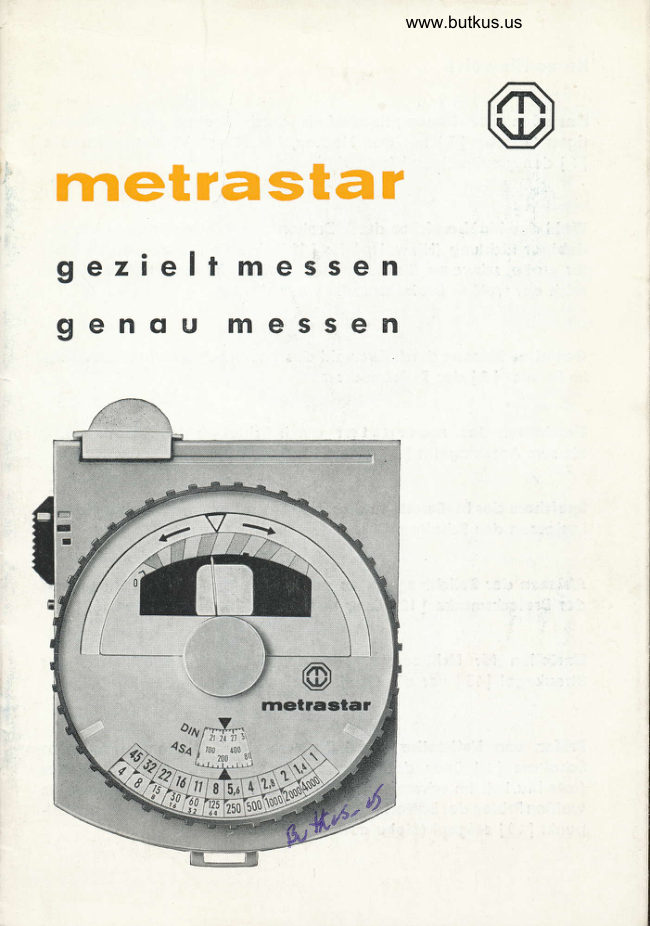
From the M. Butkus archive. Original publisher and archive notices are retained.
Check the model and edition against your equipment.
PDF verified 2026-10-10.