Camera accessories
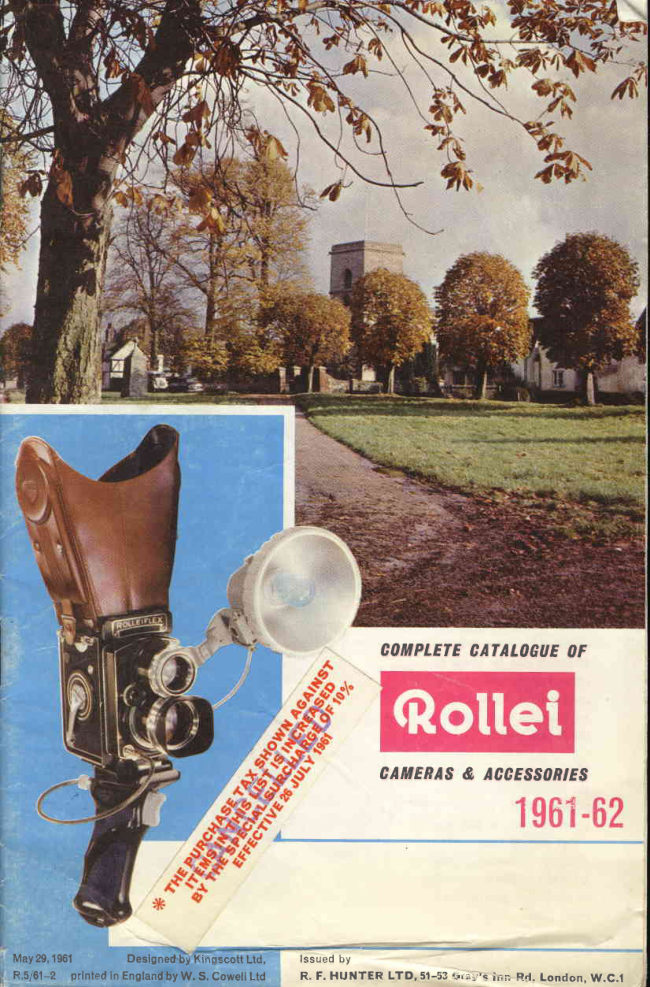
Rollei Camera and Accessories '61 - '62 User manual
User manual for Rollei Camera and Accessories '61 - '62. 47 pages in English. Read the original PDF, download or print a copy without registration.
47 pagesEnglish7.6 MB PDF
Loading your manual…Open PDF directly
Document details
- Brand
- Rollei
- Model / document
- Rollei Camera and Accessories '61 - '62
- Document type
- User manual
- Language
- English
- Pages
- 47
- File size
- 7.6 MB
- Category
- Camera accessories
- Document date
- Not specified in catalog
Search available document text
Find a term, then jump to its page in the original PDF. Image-only pages may not be searchable; check the PDF for exact wording and diagrams.
Page 3 · Read text
7
      WHYA


      To choosea Rollei is to choosethe finest camerain the world. The Rollei is really two cameras.
       One, taking the picture and the secondgiving you a preview of this picture - in full size - right
      way up - in full colour, which is observedbefore and during exposure.
         Whether you are a beginner or professional, Rollei is the camera for you and its system
       ensuresyour getting the best possible picture.
        The large brilliant focusing screenmakes you the complete master of picture composition.
      As this picture is in full colour, one can selectwith easethe correct colour distribution. A turn
         of the focusing knob brings the picture dead sharp and as an added check, a large magnifier
          is housed in the focusing hood to guaranteeevery time complete sharpness.The brightness of
        the image on the focusing screenis always something of a revelation to the new owner of a
         Rollei.
      Wh i c h e ve r mo d e l o f
        Rollei you  select, you
       always see exactly what
       you  are  taking and by
          skilful  positioning of the
        c o n t r o l s ,   t h e w h o l e
        attention can be given to
        obtaining the best possible
       composition.Now there is
       an  entirely new Rollei -
        the Rollei-Magic.
         This is the only 21 in. x
       2 l    i n . c a m e r a w h i c h
        automatically gives correct
       exposureand a preview of
       your picture - in  full  size
           - and in  full colour. The
       exposure is automatically
        set and a perfectly exposed
      negative is guaranteed
       every time.
     2
t                              www.orphancameras.com                                                                                                               ItI
View original page 3Page 4 · Read text
COLOURPHOTOGBA
   WITI|A


Successfulcolour photography  is probably the most satisfying type of work which any photographer
can do, whether he is a Professional satisfying the requirements of his clients, a keen amateur making
picturesfor exhibition, or an ardent snapshotterpleasinghimself and his friends. Colour photography
with a Rolleiflex is by far the easiest method of achieving this successbecause the technical problems
of camera handling are reduced to the minimum and the finished picture can be visualized accurately
thanks to the glowing image in  full colour, visible on the Rollei screen. Whichever model of the
Rollei may be used, the technical problems of exposure, framing and focusing are reduced to the
minimum and the photographer is free to concentrate on aesthetic problems - the expression in                                                     'exact                                                 moment'  in  illustrative photography,portraiture, the composition in landscape, or  the
Furthermore, the Rollei screen gives an uninterrupted view before, during and after the picture has
been taken. There is no sudden darkness, not even a split second of time when the picture is not
fully and clearly presented. Thanks to the twin-lens system of parallax correction and accurate
focusing,there is never a morhent's doubt of what is in the picture area, which colours are adjacent
to other colours, which might give a colour cast or a colour clash.
Films Available
Colour film is, of course, available for the Rollei as reversal material giving colour transparencies
or negativematerial giving colour prints. Both are readily obtainable in the 120 roll film size and can
be used for the highest quality colour reproduction from the full 2|  in. x 2t  in. format, or with
somemodelsoftheRollei,intheeconomicall6-onorSuperSlide(lf  in. x   lf in.)size.Foramateur
proiection use, the latter size gives a very economical method of obtaining sixteen pictures on a
roll of 120 film which can be mounted and projected in a miniature slide projector,  still giving a very
large picture area and therefore greatly increased picture quality when compared to the 24 x 36 mm,
miniature size. The projected 2l  in. x 2+ in. transparency is of such amazing quality  that even
enormous screens can be used and the picturg  still shows a fantastic wealth of detail and a rare
cotour quality unobtainable by other means.
  In the realm of colour prints, both the 2{ in. x  2l  in. and the  lf  in. x  1f in. size formats will
give a very much finer quality print than their little 35 mm. brothers and becauseof the use of
backing paper  with  the  film,  the negatives
are produced scratch and blemish  free and
again permit  of much  greater enlargement
and better detail and quality, thanks  to the
very much larger original negative area.
    If,  however, the 35 mm.  size is required
occasionally  or   for  special  purposes,  the
Rolleikin cine film attachments are available
at low cost for most Rollei models. The same
superiority and advantages are available  to
the worker in this size and the brilliant screen
with  accurate focusing and   full  parallax
correction right down to the closest distance
of 9i in. is possible,when using the Rolleinar
close-up attachments.
View original page 4Page 5 · Read text
Using Colourwith the Rollei
The first trap into which the beginner in colour is likely to fall is that of trying to use too much colour
and of being aware only of scenes that show great splashes of vivid hues. Flower borders, summer
dressesand bathing belles on the beach are among the things to attract him in the first flush of the
novelty of colour. Try these by  all means to satisfy yourself that the process works, but subjects
having simpler colours and quiet tones with a predominance of grey and the occasional small aicent
 of a strong colour will be found to be much more effective and pleasing. As in monochrome work,
oomposition in line can be helpful in holding your pictures together, but colour composition  is even
more important. Of the latter,  little more than the maiir pointers can be given as, in  full,   it  is a
very lengthy subject and the world of art is already well supplied with treatises on this subject which
should be studied for further information.
    It  is, therefore, impossible to pursue this subject in  detail,  but.it   is sufficient to say that the
arrangement of the colours in your picture should be harmonious. Two or more brilliant  oi saturated
colours are rarely satisfactory, except when one is a small accent. For instance, a large patch ofblue
next to one of yellow or similar patches of red and green will produce too much colour contrast and
may cause conflict and disunity in your picture. This condition  will be particularly unpleasant if both
colours are fully saturated and of equal area. The conflict  will be at its worst (we say 'the colours
clash') when two adjacent colours are not complementary,  like red and magenta or blue and
blue-green.
  The warmer colours, such as red, orange and yellow, are best used for foreground subjects, the
cooler colours, like green, blue and mauve, for backgrounds and more distant areas. As in black and
white work, the darker tones are better for the nearer planes and the lighter tones for the further
planes if the picture is to have any third-dimensional  quality, but most outdoor scenes do precisely
this of their own accord without any attention from the photographer,
    It must be remembered that a pale or unsaturated colour close to a strong colour may pick up a
colour cast from  its stronger neighbour, so beware of faces too close to green foliage and other
similar points of contact.
  Generally speaking, the eye cannot tolerate badly out-of-focus areas in colour as it can in black
and white. They become jarring and unpleasant and must be avoided unless the worker really knows
what he is doing and has already sorne experience of their out-of-focus effects, All can be Carefullv
watched and accurately seen on the actual size Rollei screen,
llluminationfor Golour
Many of the colour films available today are marketed in two forms, one for daylight use and the
other for artificial light and with the film is generally supplied some fairly accurate information as to
what  light  sources should be used and a  list  of  filters suggested for any  variation  from  this
recommendation' At first sight this may appear somewhat strange, as in black and white photography
little thought need be given to the nature of the light source but only to the level of itlumination.
In colour photography, however, all cblour values are affected by rhe colour of the light falling on
the subject. This will be immediately apparent when  it is realized that  if bluish light  f;lls on alale
yellow subject, the colour photograph would show  it as green! Similarty  if you were to photogriph
a patch of snow in sunlight in the middle hours of the day  it would probably appear as whitebr
blue-white; later in the day, however, the same patch would appear yellowish and  still later, just
before sunset, as orange. It will therefore be understood that the colour of the light source will have
                                              a very  great influence on  colour  rendering
                                                         of the subject.
                                         Noon  daylight is a bluish light, half-watt
                                                       or  tungsten  is a yellowish  light and each
                                              would  tinge a  white  object  with   its own
                                                     colour. This  colour  cast  will .be recorded
                                           on the colour  film unless the makers have
                                           compensated for  this  effect. This  they  do,
                                                              in  fact, so that by  daylight a white  object
                                              appears white on  'daylight'  fllm and  it  still
                                              appears  white  by  tungsten   light  when
                                            photographed on  'artificial'  light  fitm. Both
                                                types of  illumination have many variations
                                                 and, as shown above, the different times of day
                                             cause sufficient colour  differences for  the
                                                    daylight film to need correction by a suitable
                                                        Rollei colour conversion filter. With  artificial
                                                                                                                   l i g h t m a t e r i a l h a l f - w a t t , p h o t o - f l o o d ,
                                                     fluorescent, photoflash bulbs and electronic
                                                       flash will  all need different Rollei correction
                                                                   filters.


                          www.orphancameras.com
View original page 5Page 6 · Read text
In order to select the appropriate  Rollei  conversion  filter  for any particular  illumination,    it  is
 essential to know  the precise colour  of the  light  for which  the film has been balanced by the
 manufacturers. It  is customary to express the quality of the light in terms of  its colour temperature
and then to quote the necessary correction  filter when using light  of a different  quality, Colour
temperature is usually indicated  in degrees Kelvin and a full range of  Rollei Colour  Correction
 Filters is available. These, however, are not calibrated in degrees Kelvin because the same number of
 degreesK, variation would give unequal results at either end of the Kelvin  scale. They are in fact
 calibrated in Mired, or more accurately in Deca-Mired (10's of Mired). The Mired system, although
related to the Kelvin  scale, allows accurate addition  or  subtraction  of values at any part  of the
colour temperature scale and fuller  details are given in the camera instruction manual or in Alec              'RolleiPearlman's                  Manual' (Fountain  Press), available from your Dealer.
ROLLEI MANUAL    Price 45/-
Colour Photography
by Daylight
The best type of illumination  for colour material by daylight out of doors is a soft, slightly diffused
sun, fairly high in the heavens. Otherwise bright sun with plenty of white clouds and not too great
an area of blue sky will provide conditions  likely to give a very pleasant colour rendering. In high
altitudes or near to the sea in both winter and summer sunshine, the amount of blue sky becomes a
                                                    highly important  factor and neglect of  this
                                                    point may produce transparencies or colour
                                                       prints with a distinctly over-all blue colour
                                                       cast. This can be corrected to a limited extent
                                             by the use of the Rollei H.1 ultra-violet filter
                                                     or by the R.2 colour correction filter. It is not
                                                   required, however, with  Rollei  Planar  or
                                              Xenotar lenses due to the type of glass used
                                                              in lens manufacture.
                     Exposure
                                                  Correct  exposure  is  essential  for  colour
                                                    material, as it has very little latitude, but this
                                                        limitation  need  not  unduly  frighten  the
                                               beginner in colour. The majority of reversal
                                                   colour films (transparencies) and the greater
                                                     part of the negative-positiveprocessesavailable
                                                     (colour prints) have a great measure of accord
                                                            in their sensitivitieseach within its own group
                                           and a start can be made immediately by the
                                               beginner with no equipment other than his
                                                     Rollei and a roll of colour film.  If the Rollei
                                           model has a  built-in exposure meter, then
                                                  very few mistakes can be made.
Flash
Flash bulbs  are a  highly  satisfactory method  of  supplying  the necessary correctly  balanced
illuniination for colour materials in present-day use and for many subjects it  is the only possible
method of illumination.  With  daylight  films of the reversal type, blue bulbs must, of course, be
used and with negative film  for the making  of positive prints, clear flashbulbs must be used. The
Rolleiflash gun which fits to the top bayonet of the camera, is probably the most satisfactory method
of having the light source at the camera position and this can be varied and the possioilities greatly
increasedby having one or two Rolleiflash extension units which are in fact further flash reflectors on
long leads, connected to the original  Rolleiflash and operated by the Rollei  shutter release. The
main Rolleiflash gun has  i  variable beam to cover the angle of view of the full-size format  or the
Super Slide size and flash factors are carefully worked out  for both angles on the back of the
Rolleiflash.
  Whichever type of colour photography may interest you or whether you prefer to change from
one type to  another,  all models  of  the  Rollei camera are designed to  facilitate  your  colour
photography and allow you to concentrate on your subject which  is always glowing and brilliant
on the full size Rollei screen.
View original page 6Page 7 · Read text
TELE
                     THE
                     REVOLUTIONARY
                       ROLLEIFLEX


                                                            lllustrationshows
                                                camera fitted with
                                                   Special Rolleinar
                                              Lens No. 0.35

Here is a comparison of the two focal lengths. On the left the 80 mm, lens on the Rolleiflex 2.8F
and on the right the 135 mm. lens on the Tele-Rolleiflex. Both pictures are taken at the identical
position and it should be noted how the Tele-Rolleiflexdraws the main subject and the background
closer because of the 1.7 x magnification.


                        www.orphancameras.com
View original page 7Page 8 · Read text
Rollei has long had its own special reputation, but here is something new in photography - a true
     long focus Rollei with 135 mm. lens for professional and scientific use, for press work and a superb
     instrument for the serious amateur photographer. The Tele-Rolleiflex is made possible by the
     construction of the new Zeiss Sonnar 135 mm. lens. This new lens must not be confused with the
    135 mm. Sonnar widely used on 35 mm. cameras. The latter lens consists of 4-elements with an
     angle of view of l8'. The new Sonnar fitted to the Tele-Rolleiflex has S-elements,which are grouped
      in 3 components. Its resolving power is outstanding and possessesan unusually high image contrast
    and covers the 2* x  2!  in. size with the picture field sharply covered right up to the corners even
      at the f 14 aperture. Furthermore, it has an angle of view of 32" compared with the 55' of the standard
    35 mm. lens. Thus the Sonnar opens up new vistas in subject material due to the longer focal length
    and approximately 1.75 x enlarged reproduction ratio. Coupled with the Sonnar lens is a completely
    new 4-element finder lens - Heidosmat f/4 135 mm. - of surprising sharpness.There is no doubt that
     the Tele-Rolleiflex and the Zeiss Sonnar is a wonderful combination bringing forth something
      entirely new in photography.

      The Tele-Rolleiflex is ready to take advantage of every rapidly changing scene where there is no
     time to change from normal  to a tele shot.  It  is moreover ideal for  portraiture, fashion work,
     architecture and for photographing  all distant inaccessible objects and animal  life. By means of
     the standard and the special Rolleinar lenses, the full advantage of large scale reproduction can be
    taken even at the closest focusing ranges.

     A new feature of the Tele-Rolleiflex is the possibility of positioning the film behind a specially
     inserted optically flat glass, thus ensuring plateJike flatness of the film to cover the most exacting
    requirements for enlarging. The film can, however, also be positioned normally in the film channel.
    Focusing range is from infinity to 8| feet, but the Tele-Rolleiflex in combination with special Rolleinars
    0.35 and 0.7 and standard Rolleinars can focus right down to 11 in., permitting 213 natwal  size
     pictures. Both the special Rolleinar lenses for the Tele-Rolleiflex are mounted for the twin lens
    and are compensated for parallax.

  TECHNICAL DETAILS:
       *   Lenses: Zeiss Sonnar f l4ll35 mm. taking lens with Heidosmat viewing lens f/4/135 mm.
       *   Focusing range: Infinity to 8* feet with special Rolleinar lensesin twin clip-on mount down to 4 ft 5 in. (1.35
         metres) and 3 ft. 0* in. (0.93 metres).
       *   Synchro-Compur  Shutter MXV  Speeds from   I sec.-l/500 sec. and Bulb.
       *   Detachable flat folding focusing hood with 2.5x  magnifier filling the entire picture area; built-in  direct
         viewfinder and hinged super brilliant focusing screen.
       *   Automatic parallax compensation even for Rolleikin size.
       *   New film gate to permit insertion of optically  flat glass plate supplied with Camera.
       *    lnstallation of exposure meter easily effected at any time by the user (same meter as on Rolleiflex 'T').
       *   Height 518 in.; width 4 in.; depth 5rt  in.; weight 54 oz.
       *    All Rollei accessoriesare available for use with Tele-Rolleiflex, excepting only the Panorama Head and Metal
        Ever-Ready Case.
       *   Lens AccessoriesBayonet Size III.
       *   This Camera is supplied complete with hinged lens cap, cable release and neckstrap.
*

  PRIGES:                                             RetallPrice           RetailPrice                                            Code   without tax    Tax      with tax
     Tele-Rolleiflex  fl4  Zeiss Sonnar  lens without  exposure
         meter                             TOCOS  €155 5  .0   f;25 4  7  €180  I  7
      Tele-Rolleiflex  f 14 Zeiss Sonnar lens with Exposure meter   TfcAS   €168 5  3   f,27 6 10  €195 12   |
     Ever Ready Case for above                    BETEL    27  9   I   €1  4  4    8814    |
     Exposure meter for later installation                 B E L A T   € 1 3 0 9          f ; 2 2 4     € t s 3 l
     Special set Rolleinar lenses0.35                 TELAR    f12  0  6   €1 19 1   €t3 t9  7
     Special set Rolleinar lenses 0.7                  TEZWI   €11 0  0    f1 15 9   €12 t5  9
    Spare optically Flat Glass   . .                  PLANG     f1 14 4   €0  5  7     €t  t9 11
      Rolleikin  Direct Viewfinder Mask                   T E M A S   € 0 7 4     € 0 1 3      € 0 8 7

               FOR DETAILS OF ACCESSORIES SEE PAGES 23 TO 40
View original page 8Page 9 · Read text
2,gF


WITI|COUPLEDEXPOSUREMETER
               The  Rolleiflex  2.8F  is  the most  advanced  of
                        alt ROLLEI   models  and  incorporates    all  the
                 advantages  and  comforts   of modern  ROLLEI
                  techniques.
                   Designed  to meet the most  exacting demands
                     of  the  critical,  creative  photographer   and   all
                              r e q u i r e m e n t s   o f P r o f e s s i o n a l ,  S c i e n t i f i c ,
                    Industrial  and Press Photography  by means of
                   the fast  f 12.8 lens fitted.


                        www.orphancameras.com
View original page 9Page 10 · Read text
The outstanding feature of the Rolleiflex 2.8F camera is the coupled exposure meter. Apertrre
and shutter speeds are linked with the setting needle of the exposure meter but, at the same time,
permits a completely free choice of setting in the orthodox way - a point which professional photo-
graphers will  appreciate. The  operation of this coupled shutter is the same as in Rolleiflex 3,5F,
describedon pages 12 and l3 ofthis Catalogue.
  The operation of this fine instrument  is further simplified by the automatic depth offield indicator
which is coupled with  the aperture setting. Changing the diaphragm automatically moves a white
band which  is located near to the focusing scale, so that the exact depth offield  is immediately
shown.
  The Rolleiflex 2.8F incorporates the new removable folding type of focusing hood with the new
super-brilliant focusing screen. The hood  is raised with a single hand operation and a 2,5 times
magnifier is included which covers the entire picture area. A  built-in  direct vision finder  is fitted
and directly beneath it is a focusing device with 4 x magnification for eye-level focusing.

TECHNICALDETAILS
*   Taking Lens SchneiderXenotar or Carl Zeiss Planar f 12.8180mm. ViewingLens Heidosmatf 12.8.
*  Coupled Synchro-Compur shtttter MVX  with speeds 1-li500th sec. and B (time exposure).
*   Exposure Meter  is incorporated for pre-selection of either speed or stop settings. Individual
    adjustment of both is permissible. Control wheel to feed filter corre;ctionfactor directly into the
    meter.                                                                                                         I
*   Focusing range from 40 in. to oo by revolving extra large focusing knob.
*  The exclusive automatic depth of field indicator, coupled to the diaphragm.
*   Fitted with standard co-axial socket for Rollei locking type flash cable.
*   9qn be supplied with a special camera back and optically flat glass, if specially ordered. (See
    below.)
*   Coupled film transport and shutter setting, with double exposure prevention device or provision
     for multiple exposures if required.
*   Camera back equipped with adjustable pressure plate for 6 x 6 cm. and 35 mm. sizes.
*   Lens Accessory Bayonet Size III.
*   This camera is supplied complete with hinged lens cap, cable release and neck strap.

PRICES                                                 RetailPrice             RetailPrice
                                       Code   withouttax    Tax      with tax
Rolleiflex   fl2.8F  Zeiss Planar  lens with  coupled  exposure
     meter                                 xucAP   €133 10  I   f,21 14 0  €155 4  9
Rolleiflex   fl2.8F   Xenotar   lens  with   coupled   exposure
     meter                                            xuclx      fr124 9  0   f,20 4  6  sr44 l3  6
Ever Ready  case for above                    BEXUP      f,,6 7 O     fl  O 8    8 7 7 8
Attachment    for  optically    flat  glass  (consisting    of  special
    camera  back  and  optically   flat  glass)            PLARU     €,9 3  9   €,1  I 10   €r0 13 7
Spare optically   flat glass                     PLANG     fr1 14 4    f,,o 5  7     €t  t9  tl


    The Rolleiflex 2.8F can be supplied complete with the special camera back and optically
      flat glass in the same way as on the Tele-Rolleiflex and the Rolleiflex 3.5F cameras, in
     lieu of the standard back normally supplied. This equipment can be obtained to special
     order only and there would be an additional charge over and above the camera prices
     listed above of f3 5s. 3d. including Tax. When ordering pleasequote camera code number
     required, adding further code word PLADD.


            FOR DETAILS OF ACCESSORIES SEE PAGES 23 TO 40
View original page 10Page 11 · Read text
NEW WIDEANGLE
                ROLLEIFLEX
                                                           This  is a 6  x  6 Rolleiflex  and   it has the  largest-ever   field  of
                                                             view.  With   its wide  angle  lens  it  gives  Rollei  photography   a
                                               new  starting  point.  After   all, once the picture  is taken, you can
                                                             only  reduce  the  field  of view  - by enlarging   just  sections  of a
                                                          negative   - but you can never increase  it. That  is the reason  for
                                                           the Wide  Angle  Rollei.   Its 71o angle  of view  instead   of  the
                                                          usual  56o covers  a subject   field  of  approximately   one  third
                                                          wider  and one third  higher.   It also provides   far more scope  in
                                                              selecting the best picture  area. With   its increased  field  of view,
                                                             the greater  depth  of  field zones, a nearest focusing  distance  of
                                                        2   ft.  (instead   of  3   ft.)  and  new  possibilities   of  pictorial
                                                           perspective  effects, the Wide  Angle  Rolleiflex   is the  Rollei   for
                                                             the expert.   It  is the  ideal camera  for anyone  who  has to take
                                                              pictures   in  confined   interiors,  narrow   streets,  or who  has  to
                                                           deal  with   factory   installations,    industrial   feature  shots  and
                                                                architectural   photography.    Equally,     it  is the camera  for  the
                                                                 Rollei  amateur  who knows  how  to value  the advantages  of  a
                                                                      liberal  field  of view.
                                                 A  special  lens for  this camera  has been designed  by Messrs
                                                             Carl  Zeiss  in  the form   of a Distagon     f 14, a superb  lens  with
                                                     seven  elements,  a  focal  length   of  55 mm.  and  a  focusing
                                                       range  from  24  in.  to  infinity.  The  Wide  Angle   Rolleiflex    is
equipped with a Synchro-Compur  shutter speeded from 1 to 1/500th of a second, with  full  light value coupling,
fully synchronizedfor all flash.
    Ii  dther resoects the Wide Anele Rolleiflex has a similar specification to that of the Tele-Rolleiflex described
on Dase 7 and. of course. incorodratei all the many advantagesassociatedwith the Rollei principle. We were not
abli  t-o includi  accessories for'this  new camera in the A@essory Section, but details ofthese  are given below.
Supplied complete with Neck Strap, Cable Release and Lens Cap.
  Lens accessories,Bayonet size IV.
p R I C E S :                                           R e t a i l P r i c e            RetailPrice
Wide Angle  Rolleiflex  fl4  Zeiss Distagon camera   9odg        without tax     Tax     with tax    (without Exposure Meter)              WOWOD        f.147 17  0   f,24 0  6   g17l 17 6
Ever Ready Case (with compartment for Flat Glass). .  BEWIW            f7   9    I      f,,1 4  4    €8 14   |
Exposure Meter for later installation               BELAT            f,,13 0    I        f , 2 2  4   € , 1 5 3 1
Lens Hood                              WIOBL            f2  15  6     f,,o  I  0    €3  4  6
FILTERS  IN LEATHER  CASE
Light Yellow (-1)               W H E
Medium Yellow (-1.5)                 w M I
Light Green (-l)                W L I N
Green (-1.5)                 W EEN
Orange (-1.5  to 3)              W ORA
Light Red (-2  to 3.5)                 w U B I            f,,3 13 0    f,o 11 10       t 4  4 l 0
Lieht Blue (-0.5)                W BLA
Infra Red                  W FIR
uv (-0.s)                           SKYGrey 2 (-2)                                        Ww N E U
Grey 4 (-4)                              TY
C O L O U R C O N V E R S I O N  F I L T E R S    I N  L E A T H E R  C A S E


                                                                        €6  3 10


Rolleipot (-1.5)                             WITAR            f'12  0  6       f,,l 19  1   f,13 19 7
Rolleiflash  2  Attachment   (complete   with   special  arm
      for Lens size IV)                               FLAWI             €8   1   0      fr1   6  2    € , 9 7 2
     Spare Arm  only  for above (Lens size IV)         ARMWI                f2  11  3     f,,O  8  4   S2 19 7
Spare Opticallt'  Flat Glass                       PLANG                f1  14   4     f,,O  5  7       f,l 19 11

P L E A S E  N O T E  T H E  F O L L O W I N G :
 l.  The Wide Angle Rolleiflex can be supplied with an Exposure Meter (BELAT)  for subsequent installation,
which is identical io that available for the Tele-Rolleiffex (page ?), as well as the Prot@tive Caps (BELED).
2.  Spare N@k Strap (FOCLI)  and Shoulder Pad (FOGUZ)  also available.
 3.  Other accessorieafor the Wide Angle Rolleiflex are: Penta Prism (PENTA),  Plate Adaptor Equipm€nt (FOSET),
Rolleikin (ROLKI),  Rolleifix (FOFIX),  Pistol Grip (FOBUM) and wrist Strap for Pistol Grip (FqHAN).     ,
4.  with  regard to Flash equipment. The Extension Units (FLOMB)  are avaiiable as w€ll as the Carrying Case
(BOFLA),  i0  ft. Extension'leid (KATRI),32   in. lead (KACHT),  Coiled lead (COICO) and two-way Cg"p!!qg
Piece (KOKUP).   If you already have a Rolleiflash 2, all you require is the special arm (ARMWI   - Lens size IV).
 5.  The Rollei Panorama Head is not suitable for use with this Model.
    FOR PRICES OF THE ACCESSORIES  REFERRED TO ABOVE  SEE PAGES  23-38
t0

                        www.orphancameras.com
View original page 11Page 12 · Read text
o      Themulti-sizecamera

The advantages of the square size are now universally acknowledged. The standard Rollei size is
still the 6 x 6 cm. using a 120 roll film; but a new square size has recently become extremely popular,
namely the 4 x 4 cm. giving 16 square pictures on a standard 120 roll film, or 12 on 127 sizefilm.
  For colour and special work, however, accessoriesare available which enable many Rollei cameras
to produce a range of negative sizes.
  The following  is given as a guide to help you  to choose the size according to the subject
requirements:


                                               1 * i n . x 1 8 i n .
                                                                     4 X  4   cffl.    This  popular   size  is now  widely
                                                             known   as  the  Super   Slide  and  has  the  great
                                                                  advantage  that under  projection    it  fills completely
         2L in. x 2t in.                                       fora squareminiaturescreen.colourIt  is photography.therefore   the Whenlogical usingsize
6 X  6  cm.    The   ideal   big   negative   size  with                  this  size on the  Rolleiflex  T and  Rollei-Magic,    a
unf imited   possibilities.     It  permits   a  large  angle   of                useful  telephoto    effect  is achieved  employing    the
view  both  horizontal  and  vertical  to include  a wealth              standard  75 mm.  lens.
of  detail.  So  long  as  film  emulsions  are made  from
silver,    the    grain    size,   which    determines    the
enlargement    possibilities,    obviously    offers  many
advantages   over   the   smaller   negative   sizes.  For
really  big enlargements   or  to  obtain  the  finest  results
in  the  production    of  colour   slides,  the  6  x  6 size  is
without  equal.


                                          I  i n . x 1 t i n .
                    24x 36mm.
                                                                              I n t e r n a t i o n a l
                          m i n i a t u r e   s i z e
                                       p o p u l a r l y                 18 in. x 2$ in.
                                known    as   35
mm. When  using  Rolleikin   on cameras  designed  for              4 X  5.5   Gfil.  R  very  usefur  size when  taking
this  accessory,  one  has  the  choice   of  taking  20  or               horizontal   compositions,   such as landscapes  and
36  exposures   in  a  standard   casette.  This   size   is             seascapes, giving  16 pictures  on standard  I20  roll
specially  suitable   for  economical   use  of  colour   film.                  film.     It   is  also  an  advantageous    size  when
Again,  a very useful  telephoto   effect  is obtained  when               taking   scientific,   technical  and  photographs     in
using 35 mm.  film,  in conjunction   with  75 or 80 mm.             sequence.   such   as   progress    pictures    or
lenses. When  using  the  direct  viewfinder,     it  is easily               oscillograms.     Furthermore,     one   obtains    4
possible  to  take  vertical   or  horizontal    pictures.   In               additional   pictures  to  the standard  6  x  6 size on
fact with  Rollei,  one  is just  as easy as the  other.                  120  roll   film.
                                                                  11
View original page 12Page 13 · Read text
3,5F


The Rollei principle  is a
guarantee of sharp, expertly
composed pictures. Now, on
the 3.5F, you have
additionally a guarantee of
correct exposure by means of
the coupled shutter and
exposure meter. You need
no longer think, but can
concentrate the whole time
on composition  of the
picture. Failure in picture
making with the 3.5F is a
thing of the past.


Rolleiflex 3.5F is available in two models, being equipped with either the Zeiss Planat  f 13.5or the
Schneider Xenotar f/3.5 5-element lenses and each has the exposure meter fully coupled with the
synchronized Compur shutter. The meter reading is transferred directly to the diaphragm, making
for even further simplification in handling the camera and quicker and surer shooting.
  Two operations only are now required; pre-selection of shutter spded and superimposing the
pointer of the exposure meter. Thus the diaphragm will automatically be selectedin accordance with
the previously selectedshutter speed. Thus one setting only has to be considered, namely the shutter
speed. Individual pre-selection of speed and diaphragm is now possible, a point which professional
photographers will especially appreciate. In addition, the depth of field available with any given
f/stop  is indicated by the automatic depth of  field indicator housed in the focusing knob. This
mechanical coupling makes calculation of figures no longer necessary,leaving the operator free to
concentrate entirely on composition of the picture to be taken. The exposure.meter can be adjusted
very simply for the various film speeds and can also be set to compensate for the use of filters. A
small setting button on the left side of the camera permits exposure compensation for  I to 3 exposure
values, depending on the density of the filters used. This operation is again carried out without the
necessity of any calculations. Thus automation in Rollgi takes a further step forward and always
remaining is the fundamental Rollei principle of seeing the picture in the ground glass screen the
whole time in  full size and colour, the right way up, ensuring constant control even during the
 actual exposure.
 l2
                       www.orphancameras.com
View original page 13Page 16 · Read text
The very popular  Rolleiflex  'T'is  within  the means of every serious amateur photographer. The
             'T'Rolleiflex                 is equipped with the Zeiss Tessar f 13.5175mm.4-element lens'
  The Tessar has always had an outstanding reputation for sharpness and by keeping pace with the
latest developments in optical construction  it has been found possible even further  to improve  this.                                                                                           'T'                                                             can be made into a multiplealready famous 4-element lens design. In addition the Rolleiflex
size camera by means of the accessoryMasking Set No. 16 which, in addition to giving the normal
t w e l v e p i c t u f e s 6 x 6 c m . ( 2 + x 2 + i n . ) a l s o p e r m i t s s i x t e e n p i c t u r e s 4 x 4 c m . ( l * x l * i n . ) a s w e l l
as sixteen pictures 4 x 5.5 cm. (1* x 2{ in.), all on 120 size roll film. For illustrations of these sizes
seepage ll.
  The  film  counter  is designed for  both  twelve and sixteen exposure operation and switches
automatically when the appropriate  film mask on which 4 x 4 cm. is indicated,  is inserted or                                  'T'                                    is equipped with  fully synchronized Synchro-Compur  shutter, having aremoved. The Rolteiflex
range of l-1 /500 sec. and can be supplied both with or without  built-in exposure meter. The exposule
meter can always be purchased later and simply installed as a complete unit by the owner'
  The Compur shutter is fitted with light value coupling and is operated by a single lever. This
same lever serves for selecting any desired diaphragm/speed combination.
  A detachable focusing hood  is fitted to this camera and the ground glass screen is hinged and
may be lifted to permit the insertion of the masks for the various sizes, at the same time retaining
full parallax compensation for  all sizes.
  TheEver Readycaseisavailable with strap holder on either side and thefrontofthecasecan  be
detached and replaced by means of a practical quick fastening device (see illustration on page 29).

TECHNICALDETAILS
 *   Automatic speed/stop cross coupling secures selected exposure value.
 *   One-lever-operation for setting exposure value, diaphragm and shutter speed. The same lever
    serves for choosing the most suitable stop/speed combination and-pulling  lever outward-
      for switching to another exposure value. The same procedure permits independent adjustment
     of shutter speed and diaphragm opening.
 *   Closing the back engages film  transport mechanism and exposure counter.
 *   Crank-operated film transport coupled with shutter loading.
 *   Prevention against double exposures and blanks.
 *   The Masking Set No. 16 makes most economical use of the film by providing  16 pictures
    4 x 5.5 cm. (l*  x 2+ in.) or 4 x 4 cm. Super Slides (l*  x  l*  in.) on 120 roll film.
 f,   Inserting the film Mask No. 16 automatically switches the picture counter from 12 to 16 frames
     per roll.
 *   Automatic  parallax correction for  all sizes employed'
 I   Body release placed fot easy use.
 *   Film reminder disc in the focusing knob  (to be removed  if exposure meter equipment is fitted
      later).
 *   Synchro-Compur MXV  shutter l-1/500  sec. and B for time exposures; with exposure guide
     scale to 60 secs. Fully synchronized for  all types of flash bulbs'
  f   Lens Accessory Bayonet Size I.
  I   Supplied complete with lens cap, cable release and neck strap.

P R I C ES:                                                    Retail Price               Retail Price
                                            Code     without tax     Tax        with tax
 Rolleiflex  T  with   Zeiss  Tessar 3.5 lens with  built  in
     exposure  meter                          RIBAT    f,88 11 6  f14  7 10  t102 19 4
 Rolleiflex T with Zeiss Tessar 3.5 lens without exposure
    meter                            ROBET   f75 11 3   f12  5  7    f,,8716 10
 Ever Ready Case for above                  BEROB    €,s 19 3    f,,o 19 4    €,6 18 7
 Exposure  meter  equipment   for  latet  installation         BELAT     f,,13 0   I    f2  2  4   €15 3    |
 Masking  Set No.   l6                         FOVIE         f 2  8 1 0      f , , o 7 1 1   E 2 1 6  I
         FOR DETAILS OF ACCESSORIES REFER TO PAGES 23 TO 40
                                                           15
View original page 16Page 18 · Read text
This is the ideal camera for sport and travel; being light, small and handy. It has,'moreover,
the perfect miniature sizeof 4 x 4 cm. which can be used in any standard 35 mm. slide projector
but has the advantageof completely filling the square size screen.Compare this with the 35 mm.
colour transparencies which are either vertical or horizontal but neither of which will   fill
the square screen.Compare also the negative quality made possible by the large miniature
4 x 4 cm. size as opposed to the smaller 35 mm. size. The Rolleiflex 4 x 4 gives 12 pictures
l8 in. x  l*  in. (4 x 4 cm.) on the standard 127 V.P. roll film and thus becomesthe large
format miniature camera. In addition  it has the Rollei system which shows the future picture
the right way up, in full size and natural colour both before and during exposure. Thus the
whole of one's attention can be given to composing the perfect picture.
  The Rolleiflex 4 x 4 is handsomely finished in lacquer and grey leather giving it the most -
elegantirppearance.The hood lifts into position at a touch and incorporated is a 4$x magnifier
for dead sharp focusing over the whole picture area. A built-in spoits finder for direct vision
of fast moving objects is also incorporated.
  Other features include the large focusing knob; depth of  field indicator and film speed
indicator in the focusing knob. Film loading is extremely simple and dispenseswith any red
window. Shutter loading is coupled with film wind and a double exposureprevention device
is incorporated. The Rolleiflex 4 x 4 measures only 4t x 2+ x 3*  in. and weighs only
24 oz.
  The Rolleiflex 4 x 4 is equipped with the superb SchneiderXenar f13.5160mm. taking lens
and Synchro-Compurshutter speededfrom 1-1/500th sec.with builfin  self-timing deviceand
 is fully synchronized for  all flash. The viewing lens is a Heidosmat f/2.8/60 mm. giving a
 brilliant picture in the ground glass focusing screen.
  Convenientlyinstalled body release.
   In addition to the normal leather ever-ready case there is also available a soft leather case
 with wrist loop and a metal carrying casesimilar to those availablefor the 6 x 6 models.


 *   Lens AccessoryBayonet Size I.
 *   Supplied complete with Lens Cap, Cable Releaseand Neck Strap.


 PRIGES:
                       . - . '                   (               RetailPrice             ,     RetailPrice
                                Code    withouttax    Tax      with tax
 Rolfeiflex4 x 4 f/3.5 Xenar lens with
    Synchro-ComPurshutter         VYBAX   €41 16 6   €,6 15 11   f,.48l2  5
 LeatherEverReadYCasefor above      BERVY    €,3 3  6   € 0 1 0 4    € 3 1 3 1 0


         FOR DETAILS OF ACCESSORIES SEE PAGES 23 TO 40
View original page 18Page 19 · Read text
SOONER OR LATER
  YOU WILL CHANGE
  TO AUTOMATIC
  PHOTOGRAPHY
  WHY NOT NOW?


    This is the only
    2* x 2L camera
    which gives
     automatically  correct
    exposure and a full
     size, full colour
    preview of your
     picture. A11you do
     rs compose your
     picture  in the screen
    and press the trigger.


                     9i--,


                wfffff"Bffifl#tffirvmmff$m
                     ffiKffiffiSffirffiffiffiffitrffifr
                  Witir the fabuior-is,nevr Roliel-Magic you can take superb photographs rn,ith
                the utniost ease, Tiae lS.oliei-Vflagicgives yaru t"Fletouc]i of a prof'essionai at
                 the touch of a trigger. There are no teci-lnical eornplications" With  the carnera
                 set on auto.ii-latie,ifl the exposure neeetrlesholrzsa reading, aii you rlo is compose
                vour pict'"rneand press f-he trigger.  [f the lighting is poor, you sir-nptryswitctr-i
                over to ilash or t.ime exposure -  bcti-l ere verv silnpne to clBenate.Even whem
                u-srng fiiters. the ftoilei-h{agic  gi.res vcri  ;]'llcnrniir  expoqi-tre."he  earnera

i,ti

                          www.orphancameras.com
View original page 19Page 20 · Read text
automatically adjusts itself when the
filter is mounted in position.
  Rollei-Magic  incorporates the basic
Rollei principle. A turn of the focusing
wheel brings  the  picture  into  exact
focus - full  size, full  colour, the right
way up, during and after exposure. The
automatic exposureand simplicity of the
controls enable you to devote all your
attention to composing the best possible
picture.
  Rollei-Magic  gives you  black and
white or colour negatives and employs
the standad  120 size film. This gives
12 2L x 2t   in.  negatives which  are
large enough to obviate enlargements.
Giant  enlargements can be made,  if
required, thanks to the superb Schneider
Xenar f/3.5 lens. For quality, the large
2i x 2L in. negatives or transparencies
are unsurpassed.By using Masking Set
                                                                                   'M'No.  16, you can obtain 16 negatives     Rollei-Magic with  Rolleiflash       fitted to
or  transparencies, size 4 x 5.5 cm.     camera. Seepage 37 for details.
(18 in. x 2$ in.) or 16,4 x 4 superslides
which  fit any standard 35 mm.  slide
projector  and  exactly   fiIl  a  square
screen.
  The Rollei-Magic gives you perfect exposuresevery time. Being automatic it gives accurate
exposureswith even the most sensitivefilm. Consequently there is never any negative wastage.

TECHNICAL DETAILS

*   SchneiderXenar f13.5175mm. lens in the new Gauthier Prontormat S shutter.
*   Three setting ranges for Automatic, Flash and Time exposures.
*   Detachable focusing hood with magnifier and direct frame finder for eye-level use.
*   Combined film transport and shutter setting with double exposure prevention device.
*   Focusing wheel with finger-tip control.
*   Size 3t x 41 x 58 in. Weight 35i oz.
 *   Supplied complete with Lens Cap, Cable Releaseand Neck Strap.
 *   Lens AccessoryBayonet Size II.

 P R I G ES :
                                                                        Retail Price              RetailPrice
                                              Code    without tax     Tax      with Tax
 Rollei-Magic  f 13.5175mm.Schneider Xenar - fully
  automatic                          MAGUX  €66 0  0  € 1 0 1 4 6   € 7 6 1 4 6
 Ever Ready Case for above  .                  BEMAG     f.4   I 3          f 0 1 4 6    € 5 3 9
 Masking Set No.'16                          FOVIE      f2  8 1 0   € 0 7 1 1    € 2 1 6 9

         FOR DETAILS OF ROLLEI ACCESSORIES SEE PAGES 23 TO 40
                                                           19
View original page 20Page 22 · Read text
A Zoomlens is in preparation for use on the Rollei Automatic Universal Projector with a variable


projector for the adding of any commentary.


  The Rollei Automatic Projector is most attractively styled and finished in two shades of grey. A
robust and smart carrying caie with colours matching the projector is also available as an-accessory
i"a  ttir"gti  recomme.rdJA.fnis casepermits the stora-eeof magazinesand can also be used as a base
 f;it-h;;i;1'"ctor.  A projector stand is^extremelyusefuf and we strongly recommend the use of the
 Hunter'Pr6jector--             Stand describedon page 78.
   Special Rollei 6 x 6 cm. transparency frames are available as an accessory.
PRICES:                        Please State Voltage When Ordering
                                                              Code      No Tax


                                           and  with  connection   for remote  control                                  Recorder                           with  Tape                     for use         Cable Special                                                        POT ON       In pr ep.                               focusing                                        adjustment                       sharp              including       cable,
 Carrying  Case for  Automatic   Universal  Projector                         POKOF     E7  4 O
 Spare Heat  Filter  (required  when  using  500-watt  Lamp)                      POF IL      €3  7 O
 Rollei 6 x 6 Frames (Packets of 12)                              POROD     €O 1'   9
 300-watt valve type Projector Lamp Ref' A1.178                          POWZZ      E2  0  0
 500-watt valve type Projector Lamp. Ref. A1.180                        POZZW     E2 15  0
                                                            21
View original page 22Page 23 · Read text
Table
           Projector
 This  ingenious projector  works  in
 conjunction  with  any  Rollei  6 x 6
 camera  fitted  with   the  detachable
 focusing hood and standard lens of
 75 mm.,80mm. or 135mm. focallength.
 It has the high precision expected of all
 Franke & Heidecke products and is
 very compact  in  size and extremely
 portable.
   Fitment   of  the  camera  to  the
 projector   is  extremely  simple - the
focusing hood  is removed and  the
camera locked  safely in  position on
the projector. The viewing lens of the
camera serves as the projector lens and
focusing is effected simply by using the
camera focusing knob.   It   is  quite
possibleto use the camerafor projecting
whilst   it  is loaded with  film. The
projector takes a standard car lamp
6 volt, 35 watt, which has an extremely
long life. Employing a 2i  in. x 2i  in.
size transparency, a  picture  size of
18 in. x 18 in. is obtained-quite large
enough for convenient viewing by  a
small group of people. However, it  is
possible to obtain a special Rolleinar
iens, which is  supplied in  the usual
bayonet mount sizesI, II and III to give
a large projectedpicture of 40 in. x 40 in.
and again, the Rollei 6  x  6 format
completely fills this square screen.
  Bymeansof aspecial2 x2 adapter,
supplied as an accessory,it is possible
to project the square 4 x 4 cm. Super
Slides.
  The projector  is simply set to  the
required voltage from  I l0 v. to 250 v.
on AC current and is supplied with the
usual 3 core flex. A special small size
projection screen size 18 in. x 18 in.
is available for table viewing and this
size  is  quite  large enough  to  give
enlarged pictures for small groups of
people.
P R I G E S :


      6Spare         volt x 35                  watt Lamp                                  for Table                                        Projector.                                          ANAUT      €0  3  0 plus 6d. Tax €0  g  6         'Safari'Special                Projection                                    projection                         Screen,                                               size
    18 in. x 18 in. for Rollei Table Projector          ANWAN     E2 1S  6  No Tax
A v a ila b le: J u l y , A u g u s t , 1 9 6 1
22

                         www.orphancameras.com
View original page 23Page 24 · Read text
Lens
          Accesstlrie
There  is an incomparable   range  of accessories  for  your  Rollei  camera. Do  you know  them   all,  their  purpose  and
how  they   will  help  you  to  get even  better  results  with  your  Rollei?  Go  to  your  dealer  and  study  the  range
ofaccessories  and have them  demonstrated   to you.

I T   I S M O S T   I M P O R T A N T  T O N O T E T H E F O L L O W I N G :
Opticalaccessoriessuchasfilters,supplementarylenses,soft focuslenses,lenshoods,etc.,will in futurebe marketed
with bayonet mounts in three diameters:
       I  For Tessal,  Triotar and Xenar f/3.5 (Not Rollei-Magic).
      ll  For Planar, Xenotarf/3.5  and Rollei-Magic.
    lll   For Planar and Xenotar  f/2.8 and Sonnar  f/4.
  lV   For Zeiss Distagon  f/4 (See page 10)'
  This applies also to the Rolleiflash flashgun which  is affixed to the top bayonet mount on Rollei cameras.
Kindly  note  the  correct                                         In  the  accessory   pages   following,    code  numbers    of
sequence  of  lens accessories                        every   accessory   are  given   and   particularly     with   lens
is as follows:                                                 accessories  and  Rolleiflash   these  rnust  be  quoted   so  that
1. R o lle inar.                                                   the  correct  accessory   is supplied   for  the  particular   model
2. Rolleisoft.                                                        Rollei   camera.   General    accessories   other   than   those
3. Filtets or Rolleipol.                                  mentioned   above  are  suitable    for   all  the  current   Rollei
4. Lens Hood,                                         camera  range  unless  otherwise   stated.
(lmportant.      - Always   quote  Code  Numbers   when   ordering.   Exposure   value   correction   given   in
parentheses),
   All   Rollei   lens  accessories  have  anti-reflection    coating.   Coating   of  the camera  lens  surface  materially    increases
the  brilliance   of the picture.  However,   to  retain  this  brilliance  when  using  lens accessories   it  is essential  that  these
too must  also be coated.  All  Rollei  optical  lens accessories are treated  with  a hard  abrasion-resistant   anti-reflection
coating.   In  addition   the  coating  on  each   filter   is adjusted   to  enhance  the  effect  of  the   filter's   colour   and  to  give
maximum contrast. All  optical accessories are supplied in leather cases at no
extra cost.

ROLLEI LENS HOOD
A  lens hood   is an essential  piece  of equipment.   Not  only  to  protect  the  lens
from  extraneous    light  but  also  to  shield  the  lens  from   rain,  snow  or  spray  at
water  sport  events.  The  Rollei   lens hood   is  fitted   with  bayonet  mount   which
locks on the outer bayonet  mount  ofthe  camera  taking  lens.  It can, ofcourse,
be used  in  conjunction    with   other  lens  accessories.

LENS HOOD in leather case          Lens  RetailPrice           RetailPrice
                                   Code  Size   withouttax            t a x      with taxFor Rolleiflex f12.8 Planar, Xenotar and fl4 Sonnar
For Rolleiflex f/3.5 Planar, Xenotar and Rollei-Magic   cEoBE   lll     f,210 3      f , o 8 2     8218  5
For Rolleiflex fi3.5 Tessar and Xenar           G U O B E  I I          f 2 6 4      € 0 7 6      €2 13 t0
    (Not Rollei-Magic).  .                 BAOBE   I           f . 2 0 9          f 0 6 8              f , , 2 7 5
For Rolleiflex 4 x 4 f13.5 Xenar             VYOBE    I          fl  16 3   €0  5 10   E 2 2 l
For Rolleicord f/3.5                   BAOBE   I      8 2 0 9          f 0 6 8              / E , 2 7 5

                ROLLEI FILTERS
                                   The  table  on  page  25  shows  the  range   of  filters  available   (except  colour
                                        conversion    filters),   their  use  and  the  increases  required   in  exposure.  The
                                                           filters  fasten  to  the  inner  bayonet  mount   of  the  taking   lens and  each  filter   is
                                         supplied  in a leather  case. Separate  cornbinations   in leather cases are, however,
                                             available,  such as lens hood  complete  with  two  filters  to choice  or a complete
                                               set  in  leather  case  consisting    of  lens  hood,  two  sets  of  Rolleinar    lenses  and
                                                 five   filters   to  your   choice.  For   earlier   Rollei  cameras  not  equipped   with
                                      bayonet  mount,   an  intermediate   bayonet   ring   is  required.   Study  the  wide
                                      range  of  Rollei   filters  available,  as they   will  greatly  increase  the  scope  of
                                         your  camera.
                                                           23
View original page 24Page 25 · Read text
FILTERS in leather case
For Rolleiflex  112.8Planar, Xenotar  and f/4 Sonnar     Lens   Retail Price               Retail Price
                                   Code   Size  without tax    Tax         with tax
Light Yellow (-  1)                     C E I H E
Medium Yellow (-  1.5)                    CEIMI
Light Green (-  1)                       CELIN
Green (-  1.5)                      CEEEN
Orange(-1.5      3) ..                CEORA
Light Red ( -2   . ..  -3.5)                  CEUBI      ilt     f2 17   I     f,o  9  5    €3  7  2Light Blue (-0.5)                      CEBLA
Infra-red                            CEFIR
uv (-0.5)                        CESKY
Grey 2 (-2)                       CENEU
Grey 4 (-4)                            CEITY
For Rolleiflex  113.5Planar, Xenotar  and Rollei-Magic
Light Yellow (-  1)                         GUIHE
Medium Yellow (-  1.5)                       GUIMI
Light Green (-  1)                           GULIN
Green (-  1.5)                         GUEEN
Orange(- 1.5     3) . .                  GUORA
Light Red ( -2   ..  . -3.5)                    GUUBI
Light Blue (-0.5)          : .                    GUBLA               1 0  € 0 7 1 1   a 2 | 6 9
Infra-red                                 GUFIR
uv  (-0.5)                            GUSKY
Grey 2 (-2)                          GUNEU
Grey 4 (-4)                               GUITY
Hl  (-0)  for Rollei-Magic only                                                                      ,      . .       GUHAZ
For Rolleiflex  f/3.5 Tessar, Xenar,  Rolleiflex  4 x 4 and Rolleicord  f/3.5 (Not Rollei-Magic)
Light Yellow (-1)                           BAIHE
Medium Yellow (-  1.5)                         BAIMI
Light Gresn ( - 1)                          BA Ll N
Green (-1.5)                           BAEEN
Orange(- 1.5     3) . .                   BAORA
Light Red ( -2   . .. -3.5)                     BAUBI
Light Blue (-0.s)                          BABLA                   f , l 1 9  7   € 0 6  5   E 2 6  0
Infra-red                                   BAFIR
uv  (-0.5)                             BASKY
Ht (-o)                              BAHAZ
Grey 2 (-2)                            BANEU
Grey 4 (-4)                                BAITY
                             ROLLEI COI-OUR CONVERSION
                              FILTERS
                                                      A   valuable   aid   to  colour   photography    with   the
                                                                            Rollei   is provided  by these  filters,  which  are intended
                                                                                to  convert   the  colour  temperature    of  the  available
                                                                                     light   to  that   for  which  the  film  (either  daylight   or
                                                                                         artificial   light)   is balanced.  These  filters  also  correct
                                                                      the  almost   inevitable   blue  or  red  colour   casts and
                                                              can  be used  for  intentional   variation   of  the  colour
                                                                         rendition   according    to  personal   taste  as  desired.
                                                              There  are two  basic types  of  filters,  each  of which   is
                                                                    supplied     in   four    densities.   The   reddish-brown
                                                                                     filters   Rl,   R2,  R5  and   Rll    are  for   eliminating
                                                              excess blue  with  ascending  colour  temperature   and
                                                                      the blue  filters  Bl,B.2,  85 and  Bl   l are for  eliminating
                                                              excess   red   with   decreasing   colour    temperature.
                                                           These  filter numbers  are short  for  10, 20, 50 and  110
slasswith specialanti-reflectioncoatinsandcomprete*trn oll,'ii*;::#:T,f,:",Xir?tt1'fr:1ff.1'i.:1."'.t11
compersation  is possible by combination  with another  filter of the same group. Each set of  filteri  will provide
ten different combinations:  l-2-3-5-6-7-ll-12-13-16.    These filters are avaitabie either singly, or six suci  filters
according to choice, in a single hinged leather cas,
  . The Rl  in colour photography has no additional U.V. effct  on 5-element lenses but has slight colour conversion
similar to the so-called sky light  filter. The effct  of Rl on 4€lement lensc  is increased U.V. absorption and slight
colouf conversion.
ROLLEI COLOUR CONVERSION FILTERS in leather case
For Rolleiflex f/2.8 Planar, Xenotar and f/4 Sonnar     Lens Retail Price              Retail Price
                                    Code    Size without tax     Tax       with tax


24

                        www.orphancameras.com
View original page 25Page 28 · Read text
ROLLEISOFT SOFT FOCUS ATTACHMENTS
Soft focus lenses made in two grades, namely '0' and  '1,' which soften the s_upercritical  definition and_produce                                                                                                            glass                                                                                      with ba_yonet-mount..The                                                         invaluable                                                               acessory_ntted                                              light_ing.-An                        particularli                                  with backstriking        halo efects,
                                                                            soft focus effect                                                                                          whilst the No.  'l'  is                                                                                          used                                 The                                        No.  '0' is                                              used for weak                                  in grooves.              circles'groundtiJioicmtri"
ioi prcnounced soft foius  effat. They are used principally  for portraiture. The ef@t can be judged on the ground
glasi screen by placing the Rolleisoft on the finder lens.
ROLLEISOFT SOFT FOCUS LENSES in leather case
N o .  0                                               Lens   Retail Price            RetailPrice
                                        Code    Size   without tax    Tax      with tax
For  Rolleiflex  f/2.8  Planar,  Xenotar  and  fl{  Sonnar   CETN U       lll       f,4  9  3     f,,o 14 6    €,5 3  9
For  Rolleiflex  f/3.5 Planar, Xenotar  and Rollei-Magic   G U T N U       I I      € 3 1 9  3    f0 12 11   E4 12 2
For        Rolleiflex        f 13.5  Tessar   and   Xenar    (Not                                    BATNU  )    Rollei-Magic)
For Rolleiflex 4 x 4 f13.5Xenar               BATNU    f l     €3 11 0    f,,o 11 6   E4  2  6
For Rolleicord f13.5                      BATNU   )
No.  I
For  Rolleiflex  f/2.8  Planar,  Xenotar  and  f 14 Sonnar   CETON            lll          t'4      I  3    f0 14 6    €,5 3   I
For Rolleiflex  f/3.5 Planar, Xenotar  and Rollei-Magic    GUTON            ll       €3  19  3    f0 12 11   E4 12 2
For    Rolleiflex       f ,t3.5  Tessar   and   Xenar   (Not                                 I
     Rollei-Magic)                             BATON         I- ' I      Ace' i J iq' '          f,0 11  6    8 4 2 6F o r R o l l e i f l e x 4   x 4 f l 3 . 5 X e n a r                       B A T O N
For  Rolleicord  f/3.5                           BATON       )


ROLLEIPOL POTARISING FILTER
A oolarisinc  filter  will be found an invaluable ac@ssory for the elimination  or subduing of-disturbing  r^eflections
 fr.fi    ,li;;';;;:;"iu'iii"          o6i""ii"i.uiriiii.      unO"r  certiin  conditions  it filters the blue sky. Rolleipol  is first^fitted
 iiiiii"    hiiii"i   idiri i"a  ."taGO  until the desired eff*t   is obtained on the ground glass screen and is then transfbrred
 to the taking lens.
ROLLEIPOL POLARISING SCREEN (-1.5) in leather case
                                                      Lens   Retail Price               Retail Price
                                          Code    Size    without tax     Tax        with tax
 For Rolleiflex f/2.8 Planar, Xenotar and f/4 Sonnar   CETAR          lll     €8 14  6    €1     I   4    €10  2 10
 ForRolleiffexf/i.5Planar,XenotarandRollei-Magic   GUTAR         ll      €7 19  0   €1  510     €9   4l0
 For  Rolleiflex   f/3.5  Tessar  and  Xenar   (Not            -     -   )
 .-ffl'fiX?"]+r/i.sx"'u...   ::   :.  Ei+i[  l'    t7 4 3 €1 3 5  €8 7 8
 For Rolleicord t13.5   ..                     BATAR   J
 LENS CAPS
 Rolleiflex cameras other than modet 'T' and 4 x 4 are equipped with folding do-uble-lens-caps a.nd these can also
 i;;;;;ii"d      6r;ailier   model n"it"iR"*  cameras. Plastic iens caps are available for the Rolleiflex'T',4x4'
 Rollei--Magic and Rolleicord VA.
 ROLLEI LENS CAPS Hinged'type and satin'chrome plated
                                                       Lens   Retail Price               Retail Price
                                          Code    Size    without tax     Tax        with tax
 For Rolleiflex f/2.8 Planar, Xenotar and f/4 Sonnar  CECAP          lll     E1  2  0     f0   3  7      €l   5  7
 For Rolleiflex f/3.5 Planar and xenotar (Not 3.5F)  GUCAP        ll     €1  0  6   €0  3  4    €1  3 l0
 Special for Rolleiflex 3.5F                   CAPGU        ll      €1  0  6     f0   3  4    €1  3 l0
                                 €ore 4 €0 3 2  e1 2 6 F- ffi[iffL'fifr'"i'."'u":.*""u:.::    ::  Ei3iF ]'
 ROLLEI LENS CAPS, PLASTIC
                              €05 e  f,o011 €06 8                                 ::   ::                       9+31[                                                          ]' [::ffii:ifi:llll*:""'"':1u"::                                                                                                                                     '  '                                                                                                                                  ll      €0  2 11   €0  0  6    €0  3  5                                    CAPMA For Rollei-Magic
                                                            27
View original page 28Related documents and language editions
RolleiPDF
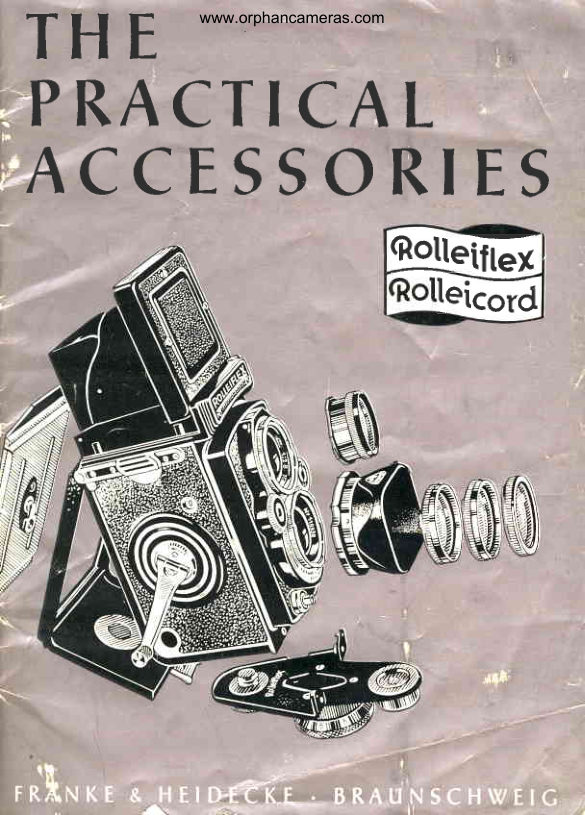
Rollei PRACTICAL ACCESSORIES
User manual
17 pages · EnglishRead →
RolleiPDF
Rollei Practical Accessories - 1959
User manual
25 pages · EnglishRead →
RolleiPDF
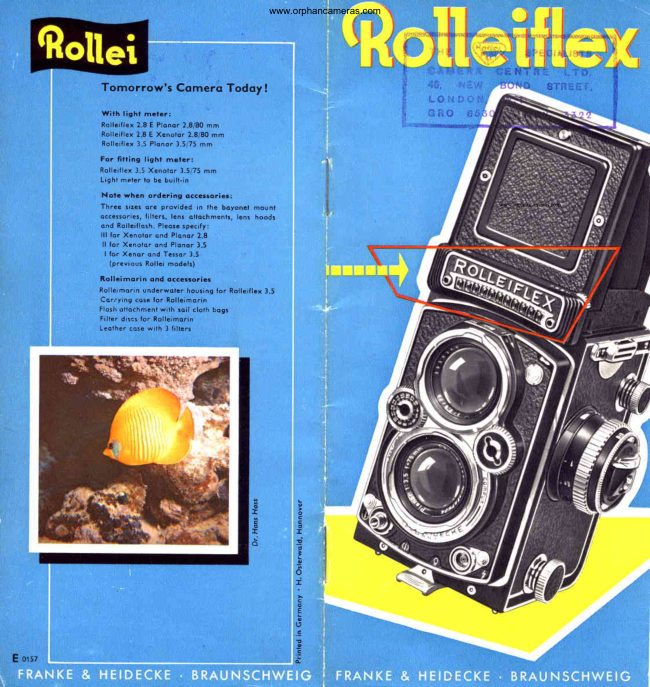
Rolleiflex
Product booklet
13 pages · EnglishRead →
RolleiPDF
Rolleiflex Die Praktischen Erganzungen
Product booklet
13 pages · GermanRead →
RolleiPDF
Rollei Practical Accessories - 1951
User manual
17 pages · Not specifiedRead →
RolleiPDF
Rolleicord Practical Accessories
User manual
16 pages · Not specifiedRead →
RolleiPDF
Rolleiflex T
User manual
27 pages · Not specifiedRead →
From the M. Butkus archive. Original publisher and archive notices are retained.
Check the model and edition against your equipment.
PDF verified 2026-10-10.