Sewing machines
Singer Letter A — User manual
User manual for Singer Letter A. 4 pages in English. Read the original PDF, download or print a copy without registration.
4 pagesEnglish0.2 MB PDF
Loading your manual…Open PDF directly
Document details
- Brand
- Singer
- Model / document
- Singer Letter A
- Document type
- User manual
- Language
- English
- Pages
- 4
- File size
- 0.2 MB
- Category
- Sewing machines
- Document date
- Not specified in catalog
Search available document text
Find a term, then jump to its page in the original PDF. Image-only pages may not be searchable; check the PDF for exact wording and diagrams.
Page 1 · Read text
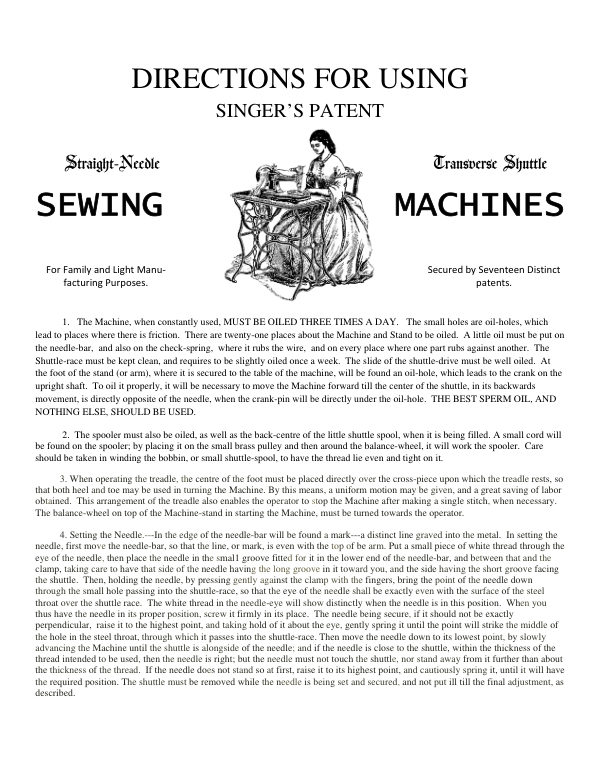
DIRECTIONS FOR USING
                SINGER’S PATENT

     Straight-Needle                                           Transverse Shuttle


  For Family and Light Manu‐                                                    Secured by Seventeen Distinct
      facturing Purposes.                                                                         patents.


       1. The Machine, when constantly used, MUST BE OILED THREE TIMES A DAY. The small holes are oil-holes, which
lead to places where there is friction. There are twenty-one places about the Machine and Stand to be oiled. A little oil must be put on
the needle-bar, and also on the check-spring, where it rubs the wire, and on every place where one part rubs against another. The
Shuttle-race must be kept clean, and requires to be slightly oiled once a week. The slide of the shuttle-drive must be well oiled. At
the foot of the stand (or arm), where it is secured to the table of the machine, will be found an oil-hole, which leads to the crank on the
upright shaft. To oil it properly, it will be necessary to move the Machine forward till the center of the shuttle, in its backwards
movement, is directly opposite of the needle, when the crank-pin will be directly under the oil-hole. THE BEST SPERM OIL, AND
NOTHING ELSE, SHOULD BE USED.

       2. The spooler must also be oiled, as well as the back-centre of the little shuttle spool, when it is being filled. A small cord will
be found on the spooler; by placing it on the small brass pulley and then around the balance-wheel, it will work the spooler. Care
should be taken in winding the bobbin, or small shuttle-spool, to have the thread lie even and tight on it.

       3. When operating the treadle, the centre of the foot must be placed directly over the cross-piece upon which the treadle rests, so
that both heel and toe may be used in turning the Machine. By this means, a uniform motion may be given, and a great saving of labor
obtained. This arrangement of the treadle also enables the operator to stop the Machine after making a single stitch, when necessary.
The balance-wheel on top of the Machine-stand in starting the Machine, must be turned towards the operator.

       4. Setting the Needle.---In the edge of the needle-bar will be found a mark---a distinct line graved into the metal. In setting the
needle, first move the needle-bar, so that the line, or mark, is even with the top of be arm. Put a small piece of white thread through the
eye of the needle, then place the needle in the smal1 groove fitted for it in the lower end of the needle-bar, and between that and the
clamp, taking care to have that side of the needle having the long groove in it toward you, and the side having the short groove facing
the shuttle. Then, holding the needle, by pressing gently against the clamp with the fingers, bring the point of the needle down
through the small hole passing into the shuttle-race, so that the eye of the needle shall be exactly even with the surface of the steel
throat over the shuttle race. The white thread in the needle-eye will show distinctly when the needle is in this position. When you
thus have the needle in its proper position, screw it firmly in its place. The needle being secure, if it should not be exactly
perpendicular, raise it to the highest point, and taking hold of it about the eye, gently spring it until the point will strike the middle of
the hole in the steel throat, through which it passes into the shuttle-race. Then move the needle down to its lowest point, by slowly
advancing the Machine until the shuttle is alongside of the needle; and if the needle is close to the shuttle, within the thickness of the
thread intended to be used, then the needle is right; but the needle must not touch the shuttle, nor stand away from it further than about
the thickness of the thread. If the needle does not stand so at first, raise it to its highest point, and cautiously spring it, until it will have
the required position. The shuttle must be removed while the needle is being set and secured, and not put ill till the final adjustment, as
described.
View original page 1Page 2 · Read text
5, Threading the Shuttle,-The thread from the shuttle... bobbin must first be passed through the hole nearest the blunt end of the
shuttle, and from thence through as many of the holes as shall be necessary to produce the degree of tension required; and, lastly, in all
cases the thread must lead through the hole nearest the point of the shuttle, Should the thread come out of the hole nearest the point of
the shuttle, it must be passed under the thread-guide on top of the shuttle; but should the thread go into the hole above spoken of, it
must first be passed out through the slot or long hole, and then under the thread-guide. In all cases the thread must be passed at last
under the thread-guide on top of the shuttle. One part of the thread should never be allowed to override the other. Before commencing
to sew, the shuttle-thread must be drawn through the throat, and laid across the feed under the work to be sewn. To place the bobbin in
the shuttle, put one point of the bobbin into the small hole on the spring in the point of the shuttle, and slide the other point into the
groove in the blunt end of the shuttle until the point of the bobbin springs into the small hole at the end of the groove. The thread must
always run over the bobbin toward the top of the shuttle. The new spring shuttle, and no other, is intended to be used in this Machine.

6. Threading the Needle.--The operator must observe particularly in what manner the needle is threaded when the Machine is first
unpacked, and afterward do it in the same way. But should the thread get misplaced, the following is a description of the proper
method: The spool being placed on its spindle, pass the thread through the eye at the end of the tension wire, and thence through the
eye at the end of the check-spring lever; then hook the two parts of the thread--namely, that ascending to the check-spring lever from
the tension-wire, and that descending from the check-spring lever to the needle, into the hook at the lower end of the wire-staple on
the face-plate. Next, pass the thread through the hole or eye in the lower end of the needle-bar, and through the eye of the needle.
Regulate the tension by turning the wing on the tension wire over toward the operator. Take care that the threads are not crossed or
wound, round each other in the hook above spoken of.

7, The Check-Spring Lever. --Near the top of the bar which carries he needle, at the highest point of the Machine, is a wire, placed in a
horizontal position, working in a joint or hinge at one end, and having an eye at the other end, through which the thread passes, This
wire is moved by a spring working under it, and passes between two wire staples; one of these staples is fixed by a set-screw to the
upper end of the needle-bar, and the other is attached by a set-screw to the upper part of the face-plate. To adjust in its proper place the
staple upon the face-plate, the Machine should be moved till the needle-bar reaches the highest point, and resting there, the staple upon
the face-plate should be moved downward, until it brings the horizontal wire, before described, within the thickness of a sheet of paper
of the top of the needle-bar; then this staple should be screwed tight in its place, The wire-staple upon the needle-bar may be adjusted
to its proper position by first putting a white thread in the eye of the needle, and a piece of fine broadcloth, doubled, in the place to be
sewed. Then move the Machine until the needle descends, so that the needle-eye is directly at the upper surface of the cloth (the white
thread will make that plainly visible); then, resting there, bring the staple of the needle-bar in contact with the upper surface of the
horizontal wire first spoken of, and then screw this staple firmly in its place. After this is done, upon moving the Machine forward, it
will be seen that the effect of this needle-bar staple is to hold the thread strained, and prevent all possibility of
its tangling, until the eye of the needle reaches the upper surface of the cloth; and then, at that instant, to relieve the thread from all
strain, so as to avoid chafing it by the action of the needle-eye in its rapid passage through the cloth. This staple on the needle-bar
performs another important office; it will be perceived that this staple is bent to the right, or toward the hinge of the horizontal wire.
The effect of this inclination of the needle-bar staple is to cause it to act on the horizontal wire nearer its hinge or fulcrum, which
arrangement causes that end of the horizontal wire having the eye through which the thread passes, to descend faster in proportion as
this staple is inclined more toward the right; and the consequence of this is, to form the proper degree of slack thread, so that, after the
needle has gone down to its lowest point, and slightly reacted to form a loop, the shuttle may pass through the loop without difficulty,
These wires are intended to be so arranged, that whilst the shuttle is passing through the loop, no slack thread may be drawn from the
spool which supplies the needle.

     Each of the Machines will be furnished with an extra spring for the check-spring lever. One of these can be removed, and the
other substituted, by the operator, in half a minute. These two springs are made of different sized wire, and possess different degrees
of power. The lighter spring is sufficient for all ordinary light work, for heavy work, the stiffer spring must be used. Underneath the
check-bracket are three separate holes to receive one end of these springs. Placed in the hole nearer the front of the Machine, the
spring exerts the most power.

     The general result and effect of this beautiful invention of the check-spring is, to insure a more exact and uniform tension on the
needle-thread, and to enable the Machine to be run at a much higher rate of speed without danger of breaking the thread, than with any
other contrivance hitherto known. The ease with which it may be adjusted and kept in perfect working order is also a great advantage.

    To insure a perfect seam, the tension on the needle thread should always balance the force of the spring on the check-lever, so
that the needle-bar, in its upward motion, should take the thread from the spool for the next stitch, instead of the spring.
View original page 2Page 3 · Read text
8. Directly in front of the Machine will be perceived a spring, with one end entering into a small hole in the face-plate which
holds the needle-bar and the foot-bar, and the other passing through a hole in the foot-bar. The power of this spring is graduated by
changing one end in the different holes in the foot-bar. Heavy goods require more pressure than light goods. To change this spring to
the required pressure, it must be pressed down from the top first, and then removed from the hole in the foot-bar. To replace it, it must
first be placed in the required hole in the foot-bar, and sprung into its place in the face-plate.

       9. Feed Motion.-Directly in front of the operator, and under the border of the table, will be found a set screw for adjusting the
length of the stitch, To lengthen the stitch, the screw must be turned to the left or unscrewed; to shorten, turn in an opposite direction.
To prevent this screw from working loose, from the action of the Machine, there is an inclined plane underneath the screw, which may
be tightened by forcing against the end of it. A whole for that purpose will be found directly under the border of the Machine, at right
angles with the adjusting screw.

      10. When you wish to take goods from the Machine, after being sewed, always raise the needle to its highest point, and let it rest
there; then raise the steel foot that presses down the cloth; then take bold of the thread, just above the needle-clamp, and draw about
two inches of thread from the spool, so the thread may pass freely through the needle-eye, without springing the needle; then take bold
of the goods with the left hand, and draw them gently from the left side of the Machine about two inches, and with a scissors cut both
threads at the same time, A strict observance of this rule will save the breaking of many needles.

      11. Tension of the Two Threads.--To make an ordinary tight seam, the two threads should be drawn, as nearly as may be, to the
centre of the cloth; and to make a fair stitch on the upper side, the needle-thread should not be quite so tight as the shuttle-thread, The
tension of the needle-thread may be increased by turning the clamp on the steel wire over toward the operator, or diminished by
turning the clamp backward, It may thus be adjusted with the most minute accuracy. First, fix the draw or tension of the shuttle-thread
as you want it, and then adjust the tension of the needle-thread, so as to match or balance that of the shuttle.

      12. The Driving Belt,--The belt which communicates motion to the Machine should always be tight enough to move the
Machine without slipping, and no tighter than is requisite to perform that office. Should it become too loose, it may be tightened to a
certain extent by unscrewing the nut which holds the stud on which the large wheel revolves, When the nut is thus loosened, pull the
large wheel backward, so as to make the belt tighter; hold it fast until the nut is screwed back so as to hold the wheel firmly. Should
the belt happen to stretch beyond the capacity of the adjustment last described to tighten it, then the belt must be shortened.

      13. If at any time the Machine appears to run too hard, it may be presumed that some part which requires oiling has not been
oiled. Wherever one part rubs against another, oiling is necessary.

      14. Hemming-Gauges.-The adjustable hemming-gauge is attached to the foot-bar of the Machine with a screw, the presser-foot
resting firmly on the top.  It should be adjusted in such a manner, that the needle will pass through the centre of the hole in the
hemming-gauge. When not required, the gauge may be removed by turning the screw back for enough to disengage it, without
entirely removing the screw. The screw may be always left in its place in the foot-bar. To commence a hem, first raise the foot-bar to
its highest point, letting it rest there until the goods to be hemmed are passed through the gauge. The edge to be hemmed must be
passed under the gauge, and brought up through the opening between the steel spring and tongue, being careful that a sufficient
quantities of the goods pass through to make a perfect hem, then let down the foot-bar as in ordinary sewing. To commence at the end
of the goods, it will be found convenient to pass a thread, with a common needle, through the corner of the goods-passing first the
thread through the gauge, drawing the goods gently into the gauge, in the manner above described, as far as the needle, or to the
required point for commencing. To make a wide hem, first fold the goods the required depth; pass the goods under the hemmer, and
bring the top part of the fold into the hemmer, as above described. The hemming gauge will in all cases be attached to the Machine.
View original page 3Page 4 · Read text
THET   SINGES   ER SEEWINNG M ACHINNES


     Our LET'TER AA FAMILY SEWWING MACHINNE is fast gainingg a world-wide rreputation. It is bbeyond doubt thhe best and cheappest and most
beautiiful of all Familyy Sewing Machinnes yet offered tot  the public. Noo other Family S ewing Machine has so many useeful appliances ffor Hemming,
Bindinng, Felling, Tuckking, Gathering,, Gauging, Braidding, Embroideriing, Cording, andd so forth. No otther Family Sewwing Machine haas so much
capaciity for a great vaariety of work. Itt will sew all kinnds of cloth, and with all kinds oof thread. Great aand recent improovements make oour Family
Sewinng Machine mostt reliable, and mostm   durable, andd most certain in action at all ratees of speed. It mmakes the interloccked stitch, whicch is the best
stitch known. Any onee, even of the most ordinary cappacity, can see att a glance, how too use the Letter A Family Sewinng Machine. Ouur Family Sewing
Machiines are finishedd in chaste and exxquisite style.

     The Folding Caase of the Familyy Machine is a piiece of cunning workmanship off the most usefull kind. It protectts the Machine wwhen not in use
and wwhen about to be operated may bee opened as a spacious and substtantial table to suustain the work.. While some of the Cases, madee out of the
choiceest woods, are finished in the simmplest and chastest manner possible, others are aadorned and embbellished in the mmost costly and superb manner.

        It is absolutely necessaryn         to see the Family Macchine in operatioon, so as to judgee of its great cappacity and beautyy.

        It is fast becomiing as popular foor family sewingg as our Manufaccturing Machinees are for manufaacturing purposees.

    MACHINES FOOR MANUFACCTUIUNG PURPPOSES.-These MachinesM        are noww in general usee for BOOT AND SSHOE MAKING TAAILORING, STAY
MAKINNG, CAP MAKINGG, DRESS MAKINNG, ARMY CLOTHHING, HARNESS MAKING,M      CARRIAAGE TRIMMING, aand so forth..

    OUR NO. 2 MACCHINES ARE THE ONLYO   MACHINES THAT HAVE EVERR BEEN SUCCESSFFULLY INTRODUCCED FOR MANUFAACTURING PURPOOSES.

     Our No.3 Machhines (with Vibraating Presser, whhich is indispenssable for heavy ppatent leather woork,) are especiaally adapted to alll kinds of light
and heeavy Leather Woork, in Carriage Trimming, Boott and Shoe Makiing, Harness Maaking, etc, etc. TThey are of extraa size, with an arrm long enough
to takee under it and stiitch the largest sizeds     carriage daashes. There is sccarcely any part of a Trimmer's sstitching that cannnot be better doone by them thann
by hannd; so, too, the savings      of time annd labor is very great.g    The table of these-Machinnes is 24 inches llong, and the shuuttle will hold siix times as muchh
threadd as the shuttle of those used for tailoring purposses. The large maachines work as fast as small onnes.

    TThe public have been swindled byb  spurious macchines made in immitation of ours.. The metal in thhem, from the Irron casting to thee smallest piece
is of ppoor quality. It iss only by doing aa great business,, and having exteensive manufactturing establishmments, that good machines can b e made at
moderrate prices. The bestb   designed Machines,M     BADLY MADE, are always liable to gget out of order, and are sure to ccost considerabl e trouble and
moneyy to keep them inn repair.

     The qualities to be looked for inn a Machine are: certainty of corrrect action at alll rates of speed, simplicity of co nstruction, greatt durability, and
rapidi ty of operation, with the least labbor. Machines, to combine these essential qualiities, must be maade of the best mmetal and finisheed to perfection.
We haave the ways andd means, on a grrand scale, to do this.

     The purchasers of Machines, whhose daily breadd it may concern, will find that thhose having the above qualities nnot only work wwell at rapid as
well aas slow rates of speed,s      but last loong in the finest possiblep      workingg order. Our Maachines, as madee by us, will earnn more money wwith less labor
than aany others, whethher in imitation ofo ours or not. InI  fact they are cheaperc       than anyy other machine aas a gift.

     SILK TWIST, THREAD,T        OIL, &c. &c. &c.--OOur Branch Officces are supplied wwith Binding annd Hemming Gauuges, Silk Twistt, Linen and
Cottonn Thread on spools, Oil of the veery best quality, as well as all othher things necesssary in the use oof our Machines .

    NEEDLES.-Wee manufacture ouur own Needles, and would warnn all persons usinng our Machine s not to buy anyy others. We kno w that there are
needlees sold of the moost inferior qualiity, at higher pricces than we charrge for the best. The needles soldd by us are manuufactured speciaally for our
Machiines. A bad or unnsuitable needlee may render the working of the bestb   machine almmost useless.

     Our customers maym   rest assuredd that all our Braanch Offices are furnished with tthe "genuine artiicle."

     IN CASE OF SMALLS     PURCHHASES, the monney may be sent in postage stampps, currency or bbank notes. Pers ons sending ordeers for silk,
threadd and needles, byy mail or otherwise, must alwayss send the moneyy with the order.. We keep no oppen accounts of these articles, onn account of the
great mmultiplicity of smmall orders we area  constantly receiving. By the needles and posttage stamps we can make the chhange correctly, whatever sum
may bbe sent us.

    NOTICE TO CORRESPONDEENTS.--- Corresppondents will pleease write their nnames distinctlyy. It is all importtant that we shouuld; in each .casee,
know their Post Officee, County and Sttate. All personss having business with our BRANNCH OFFICES , will please adddress their letterss to THE
SING ER MANUFACCTURING COMMPANY.

     Send for a Pampphlet and Price List.L

                       THEE SINGERR MANUFFACTURIING COMMPANY,
                                                                                                   468 Broaddway, New Yorkk.
View original page 4Related documents and language editions
SingerPDF
Adjuster's for the Singer Model 20
Service manual
19 pages · EnglishRead →
SingerPDF
Singer 101-4 & 101-12
User manual
56 pages · EnglishRead →
SingerPDF
Singer 101-4 & 101-12 (black and white scan)
User manual
54 pages · EnglishRead →
SingerPDF
Singer 115
User manual
36 pages · EnglishRead →
SingerPDF
Singer 127 & 128
User manual
18 pages · EnglishRead →
SingerPDF
Singer 12K
User manual
12 pages · EnglishRead →
SingerPDF
Singer 15
User manual
36 pages · EnglishRead →
SingerPDF
Singer 15-125
User manual
38 pages · EnglishRead →
SingerPDF
Singer 15-22
User manual
13 pages · EnglishRead →
SingerPDF
Singer 15-30 / 15-87 & Generic 15 Class (rotated for printing)
User manual
14 pages · EnglishRead →
SingerPDF
Singer 15-30 / 15-87 & generic 15 class machines
User manual
14 pages · EnglishRead →
SingerPDF
Singer 15-86
User manual
24 pages · EnglishRead →
From the ISMACS International. Original publisher and archive notices are retained.
Check the model and edition against your equipment.
PDF verified 2026-10-11.