Light meters
TWO Leica Meter Exposures PAGE User manual
User manual for TWO Leica Meter Exposures PAGE. 4 pages in English. Read the original PDF, download or print a copy without registration.
4 pagesEnglish0.7 MB PDF
Loading your manual…Open PDF directly
Document details
- Brand
- Leica
- Model / document
- TWO Leica Meter Exposures PAGE
- Document type
- User manual
- Language
- English
- Pages
- 4
- File size
- 0.7 MB
- Category
- Light meters
- Document date
- Not specified in catalog
Search available document text
Find a term, then jump to its page in the original PDF. Image-only pages may not be searchable; check the PDF for exact wording and diagrams.
Page 1 · Read text
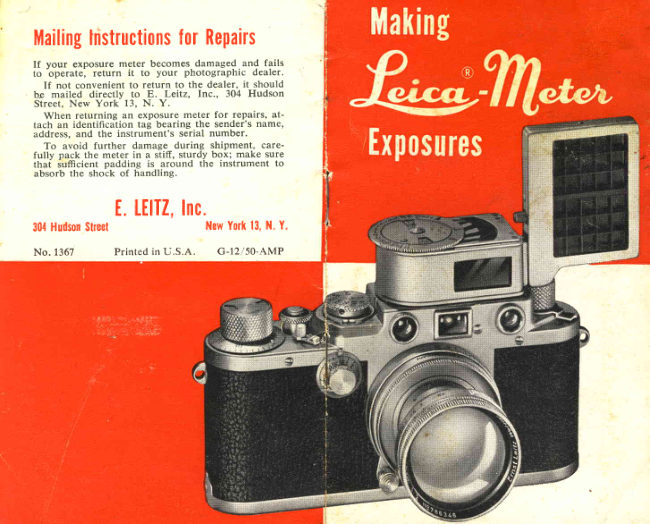
lvlailinglnstructionsforRepairs
If  your  exposure meter becomes damaged. and  fails
to  operate,  return    it  to  your  photographic  dealer.
    If  not convenient to return  to the dealer,  it should
b-e mailed   directly   to  E.  Leitz,   Inc.,  304 Hudson
Street, New York  13, N. Y.
  When  returning an exposure meter for  repairs,  at-
tach an identification  tag bearing the sender's name,
address, and the instrument's   serial number.
  To  avoid  further  damage  during  shipment,  care-
fully pack the meter in a stift, sturdy box; make sure
that  sufficient  padding   is around  the  instrument   to
absorb the shock of handling.
             [. [ElTZnInc.
304HudsonStreet        NewYork13,N.Y"

No. 1367      Printedin U.S.A.   G-12i50-AMP
View original page 1Page 3 · Read text
covered.
                              UniversalApplicationof theDirectionsforUse
The Leica-Meter  can be used in the hand, as well as
attached  to  the camera.
  Turn  the inner  disc to a position  corresponding  to
the A.S.A.  sensitivity  of  the  film.  This  setting need
only be changed wh en a film  of different  sensitivity  is
used in the cam.era.
Jv|easurement
Y  M easttring Range I.The  light  entrance window  of the meter  is directed      CareandHandling
towards  the  subject  and  the  marking    V  on  the               Your  exposure meter  is a  precision  instrument.    It
outer  knurled  scale is turned  opposite  the black  or                should  r6ceive  the same careful  handling  and  treat-
white channel in line with  the needle. This  will  auto-              ment  that  are given  to an expensive camera  or any
matically  set the required  stop as well as the correct                   fine  precision  ihstrument.  Your  meter  has been  as-
exposure time.                                                  sembled  with  a watchmaker's    skill  and  should  not,
                                                                   under any circumstances,  be tampered  with  or taken
V  M easuring Range II.                                              apart.^
Under  poor  light  conditions,  the baffie lever  is flipped                  Several   general   precautions   must,  always  be
icrward  (see illustration  page 4) is turned  to position               observed.
V     and  the  marking  V   on  the  knurled  scale           Extreme Temperatures
ring  is brought  in  line  with  the needle.                                                                        'femperaturesYour  meter should not be subjected  to extreme heat.                                                                                                        atmospheric                                                                                                                  of normal                                                                                                             in                                                                                   excess                                                                                                                                -con-V   Measuring Range  III.                           .                                                                                                                           to                                                                                                                the photovoltaic                                                                    may                                                                                  be injurious                                                                               ditiohs  (130oF)
(Necessary  only  for  poor  lighting  conditions.)  After                     cell.
the  super-sensitive  element  has been  inserted,  the               Due  to  its hermeticalty  sealed constru ction, the cell
index  mark   V     is used  in  the same way  as de-                     is not  affected by low  temperatures  and  is resistant
scribed  above.   Position   of   the   lever  becomes                  to moisture.
immaterial.
  Take care not  to cover up the  light  entrance win-           Care of Lens
dow. The  appropriate  F  stops and exposure  tirnes               Avoid  scratching the lens, or allowing  dust to accu-'
can  still be fe-aa off even after  the Leica-Meter   is no               mulate  on  its  surface, which  will  hinder  the  trans-
longer pointed  to the object to be photographed.                   mission  of  light.
View original page 3Page 4 · Read text
a.m. and 4 p.m. is the best source tll light to get ac-
Carrying the Meter                                                curate  results with  daylight  color  film.  lllumination
                                                                    from  a blue or gray sky or that  in the shadow areas
Although  your  Leica-Meter   will  withstand  normal                  usually imparts  a Utuish tinge to the picture.  Direct
shock and handling, be particularly  careful not  to                   sunlight  is reddish  in  the  early  morning  and  late
drop  or- bang  it. Your  meter may be conveniently                 afternoon.
carried  in the leather case provided.                               Most  color  film  of  the  indoor-roll  type  is  color-
                                                               balanced for  photoflood  illumination.
Exposurefor0utdoorScenes                          Scenes                           lndoorExposure lor Black and White                                                                                                  illumination,  open  baffie by  tlipping                                                                    With  daylight
The meter  is read when pointed  toward  the subject                   baffie lever forward;  for  artificial  and weak daylight
                    position,fro.m                                                                                illumination,                                                                                     simply  attach  super-sensitive element      the camera                                 in the same                                 manner as you   ,*+point.yo,ur           camera.                                                                                      for  readings.                    This technique                                                is satisfactory-for
practically_all -outdoor scenes. The main exceptibn  is
where the brigh.tness in_the background, as vidwed by
the meter, is_widety different from  that of the princi-
pal                           of such                            scenes                                      are    .subject._Examples                                        backJighted     ASAFilmExposureIndexes        and dark subjects                            against                                            light                                      backgrounds.lubjects
hor these scenes, the exposure should be measured
by taking a close-up reading on the actual subject or                Ansco Films            Daylight   Tungsten
a similar  substitute subject.
   In     making             a close-up                        reading,                                 the meter                                                        is actually                                                                 35 mm. FiIm                                       (Be     asheld        near to                the subject                         as convenient.                                                 careful
not  to measure the shadow cast by the meter.)  Al-                    Ultra-Speed Pan          100      64
though the brightness of a subject is independent  of                 Supreme                 50      32
distance, the meter can  indicate  that  brightness so
long as it sees only the particular  subject; hence,  it  is                 Ansco  Color  Positive  Film
held close to small subjects, but may be held propor-                    35 mm. Daylight Type         12tionately  farther  from  larger  surfaces.                                                                   35 mm. Tungsten Type               -                    l 2  As a substitute of'corresponding  reflectance, the
palm  of  the hand  is  often  convenient. A  close-up
reading, with  the meter held about four inches from            Eastman Kodak Films
the hand,  will  give dependable exposure for average
scenes. If  the subject is  in a shadow, the hand  is
held in the shadow of the body.                                    35 mm.
                                                                  Super-XX  Panchromatic    100      80
Exposure lor Color                                                   Plus-X  Panchromatic        50      40
Color  photography  requires  the exact measurement                    Panatomic-X                      ,:       20
of exposure.in order to obtain  faithful  reproductions.                      Infra-Red                             8*
Close-up reading on the principal  parts of the subject                 *With  Leitz  Inlra-Red   filter.usually gives the most accurate exposure.
                                                              Kodak                                                                                Color  Film                               a color                                      transparency       lightness                  darkness                                  of  The                  or                                                                              DaYlight-35mm. 10        ,*                                         within                                              the  film's                     exposure,                                  but                                                               Kodachrome, is   controlled             by                  the
latitude the color reproduction   is largely determined                 *With  Kodacfuome  Photoflood  Filter.by the color of the light.  Direct  sunlight between 10
View original page 4Related documents and language editions
From the M. Butkus archive. Original publisher and archive notices are retained.
Check the model and edition against your equipment.
PDF verified 2026-10-10.