Film cameras
WIDELUX F8 Panaromic User manual
User manual for WIDELUX F8 Panaromic. 11 pages in English. Read the original PDF, download or print a copy without registration.
11 pagesEnglish2.8 MB PDF

Loading your manual…Open PDF directly
Document details
- Brand
- Widelux
- Model / document
- WIDELUX F8 Panaromic
- Document type
- User manual
- Language
- English
- Pages
- 11
- File size
- 2.8 MB
- Category
- Film cameras
- Document date
- Not specified in catalog
Search available document text
Find a term, then jump to its page in the original PDF. Image-only pages may not be searchable; check the PDF for exact wording and diagrams.
Page 6 · Read text
LOADING THE CAMERA
        First, remove the camera back by turning the knob on the back of the camera to the "UNLOCK" position.
      Then pull up on the "FILM REWIND KNOB", until the film cassette can be inserted intothe film chamber.,
       Release the knob, and turn it slightly, to engage the spool in the cassette.
     To make the film easier to thread into the camera, curl the tip of the film, as shown in figure A.
      Thread the film through the rollers and around the film guide, making sure that the sprocket holes in the
       film are properly engaged by the sprockets of the film advance mechanism. Insert the end of the film into
      the take-up spool, and turn the "FILM WIND KNOB" until-.the sprocket holes on both sides of the
       film have been engaged by the film sprockets.
       Continue turning the film winding knob until it stops. Observe the film as it moves through the camera,
      and make any adjustments in the position of the film at this time. Replace the back on the camera, making
       sure that the red "UNLOCK" is on the left of the camera; turn the "LOCK KNOB" to the "LOCK"
       position while gently pressing against the back of the cover. Press the "SHUTTER RELEASE", and Wind
      the "FlLM WIND KNOB" once, to take up any slack in the film,
      and to bring unexposed film into the film aperture.
      Your WIDELUX is now ready to use.                                                                                                                       :Irt-
                                                                          FIGURE      \l\\
                                                               4
View original page 6Page 7 · Read text
Because the film is loaded in a curve, which permits the super wide angle of view. the film is somewhat
    harder to transport than normal.
    After finishing the roll of film, rewind the film into the cassette by pulling out the "FlLM REWIND KNOB"
-    to the first position, and rotating it in the direction of the arrow. The"REWIND BUTTON", onthe bottom
    of the camera, must be depressed during the rewinding operation.
    Although film magazines are manufactured to international standards, some custom magazines may not fit
    properly in the camera. This may cause the film to bind, and may even cause the film to break. We recom-
   mend that only standard size film magazines be used in the WIDELUX.

                    TWO "DON'T"s, and THREE "DO"s
   DO NOT:
     1. Release the shutter without setting the shutter speed control knob exactly on the desired speed.
    2. Forget what kind of film is loaded in the camera, and whether it is a long roll (36 exposures in an ordinary
       camera), or a short roll (20 exposures in an ordinary camera).
    DO:
                                                                                                  camera     1. Position the camera horizontally when taking a normal picture - the spirit level on the top of the
      should be used to level the camera.
                            www.orphancameras.com-5-
View original page 7Page 8 · Read text
2. Be very careful to keep your fingers out of the picture.
3. Remember the other important items in th is instruction booklet.


                                     ,,DON'T"S

1. Don't release the shutter without setting the shutter speed control knob exactly on the desired speed-
   because the shutter of the WIDELUX is a unique mechanism.  lt is similar to the transmission system of
 ' an automobile. Just as in an automobile transmission the improper use of the gears can damage the
   system, so can the improper use of the shutter speed control knob damage the shutter mechanism.
  To change shutter speed, it is not necessary to lift the control knob; simply turn it to thedesired setting.
    lf the knob does not turn easily, do not force it. but turn it in the opposite direction slightly, then try
   to turn it back. When the camera is new, this may happen often, but never use force to turn the knob,
   as this will damage the shutter mechanism.
2. Don't forget what kind of film is loaded in the camera. because, with yourWlDELUX, you can obtain
   only 21 pictures on a standard long roll, and only 11 on a short roll. DO NOT TRY TO GET MORE
  THAN THAT, or the film may break, and it will be impossible to rewind the film and unload the camera.
     lf the film does break, the camera may be unloaded in a darkroom or changing bag.
  CHECK THE AUTOMATIC FILM COUNTER BEFORE TAKING EACH PICTURE.
                                           -6-
View original page 8Page 9 · Read text
Fl
                                              "DO's"
             1. Position the camera horizontally when taking a normal picture, because the WIDELUX uses a rotating lens
               system to obtain the amazing super wide angle pictures.
           One characteristic of the system is that if the camera is pointing up, horizontal lines will appear concave,
              while if the camera is pointing down, horizontal lines will appear convex. This effect is demonstrated to
            some extent by the image in the viewfinder. To obtain straight horizontal lines, place your eye as close as
                possible to the viewfinder, and line up a horizontal line within the viewfinder frame. This technique  is
                 easily mastered after only a few trials. The picture in the viewfinder is actually only 90% of the picture
               recorded on the film; things barely seen in the viewfinder will be recorded on the film clearly.
            2. Be very careful to keep your fingers out of the picture. The field of view is 55" vertical and 140o horizontal
            by diagonal measurement which means that new users often include the image of their finger tips in the
                 picture. On the top of the lens housing, there are two arrows, set 140o apart. When making hand-held
                shots, be sure that your fingers do not intrude into the area outlined by the arrows. lf you are making
                 vertical shots, you may find that your feet show in the negative, as well as your fingers.                                                                                                                                                                                                                                                           i
           3. Remember the other important items in this booklet. Your photographs may display a peculiar'per-
               spective distortion inherent in this camera, which makes horizontal parallel lines appear to curve away
             from each other at the edges of the picture. This is not a defect in the lens, but the natural property
                               www.orphancameras.com-7  -
View original page 9Page 10 · Read text
of images as the distance to the object increases.
   Although the range of shutter speeds may seem limited, in practice, the three speeds of 1115, 1/125, and
   1/250 will cover just about every situation.

We have explained rather meticulously the items and procedures to beremembered in usingyourWlDELUX.
Such detail may lead you to believe that it is complicated to operate, and requires special techniques. Al-
though the WIDELUX is a complex piece of machinery,  it is really quite simple to operate. The special
techniques are only to insure that you receive the maximum lenefit from the special features of the
WIDELUX.
The WIDELUX is a unique new camera in its design, performance, and mechanical operation.
We are sure that you will find the best use of the WIDELUX after mastering these instructions. We sincerely
wish to improve the camera, and to give the best service to you.
We wish you good luck in your photography with the WIDELUX.
++++++++++++++++++++++++++++++++++++++++


                                           -8-
View original page 10Page 11 · Read text
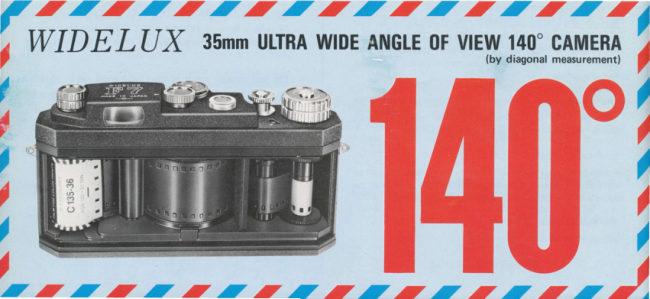
WIDELUX
     35MM ULTRA WIDE ANGLE OF VIEW 140" CAMERA
                                              (by diagonal measurement)

                            Manufacturers & Exporters
PANON CAMERA SHOKO CO.. LTD.
       24-3-4, 2-chofn€, Azusawa, ltabashi-ku, Tokyo, Japan.
       Telephones: (965) 8686, 8687
         Cable Addressi "FUJIPANON" TOKYO
        Code Used:   Bentley 2nd Phrase Code
       Bankers:   THE BANK OF TOKYO, LTD.


             www.orphancameras.com                                   Printed in Japan
View original page 11Related documents and language editions


From the M. Butkus archive. Original publisher and archive notices are retained.
Check the model and edition against your equipment.
PDF verified 2026-10-10.