This reference material was created in 1997, well
before the Internet was as popular and as easy as it is these days (Oct.
2005 - date I reposted this information). Heck, cell phone calls were
still expensive and forget about thinking that the new blackberry can show
the internet on a phone (2005). This information was located on the
Seton Hall University, N.J. web site until 2003 where I did work for some
13 years.
This information was collected and presented for a state grant a professor received at that time. Creating a web page was really high tech at that time. Having Internet access was even a rarity then. On a whim I decided to "Google" my old login name and found hundreds of links to this page for these sites on the Seton Hall University web site. The site was under my old employment name, but this site was removed (we, they were quite advance way back in 1997 !).
My sister's passing, many years ago due to smoking, was my initial reason for helping to post this information. I worked well beyond the hours allotted by the grant to get this site posted. Since there continues to be some hundreds of links to this information, I am posting it again on my personal site.
I created these HTML pages with Netscape Composer, the only thing available at the time !
Now using MS Expressions :)
A Seton Hall College of Nursing professor collected and created the documentation, I created the pages and links. Please remember, the date is 1997 when the addresses, pricing and phone numbers were first posted.
I have been asked a number of times to add to this information. Additional links are below with hopefully new or diverse information. Yes, you can be bullied into drugs (smoking, drugs) as well as other dangerous habits.
This information was collected and presented for a state grant a professor received at that time. Creating a web page was really high tech at that time. Having Internet access was even a rarity then. On a whim I decided to "Google" my old login name and found hundreds of links to this page for these sites on the Seton Hall University web site. The site was under my old employment name, but this site was removed (we, they were quite advance way back in 1997 !).
My sister's passing, many years ago due to smoking, was my initial reason for helping to post this information. I worked well beyond the hours allotted by the grant to get this site posted. Since there continues to be some hundreds of links to this information, I am posting it again on my personal site.
I created these HTML pages with Netscape Composer, the only thing available at the time !
Now using MS Expressions :)
A Seton Hall College of Nursing professor collected and created the documentation, I created the pages and links. Please remember, the date is 1997 when the addresses, pricing and phone numbers were first posted.
I have been asked a number of times to add to this information. Additional links are below with hopefully new or diverse information. Yes, you can be bullied into drugs (smoking, drugs) as well as other dangerous habits.
LINKS - added by requests from groups / associations
/ student projects
-- Great list for current resources --
- - - - - - - - - - -
Welcome to American Stop Smoking Intervention (ASSIST) Home Page
-- Great list for current resources --
- - - - - - - - - - -
Welcome to American Stop Smoking Intervention (ASSIST) Home Page
- - - - items below last update 7-23-1997- - - -
(Prez Clinton's second
term - Princess Di was killed)
Click on these subjects for more information:
BACKGROUND AND PURPOSE: ASSIST represents a collaborative
effort between the National Cancer Institute (NCI) and the American Cancer Society
(ACS), along with state and local health departments and other voluntary organizations
to develop comprehensive tobacco control programs in 17 states. Its purpose is to
demonstrate that the wide-spread, coordinated application of the best available
strategies to prevent and control tobacco use will significantly accelerate the
current downward trend in smoking and tobacco use. The result is a substantial reduction
in the number and rate of tobacco-related cancers in the United States. The ASSIST
intervention model is based on proven smoking prevention and control methods developed
within the NCI's intervention trials and other smoking and behavioral research.
OBJECTIVES: The primary objective of ASSIST is to
demonstrate and evaluate ways to accelerate the decline in smoking prevalence in
all 17 ASSIST states, reducing the rate by 43% by the year 2000. In order to achieve
change of this magnitude, ASSIST interventions will be implemented in ways that
will affect the greatest number of smokers and potential smokers, placing special
emphasis on blue collar workers, women, ethnic minorities, and youth.
ASSIST INTERVENTION: ASSIST is a community-based
intervention directed by state and local volunteer coalitions which plan and implement
tobacco control activities. Through ASSIST, media and policy advocacy interventions
will be directed at the community using the health care system, schools, worksites,
and other community channels. Broad, sweeping changes in policies that regulate
where tobacco can be used are key to changing tile social environment. Public support
for tobacco control policies can be strengthened by using the media and media advocacy
techniques to increase coverage of these issues and to reinforce the emerging non-smoking
norm. Interventions involving policy and media create a demand for program services
by community providers. With the exception of training health care providers to
deliver brief cessation counseling, ASSIST promotes but does not provide funds to
develop or provide program services. Instead, it will mobilize and activate community
resources for smoking prevention and cessation. For example, the ACS will provide
support with educational materials, and the efforts of an active network of more
than 800,000 volunteers and 1,000 local units in the 17 ASSIST sites. Tile focus
on policy and media advocacy rather than on program services will allow limited
resources to be allocated to those interventions that have the greatest potential
for reducing smoking prevalence in ASSIST sites.
IMPACT OF ASSIST. Ninety-one million Americans from
across the country, including 18 million smokers, will be reached by ASSIST. More
than 4.5 million extra adults will quit smoking and 2 million adolescents will be
prevented from becoming addicted. Overall, it is expected that 1.2 million premature
deaths will be averted, including, 422,000 deaths from lung cancer.
TIMELINE: Seventeen state health departments are
funded through the contract mechanism for a 24 month planning period which began
in September 1991 (Phase 1). The five year intervention phase will begin September
of 1993 and continue through 1998 (Phase 11).
FUNDED SITES: Contracts were awarded to public health
departments in: Colorado, Indiana, Maine, Massachusetts, Michigan, Minnesota, Missouri,
New Jersey, New Mexico, New York, North Carolina, Rhode Island, South Carolina,
Virginia, Washington, West Virginia and Wisconsin. Total awards to states over the
7-year period are $114.5 million. The ACS will support ASSIST with a matching 15%
contribution of the total contract funding in each ASSIST site.
Educational Resources for Risk Populations -- Children --
Author: Coalition on Smoking and Health
Source: National Center for Tobacco Free Kids
Source:DHHS Press Release
Source: California Department of Health Services
- Tips for Owners/Managers
- Tips for Clerks
- Information Kit
New Hampshire Division of Public Health Services and the Smoke Free NH Alliance
-
Targeting Teens - the Tobacco Industry Advertising Strategies"
Author: Navada Tobacco Prevention Coalition
- "Facts on Adolescent Smoking"
Author: General sources listed in publication
-
"Smoking and low birth weights"
Author: HHS news release or view theSmoked
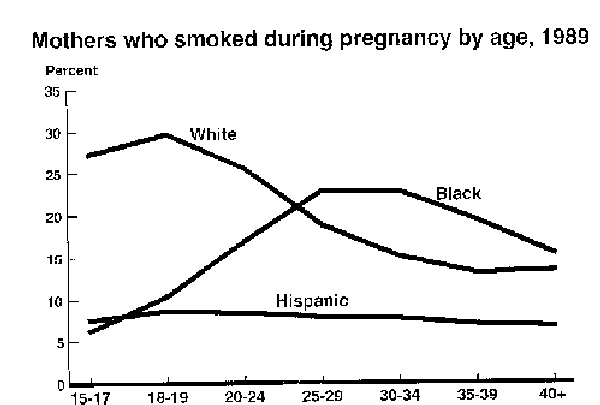 or Weight
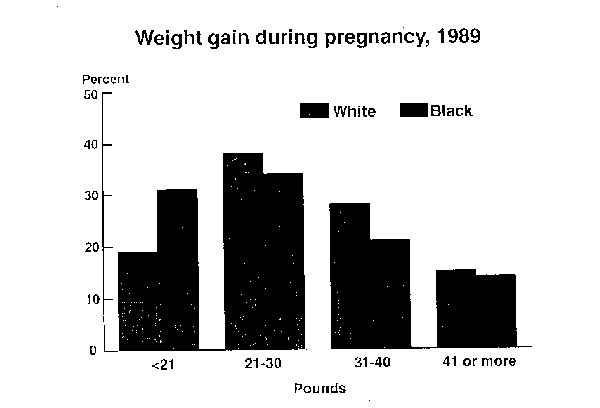 graphs
 -
Starategic Colition of Girls and Women United Against Tobacco
- "African Americans and Smoking"
Author: Office on Smoking & Health
- "Report of Tobacco Policy Research Group on Marketing and Promotions
Targeted at African Americans, Latinos, and Women"
Author: Tobacco Control, 1992 1 (suppl), s24 - s30
Addiction - Understanding Nicotine
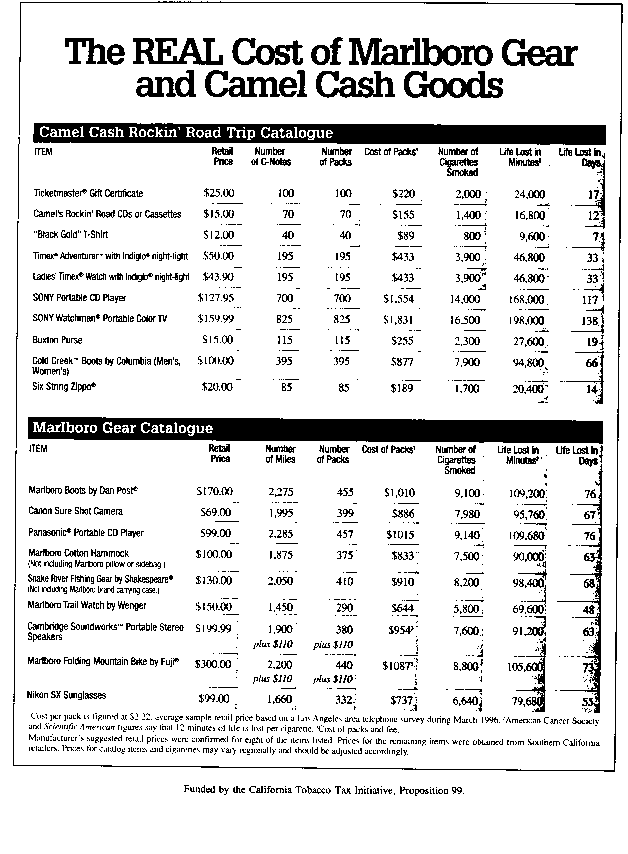
Economic Costs of Tobacco
- The real cost of Marlboro Gear and Camel Cash Goods
Author: California Tobacco Tax Initiative
- "The Human Cost of Tobacco Use"
Author: McKenzie, Bartecchi, Schrier (1994) The New England Journal of Medicine,
-
"Second Hand Smoke in Your Home"
Author: South Carolina Department of Health and Environmental Control
Media and Advertising in Tobacco
SMOKE FREE COMMUNITIES
The Smoke Free Community Guide to American Lung Association Programs
How can communities address smoking control?
American Lung Association Programs
SMOKE FREE DINING
GASP (Group against smoking pollution) Smoke free dining information in New Jersey
Fighting Heart Disease and Stroke, New Jersey Affiliate
Tobacco Use: A Public Health Disaster
Work Place: ESTABLISHING TOBACCO CONTROL POLICIES
Tobacco Control: Preventing Youth Tobacco Sales
SCHOOL PROGRAMS TO PREVENT TOBACCO USAGE