Lenses & filters
Beseler enlarging lenses User manual
User manual for Beseler enlarging lenses. 10 pages in English. Read the original PDF, download or print a copy without registration.
10 pagesEnglish2.4 MB PDF
Loading your manual…Open PDF directly
Document details
- Brand
- Beseler
- Model / document
- Beseler enlarging lenses
- Document type
- User manual
- Language
- English
- Pages
- 10
- File size
- 2.4 MB
- Category
- Lenses & filters
- Document date
- Not specified in catalog
Search available document text
Find a term, then jump to its page in the original PDF. Image-only pages may not be searchable; check the PDF for exact wording and diagrams.
Page 1 · Read text
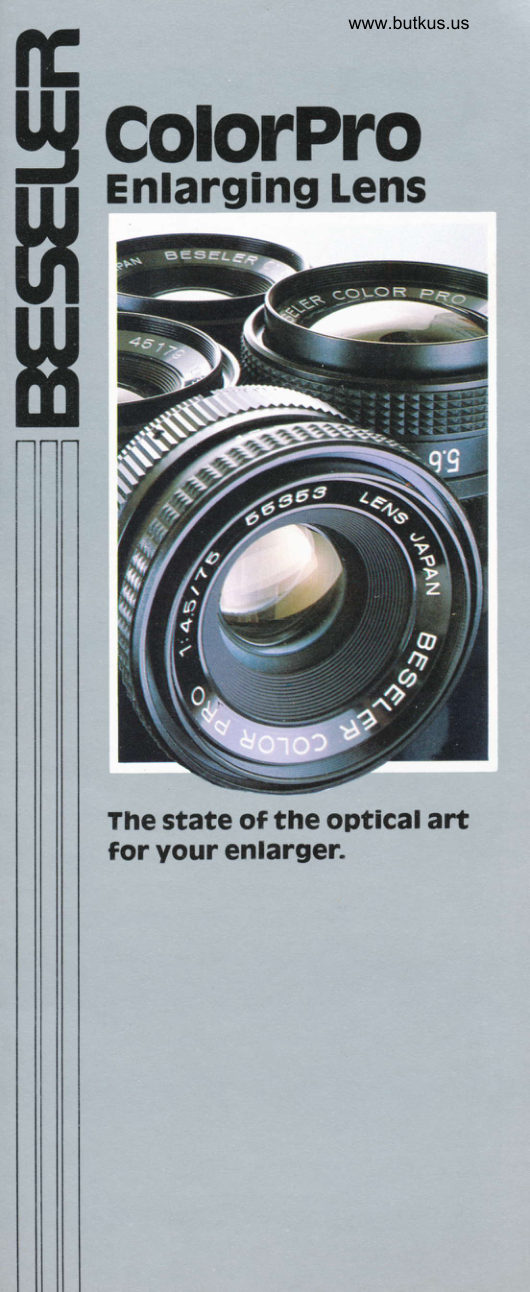
fEg                             www.butkus.us    Enlarging Lens
H
H

ffil
||ll
      The state of the opt:cal aft
       for your enlarger.

lill|

lilill

|lilt
View original page 1Page 2 · Read text
Your prints are only as good as your
enrargrng lens
How much have you invested in lenses for your camera?
Chances are, the answer numbers in the'hundreds or
thousands of dollars. Now then . .  . what's vour investmenr
in enlarging lenses? And how. long ago did you acquire
those lenses (or is it just a lens)?
  Many a serious photographer has been known to insist
on nothing but the very best for his camera. Only to print
the resulting negative or transparency with an ancient
enlarging lens. Or one of dubious quality. And then won-
der why the resulting prints didn't really measure up to
expectations.
  The logic is inescapeable: no matter how great the
original             .is, the print can't be any better than the lens on
your enlarger.
. Beseler is pleased to offer a new series of enlarginglenses designed to complement the finest camera optics.
They. are not simply. very good lenses-they represent
the absolute state of the art in premium quality enlarging
optlcs.
  The name: Beseler ColorPro enlarging lenses. As the
name suggesls. they are color corrected (but equally good
for black-and-white.  of course) and of true professional
quality..lf yo!_own one of today's fine cameras-in any
format from 35mm through 4x5-your camera, and your
talent, deserve a Beseler eolorPro-lens
View original page 2
Page 3 · Read text
www.butkus.us


Beeler ColorPro lens mounted  in Besel€r l€nsboard with pilot light.

What makes an enlarging lens great?
The first quality most photographers would look for in an
enlarging lens is,sharpness. To an optical designer, sharp-
ness is actually the sum of two equally important  factors:
resolution and controst. But that's iust the beqinninq.
  An enlarging lens should also have two qialitieiwhich
are very different from what you'd look for in a camera
lens. It should be optimized for use at relativelv close
working distances-working distances are usually jmatter
of only a few inches or feet (magnifications bei*een 2X
and 20X) whereas a camera leni is desiqned for use at
infinity in most cases. Similarly, the enlar'ging lens must
have a flat field to insure edge to edge sharpness of the
projected image.
View original page 3
Page 4 · Read text
Naturally. a {ast lens is also desirable to make {ocusing
   easier and to keep exposures shor1. This last factor does
  more than just save on time and electricity . . . it helps
  avoid reciprocity failure. a troublesome quirk that can
                              ,f f your pxposure calculatior  rc.,-$row   ,
fu{ Color correctron  is .-urother must. of c()urse. All colors    trtust be tocused in the same plane or color fringing and
   loss of sharpness can result.
     In short. an enlarging lens should have superb resolu
   tion and contrast. a maqnification ranee which matches
   the film format for whiih  it t intendeJ. a fl.it field and
    critical correction of chromatic abenations.And.of course.
    all these qualities should be as even as possible. corner
   to corner. Here's how Beseler ColorPro enlarging lenses
  measure up.

 Why Beseler ColorPro'" lenses are better
  Over the years. several famous names have stood for the
   ultimate in enlarging lens quality. and Beseler has offered
  them all with Beseler enlargers. But now. recent advances
  in optical technology have made it possible to make
   enlarging lenses which set still higher standards. Beseler.
  drawing from years of experience with enlargers and


                                                           Digitally signed by Mike Butkus
                                            DN: cn=Mike Butkus, o, ou=Butkus.org,
                                                email=mike@butkus.org, c=US  Mike Butkus                                                    Date: 2024.12.05 14:30:52 -05'00'


                                                                tl                  Il
           B 4 568
                             |  il  ilil|ililt|


              Sir precisi()n-qround  elenrents in four llrrrrps ,rdd up t{) lhe
                 ullinrale  ail errlarqiilg lens qrralitv.


         F,iqlrt diaphragnr blades-nrore than on nrany rxirer ertlargir)g  lcrlses-pr(,\ide
     a rrxrre ne:rrlv circrlar dl)enrrre.
View original page 4Page 5 · Read text
www.butkus.us

 photographers, has chosen to establish those new bench-
 marks: Beseler ColorPro lenses. fu you'll see in the fol-
 lowing sections, and in the specificition tables on the
 back of this brochure, ColorPro lenses match or exceed
  .Qf.v other.enlarging lens anpvhere. in every departmeryf
 Why Beseler? Well. it helps to have decades-of experienF!
  in enlarging:you learn a lot about what's needed.'We abb'
 had the benefii of the very latest optical glass formula-
 tions, coating techniques and computer design programs.
   But most of all, it was a queition of oble'ctivZs. We
 weren't concerned with cost ceilings or produition quotas;
 our only objective yuas to produte the finest enlarging
 lenses ever made. As it happens, we were able to d-o it
 at a price which is competitive with other premium quality
 enlarging lenses.


 Features you'll ftnd in all Beseler ColorPro'u
 enlarging lenses:
With obvious exceptions such as madmum aperture,
 focal length and design magnification, ColorPro lenses
 from the shortest (50mm) to the longest (135mm) have
 the same basic features and qualitie!. They add up to
 superb enlarging optics!

Human Engineered
 ColorPro lenses are of a veiy special quality, in both
 optical and mechanical terms, human enqineered for
ease      of use.          Check                    the                     diaphragm                                                are                                                         eight                                   blades - th?re of them,         not             three or                             the aperture                   six-so                                                                nea-rly                                                        is more
 c.ircula.r. The aperture ring is rubberized for a sure grifi
 (but it's metal underneath-squeeze  it, it won't bind- as
 plastic would), and Beseler maintains strict control of the
rotational force (torque) required to adjust the aperture,
so the lens operates smoothly throughout                                      the entirfu                                          "are
aperture range. The aperture numbers     exceptional{  illarge and easy to read. Every part is sturdy,-Optically,weil madd
precisely machined for a lifetime of service.           the
lenses are hand assembled, each element individuallv
centered and checked for a precisely aligned optical axii.
As the finishing                 .touch, eacl'r lens is- sup*plied in a plastic
storage case, with lens cap.

Design magnifications in the ranges you need
Any lens is designed with an "optimum conjugate" a
magnification factor at which the lens performl at its verv
best. That factor is somewhere in the'middle of a rano6
in which ihe lens produces excellent results. Colorpio
lenses are designed to work best at the maqnifications
you're most likely to use-and that varies witl-ieach lens.
For example, the 50mm f/2.8 Colorpro, which is ideal
fo.r 35mm.negatives, has an optimum conjugate of 8X,
which would produce a slightly cropped 8x10- print. The
magnification range of thislens is irom 2X to 20X. The
other lenses, which are for larger negatives and trans-
pare.ncies, and therefore require less magnification to
produce standard print sizes, have 5X optimums, with 2X
to 10X ranges.
View original page 5Page 6 · Read text
What lens for what format?
  The focal length of the enlarging lens that's best for any
   given negative or transparency {ormat is.generally. simjlar                      nnormal"   io what'iould be the         camera lens for that for-
   mat. For example. 50mm lenses for the 35mm film for
1fuq31. 75mm lenses for 2\a square. These are the focal
F-- rrqths which deliver the greatest possible degree of mag
 Trifidation. You could use a longerlthan-normal lens (such
   as a 75mm.lens with a 35mm negative)' but you wouldn't
   be able to make very big enlargements.  It could. however.
  be the way to make unusually small prints. Conversely,
   while the use of a shorter than-normal lens will not permit
   coverage of the full format.  it does allow you to. crop in
  on a po.tion of the negative and enlarge it greatly (i.e., a
  50mm lens with a 2ti " negative).
     Beseler ColorPro lenses are made in a wide range of
   focallengths. so that you can always have exactly the right
   lens for any film format. giving you the greatest on-
   baseboard magnification capability.
   Beseler GolorPro Lenses    Film format
          5Omm t/2.8            35mm (24 x 36mm
            7Smml/4.5            2% square (6x6cm)
         9omm t/5.6             2% x2% (6x7cm)
         lOSmm f/5.6               2% x 3% (6x9cm)
          135mm l/5.6                4x5 (9x12cm)


    Specifications and cosmetics subject to change without notice


     ilTBESEI,E;I
           It's Hard to lmagine
     a Darkroom wlthout us.


   Beseler Photo Marketing Co., Inc. 8 Femwood Road' Florham Park, N'J' 07932
   Printed in U.S.A.                               @ 1979 BPM                     7gS-40-22t11B05OMJp
View original page 6Page 7 · Read text
www.butkus.us

How focal length affects print size


  At an elevation of about 24", the    At the same elevation, the 75mm
  50mm ColorPro will yield a lOX    ColorPro will produce a 6X
   magnification (or a slightly cropped      magniftcation  (or a similarly cropped
   8xl0 print) from a 35mm negative.       5x7 print) from a 35mm negative.


Never use a camera lens on your enlarger
As we mentioned above, camera lenses are optimized f.or
use at infinity and for use with three dimensional sub-
jects. An enlarging lens is designed for use at closer work-
ing distances and flat "subjects." So, while it is possible
to mount a camera lens on your enlarger, and you can
make prints with it, those prints won't have the quality
you can get with a ColorPro enlarging lens.


Exceptional color corrections
ColorPro lenses deliver prints from color negatives and
transparencies with all the sharpness that's in the original,
because of state-of-the-art corrections for chromatic aber-
rations. The glasses used arb like those which are found
in apochromatic lenses used for demanding color engrav-
ing applications.
  Equally important, you can focus a ColorPro wide
open, then stop it down as much as you like-it will re-
main in perfect focus. Unfortunately, this is not always
the case with ordinary enlarging lenses.
View original page 7
Page 8 · Read text
Easy to mount on most any enlarger
   ColorPro lenses are equipped with the 39mm Leica
    thread mount which is the world standard. Whether your
    enlarger is a Beseler or some other brand, you'll find your
   new lens easy to mount. If you're purchasing a new en-
rlarger, simply tell your photo dealer you want a Color
Iro     lens, and he'll provide the appropriate lensboard and         nut, if required. The lenses mount easily and are-jam    supplied with a jam nut for this purpose. A close exam-
    ination of even this relatively simple part will tell you a lot
    about the quality of ColorPro lenses: the nut is knurled,
    beautifully machined. No special tools are required for
   mounting. With a few unusual enlargers, adapters may
   be needed.


   Ideal for copy photography too
   True, we said above that camera lenses make poor en-
    larging lenses. But with some subject matter a ColorPro
    enlarging lens may be the best possible choice for your
   camera! Since they are corrected for close working dis-
   tances and for flat subject matter, they are obviously
    ideally suited to copying flat originals. All that's needed is
   a bellows or focusing mount with 39mm adapter. These
    are widely available from camera and accessory makers.
       ColorPro lenses are also well suited to relay lens
    applications in other equipment, photography of fluor-
    escent and CRT images and various projection uses. Con-
     sult with Beseler  if you have such needs.
View original page 8Page 9 · Read text
www.butkus.us
Speed for easy focusing, short exposures
The photoengraving lenses mentioned aboye have-very
smali maximrlm apZrtures -fl9  is typical. But all ColorPro lenses are at least  f 15.6 for easy. precise focusing and
short exposures. The 75mm lens offers even higher f/4.5
speed. while the 50mm is an extremely fast f,/2.81Due to
the reciprocity characteristics of enlarging papers. an ex-
posure of 40 sec. at   f 18 may result in an underexposed
print. while  it would be correct at 20 sec. at  f i5.6-though
in theory the results should be identical. So it's important
to have ample lens speed. (For the technically curious.
this is because papers react to the length of the exposure
as well as the intensity of the light. The resulting disparity
is called reciprocity  failure.)


 Beseler ColorPro'"-the new standard
 Here at Beseler. we re especially pleased to bring you
 these new ColorPro enlarging lenses. for they are the
 finishing touch to our complete array of .Beseler dark
 room elquipment. ColorPro lenses are truly the state of
 the optical art. and the perfect complement to fine
 Beseler enlargers and analyzers. But whatever youl 9n
 larger. you can improve your print quality with a. Color
 PrJ leni  . . . and allit takes is a visit to your Beseler dealer.
View original page 9
Page 10 · Read text
Beseler GolorPro SOmm tl2.a
    Focal Lenqth             5Omm
    Relative aperture                1:2.8
   Aperture range                  t/2.8 lo f/l6, click stops
    Construction                 6 elements in 4 groups
    Standa rd M agnitication       8X
    (Optimum coniugate)
    Maqnification range         2X to 2OX
   Anole of View              460 30'
   Coverage                24x36mm (43.2mmd)
   Rear mounl                 Jt|mm lp=llzo)
    Front mounl               40.5mm (P=O.5mm)
   Weight                       lOOg
Beseler GolorPro 75mm t|4.5
    Focal lenqth             75mm
    Relative aperture                1:4.5
   Aperlure range                                  l/ 4.5 lo f/22, click stops
    Construction                6 elements in 4 groups
   Standard Maqnilication        5X
    Maqnification range         2X to lOX
   Anole ol View               560 40'
   Coverage                6cm x 6cm (84.9mmd)
    Rear mount             39mm (P=1 126)
    Front mount              40.5mm (P=O.5mm)
   Weight                      lOOg
Beseler GolorPro 9omm f/5.6
    Focal length              9Omm
    Relative aperture                1:5.6
    Aperture range                  f/5.6 to f/32, click stops
    Construction                 6 elements in 4 groups
    Standard M aqnif ication       5X
    Maqnification range         2X to lOX
   Anqle ol View               600
   Coverage                6cm x 7cm (92.2mmd)
   Rear mounl             39mm (p=1/26)
    Front mounl               40.5mm (P=O.5mm)
   Weiqhl                      lOOq
Beseler GolorPro 1O5mm t|5.6
    Focal length              lO5mm
    Relative aperlure                1:5.6
    Aperture range                  f/5.6 to f/45, click stops
    Construction                 6 elements in 4 groups
    :ilanoaro Magn|lrcanon       5X
    Magnification range         2X to 1OX
   Anqle of View                     560,
   Coveraoe                6cm x 9cm (1O8.2mmct)
   Rear mount             39mm (P=1/26)
    Front mount              40.5mm (P=O.5mm)
   Weight                    12Os
Beseler ColorPro 135mm f/5.6
    Focal length              135mm
    Relative aoerture                1:5.6
    Aperture range                  l/5.6 to t/45, click stops
    Construction                 6 elemenls in 4 groups
    Standard Magnif ication       5X
    Maonification ranqe         2X to 1OX
   Angle of view                580
   Coveraqe                               4tt x 5t'
   Rear mount             39mm (p=1/26)
    Fronl mount               4O.5mm (P=O.5mm)
   Weiqht                                      1 55q
View original page 10Related documents and language editions
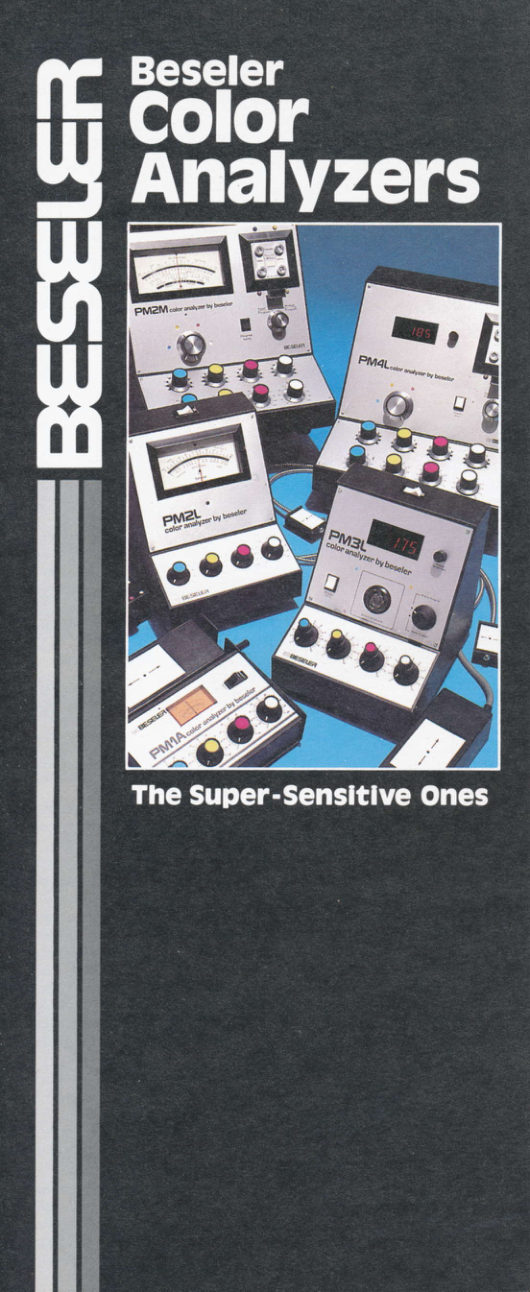
From the M. Butkus archive. Original publisher and archive notices are retained.
Check the model and edition against your equipment.
PDF verified 2026-10-10.