Film cameras
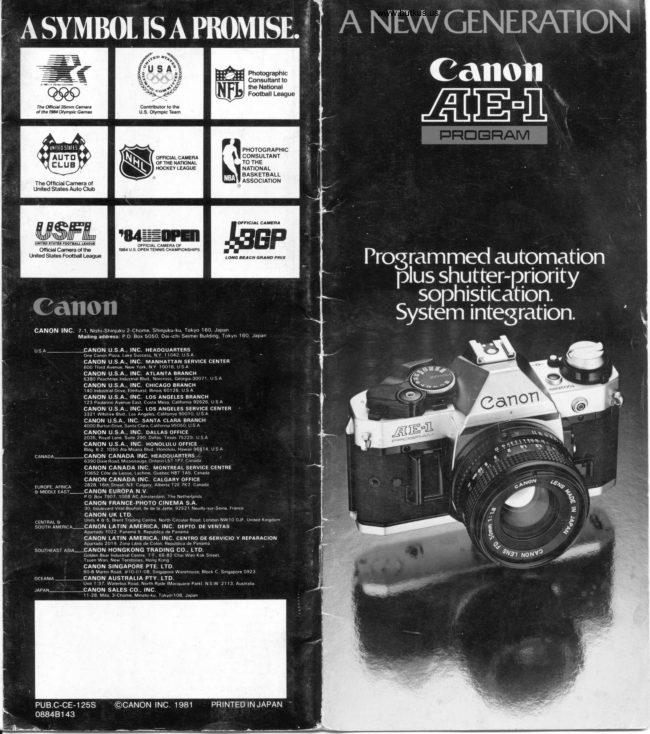
Canon AE-1 Program system booklet- only - color Product booklet
Product booklet for Canon AE-1 Program system booklet- only - color. 20 pages in English. Read the original PDF, download or print a copy without registration.
20 pagesEnglish8.7 MB PDF
Loading your manual…Open PDF directly
Document details
- Brand
- Canon
- Model / document
- Canon AE-1 Program system booklet- only - color
- Document type
- Product booklet
- Language
- English
- Pages
- 20
- File size
- 8.7 MB
- Category
- Film cameras
- Document date
- Not specified in catalog
Search available document text
Find a term, then jump to its page in the original PDF. Image-only pages may not be searchable; check the PDF for exact wording and diagrams.
Page 1 · Read text
www.butkus.us


                            ffiffiili*."


 f,#,ffiffifu
    mrulCffiaottr
Urld  States bbllLe4*
View original page 1Page 6 · Read text
www.butkus.us
Manual                    Programmed AE: ProgrammedHow it CombinationsWorks
                                                                                                                                    ol Shutter Speed and Aper-
                                                                                                                                 ture in Programmed

                                     {::::: ll:)

                                                                                    \


                                                                                                                                               SHUITE R

     With two AE modes (plus Electronic Flash AE), why the                       You've already read how incredably easy-and vel-
need   f or manual control as well, you may ask.                                 satile-the Canon AE-'l PROGRAM  is to use on its Programmed
    One reason is that some photographers still like to do                AE mode.  lt's a joy lor amateur and prof essional altke, because
everything themselves and the other is that the situation (e.9.,                                    it  f rees one   f rom the need to think about either the aperture or
unusual lighting conditions or for special creatlve etfects)                       shutter speed selttng.
sometimes requires  it.                                                Shown above is a line dtagram of programmed combina-
     Manual doesn't mean dif  f icult, however, with the AE-  1                       tions of shutter speed and aperture in Programmed AE mode'
PROGRAM.  First, disengage the lens'aperture ring  f rom the "A"                using a somm  f /1.4 lens. The program responds to changes in
mark. Next, select a shutter speed by turning the shutter speed                 the lighting situation by adjusting the shutter speed and aper-
                                                                                                                                                                                                                                                                                                                                                                                                             f or example, the shutter speedselector dial. Now, depress the shutter release button half way.                    ture. In a very bright situation,
A red "M" will appear in the viewf inder to remind you that you              may be 1/1000 sec. and the aperture f/16. On a cloudyday'on
are on manual mode, while the aperture lhe camera would                      the other hand,  it might be 11125 sec. at f/5.6. In a place so dark
otherwise have chosen will also be displayed. The choice is                      that the aperture is wide open attl1.4, the shutter speed could
yours whether to set this aperture or compensate by over- or                be  f rom  '1 /8 sec. to 1 second.
underexposing the shot.                                                     The AE-1 PROGRAM's meter employs a center-weighted
                                                                        averaging system. This means that the light is measured with
                                                                                    special emphasis on the center portion of the picture lrame
                                                                     where the subiect is most likely to be placed. This portion  is
                                                                                 located lust below the center line of the viewf inder to reduce
                                                                                 the risk ot underexposure    f rom a bright sky or backlighting.
                                                                     The light sensitivity pattern (shown below) remains virtual-
                                                                                                               ly unchanged even when different lenses are used.
View original page 6Page 7 · Read text
Seeing is Believing


       Laser-matte Screen                   Manual Aperlure
                                                   Control LED

                                                 AE                                    fr            Programmed                                                   Control LED                         l:ir{:\
         N,l icroprism n i"s-+,1f;',1                                   t...r I  l::/
                                             Down                                                                                                                          L--'-{                                          Stopped                                                      F<[<l=.:<                                  \':.Yjl./='f*                                         Metering                                                 Index                                                                                                                    New Split Rangetinder                                                                               N,lark                            Conventional                                                                                                                      Split-image Range-tinder                                                                                                                                 I
                   New Solit
                            Rangefinder
                                                                                  wilh the gentle-angled part of the screen. The conventional                          Flash Charge-completion LED Display                                                                                split-image rangef inder employs the single-angled echellette    (with Speedlites 188A and 1 66A: AE Flash Conf irmation Signal)                                                                                   prism. The problem with this system is that the image darkens
                                             Aperture Display                  when slow lenses are used, blackening out at about f/4. With
                                                                            the New Split rangefinder, no darkening occurs even at f/5.6.
                                                                     The surface of the focusing screen itself in the past also
                                                                              contributed to darkening of the image at small apertures.  Until    The AE-1 PROGRAM  is excitingly different. This is your                                                             now the matte's surface particles were rrregularly shaped withimmediate reaction when you look through the viewfinder, since                                                                                 the consequence that light rays striking  it were diff used inall you see is the image which comes in bright and clear as you                                                                                        different directions. Canon hasfocus.                                                                              solved this problem with a unique     But where is the essential exposure information ? The                                                                             laser-matte screen.  lts surf ace tex-answer is: invisible, at least until you need  it, at which time you                                                                                       ture is  f iner and smoother, and thepress the shutter release button halfway. Or the Exposure Pre-                                                                                       particle sizes are different. Lightview Switch. Either way, the information wrll appear in red LED                                                                               rays hitting the surface are lessdigital displays on the right-hand side-well out of the way of                                                                                                                        diff used, so less light is lost. As athe  f ield of view.  lf the picture will be underexposed, the                                                                                        resull the AE-1 PROGRAM's view-appropriate aperture blinks to warn you. And  if the shutter                                                                                    tinder is 50o/o brighter than its pre-speed selected in the programmed mode is 1/30 sec. or slower,                                                                              decessors. And unlike somethe "P" blinks to warn you of camera shake. The brightness of                                                                       makers'matte screens, this newthese LEDs changes according to the brightness of your sub-                                                                              laser-malte screen purposely hasject, so they are always easy to read, no matter what the lighting                                                                   an irregular pattern to solve theconditions.                                                                         oroblem of moi16 effect.         www.butkus.us     This remarkable design is a tribute to Canon's advanced
microelectronics technology. No less important in contributing
to the viewf inder's amazing clarity and brightness, however, are                 The AE- l PROGRAM steps into professional territory withseveral other Canon ootical advances.                                                                             another great feature: interchangeable focusing screens. There
     Foremost among these is the AE-1 PROGRAM's standard                 are eight to choose   f rom. Select the screen which best suits
New Split rangefinder. A world's  f irst, the New Split is made up                 your subject, the maximum aperture of the lens you intend to
of crossed prisms having two angles lined up to form a grating.                  use, and your own creative inclination.The prisms are positioned vertically. When the light beam com-
 ing through a large-aperture lens is broad, the steep-angled
part is used. With a small aperture lens, focusing is performed                         t@l

                                                                         New Spl               A. M,croprrsm          B. New spt't       C. ltt vane                       rt/l\4icroprismEEE


                                                                                  D. t4atte/section H. Matte/scare               l. Double Cross'hair  L. Cross Splil'image,
 Magnilied View ot New Split                                                                                                                                         Reticle
 10                                                                                                        For a description ol the various screens, please see p.27.                               11
View original page 7Page 9 · Read text
Convenient Action Grip         Shutter Release Button
Easy-to-Use Shutter Speed Selector Dial                                A Canon idea designed       A  f inger rest makes the
    More than just a shutter speed dial,lhis selector dial ena-                   to help you keep the camera      sof t-action electro-magnetic
bles you to select your exposure mode. With the lens on "A,"                   rock-steady. This feature and    shutter release even easier to
you can choose either Programmed AE or Shutter-speed                      the raised contour of the bat-     operate.
Priority AE. Shutter speeds can also be selected for manual use                  tery cover provide a  f irm grip
This dial also has a surrounding guard lo prolect againsl acci-                     tor excellent mobillty in action
dental movement.                                                                      siluatrons.


Main Switch and Self-Timer                                                  Long-lasting 6V Battery        Hot Shoe
     Turn this switch to "A," and the camera can be operated.                  A single 6-Volt battery          Matches  all Speedlites
                                                                                                                                                                                                                                                                                                                                                                                                                            f lash photo-Move  it to "L," for lock, and the camera's power  is shut off to                         will power the camera's            for synchronized
                                                                                                                                                                                                                                                                                                                   f unctions for   graphy A" t "intheview-prevent accidental shutter release. Turn  rt to "S" to operate the                 varied electronic
                                                                                                                                                                                                                                                                                                                             f inder lights up to show   f lash1O-sec. self-timer. Press the shutter button and a bee-bee-beep              a vear under normal use.
warning sounds, increasing in  f requency two seconds before                                             charge completion.
shutter release.


                                                                                                                          I


                                                                                                                                                         I


                                                                                      www.butkus.us

                                                                  Stop-down Lever             Winder and Motor Drive Ter-
AE Lock Switch                                                                            "L" shaped lever folds      minals
       Facilitating exposure compensation, the AE Lock Switch                  out for easy depth-of-f ield           These terminals align
 triggers a memory control to  f ree your left hand for focusing or                 preview. Also enables stop-      with the winder contacts to
 steadying the camera. Partially depress the shutter release but-             ped-down metering when        orovide perfect electronic
 ton to meter and press in the AE Lock Switch. Keeping the shut-               using an FL lens or close-up     matching and enable instan-
 ter release button depressed, compose your picture and shoot.               accessories.                   taneous film advance.

14
View original page 9Page 13 · Read text
Taking You To
        Greater Creative Heights


                                               A Different Outlook
                                                                         Angle of View
                                                                     The scene's the same but the area lhat each lens takes in
                                                                                                               is different. The pictures (below left) were taken from the same
                                                                               spot with four lenses of different focal length from 24mm to
                                                              300mm. The shorter the focal length, the wider the area of the
                                                                      scene the lens takes in. Objects within the scene appear small.
                                                                     As the focal length increases, the lens takes in less of the scene
                                                                   and the size of the sublect increases.

                                                                          Perspective
                                                                           With a wide-angle lens you often shoot closer to the sub-
                                                                                          ject than you do with a telephoto lens. This leads to a difference
                                                                                                       in perspective. In order to keep the subject the same size in this
                                                                                    series of photos, the photographer moved progressively  farther
                                                                away each time he switched to a lens with a longer focal length.

                                                                         Angle of View                   Perspective
                                                                      24mm


     The great advantage of SLR cameras is that their lenses
are interchangeable. And the great thing about the AE-1
PROGRAM, in particular, is that  it can be used with one of the
most comprehensive ranges of lenses available today: the
Canon FD Series.
     Covering the entire spectrum from fish-eye to super-
telephoto, the FD Lens Series comprises over 50 superb lenses.
    Compactness and handling ease are two of their vital
characterrstics. Mounting and dismounting are quick and easy.
For the former, align the red dots and give the lens a twist.
When dismounting, merely press the release button located on                                                       www.butkus.us
the lens and twist in the opposite direction. And their reliable                                                                        300mm                   300mmmounting system causes absolutely no wear of the mounting
 surface, no matter how many thousands  of times the lens is
cnangeo.
      Ouality and performance also serve to distinguish Canon
 FD lenses  f rom those of other makers. Since they are manufac-
 tured to meet the same high standards of excellence as
 Canon's cameras, each lens is greatly reliable, providing optimum
 resolution and color reproduction.

2.
View original page 13Page 14 · Read text
www.butkus.us

                                                                                                 indicator), aperture display (appropriate aperture    f lashes to
                                                                        warn of overexposure and underexposure), stopped-down
                                                                           metering index, " I  " mark  (f lash charge-completion
                                                                                                     ind jcator with specif ied Canon   f lash units and auto   f lash
                                                                                        conf irmation signal with Speedlites 188A and 166A)
                                                                                  Dioptric Adjustment:  Built-in eyepiece is adjusted lo slandard
                                                                         - 1.0 diopter.                                                                     Focusing Screen: Standard split-image/microprism
                                                                                   rangefrnder and seven other types of interchangeable
                                                                              screens are optionally available.
                                                                                Light Metering System: Through-the-lens (TTL), Central
                                                                       Emphasis Averaging System by SPC (Silicon Photo Cell).
                                                                         Meter Coupling Range: EV 1 (1 sec attl1.4) to EV 18 (1/1000
                                                                                           sec. at f/16) with ISO/ASA  1 00 film andl l't.4speed lens
                                                                               Film Soeed Scale: ISO/ASA 12 to 3200.
                                                                  Exposure Memory: EV locked in when shutter release button js
                                                                             pressed  half way and the AE lock switch is pressed once.
                                                                          Exposure memorized as long as shutter button is pressed
                                                                                     halfway.
                                                                  Exposure Preview: By pressing shutter button or exposure
                                                                               preview swrtch.
                                                                           Shutter: Cloth, focal plane, 4-spindle, electronically  controlled.
                                                                         With shock and noise absorbers.
                                                                     Main Switch: Three positions: "A," "L," and "S." At "1" all active
                                                                                              circuits are cut olf as a safety feature. "S" position is for self
                                                                                   trmer photography.
                                                                            Shutter Release Button: Two-step, electromagnetic with lock,
                                                                            cable release socket, and  f inger rest.
                                                                                                                                                                "B," and                                                                            Shutter Speed Selector Dial: 2 sec. 1/1000 sec.,
                                                            "PROGRAM" (for programmed AE) With guard
                                                                               Self-timer: Electronically-controlled. Main switch is set to "S."
                                                                                Activated by pressing shutter button. Ten second delay with
                                                                                     electronic "beep beep' sound. Cancelation poss jble.
                                                                  Stop-down Lever: For depth-of  -f ield preview (FD lens) or
                                                                           metering (non FD lens or close-up accessories).
                                                                  Power Source: One 6V alkaline manganese (Eveready [UCAR]
                                                      No 53/),silveroxide (Eveready IUCAR] No 544, JIS 4G13,
                                                                                     Mallory PX 28  ), or lithium (Mallory PX 28 L) battery Battery
                                                                                               lasts about one year under normal use.
                                                                             Battery Check: "Beep-beep" sound when pressing battery
                                                                      check button. Number of beeps per second emitted
                                                                       decreases with power level.
                                                                            Flash Synchronization: X synchronization at 1/60 sec.i M
a'                                                                             synchronization at 1 /30 sec. or slower. Direct contact at
                                                                         accessory shoe for hot shoe flash. PC socket (JlS-B type)
                                                                                  with shock-preventive rim   f or cord type   f lash on  f ront of
Specif ications                                                       Automatic Flash: Full AE flash photography with specif ied
Type: 35mm single-lens ref lex (SLR) carnera with electronically               Canon Speedlites. Shutter speed automatically set. Aperture
    controlled Automatic Exposure (AE) and focal plane shulter.                   automatically controlled according to setting of  f lash when
Exposure Modes: Programmed AE, shutter speed priority AE,                         pilot lamp illuminates.
   AE  f lash photography with specif ied Canon Speedlrtes, and             Back Cover: Opened wjth rewjnd knob. Removable. With
   manual override.                                           memo holder.
Format: 24x 36mm.                                                           Film Advance Lever: Single-stroke 120" throw with 30' stand'
Usable Lenses: Canon FD (for full-aperture metering) and                                  of  f . Ratchet winding possible.
   Canon FL and non-FD (lor stopped-down metering) series                 Film Counter: Additive type. Automatically resets to "S" upon
    lenses.                                                               opening back cover. Counts backwards as  f ilm is rewound.
Standard Lenses: FD 50mm ll1.2,FD 50mm   f /1.4. FD 50mm                Other Safety Devices: Camera will not function when power
    t/1 8                                                                                     level insufficient. Film winding impossible while shutter is in
Lens Mount: Canon breech lock mount.                                            operalron.
Viewfinder: Fixed eye-level pentaprism. Gives 94o/o vertical and             Dimensions:  1 4 1 mm x 88mm x 47.5mm (5'9/16" x 3-7 116" x
     940/o horizontal coverage of the actual picture area with                                      1 - 7/8") body only.
    0.83x magnif ication at inf inity with a slandard lens.                       Weight: 5659 (1 9-1 5/16 ozs.) body only
    Inlormation is displayed in  f orm ol LED digital display to the                     /359 (25-15/16 ozs.) with FD 50mm f/1 8lens
     right ol  f ield of view. Includes "P" mark (programmed AE and
   camera shake warning), "M" mark (manual control                                                      Sub;ect to change without notice.

24                                                                                                                              25
View original page 14Related documents and language editions


From the M. Butkus Camera Manual Library. Original publisher and archive notices are retained.
Check the model and edition against your equipment.
PDF verified 2026-10-10.