Film cameras
Kodak Ektachrome 100 Slide Film User manual
User manual for Kodak Ektachrome 100 Slide Film. 6 pages in English. Read the original PDF, download or print a copy without registration.
6 pagesEnglish0.1 MB PDF
Loading your manual…Open PDF directly
Document details
- Brand
- Kodak
- Model / document
- Kodak Ektachrome 100 Slide Film
- Document type
- User manual
- Language
- English
- Pages
- 6
- File size
- 0.1 MB
- Category
- Film cameras
- Document date
- Not specified in catalog
Search available document text
Find a term, then jump to its page in the original PDF. Image-only pages may not be searchable; check the PDF for exact wording and diagrams.
Page 1 · Read text
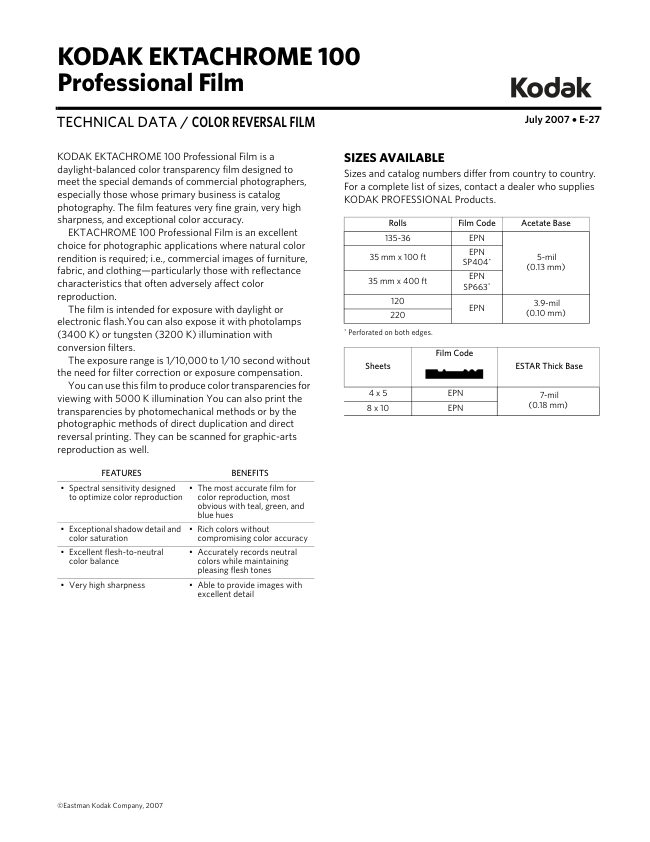
KODAK EKTACHROME 100
Professional Film

TECHNICAL DATA / COLOR REVERSAL FILM                                               July 2007 • E-27


KODAK EKTACHROME 100 Professional Film is a           SIZES AVAILABLE
daylight-balanced color transparency film designed to                                                                Sizes and catalog numbers differ from country to country.
meet the special demands of commercial photographers,                                                              For a complete list of sizes, contact a dealer who supplies
especially those whose primary business is catalog                                          KODAK PROFESSIONAL Products.
photography. The film features very fine grain, very high
sharpness, and exceptional color accuracy.                                        Rolls             Film Code      Acetate Base
  EKTACHROME 100 Professional Film is an excellent                                                                            135-36           EPN
choice for photographic applications where natural color
                                                                               EPN
rendition is required; i.e., commercial images of furniture,             35 mm x 100 ft        SP404*            5-mil
fabric, and clothing—particularly those with reflectance                                                             (0.13 mm)
                                                                               EPN
characteristics that often adversely affect color                      35 mm x 400 ft        SP663*
reproduction.
                                                                          120                                  3.9-mil
                                                                               EPN  The film is intended for exposure with daylight or                                                                                                                          (0.10 mm)                                                                  220
electronic flash.You can also expose it with photolamps
(3400 K) or tungsten (3200 K) illumination with                              * Perforated on both edges.
conversion filters.
                                                                                                 Film Code
  The exposure range is 1/10,000 to 1/10 second without
                                                                         Sheets                         ESTAR Thick Base
the need for filter correction or exposure compensation.
  You can use this film to produce color transparencies for
                                                           4 x 5            EPN                    7-milviewing with 5000 K illumination You can also print the
                                                            8 x 10           EPN                 (0.18 mm)transparencies by photomechanical methods or by the
photographic methods of direct duplication and direct
reversal printing. They can be scanned for graphic-arts
reproduction as well.


         FEATURES                   BENEFITS

 • Spectral sensitivity designed    • The most accurate film for
   to optimize color reproduction    color reproduction, most
                                  obvious with teal, green, and
                                   blue hues

 • Exceptional shadow detail and  • Rich colors without
   color saturation                compromising color accuracy

 • Excellent flesh-to-neutral       • Accurately records neutral
   color balance                     colors while maintaining
                                    pleasing flesh tones

 • Very high sharpness            • Able to provide images with
                                      excellent detail


©Eastman Kodak Company, 2007
View original page 1Page 2 · Read text
STORAGE AND HANDLING                             Electronic Flash
Load and unload film in subdued light.                      Use the appropriate guide number in the table below as a
  Store unexposed film at 13°C (55°F ) or lower, in the             starting point for your equipment. First select the unit
original sealed package. To avoid moisture condensation         output closest to the number given by your flash
on film that has been refrigerated, allow the film to warm         manufacturer. Then find the guide number for feet or
up to room temperature before opening the package.             metres. To determine the lens opening, divide the guide
Process film as soon as possible after exposure.               number by the flash-to-subject distance. If transparencies
  Protect processed film from strong light, and store them         are consistently too thin (overexposed), use a higher guide
in a cool dry place. For more information on storing             number; if they are too dense (underexposed), use a lower
transparencies, see KODAK Publication No. E-30, Storage        number.
and Care of KODAK Photographic Materials—Before and
                                                                                                Guide Number
After Processing.                                                            Unit Output
                                                                           (BCPS)*            Distance in          Distance in
                                                                                                       Feet              Metres
DARKROOM RECOMMENDATIONS                          350             40                   12
Do not use a safelight. Handle unprocessed film in total                500              50                   15
darkness.                                                       700             60                  18

                                                                  1000              70                   21
EXPOSURE                                                     1400              85               26
                                                             2000              100              30
Exposure Index Numbers
                                                              2800               120               36Use the exposure index (EI) numbers below with light
meters or cameras marked for ISO or ASA speeds or                 4000              140              42
exposure indexes. Do not change the film-speed setting               5600               170              50
when metering through a filter. Metering through filters               8000            200             60
may affect light meter accuracy; see your meter or camera                                                                         *BCPS = beam candlepower seconds.
manual for specific information. For critical work, make a
series of test exposures.                                    Multiple Exposures with Electronic Flash
                                             No filter corrections or exposure adjustments are required
                         KODAK
                                                 Exposure           for 1 or 2 flashes (multipops). For additional multipops, see          Light Source          WRATTEN
                                                     Index           the adjustments in the table below.                                    Gelatin Filter

 Daylight or Electronic Flash         None           100
                                                                       KODAK Color
 Photolamp (3400 K)               No. 80B          32                  Number of           Compensating      Exposure
                                                                                   Flashes                              Adjustment
 Tungsten (3200 K)                 No. 80A          25                                                               Filter
                                                                                                          1 or 2               None          None
Daylight                                                         4             CC025M        +1/3 stop
Use the exposures in the table below for average frontlit                                                                   8             CC05M         +1/2 stop
subjects from 2 hours after sunrise to 2 hours before
                                                                                   16             CC05M        +2/3 stop
sunset.


                                Shutter Speed       Lens
      Lighting Conditions
                                (second)       Opening

 Bright /hazy sun on               1/125           f/22
 light sand or snow

 Bright or hazy sun,                1/125            f/16*
 distinct shadows

 Weak, hazy sun, soft               1/125              f/11
 shadows

 Cloudy bright, no shadows         1/125            f/8

 Heavy overcast, open shade†       1/125            f/5.6

* Use f/8 for back-lit close-up subjects.
† Subject shaded from the sun but lit by a large area of clear sky.


2                                           KODAK EKTACHROME 100 Professional Film • E-27
View original page 2Page 3 · Read text
Fluorescent and High-Intensity Discharge Lamps         Adjustments for Long and Short Exposures
Use the color-compensating filters and exposure            No filter correction or exposure adjustment is required for
adjustments below as starting points to expose this film         exposures from 1/10,000 to 1/10 second. At 1 second, use
under fluorescent or high-intensity discharge lamps. For         a CC05M filter and increase exposure by 1/3 stop. We do
critical applications, make a series of test exposures under        not recommend exposure times longer than 1 second. At
your actual conditions.                                          longer exposures, significant color balance shifts in the
  To avoid the brightness and color variations that occur         cyan-green direction or contrast mismatch may occur.
during a single alternating-current cycle, use exposure                                                           Note: This information applies only when the film is
times of 1/60 second or longer with fluorescent lamps;                                                        exposed to daylight. The data are based on average
with high-intensity discharge lamps, use exposure times of                                                           emulsions rounded to the nearest 1/3 stop and assume
1/125 second or longer.                                                         normal recommended processing. Use the data only as a
                                                                  guide. For critical applications, make tests under your
                     KODAK Color
        Fluorescent                              Exposure            conditions.                           Compensating
        Lamps                              Adjustment
                                          Filters
 Daylight                     50R           +11/3 stops      PROCESSING
 White                  40M         +2/3 stop
                                                             Process KODAK EKTACHROME 100 Professional Film in
 Warm White              20C + 40M          +1 stop                                          KODAK Chemicals, Process E-6.
 Warm White Deluxe         30B + 30C        +2 stops             For consistent processing of this and other KODAK
 Cool White             40M + 10Y          +1 stop        EKTACHROME Films, use a lab that is a member of the
 Cool White Deluxe          20C + 10M       +2/3 stop       KODAK Q-LAB Process Monitoring Service.

 Unknown Fluorescent *        30M         +2/3 stop

*When the type of fluorescent lamp is unknown, try this filter and exposure      RETOUCHING
 adjustment; color rendition may be less than optimum.
                                                    Use KODAK E-6 Transparency Retouching Dyes. You can
                      KODAK Color                        chemically retouch sheet and 120/220 formats of
        High-Intensity                             Exposure
                            Compensating
      Discharge Lamps                                              Adjustment      EKTACHROME 100 Professional Film on both the base and
                                            Filters
                                                              the emulsion side. Retouch only the emulsion side of the
 General Electric Lucalox *       80B + 20C      +21/3 stops        135 size.
 General Electric Multi-Vapor     20R + 20M      +2/3 stop            For information on retouching equipment, supplies, and
 Deluxe White Mercury         30R + 30M       +11/3 stops         techniques, see KODAK Publication No. E-68, Retouching
 Clear Mercury                  70R         +12/3 stops          Color Transparencies on KODAK EKTACHROME Film.

*This is a high-pressure sodium-vapor lamp. The information here may not
 apply to other manufacturers' high-pressure sodium-vapor lamps due to
 differences in spectral characteristics.
Note: Consult the manufacturer of high-intensity lamps for
ozone ventilation requirements and safety information on
ultraviolet radiation.

  Some primary color filters were used in the previous
tables to reduce the number of filters and keep the
exposure adjustment to a minimum. Red filters were
substituted for equivalent filtration in magenta and yellow.
Blue filters were substituted for equivalent filtration in cyan
and magenta.


KODAK EKTACHROME 100 Professional Film • E-27                                                       3
View original page 3Page 4 · Read text
PRINTING TRANSPARENCIES                SCANNING TRANSPARENCIES
You can reproduce images made on KODAK                   For Graphic Arts Applications
EKTACHROME 100 Professional Film by using a variety of       The KODAK EKTACHROME Film family is characterized by
Kodak materials.                                                 sets of image dyes which perform similarly when scanned.
                                                     The scanner operator can set up one basic tone scale and
Duplicate Color Transparencies                               color-correction channel for all EKTACHROME Films and
For direct printing, use—                                     then optimize the tone scale and gray balance for the
  KODAK PROFESSIONAL EKTACHROME Duplicating          requirements of individual images.
   Film EDUPE                                          Use the KODAK Color Input Target / Q-60E1
                                                        (4 x 5-inch transparency) or Q-60E3A (35 mm slide) to
Color Prints                                                      establish the setup for KODAK EKTACHROME Films on all
You can scan your image to a file and print digitally to—           scanners. This target meets ANSI standards and
  KODAK PROFESSIONAL PORTRA, SUPRA, and ULTRA         represents the dye sets of all EKTACHROME Films.
  ENDURA Papers
                                                    Scanning for Photo CD Applications  KODAK PROFESSIONAL ENDURA Clear Digital Display
                                                                For Output to a Photo CD Player: Using the Universal E-6   Material
                                                                Film Term should result in an image that closely matches
  KODAK PROFESSIONAL ENDURA Transparency                                                            your original transparency in density, tone scale, and
   Display Material                                                                       overall color balance when viewed on a player. Use the
  KODAK PROFESSIONAL ENDURA Metallic Paper             Universal E-6 Film Term to scan all KODAK EKTACHROME
                                                                    films for Photo CD Imaging Workstation applications.
                                                                For Output to Devices Other than Photo CD Players:
                                                    The YCC data that results when using the Universal E-6
                                                               Film Term is capable of producing a high-quality duplicate
                                                                   of your original in terms of density, tone scale, and color
                                                                reproduction. Final quality of your reproduced image
                                                       depends on the capabilities of your output device, the
                                                             viewing environment, and the rendering path that is used.


4                                           KODAK EKTACHROME 100 Professional Film • E-27
View original page 4Page 6 · Read text
KODAK EKTACHROME 100 Professional Film


 MORE INFORMATION
  Kodak has many publications to assist you with                      For the latest version of technical support publications for KODAK
  information on Kodak products, equipment, and materials.              PROFESSIONAL Products, visit Kodak on-line at:
    The following publications are available from Kodak                        http://www.kodak.com/go/professional
  customer service, or from dealers who sell Kodak products,                                                                                                                          If you have questions about KODAK PROFESSIONAL Products,
  or you can contact Kodak in your country for more                                                                                                                               call Kodak.
  information.                                                                                                                 In the U.S.A.:
                                                                               1-800-242-2424, Ext. 19, Monday–Friday
   E-8        KODAK EKTACHROME 64 Professional Film
                                                                         9 a.m.–7 p.m. (Eastern time)
   E-28        KODAK PROFESSIONAL EKTACHROME Film E200
                                                                                                                   In Canada:
   E-30           Storage and Care of KODAK Photographic                                                                                   1-800-465-6325, Monday–Friday
                  Materials—Before and After Processing
                                                                         8 a.m.–5 p.m. (Eastern time)
   E-68          Retouching Transparencies on KODAK EKTACHROME
                    Film                                                             Note: The Kodak materials described in this publication for
   E103RF      KODAK PROFESSIONAL Color Reversal Films              use with KODAK EKTACHROME 100 Professional Film are
    E-113       KODAK EKTACHROME 100 Plus Professional Film            available from dealers who supply KODAK
   E-130       KODAK EKTACHROME 64T Professional Film           PROFESSIONAL Products. You can use other materials,
   E-144       KODAK EKTACHROME 160T Professional Film             but you may not obtain similar results.

   E-145       KODAK EKTACHROME 320T Professional Film

   E-147       KODAK EKTACHROME P1600 Professional Film

    E-161       KODAK EKTACHROME 400X Professional Film

   E-163       KODAK PROFESSIONAL EKTACHROME Film E100VS

   E-4024      KODAK PROFESSIONAL EKTACHROME Films E100G
                 and E100GX

   E-2529      KODAK PROFESSIONAL EKTACHROME Duplicating
                    Film EDUPE

   Z-119          Using KODAK Chemicals, Process E-6


Kodak, Kodak Professional, Ektachrome, Endura, Estar, Q-Lab, Portra, Supra, Ultra, and
Wratten are trademarks.


Minor Revision 7-07
Printed in U.S.A.


KODAK EKTACHROME 100
Professional Film
KODAK Publication No. E-27


Film & Photofinishing Systems Group
EASTMAN KODAK COMPANY • ROCHESTER, NY 14650
View original page 6Related documents and language editions
From the M. Butkus archive. Original publisher and archive notices are retained.
Check the model and edition against your equipment.
PDF verified 2026-10-10.