Film cameras
Kodak Vericolor Slide Film User manual
User manual for Kodak Vericolor Slide Film. 4 pages in English. Read the original PDF, download or print a copy without registration.
4 pagesEnglish0.0 MB PDF
Loading your manual…Open PDF directly
Document details
- Brand
- Kodak
- Model / document
- Kodak Vericolor Slide Film
- Document type
- User manual
- Language
- English
- Pages
- 4
- File size
- 0.0 MB
- Category
- Film cameras
- Document date
- Not specified in catalog
Search available document text
Find a term, then jump to its page in the original PDF. Image-only pages may not be searchable; check the PDF for exact wording and diagrams.
Page 1 · Read text
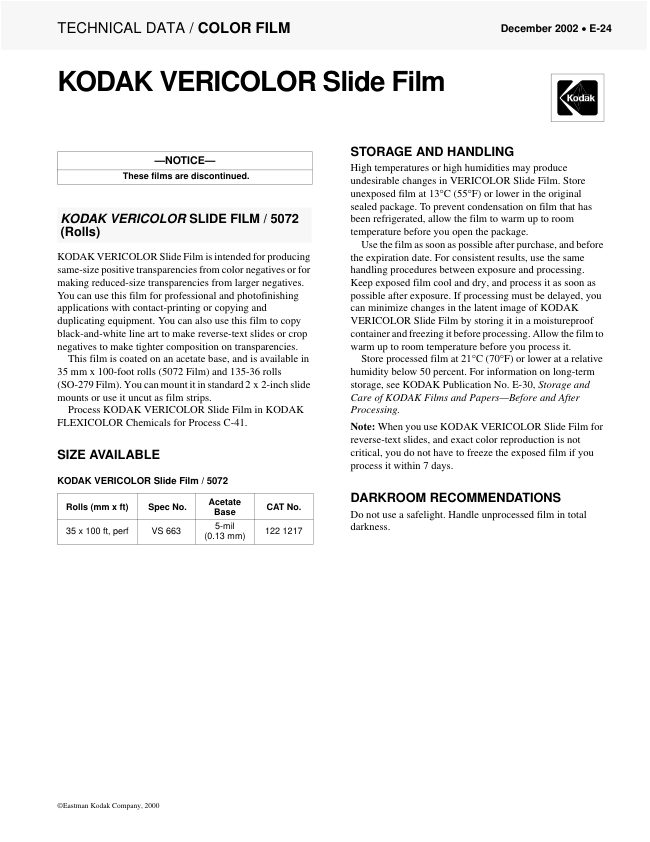
• E-24TECHNICAL DATA / COLOR FILM                                 December 2002

KODAK VERICOLOR Slide Film


                                 STORAGE AND HANDLING
             —NOTICE—                                                       High temperatures or high humidities may produce
             These films are discontinued.                                                                  undesirable changes in VERICOLOR Slide Film. Store
                                                          unexposed film at 13°C (55°F) or lower in the original
                                                                  sealed package. To prevent condensation on film that has
KODAK VERICOLOR SLIDE FILM / 5072          been refrigerated, allow the film to warm up to room
 (Rolls)                                                      temperature before you open the package.
                                                       Use the film as soon as possible after purchase, and before
KODAK VERICOLOR Slide Film is intended for producing         the expiration date. For consistent results, use the same
same-size positive transparencies from color negatives or for         handling procedures between exposure and processing.
making reduced-size transparencies from larger negatives.        Keep exposed film cool and dry, and process it as soon as
You can use this film for professional and photofinishing            possible after exposure. If processing must be delayed, you
applications with contact-printing or copying and                 can minimize changes in the latent image of KODAK
duplicating equipment. You can also use this film to copy       VERICOLOR Slide Film by storing it in a moistureproof
black-and-white line art to make reverse-text slides or crop          container and freezing it before processing. Allow the film to
negatives to make tighter composition on transparencies.         warm up to room temperature before you process it.
  This film is coated on an acetate base, and is available in            Store processed film at 21°C (70°F) or lower at a relative
35 mm x 100-foot rolls (5072 Film) and 135-36 rolls              humidity below 50 percent. For information on long-term
(SO-279 Film). You can mount it in standard 2 x 2-inch slide          storage, see KODAK Publication No. E-30, Storage and
mounts or use it uncut as film strips.                          Care of KODAK Films and Papers—Before and After
  Process KODAK VERICOLOR Slide Film in KODAK          Processing.
FLEXICOLOR Chemicals for Process C-41.                                                           Note: When you use KODAK VERICOLOR Slide Film for
                                                                      reverse-text slides, and exact color reproduction is not
SIZE AVAILABLE                                                     critical, you do not have to freeze the exposed film if you
                                                                 process it within 7 days.
KODAK VERICOLOR Slide Film / 5072
                                Acetate            DARKROOM RECOMMENDATIONS  Rolls (mm x ft)    Spec No.             CAT No.
                             Base                  Do not use a safelight. Handle unprocessed film in total
                                        5-mil                          darkness.  35 x 100 ft, perf    VS 663                 122 1217                                    (0.13 mm)


©Eastman Kodak Company, 2000
View original page 1Page 2 · Read text
EXPOSURE                                  Using KODAK WRATTEN Gelatin Filters
Equipment                                          Use an Exposure Index (EI) of 8 with no filters over the light
                                                                    source. Place the WRATTEN Gelatin Filter over the lens.Expose this film with optical- or contact-printing equipment.
For large-scale production, you can use printers and copying
equipment modified for production applications.                    Background    KODAK WRATTEN     Exposure                                                                 Color in Slide      Gelatin Filter No.     Adjustment*
  Use exposing equipment that has a tungsten-halogen
                                                             Red-brown              None               0(3200 K) light source, a heat-absorbing glass, an ultraviolet
absorber (such as a KODAK WRATTEN Gelatin Filter              Purple                    12             2 stops                                                                                      (deep yellow)No. 2B or a KODAK Color Printing Filter CP2B), and
                                                                                 12 + 85Bbuilt-in dichroic filters.                                         Dark blue                                2 stops                                                                                   (deep yellow + amber)
                                                                                    29
Printing Color Negatives and Internegatives          Cyan                (deep red tricolor)       4 stops
KODAK VERICOLOR Slide Film is intended for exposure                                                                              34A
times of 1⁄4 second to 8 seconds. Set the illumination level           Dark green                     (violet)            4 stops
at the exposure plane to 16 footcandles (172 lux) without a                                                                              38A
negative or filters in the light beam. Use an initial exposure        Red                           (blue)            4 stops
time between 1 and 4 seconds.                                                          44                                                           Orange                                  4 stops  To print negatives made on Kodak color films onto                                                  (light blue-green)
VERICOLOR Slide Film, use a starting filter pack of                                       47                                                              Dark Yellow                               4 stops20M + 30Y. Negatives made on daylight-balanced films                                        (blue tricolor)
exposed with tungsten light will require more yellow                                       61                                                           Magenta                                 4 stops
filtration.                                                                           (deep green tricolor)
  The filter pack is based on average emulsions of KODAK              * You can increase exposure by extending the exposure time, as long as
VERICOLOR Slide Film. See the film carton for                                               it does not exceed 8 seconds.
supplementary information on each emulsion. This
                                             Using Color Compensating Filtersinformation includes starting filter-pack and aperture
                                                     Use an Exposure Index (EI) of 2 with a filter pack ofadjustments. The aperture adjustment includes the exposure
                                                CP60R + CP50 over the light source. Place theadjustment required for the filters.
                                                               color-compensating filters over the lens.  Because of the variables involved in producing
internegatives from different types of transparency films,
                                                            KODAK Colormake tests to determine the best filter pack for printing               Background                      Exposure                                                                          Compensating
internegatives onto KODAK VERICOLOR Slide Film. Start           Color in Slide           Filter        Adjustment*
with a filter pack that produces successful results in printing                                                           Magenta             75G           1 stop
original camera negatives and adjust filtration and exposure                                                                  Blue               50R + 50Y          11⁄2 stops
as required.
                                                         Cyan              70R + 05Y          0
Making Reverse-Text Slides                              Dark green           50M           1 stop
You can use KODAK VERICOLOR Slide Film to produce           Yellow-orange        90B + 40C        2 stops
reverse-text slides with white or near-white letters on a dark                        Remove the CP
or colored background. To make a reverse-text slide,                                                          filter pack from                                                              Dark red             the light source.        0
photograph dark letters on white background with color                           Add 90C + 20G in
compensating filters over the lens. For backgrounds of                                          front of the lens.
various colors, use the filters and exposures given in the                                                                                                * You can increase exposure by extending the exposure time, as
tables below.                                                                  long as it does not exceed 8 seconds.
  Use a 3200 K light source. To determine the shutter speed
and lens aperture for exposure, use an incident-light meter     PROCESSING
set at the exposure index indicated below. When you add the
                                                               Process KODAK VERICOLOR Slide Film in KODAKfilters in front of the camera lens, increase the exposure as
                                            FLEXICOLOR Chemicals for Process C-41. Do not processshown in the tables. Make an exposure series of at least
                                                                            this film in washless minilab process cycles, i.e., Process±1 stop in 1⁄2-stop increments. Keep the exposure time
                                                    C-41B and C-41RA. This film is of an older design thatbetween 1 and 8 seconds.
                                                                     requires a stabilizing agent for image stability. Process this
Note: Reverse-text slides exposed with KODAK                    film only in a processor that uses KODAK FLEXICOLOR
WRATTEN Gelatin Filters usually have more saturated              Stabilizer III and Replenisher.
colors than slides made with KODAK Color Compensating          For information on processing, see KODAK Publication
Filters.                                                   No. Z-131, Using KODAK FLEXICOLOR Chemicals.


2                                                KODAK VERICOLOR Slide Film • E-24
View original page 2Page 3 · Read text
Note: You can freeze exposed KODAK VERICOLOR PrintKODAK VERICOLOR PRINT FILM / 4111                                                           Film to minimize changes. If you cannot process this film
 (Sheets)                                                                 within 4 hours after exposing it, store it in a moistureproof
                                                                   container and freeze it to avoid changes in the latent image.
KODAK VERICOLOR Print Film is intended for producing                                                       Allow the film to warm up to room temperature before you
positive transparencies from color negatives and                                                                process it.
internegatives for displays or photo mechanical
reproduction. This film has a dimensionally stable 7-mil
ESTAR Thick Base with a retouching surface on both sides.    DARKROOM RECOMMEDATIONS
                                             Do not use a safelight. Handle unprocessed film in total
SIZES AVAILABLE                                         darkness.

KODAK VERICOLOR Print Film / 4111              EXPOSURE
                        ESTAR Thick               Equipment   Rolls (in. x ft)    Spec No.              CAT No.
                             Base                     Use exposing equipment that has a tungten-halogen
     40 x 100                          7-mil      122 2223         (3200 K) light source, a heat-absorbing glass, and                    351     50 x 100                      (0.18 mm)    122 2249           untraviolet-absorbing filter (such as a KODAK WRATTEN
                                                                  Gelatin Filter No. 2B or a KODAK Color Printing Filter
                                                        CP2B), and built-in dichroic filters.
                      Size    ESTAR Thick     Sheets                          CAT No.                     (Inches)      Base                     Printing Color Negatives and Internegatives
       10           4 x 5                  122 1357      KODAK VERICOLOR Print Film is intended for exposures
       10          8 x 10                  122 1373          times of 1 to 20 seconds. Set the illumination at the exposure
                                                                plane at 2 footcandles (22 lux) without a negative or filters in       50          8 x 10          7-mil      122 1399
                                                                    the light beam. Use an initial exposure time between 1 and       50          10 x 10      (0.18 mm)    122 1415
                                                       15 seconds.       10          11 x 14                 122 1431                                                    To print negatives made on Kodak color films onto
       10          20 x 24                 122 1472                                           VERICOLOR Print Film, use a starting filter pack of
                                            20M + 30Y. Negatives made on daylight-balanced films
STORAGE AND HANDLING                          exposed with tungsten light will require more yellow
High temperatures or high humidities may produce                     filtration. Push processed negatives may require a different
undesirable changes in these films. Store unexposed film at            filter pack.
13°C (55°F) or lower in the original sealed package. To             These filter packs are based on average emulsions of
prevent condensation on film that has been refrigerated,        VERICOLOR Print Film. See the film carton for
allow the film to warm up to room temperature before you         supplementary information on each emulsion. The
open the package.                                                information lists filter and includes aperture adjustments for
  Use the film as soon as possible after purchase, and before         times of 10 and 120 seconds. The aperture adjustment
the expiration date. For consistent results, use the same             includes the exposure adjustment required for the filters.
handling procedures between exposure and processing.             Use these recommendations as a guide for making trial
Keep exposed film cool and dry, and process it as soon as           exposures. For best tone rendering and color balance, make
possible after exposure.                                         a test transparency from each type of film negative. View the
  Store processed film at 21°C (70°F) or lower at a relative           test tranparencies on a illuminator that has the same color
humidity below 50 percent. For information on long-term            quality and brightness as the illuminator you will use to
storage, see KODAK Publication No. E-30, Storage and            display or view the finished transparencies.
Care of KODAK Films and Papers—Before and After               Because of the variables involved in producing
Processing.                                                         internegatives from different types of transparency films,
                                                   make test to determine the best filter pack for printing
                                                                     internegatives onto KODAK VERICOLOR Print Film. Start
                                                              with a filter pack that produces successful results in printing
                                                                       original camera negatives and adjust filtration and exposure
                                                                  as required.


KODAK VERICOLOR Slide Film • E-24                                                             3
View original page 3Page 4 · Read text
KODAK VERICOLOR Slide Film


PROCESSING                      MORE INFORMATION
Process KODAK VERICOLOR Print Film in KODAK           Kodak has many publications to assist you with information
FLEXICOLOR Chemicals for Process C-41. Do not process        on Kodak products, equipment, and materials.
this film in washless minilab process cycles, i.e., Process           The following publications are available from Kodak
C-41B and C-41RA. This film is of an older design that            customer service, or from dealers who sell Kodak products,
requires a stabilizing agent for image stability. Process this          or you can contact Kodak in your country for more
film only in a processor that uses KODAK FLEXICOLOR          information.
Stabilizer III and Replenisher.
  For information on processing, see KODAK Publication          E-30    Storage and Handling of KODAK Films and Papers—
                                                                            Before and After ProcessingNo. Z-131, Using KODAK FLEXICOLOR Chemicals at
www.kodak.com/go/photochemicals.                            Z-131   Using KODAK FLEXICOLOR Chemicals
                                                           Note: The Kodak materials described in this publication for
RETOUCHING                                            use with KODAK VERICOLOR Films are available from
                                                                    dealers who supply KODAK PROFESSIONAL Products.Use KODAK E-6 Transparency Retouching Dyes or
                                                You can use other materials, but you may not obtain similarKODAK Liquid Retouching Colors to retouch
                                                                             results.transparencies made on KODAK VERICOLOR Print Film.
Note: Although both types of dyes will produce a good
visual match, neither will perfectly match the image dyes of
KODAK VERICOLOR Print Film; therefore, you may
notice a slight mismatch in photomechanical reproductions
of the transparencies. Also, when retouched transparencies
are used in displays for an extended period of time, the
retouching dyes and image dyes may not change a the same
rate.


KODAK VERICOLOR Slide Film                 Kodak, Estar, Flexicolor, Vericolor, and Wratten are trademarks.                Minor Revision 12-02
KODAK Publication No. E-24                                                                                                             Printed in U.S.A.
CAT 000 0000
View original page 4Related documents and language editions
From the M. Butkus archive. Original publisher and archive notices are retained.
Check the model and edition against your equipment.
PDF verified 2026-10-10.