Film cameras
Konica FP-1 Program scanned from book User manual
User manual for Konica FP-1 Program scanned from book. 35 pages in English. Read the original PDF, download or print a copy without registration.
35 pagesEnglish4.9 MB PDF
Loading your manual…Open PDF directly
Document details
- Brand
- Konica
- Model / document
- Konica FP-1 Program scanned from book
- Document type
- User manual
- Language
- English
- Pages
- 35
- File size
- 4.9 MB
- Category
- Film cameras
- Document date
- Not specified in catalog
Search available document text
Find a term, then jump to its page in the original PDF. Image-only pages may not be searchable; check the PDF for exact wording and diagrams.
Page 3 · Read text
www.butkus.us

@'@Olt ol Fcur        ln Foo!


Fotografering steg tair stog           Pasos para fotografiar
l. Liigg  i batteri.                             l. Colocar las pila.
2. Liigg  i en filmrulle.                2. Colocar un rollo de pelicula.
3. Stell in filmkdnsligheten (ASA).      3. Ajustar la ASA sensibilidad de la
4. Stdll in pi AE-mdrket.                        pelicula.
5. Rikta in Kameran och stfrll in   4. Ajustar la posici6n AE.
    avstindet.                       5. Enfocar y encuadrar.
6. Tryck ldtt pi avtryckaren och   6. Presionar ligeramente el bot6n
    kontrollera korrekt exponering.           disparador y asegurarse de la cor-
7. Spola tillbaka den f,Jirdigex-               recta exposici6n.
   ponerade filmen.                   7. Rebobinar la pelicula cuando ha
                                        completamente expuesta.
View original page 3Page 7 · Read text
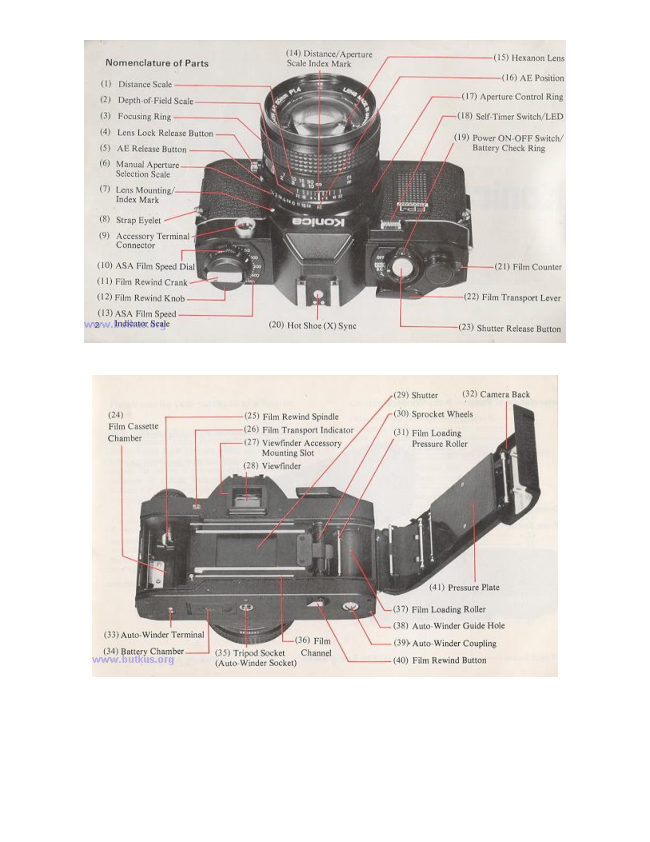
Bezeichnung der Einzelteile     Nomenclature des pieces     Delarnas namn               Nomenclature de las partes
  (l)   Entfernungsskala                                  (l)   Echelle des distances                            (l)  Avstendsskala                                   (l)  Excala de distancia
 (2)  Schdrfentietenskala                           (2)  Echelle de profondeur de champ           (2)  Skala fijr skiirpedjup                       (2)  Escala de profundidad de campo
 (3)  Entfernungseinstelling                         (3)  Bague de mise au point                    (3)  Ring  ftir avstindsinstiillning                (3)  Anillo de enfoque
 (4)  Sperrtaste fiir                               (4)  Bouton de d6verrouillage de               (4)  Lisspdrr vid byte av objektiv             (4)  Boton de desbloqueo de la lente       Wechselobjekrive                                       I'objectif                                       (5)  Spiirrknapp  ftir AE automatik              (s)  Boton desbloqueo AE     ffi (5)  Arretierung  fi.ir automatische               (5)  Bouton de blocage automatique           (6)  Skala lor manuell bldndare                 (6)  Escala de seleccion de apertura ma-     5
      Blendensteuerung                            (6)  Echelle des diaphragmes                     (7)  lndex  frjr objektivets pesdttning och            nual
 (6)  Skala fiir manuelle                          (7)  Repire de montage,/                             avtagnlng                                     (7)  Indice de montaje de la lente
       Blendeneinstellung                        d6montage I'objectif                            (8)  Ogla  fiir birrem                            (8)  Ojal de la correa
 (7)  Index zum Einsetzen  der                     (8)  Boucle du boitier                 -       (e)   Tillbeh<irsuttag                                (e)  Conexi6n terminal de accesorios
       Wechselobjektive                                 (e)   Prise multiple                                                      ( l0)   Instdllningsring  ftir filmhastighet               ( l0)  Dial de sensibilidad de la pelicula
 (8) Ose fiir Tragriemen                                           ( l0)  56lecteur de sensibilit6                      (ASA)                                                (ll)   Manivela de rebobinado de  la
 (9)  FernbedienungsanschluB                     {l l)  Manivelle de rebobinage                        (l l)  Vev ftir filmiterspolning                            pelicula
(10)  Einstellrad  fiir Filmempfindlichkeit       (t2)  Bouton de rebobinage                    (12)  Aterspolningsknapp                  (12) Boton de rebobinado de la pelicula
(l l)  Kurbel fiir Filmriickspulung                   (l 3)  Echelle de sensibilite                                         ( l3)  Skala fdr filmhastigheter (ASA)        (13)  Escala indicadora de sensibilidad  de
(12)  Filmriickspulknopf                                             ( l4)  Index des distances  et des                             ( I4)  Index  fiir avstend/blendare                     la pelicula (ASA)
(13) Skala fiir Film-                              diaphragmes                                  (15)  Hexanon objektiv                                             ( l4)   Indice de escala de
      empfindlichkeit (ASA)                                     ( l5)  Objectif Hexanon                                               ( l6)  AE-markering                                  distancia/abertura
(14) Eimstellindex  fi.ir                                               ( l6)  Repdre d'automatisme                      (17)  Ring lor bliindarinstiillning                        (l 5)  Lente Hexanon
      Entfernung und Blende                  (17)  Bague des diaphragmes                                    ( l8)   Sjiilvutl<isare                                                         ( l6)  Posicion AE
(15) Hexanon-Objektiv                                             ( l8)  Retardateur                               (le)  Ring for till/frip-66[6pp|;nt  o.5          ( l7)  Anillo de control de abertura
(16) Automatische                             (le)   Interrupteur de mise sous,Aors                   batterikontroll                            (18)   Interruptor  del
       Blendeneinstellung  (AE)                       tension et bague de contr6le de         (20)  Blixtkontakt (direktkontakt)                  autodisparador/LED
(17)  Blendeneinstellring                           charge de pile                                   (2 1)   Bildriikneverk                             (le)  Anillo de interruptor de
(18)  Selbstauslciser mit                       (20)  Contact de synchronisation              (22)  Filmtransportarm                          encendido/apagado y estado pila
      Leuchtdiodenanzeige                      (2t)  Compteur de vues                          (23)   Avtryckare                               (20)  Contacto de zapata (X)
( I 9)  StromversorgungsschalterT                 (22)  Levier d'armement                                                                         sincronizado
       Batteriepriifring                              (23 )  D6clencheur                                                                                                  (2 1)  Contador de pelicula
(20) Zubehcirschuh mit Blitz                                                                                                                  (22)  Palanca de transporte la pelicula
      Mittenkontakt (X Synch)                                                                                                                 (23)  Boton del disparador
(21)  Filmziihlwerk
(22) Filmtransporthebel
(23) VerschluBausltiseknopf
View original page 7Page 10 · Read text
www.butkus.us


How to Use the Strap (P.221
Verwendung des Tragriemen
(s. 37)
Mise en place de la courroie
(P.53)
Montering av biirremmen
(s, 69)
C6mo usar el estuche y
la correa (P, 831


Mounting and Dismounting
ol Lens (P. 22)
Einsetzen und Abnehmen
eines Objektivs (S, 37)
Montage et d6montage
de l'objectif (P. 53)
Objektivets pA-och
avmontsring (S, 69)
Montaje y desmontaje
de lente (P, 83)
View original page 10
Page 11 · Read text
A
                    @ f nserting Battory lP. 221
Einsetzen der Batterie (S,37)
Mise en place des pile (P. 531ls6ttning av batteri (S. 691  @       @
Colocaci6n de pila (P. 83)      o                                    A
                                                          www.butkus.us


Power On/Off Switch and
Battery Check Ring (P.23)
Stromversorgun gsschalter
und Batteriepr0fring (S. 38)
Intorrupteur de mise sous/hors
tension et bague de contrOle (P. 541
Ring fiir till/frAn-omkoppling
och batterikontroll  (S. 7O  l
Anillo de interrruptor de encendido/
apagado y ostado de pila (P. 841
View original page 11Page 12 · Read text
www.butkus.us


Film Loading (P.23)
Einlegen des Films (S. 38)
Chargement de la pelicula
{P.54}
Filmladdning {S.7Ol
Colocaci6n ds la pelicula
(P.841


           o000DDDOOOO


            000Doooooooooo
                                                                      E-4
View original page 12Page 13 · Read text
O D O O D D D O O O O OD OE


                            www.butkus.us
0 o D D o tlll   \r!   D o o E E 0 o 0


           Setting ASA Film Speed (P. 241
             Einstellen der ASA-Filmempfindlichkeit  (S. 39  )
           R6glage de la sensibilit6 ASA du film (P' 55)
        ASA Filmk6nslighetsinstSllning (S.71 )
            Ajuste de sensibilidad ASA de la pellcula (P. 85)

       Actual ASA Dial
    aoo50ool0O      ..200   oo400ooo
    (2sx32)(40) (64)(80)    0 25I  1 60)   (2s0x320) (500x640x800)
        Intermediate Settings
View original page 13Page 16 · Read text
www.butkus.us
Electronic Flash Photography  (P. 27l.
Aufnahmen mit Elektron€nblitz (S.431             ilil:ffi:l'#T,'[:fi,H:"y,3x1,."''Photographie au flash electronique (P.59)    l\l                                                      (P.6O)    ffiffi                                                      I  I   Photographie d Auto-WinderFotografering med elektronblixt {S,74}                Fotografering med Auto-Winder (5.751     HffiFW
Fotografia con flash electtr6nico (P.891               Bobinador Automdtico (P.9O)                l5

                                            \r--L           :@l
           :Y
                                                                     N.'r
View original page 16Page 17 · Read text
Accessories (P.29)
       Zubeh6rgeret (S.45)
       Accessoires (P.61)
        Tillbehiir (S.761
       Accesorios (P.911

   Auto-Winder F (O-1)


                               Auto-Winder F with
                                Radio Controller Set (O-31                  Auto-Winder F with                                                                            IntervalTimer (O-41


Remote Control Swich (O-21
 ff
View original page 17Page 20 · Read text
www.butkus.us
Specifications of the Konica FP-1
Type: 35 mm focal plane shutter TTl-Programmed-                other than the X-18. X-24 and X-36.
    AE single-lens reflex camera.                        Self-timer: Digitd-controlled electronic self-timer
Film: 35mm film in cassette.                         Finder: Pentaprism eye-level finder, magnification X
Picture size: 24 x 36mm.                                     0.67 (at infinity with 40mm standard lens),
                                                                           field-of-view ratio 907o, real-image alignmentStandard lens:                                                          system with split image, microdiaprism and      Konica Hexanon AR 40mm f/1.8                                                           ground glass.      Konica Hexanon AR 50mm f/1.4
      Konica Hexanon AR 50mm f/1.7                    Viewfinder information: LED indicator for aperture
      Konica Hexanon AR 50mm f/1.8                         in use from t/2.8-f/ll    advises correct
      Konica Hexanon AR 57mm f/1.2                           exposure in AE photography.
                                                                      Lighting green LED: Indication of the corectMount: Bayonet-type Konica mount II
                                                                        exposure.
Aperture mechanism: Programmed AE-type  fully                 Lighting red LED: Under exposure warning.
       automatic apertures with three stages of f/2.8,                 Flashing green LED: Indication for completed       f/5.6, and f/ll.                                             recharge of the electronic flash unit.
 Shutter: Digital-controlled, vertical travel electronic                Flashing red LED: Manual indication.
       metal focal plane shutter. The shutter speeds        Exposure adjustment: Centre weighted metering
        are available with a non stage progression from             system with CdS (Cadmiun Sulphide)
       l/30 sec. to l/100O sec.                                 photo cell.
                                              sec.              O The programmed AE mode is an automatic Shutter speeds: l/3O -  l/1000
 Synchro: Hot shoe synchro socket, automatically set               exposure system with a combination of shutter
      to l/100 sec. with exclusive Konica X-18,              speed and aperture is determined for a given
       X-24. X-36 Automatic Electronic Flash Units.                   brightness.       Manually set to l/100 sec. with electronic flash
View original page 20Page 22 · Read text
www.butkus.us
ENGLISH                                                lens and turn it clockwise until it stops with a clicking
                                                     sound. (8,1)
Thank you for your purchase of a Konica FP-l.      To remove the lens, hold the base of the lens and turn it
The Konica FP-l is a programmed Automatic-Exposure     counterclockwise, while the lens interchange button is kept
(AE) Through-the-Lens (TTL) Single Lens Reflex (SLR)    depressed. Take out the lens when the red dot of the lens
camera which automatically  Selects both the aperture and    comes in line with the lens mount/dismount  of the camera
shutter speed at the instant the shutter is released. Due to   body (red dot), (B-2)
the incorporation of various electronic components the   o When the lens is detached, ensure that no dust enters the
Konica FP-l is one of the easiest to use camera ever made.    camera and lens barrel and that the lens surface is not
The use of the optionally available Auto-Winder F con-    scratched or marred with fingerprints.
verts the Konica FP-l into a fully automatic loading and   Under any circumstances, do not touch the inner parts of
advancing camera. The availability of a vast array of    the camera.
lenses and accessories enables vou to broaden your
picture-taking range.                                               Battery (P, 10)                                              @lnserting
                                    o Use a 6V alkaline battery 4LR44 (Eveready No. 537) or
                                             a silver oxide battery 4SR44 (Eveready No. 544).
@ Xow to Use the StraP (P. 9)                               l) To open the Battery Chamber place your firngernail in
 l) Open the metal fastner and detach the tip of the strap.     the indented area and push  it in the direction of the arrow.
 2) Put the strap through the triangular ring of the strap    (c, 1)
 eyelet on the front of the camera body.                   2) Wipe an alkaline or silver oxide battery with a piece of
                                                         dry cloth. According to the " *"  and " - " position marks                                                               indicated inside the battery chamber, place the battery and
(B Mounting and Dismounting of Lens (P. 9)           close the cover. (C, 2l
To install a lens, align the red dot of the lens with the lens   O When pictures are to be taken with temperatures less
mount/dismount index mark (red dot) on the camera body    than OoC (32"F), use new battery. In this situation, the
and lightly sink the lens into the camera body. Hold the    performance of the battery will be lower than at normal
View original page 22Page 23 · Read text
temperature. Keep then warm.                   LED in the left-hand side of the viewfinder indicates a full
O Even if an under-exposure warning appears when the    voltage. If the LED does not come on, reDlace the batterv
temperature is less than OoC (32"F), the battery will be   with a new one.
usable at normal temperatures.                  O The battery will generally last for one year or so. Make
o When you know you will use the camera in a cold place,    sure that you check the battery when your camera has not
make sure that you have a spare battery and keep them   been used over a long of time.
warm next to your body or by some other means toprevent a drop in the battery performance.           @film Loading (P. 11, 12l                ffi
                                              The Konica FP-l uses all standard 35 mm l2-,20-,24-,    23
@ Po*e, On/Ott Switch and Battery Check Ring     36-exposure film cassettes.
   (P, 10)                                        The film loading system of the Konica FP-l is so designed
                                                                                                                     asThe ring around the shutter release button serves as a    that a roll of film may be loaded with ease and certainty,
power on/off switch and a battery checker.                  the film is set into the prescribed position, the back cover is
                                                          closed and the film transport lever is locked to transport
                                                         the hlm to the first frame for exposure.
Shutter Release Lock (D, 1l                                   l) Pull up the film rewind knob and then pull again,
 l) Turn the ring and bring the index mark in line with ON.   harder and the back cover will open. (E, 1)
and your camera will be ready to take pictures.           2) Insert a cassette into the cassette chamber and push the
2) If the index mark is aligned with OFF, the battery will    film rewind knob down to the original position. If the knob
be switched off to prevent the shutter from being releised.    stops halfway, turn it clockwise and counterclockwise,
It will also prevent a rundown of battery power.             antil the knob drops down. (E, 2l
                                                     3) Pull out the film while holding the frlm cassette in its
                                                   chamber. Stretch it out until it comes over the roller.Battery Check (D,21                                                        Place it on the roller. (E, 3l
Look through the finder while pushing the battery check    For film with a long leader, pull it out until the first two or
ring in the direction of the arrow. The lighting of the green    three perforations on the upper side appear.
View original page 23Page 25 · Read text
Coupled to the focusing ring: Bring the upper half of an                      Indicarion of the Correct Exposure
image in line with the lower half at the split-image section                   The green LED will light up when the
for focusing.                                                                     subject is within the correct range of
At the micro-diaprism section, the lens will be sharply                      exposure. In this situation, depress the
focused on the subject when the image stops flickering and                       shutter release button, for a properly
is clearly visible.                                                          exposed photograph.
The matt section, is used for close-up or telephoto lens
photography.


                                                                          Lighting ofgreen LED
LED lnformation in the Viewfinder
The Konica FP-l is a fully programmed AE camera with
an ideal program which varies the shutter speeds nonstage                                                                      U nder-exposure Warningprogression from l/30 to l/1000 sec. and coupled to va-
riable apertures in three stages from f/2.8 to 5.6 and  I I to                The red LED will light up when the
select the correct combination of shutter speed and                       subject is in a situation where the light
aperture. For this reason, a lens mounted on this camera,                                is dim. This is an under-exposure war-
less than f/2.8, serves in the same capacity as an f/2.8 lens,                     ning. Switch your camera to the flash
and the smallest aperture value is f/ll.  While looking                     mode.
through the finder, slightly depress the shutter release but-
ton, and the green or red LED in the left-hand side of the
viewfinder will light up or "flash" providing information on
the correct exposure and other photographic  data.                                                                         Lighting of red LED
View original page 25Page 26 · Read text
www.butkus.us
                  Indication for Completed Recharge  J Film Rewind (P. 14)
                of th€ El€ctronic Flash Unit           l) Push the film rewind button on the bottom of the
              When a Konica X-18 Auto Electronic   camera body inwards, and the button will lock. (J, 1)
                 Flash or other Konica dedicated elec-   2) Flip up the lilm rewind crank and turn it in the ar-
                      tronic flash unit is fitted to the hot shoe    row-indicated direction, and the film will be taken up on
                  of your Konica FP-I, the green LED   the feed cassette spool. Here, the film transport indicator
                    will "flash", indicating the completed    will turn. (J, 2l
                  recharge of the electronic flash unit.    3) The film rewind will be completed when the pressure on
                                                         the rewind lever suddenly reduces and the frlm transport
                                                               indicator stops turning. Open the back and remove theFlashing ofgreen LED                                                               cassette. (J, 3)
                                              The sunken film rewind button will return to the original
                                                             position when the film transport lever is cocked.

              Manual Indication
                  While depressing the AE Release But-
                   ton of the lens, move the aperture ring  K Photographing with the Self-Timer (P, 14)
               from the AE position to the aperture   Push in the self-timer switch. and the LED will start
                    indicated on the electronic flash unit.     blinking, indicating that the self-timer is put into operation.
             The red LED will "flash" and the   The duration of the self-timer l0 seconds and the LED
                    shutter speed will be set to l/100 sec.    "flashes" faster and faster. {K, 1)
             Use this system for electronic flash
                photography with an electronic flash
                   unit other than a dedicated one.Flashing of red LED
View original page 26Page 27 · Read text
Shield tho eyepiece (K, 2)                          In a situation where the subjoct is bright and the
 When the self-timer is to be used, or when a picture is to be   background dark, reverse the above instructions (L,2)
 taken, place the eyepiece cap in the accessory grooves so   Double the ASA number. Example: 100 to 200.
 that stray light will not fall into the eyepiece. Otherwise,  O After special exposure photography, be sure to reset the
 the correct exposure will not be assured.           ASA speed dial to the correct sensitivity of the film.
Q exposure Compensation for Backlight     @ Electronic Flash Photography (P. 15)    ry   Photography (P. 14)                                                          During the night or in a dark room where AE photography
 In normal TIL-AE photography, the correct exposure    is unsuitable, the use of a Konica X-18, X-24 and X-36   27
may be obtained. However, in a situation where the   Auto electronic flash is recommended.
 subject is in backlight, where there is much light contrast
 between bright dim light, or where  it is desirable to produce  To use the Konica X-l8 Auto Flash
 special effects in a finished picture, the exposure may be    l) Use two AA Alkaline or nickel cadmium rechargeable
compensated to raise the effects.                              batteries to power the Konica X-18 auto flash.
                                                2) Attach the X-18 auto flash to the hot shoe a top the
 In a situation wher6 the subject is dark against    Konica FP-l camera.
a bright back ground scene (L, 1 )                   3) When the X-18 auto flash is charged   ready to shoot;                                                                                       -The AE responds to the overall bright background and in   a. the shutter speed will automatically change                                                                                                   to l/l0oth
some cases the subject may appear dark (under-exposed).    second flash sync speed.
Reduce the ASA number by l/2. You may change the   b. the aperture will automatically change to f/5.6
ASA scale by half to compensate for the backlight situa-    c. the green LED in the viewfinder will pulse indicating
tion and shoot in AE mode.                                that the flash is ready.
Example: ASA of film 100, change ASA scale to 50.     d. the range for automatic flash is:
View original page 27Page 28 · Read text
www.butkus.us
                      @ ehotography with the Auto-Winder (P. 15)
                                              The Auto-Winder F, used in conjunction with the Konica
              ASA  2s-64 | 80-160  | 200-400      FP- I makes possible auto-loading and continuous shooting
          Min. Dist.(ft.)        Maximum Distance (ft.)         at l:5 frames per second.
  t/s.6           2.3             7.9          r0.5            2l

O With flash photography using the self-timer, check that                                              Mounting to the Camera (N, 1)the charge is complete before depressing the self timer                                                   Turn the Auto-Winder power switch to "OFF" insert theswitch.
                                                         guide pin into the guide hole on the bottom of the camera
                                                         body, line up the mounting screw and tighten the mounting
                                                 knob firmly.
Use of Other Types of Electronic Flash Units
An electronic flash with a hot shoe, such as the Konica
X-28, X-20 and X-14, may be electrically connected
simply by fitting it to the hot shoe clip.                 Auto-Loading
 l) The shutter speed will automatically charge to l/IOfth     l) Please be certain to turn *OFF" the Auto-Winder
second flash sync speed.                               power switch.
2) Set the lens aperture manually per the instructions of   2) Load the film the same as is normally done without the
the electronic flash unit.                                 Auto-Winder; that is, pulling out the film lead for enough
3) For manual flash units, determine the correct aperture    to cover the roller and loading properly. (N. 2)
to set by dividing the guide number of the flash by the   3) Close the back cover and turn "ON" the Auto-Winder
camera to subject distance. Example: Using ASA 100   power switch. The Auto-Winder's  red operation lamp will
film with a Konica X-20 flash, you will get a guide number   come on and the film will automatically advance to frame
(GN) of 64 (ft.), divided by the distance (16 feet) results in     l.  The film transport indicator turns at this time,
a lens aperture of f/4 (64+16:4).                          indicating that the hlm is moving properly. (N, 3)
View original page 28Page 29 · Read text
Film Rewind                                            Operation indicator: A light flashes during film wind and a
 l) When you come to the end of your film, the      continuous light comes on when the film ends.
 Auto-Winder will stop and the operating indicator lamp   Film loading: Turn on the power switch of the winder, and
 will come on. Turn "OFF" the Auto-Winder power      the camera will set to automatic loading.
 switch.                                            Power source: Four AA Alkaline batteries.                                                                                                                                                         ffi 2) Rewind the hlm by firmly depressing the rewind button    Rolls of film exposed: Over 40 rolls of 36-exposure hlm       I
 on the bottom of the Auto-Winder. The Auto-Winder does       (with Atkaline batteries).               E
 not have to be removed when rewindins.                 Dimensions and weight: l4l x 35.5 x 36 mm         %,,.                                                                   (5.6" x 1.4" x 1.4"), l85g (6.5 oz) (w/o batteries).                                                                                               29
Continuous Shooting -  Continuously depressing theshutter release button permits continuous shooting.
Linked up with a shutter-priority AE meter moving objects    Accessories to Accessory Terminal Connector with
in a location with strongly varying light can be conti-   the Auto-Winder F Mounted
nuously shot.                                 Remote control switch @,21
                                                     With a Remote Control Switch fitted to the accessory ter-
Single frame shooting- If the shutter release button is im-   minal connector, the shutter may be released away from
mediately released after the shot is taken, one frame   the camera. The cord is 15 feet is length, making  it
shooting is possible with the film automatically advancing    possible to shoot pictures in succession, while you stay
one frame at a time.                              away from your camera.

@ A"""rsories (P. 161
 Konica Auto-Winder F (O, 1)                      Radio Controlter Set (O, 3)
The Konica Auto-Winder F is designed for exclusive use   The radio controller set consists of a receiver, which  is
on the Konica FP-I. Lightweight and compact, this   fitted to the accessory terminal connector, and a
winder is easily fitted to the camera.                         transmitter, which is held at a place away from the
View original page 29Page 30 · Read text
www.butkus.us
camera. It will operate up to 230 feet away from the   Konica New X-24 Auto Electronic Flash (O, 5)
camera, the shutter may be released while an FM signal is   The New X-24 is a flat-type electronic flash unit for which
transmitted. As this unit is fitted to the camera with a    four AA alkaline or Ni-Cd rechargeable  batteries are used
bracket, which is available as an accessory, a Konica X-18    as its power source. The three modes of f/5.6, f/Ll and
or X-24 Auto flash unit may also be used at the same time.   manual photographing may be selected with an f-stop
O Please note that it may not be possible to use this device    selector. When the New X-24 is fitted to a Konica FP- I
in some countries due to legal restrictions.               and the recharge is completed, the photographing mode is                                                       automatically changed. Here, the shutter speed is
                                                           automatically set at l/100 sec and the aperture at f/5.6,
lnterval Timer (O, 4l                                             (f/ll). The data on the ASA film speed is automaticallyThe interval timer is so designed that the shutter may be                                                             fed from the camera. The flash angle is so designed as toreleased at a fixed interval, ranging from 2 sec. to 60 min.                                                         cover the picture field of a 35 mm wide-angle lens. The useA bracket, available as an accessory, is used, in htting the                                                               of a Wide-Adapter makes  it possible to cover that of a 28
interval timer to the accessory terminal connector. A  mm wide-angle lens. In a situation where portraits are to
Konica X-18 or X-24 Auto flash unit may be used at the    be taken at a distance of 2   3m in a room with few light                                                                                       -same time. The interval timer is usable for various pur-    obstacles, the New X-24 is                                                                                   so designed that pictures may
poses, such as the documentary photographing of flowers    be taken in succession with ASA 400 hlm and new (fullyblosoming, ecological features of fauna and flora etc. Two                                                         charged) batteries.alkaline batteries are used as the power source.
                                                 Konica X-36 Auto Electronic Flash (O, 6)
The Konica Auto Electronic Flash that displays its   The X-36 uses six AA alkaline or Ni-Cd rechargeable
power ability with an Auto-Winder F                       batteries or a layer-built battery pack for its power source.
In the range of Konica Auto electronic flash units, the New      It is a powerful grip-type electronic flash unit. Like the X-
X-24 and X-36 are available, in addition to the X-18. Like    24, it has the three modes of f/5.6, f/ll  and manual.
the X-18, both units are so designed that the data on   When it is fitted to a Konica FP-l and the recharge is com-
the aperture, shutter speed and ASA speed are    pleted, the X-36 is automatically set to l/100 sec with
automatically transmitted between them and the camera.     f/s.6 (f/ tr).
View original page 30Page 32 · Read text
www.butkus.us
                                                        literatures and photos in dimensions of up toLeft Hand Release Switch (O, 7)
This unique device attaches to the accessory terminal of    l0-5/8" x l3-3/4".
the Konica FP- I allorving you to release the shutter with    Eyesight Correction Lens 2 (O,121
your left hand while focusing with your right hand.        Corrects viewfinder optics to prescription requirement;
                                                                  vastly aids viewing/focusing comfort, accuracy. +1, +2,Cable Switch (O, 8)When this switch is connected to the terminal of the   and *3  diopter lenses for farsighted persons; -1, -2                                             and     for nearsighted persons.camera, it is possible to trip the shutter by operating the       -3
band-held switch.                                  Eyecup 2 (O, 13)
Close-up Lens 55 (O, 9)                                 Large, soft rubber eyecup shields the meter and eye from                                                             extraneous light aids concentration.  Prevents metal-to-skinThis lens permits AE close-ups simply by screwing it onto                                                             contact in cold weather. Eyecup folds down for eyeglassthe front of the lens and mounting  it in place. This makes                                                               wearers.close-up photographs of plants and flowers as well as
copies of documents and pictures easy work. This is a   Konica Filters
standard 40 mm lens and it allows close-ups ranging from     It is advisable to use a UV or Skylight  firlter for the
about 45 cm (18") down to 27 cm (10.8').                 protection of your camera's lens.
Angle-Magnifinder (O, 1O)
This helpful gadget makes it possible to look into the
viewfinder from above the camera and it comes in handy
when pictures are to be taken at a low level such as in
 copying, close-up photography. Furthermore a built-in
 magnifer will enlarge the image two-fold it requined.
Copy Stand (O, 11)
 This gadget is quite handy in taking close-ups of drawings,
View original page 32Page 33 · Read text
Konica Hexanon Interchangeable Lenses             a combination of shutter speed and aperture.
                                                  Even a lens, brighter than f/2.8, may be used as one withThe Hexanon series of interchangeable lenses for the Ko-
nica FP-l comes in all types of fully automatic aperture     f/2.8 at its full opening and with the smallest aperture at                                                                               f/ll. An f/3.5,f/4 or f/5.6lens, darker thanf/2.8, may beAE lenses, ranging from a 15 mm fish-eye lens to a 40O                                                    used as it is.mm ultra-telephoto lens; zoom lenses in focal lengths of 35                                                      .,n tne K.onlca tsP-t. any ot the Hexanon senes ol ,n @   70 mm, 70   150 mm and 80   200 mm; and macro-             -                  -                         terchangeable lenses may be used.                          tr   ffilenses.
The Hexanon series of interchangeable lenses features a    In the manual mode, the shutter speed is constantly set at          ffi                                                       l/100. The apertures from the value at the full opening ofhigh image resolution, beautiful delineation and a high                                                                                               33!                                                                               are usable. For example, anf/l.4lens maycontrast. In particular, the series is provided with the dy-    the lens to f /ll
namic color coating for a better color penetration,   be used only as an f/2.8lens in the AE mode, but in the
                                                                                                                                               sec.depending on the composition and materials of the lens.    manual mode, it may be used with f/1.4 at l/100                                                                                                                use ofFlare, ghost and other adverse effects are eliminated and   When the Konica FP-l is to be used, note that the
color reproduction  is enhanced.                      some of the Hexanon interchaneeable lenses is limited.
Select yours from among the abundant Hexanon series of
interchangeable lenses, depending on the photographic
purpose, and broaden the versality of your Konica FP-1.   Hexanon Interchangeable Lenses-Limited Use with
                                                 Konica FP-1
                                    o MacroHexanonAR 105 mmf/4
                                                      Usable only when you have an auto-helicoid.
Selection and Use of Hexnon Interchangeable      o Reflex Hexanon ARM 1000 mm f/8
Lenses                                            This is an ultra-telephoto lens for the manual mode.
The Konica FP-l's programmed automatic exposure   Mounted with this lens, the Konica FP- I serves for the ma-
system is so designed that shutter speeds are available in a    nual mode and the shutter is set at a fixed speed of l/100
range of l/30 sec to l/1000 sec and f-'stop values of f/2.8,    sec. Adjust the amount of light with the built-in ND filter
f/5.6 and f/ll  and the correct exposure is determined by    for photographing in the manual mode.
View original page 33Page 34 · Read text
www.butkus.us
Precaution                                               For example, when fine weather (EVl7) gradually becomes
                                                            cloudy, the shutter speed becomes proportionately slowO Hexanon Tele-Converter AR 2X                                                   from l/1000 sec with the aperture remaining at f/ll.  lnThis is a handy auxiliary lens which doubles the focal                                                    the soft beams of sunlight (EV 14) at l/125 sec, thelength of a normal lens. All standard and telephoto lenses,                                                        exposure combination changes to l/400 sec at f/5.6. ln40 mm and bigger in focal length, and all zoom lenses are                                                        cloudy weather (EV 11) where the light is dimmer thanusable for telephoto photographing in the AE mode.                                                              f/5.6 at l/60 sec, the combination changes to f/2.8 atIf a Tele-Converter AR 2X is mounted, the f-stop value at                                                     l/2O0 sec. In a dark, cloudy situation, the shutter speed isthe full opening of the lens will be reduced by two stops.
The f/2.8 lens will serve as an 75.6 lens. The pictures    changed with the aperture remaining at f/2.8.
would be under-exposed in a situation where the light is    The Konica FP-l's programmed AE system offers correct                                                              aperture values and correct shutter speed selection thusdim, so for the use of a tele-converter, use firlm with an                                                         enabling (any "photographic buff') to use this cameraultra-high speed, such as ASA 400.                                                           without apprehension.
Konica FP-1's Programmed Automatic Exposure (AE)      EV8           EVl 1            EV14           EV17
The programmed AE mode is an automatic exposure     1/1000l/800
                                                                                          640system with a combination of shutter speed and aperture            1 /500Iand is determined for a given brightness.                                  1r400
                                                                                                                                    1 1320In the programmed AE mode of the Konica FP-I, a     1/250
combination of shutter speed and aperture  is determined  in         1,200
                                                                                          lrl60a range of EVS (f/2.8 with l/30 sec) to EV17 (f/ll  with                                                                   ,//       /                                                              1/125 l/1000 sec) with ASA 100.                                        1 100
The combinations are shown in the chart alung side.                     1 /60180      ,/        /
                                                                                                                                                         1/The shutter speeds are available practically without a stage                                                                                           50                                 ASA 100                                                                                                                                                         1/                                                                                  40from l/30 sec to l/1000 sec, whereas the apertures are       1/30  /
variable in the three stages of f/2.8, f/5.6 and f/ll.                   sec.                     f /2.8               f/5 6              t/11
View original page 34Related documents and language editions
From the M. Butkus archive. Original publisher and archive notices are retained.
Check the model and edition against your equipment.
PDF verified 2026-10-10.