Film cameras
Olympus OM707 — historical overview Reference article
Reference article for Olympus OM707 — historical overview. 5 pages in English. Read the original PDF, download or print a copy without registration.
5 pagesEnglish1.8 MB PDF
Loading your manual…Open PDF directly
Document details
- Brand
- Olympus
- Model / document
- Olympus OM707 — historical overview
- Document type
- Reference article
- Language
- English
- Pages
- 5
- File size
- 1.8 MB
- Category
- Film cameras
- Document date
- Not specified in catalog
Search available document text
Find a term, then jump to its page in the original PDF. Image-only pages may not be searchable; check the PDF for exact wording and diagrams.
Page 1 · Read text
‘Olympus OM707 - Classic cameras - Christopher J. Osborne

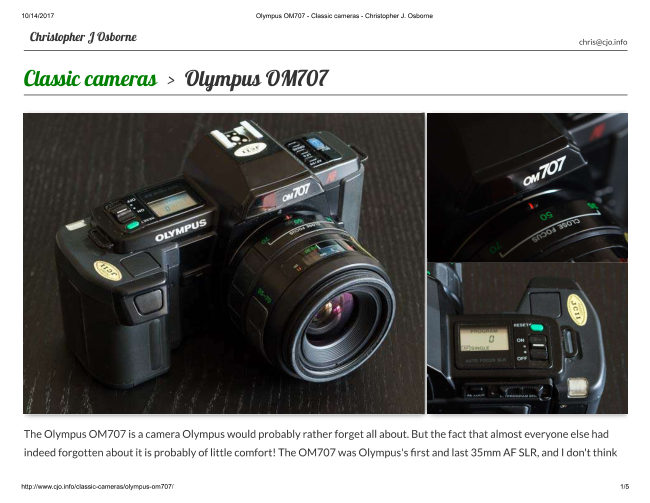
The Olympus OM707 is a camera Olympus would probably rather forget all about. But the fact that almost everyone else had

indeed forgotten about it is probably of little comfort! The OM707 was Olympus's first and last 35mm AF SLR, and | don't think

http: www.cj.infolclassic-cameraslolympus-om707/
View original page 1
Page 2 · Read text
10/142017 ‘Olympus OM707 - Classic cameras - Christopher J. Osborne
it's going too far to say that the OM707 was a disaster for Olympus: it's failure effectively brought about the end of what had
been one of the iconic 35mm SLR systems of the 1970s and 1980s. The OM707 was launched in 1986, and by 1987 Olympus has
practically given up on 35mm SLRs, having deleted almost their entire line. The only models that survived any significant time
were the expensive, top-of-the-line OM-3Ti and OM-4Ti models.

Olympus went on to launch just 3 35mm SLR cameras post OM707, only one of which was genuinely new and genuinely
Olympus: that was 1988s even more forgettable power-focus-but-not-auto-focus OM101. 7 years later in 1995 Olympus
surprised everyone by launching an updated version of the all-manual, all-mechanical, OM-3 called the OM-3Ti. But by then it
was nothing more than a beautiful and charming anachronism that sold for Leica-like prices only to well-healed collectors. (The
OM-3Tiis still a very valuable collector’s item today.) The last OM camera was OM2000 from 1997, but it wasn't a real Olympus
at all. lt was made by Cosina and apart from the OM lens mount it wasn't compatible with any of the Olympus OM system. The
OM system limped on in this state until the early 2000s.

I've always had it in my mind that the reason Olympus failed so spectacularly with the OM707 was because they were late to the
AF SLR party. But when | did some research on the OM707 | found that this wasn't the case at all. In fact Olympus were among
the first to act after the launch of the first true body-integral AF SLR, the Minolta Dynax 7000. Here's the chronology: Minolta
launched the Dynax 7000 in 1985, Nikon launched the F501 and Olympus the OM707 in 1986. And finally Canon launched the
EOS 650 and Pentax the SFX in 1987. In other words Olympus beat Canon to the market by some margin, and yet it was Canon
that went on to thoroughly dominate both the professional and consumer 35mm AF SLR markets with their EOS system. Not
only that, but Olympus as quick to launch a surprisingly comprehensive set of AF lenses for the OM707. Within a couple of
months they had a set of 8 lenses with focal lengths from 24mm to 210mm, including a macro lens.

So if being late to the party wasn't the problem, why was the OM707 such a disastrous failure?

| think the first reason was that the OM707 was strictly an auto-only camera. The OM707 was, like all early AF SLRs, an
expensive piece of cutting-edge technology. Yet in the minds of most camera buyers a lack of any kind of manual mode indicates a

http:/www.cjo.infolclassic-camerasiolympus-om707/ 215
View original page 2
Related documents and language editions

From the M. Butkus archive. Original publisher and archive notices are retained.
Check the model and edition against your equipment.
PDF verified 2026-10-10.