Film cameras
Rollei Rolleiflex 2.8 E User manual
User manual for Rollei Rolleiflex 2.8 E. 60 pages in English. Read the original PDF, download or print a copy without registration.
60 pagesEnglish6.1 MB PDF
Loading your manual…Open PDF directly
Document details
- Brand
- Rollei
- Model / document
- Rollei Rolleiflex 2.8 E
- Document type
- User manual
- Language
- English
- Pages
- 60
- File size
- 6.1 MB
- Category
- Film cameras
- Document date
- Not specified in catalog
Search available document text
Find a term, then jump to its page in the original PDF. Image-only pages may not be searchable; check the PDF for exact wording and diagrams.
Page 3 · Read text
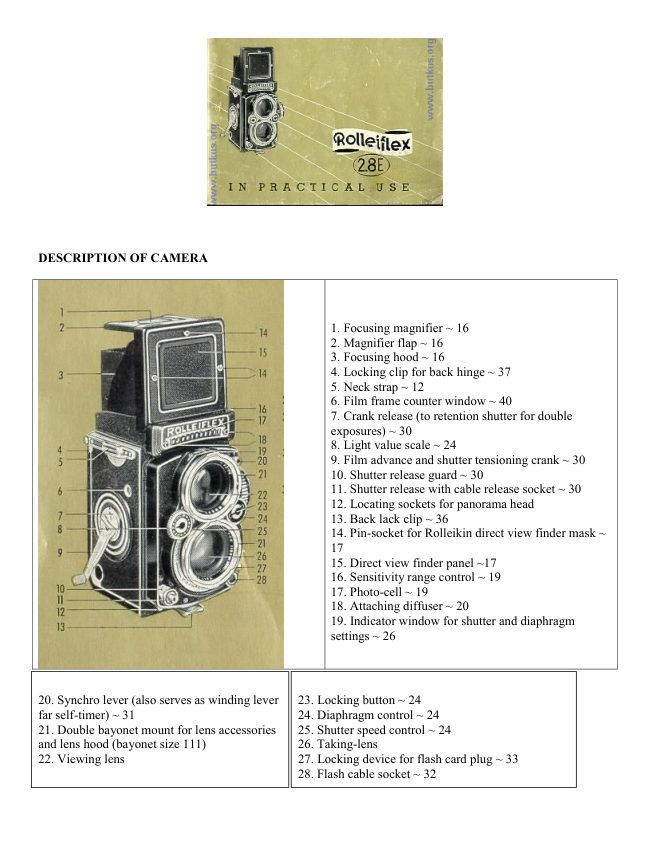
DESCRIPTION OF CAMERA                  (Defoiled explonofion + Poge)
  I  Focusing mognifier +  16            %  Shutter speed control -+ 24
 2 Mognifier flop -+ 16                       26 Toking-lens
 3  Focusing hood -+ 16                      27 Locking device for flosh cord plug + 33
 4 Locking clip for bock hinge --+ 32             28 Flqsh coble socket    32                                                                                       - 5 Neck sfroo -+ 12                        n  Tripod socket --+ 32
 6  Film frome counter window -t 40             30 Bock locking lever -+ 36 7 Cronk releose (to re-tension shufter                 3l  Adiustoble film pressure plote -+ 38
                          for double exposures) -+ 30   32 Combinotion bock for No.]20 (B ll  8)
 8  Light volue scole .+ 24                                                    ond 35 mm film -+ 36
 9 Film odvonce ond shutter lensioning cronk -+ 30   33 Winding key for loke-up spool + 38
l0  Shutter releose guord * 30                  34 Anti-reflection boffles
 ll   Shuiter releose with coble releose socket -+ 30     35 Automotic film feeler mechonism  rollers -+40
12 Locoting sockets for ponoromo heod            36 Automotic depth-of-field indicotion -+ 26
13 Bock lock clip -+ 36                      37 Focusing scoie -+ 26
14 Pin-socket for Rolleikin direct view            38 Light volue indicotion -+ 19
                                      finder mosk + lZ   39 Adiusting for film speed -+ 19
l5  Direct view finder ponel + 17               40 Meosuring portion of exposure meter + l9
l6  Sbnsitivity ronge control + 19                41 Adlustment of film lype ond speed reminder -+ 19
17 Photo-cell + 19                         42 Exposure meter odiustment ring +  l9
l8  Attoching diffuser  --+ 20                   43 Focusing knob -+ 26
 l9  Indicotor window for shutter ond diophrogm      44 Film-spool knob (Rolleikin rewinding knob) -+ 38
                                           settings -+ 26   45 Mognifier  lifting hondle +  16
20 Synchro lever (olso serves os cocki,ng lever for   46 Reor sight for direct view finder -+ lZ
                                          self-timer) -+  3l   47 Mognifier for eye.level focusing .+ lZ
21 Double boyonet mount for lens occessories       48 Retoining device for Rolleigrid lens + 16
                ond lens hood (boyonet size lll)   49 Toke-up spool knob (Rolleikin counter knob) -+ 38
22  Viewing lens                           50 Light volue toble for lime exposures *  23
23  Locking bufton + 24                               5l  Focol or film plone (focusing distonces
24  Diophrogm control    24                                               meosured from this line)                         -
View original page 3Page 8 · Read text
Above oll, the ground gloss screen provides lhe
meons for focusing lhe comero. This is occomplished
by rototing the focusing knob. Both lenses, which
ore inflexibly coupled to eoch other by meons of o
sturdy common front plofe, ore thereby odiusted
simultoneously: o shorp viewing imoge therefore
guorontees on equolly shorp picture. Since the Rollei-
flex is equipped with o fost viewing lens ond on
opticolly prepored ground gloss screen, lhe viewing
imoge is extremely bright ond cleor ond focusing
con be done very criticolly.
The focusing hood, which is designed for one-hond
operotion is kept in both open ond closed positions
by spring tension.  lt is equipped with o swinging
mognifier.  lt  offers ot opproximotely 2.5 times
mognificotion of the entire ground gloss imoge, o
still more precise meons for focusing the comerq.
lf the front ponel of the focusing hood is pushed
                                                                           'inword,' ir' is tronsfo'frGd  int6:;- di;E;inieil-tiriaei
ihrough which the subiect moy be seen in noturol
size moking it porticulorly eosy to follow fost oclion.
In fhis cose it is still possible ot oll times to mointoin
control over focus: this is mode possible by meons of
View original page 8Page 9 · Read text
o second mognifier in the bock of the focus-
                                                            ing hood, ond o diogonolly mounted mirror. A slight
                                                            roising or lowering of the Rolleiflex is oll thot  is
                                                          required lo olternote between the right-side-up open
                                                  view in the direct finder, ond the reversed center
                                                             portion of lhe ground gloss focusing imoge. The foct
                                                            thot the lwo finder openings ore locoted so close
                                                             together, enobles quick froming of the subiect ofter
                                                            focusing. The usefulness of the open direci view
                                                                finder is thereby enhonced for sports pictures.
                                                        Focusing the front lens ponel throughout lhe ronge
                                                                                   )<      from oo (infinity)   40 inches (distonces meosured                                                                                       -                                                                           film plone to the subiect) is oc-                                                  from the focol or
                                                        complished by neorly one full iurn of ihe focusing
                                                           knob. The speciol design of the focusing mechonism (o
                                                     comdrive bosed on the principle of the orchimedic
                                                                     spirol) insures uniform movement of the lens ponel in
                                                   both directions without ploy or bocklosh.
                                                       Tied in with the movement of the lenses is o simple
                                                                  sliding mechonism, locoted beneoth the ground gloss,
                                                           providing completely outomotic porollox compenso-
                                                                     lion. Consequenily, ihe finol picture is olwoys fromed
                                                         exoctly os originolly viewed on the ground gloss
                                                             screen. Similorly complete conirol is hod even when
                                                     using supplementory Rolleinor Ienses for  close-up
                                                work becouse of the prism which is built into ihe
                                                                   Heidosmot-Rolleinor.
\                                www.butkus.us
View original page 9Page 10 · Read text
Ihe exposure meter is mode up of the light sensi'
tive element, or photo-cell, in the nome plote of
the comero ond lhe meosuring mechonism in the
focusing knob. lt con be odiusted for two ronges
 of sensiiivity: ln  brilliont light the photo-cell  is
portiolly     covered by on opoque shutter behind
the honey comb lenses of the photo-cell. In dim
light the photo-cell receives oll the light coming
through ihe honey comb for  f u | | sensitivity. The
reoding is supplied in the form of the light volue
for the film speed being used. The light volue con
be obtoined by meosuring ihe light reflected from
the obiect or scene, or the incident light, through
the ottochoble  diffuser.
Tlre Synchro-Compur-Shutter  is  odiusted outomo-
ticolly for the correct exposure when set to  the
previously determined light volue. After this is done
the two controls (speed ond diophrogm) moy be
locked together by the very simply operoted coupl-
ing button. Shutter speed ond componion diophrogm
opening moy thereofter be chonged ot will, within
ihe ovoiloble ronge of operotion, using o  single
conirol ond without oltering the exposure' Eoch
speed-diophrogm combinotion oppeors, os the con-
trol is turned, in ihe peep window in front of the
ground gloss. When required the two controls moy
View original page 10
Page 11 · Read text
be seporoiely odiusted by merely uncoupling the   the sofety bock lock. lts odoptobility for lhe two
          mechonism.                                                picture sizes 21/t,X211,", ond 24X36 mm is the result
                                                           of the odlustoble film pressure plote which con be        The depth-of-field indicotor on the focusing knob  is                                                                       set for 120 (B ll8)-film (with poper bocking), or for          permonently coupled to the diophrogm ond indicotes                                                         35 mm film (without poper bocking) when used in        by meons of o white bond, thot portion of ihe field                                                                coniunction with the Rolleikin ottochment. In both
         which is in ihe octuol ronge of shorpness.            coses o film chonnel is creoted with o width thot
         Since the two lenses ore of identicol focol length     corresponds to the thickness of the film being used.
               (f :80 mm, picture ongle [ocross diogonol], 53o)    Thus thefilm con be properly held in lhe focol plone,
               it follows thot the imoge in both sections of the   ond olso con slide throuoh without undue friction
        comero will olwoys be criticolly focused on the some   when odvonced.
         portion of the subiect simultoneously. The f z 2.8   The quick ociing cronk coupled with on outomotic
        toking lens is o  five gloss construction  with    geor mechonism performs five importont functions
        two cemernled elements (modif ied Gouss-type) ond    with eoch pendulum swing:  l. odvonces film to next
          feotures outstonding correction for block ond white    frome, 2. odvonces film frome counter, 3. tensions
       ond color pictures, while the viewing-Heidosmot    lhe shutter, 4. releoses shulter lock, 5. engoges
             f  : 2.8 lens meets with the speciol requirements for    film lock. The shutter releose ond film irdvonce cronk
            criticol ground gloss screen focusing. Both lenses ore    ore locked ond unlocked olternotely, thereby offering
          treoted with obrosion resistont cooting. The boyonet      full insuronce ogoinst double exposures or skipped
         receptocles circling the mounts ore intended for     fromes.
         ottoching ihe lens hood ond supplementory  opticol
          occessories, which in this woy will be held' in    For inlentionol double exposures the cronk musl be
           opticolly correcl position ond form o solid unit with    unlocked ot the cronk bose: Turning the cronk o full
          lhe comero.                                            turn lo ihe left cocks the shutter ogoin w i t h o u t
                                                              odvoncing the  f ilm.
        The removoble combinotion back is ottoched to the
        comero by meons of two hinges with oulomotic lock    Aulomotic stops limit the extenl of cronk swing. With
        ond ot the bottom it contoins the tripod socket ond    the increosing thickness of the film on the toke-up
ito                                  www.butkus.us\  --                                                                                    -                   ir.             -.       .;-.;:-.'l-
View original page 11Page 15 · Read text
\4
    H


                      www.butkus.us


        Holding fhe Comero                             ins O.  ln this position diophrogm ond shutter con-
                                                                            irols moy be operoted comfortobly.
          Bosic rule: comero honging oround the neck wiih
           tout strop ond the comero heid firmly by both honds'    The comero is usuolly corried w,th o long strop over                                                     the shoulder. The strop remoins foui ond gives        The right hond grosps ihe comero ot the bottom,                                                             required steodiness when using ground gloss @.
         the index finger on ihe shutter releose, the thumb   When using the mognifier, merely form o loop to
          supporting the uplifted cronk (quick hondling of the    shorten the strop, using the thumb of the right hond
            film tronsport: + p. 42\. Ihe left hond does the focus-   ond odiusting comero to required posiiion @. ttris

                                     www.butkus.us
L
View original page 15Page 16 · Read text
"ru     \u                                 $h )
         ts


method of holding will oid moteriolly in ochieving    Woisi-level or eye-level positions for the comero ore
ihe steodiness required for shorp pictures.             considered normo I   f or most pictures. The extremely
Coution: o wrong or uncomforloble "gtip" moy           f lexible Rollei, however, reodily permits exposures
couse you to  lift inodvertently the honging top of   ot or neor floor level, overheod, shooting stroight
ihe ever reody cose.
                                                up or down, ond occosionolly, surprise snops "oround
                                                                                                                                possi-In order to ossure solid conloct when working with    the corner". The illusirotions @-@ show o fewo tripod, do not use the ever reody cose. For o proc-
ticol method of quick mounting: use the Rollei      bilities for such pictures with the comero in differeni
triood heod   !                                                 pos itio n s.

                                                                                                                              l5
                                                                                                                                                                      ,EI
View original page 16Page 20 · Read text
fs                /=s


                                                                                                                                                   ,ij,..          ff


Exposure Mefer
Adjusting fo DIN/ASA Speed Rotings: turn the od-    uncovering red doi-  use r e d light volue window @.
justing ring beyond the left or right stop @, uniil    Meosuring for Light Volue: turn odiusiing ring @
the correct speed roting oppeors obove the indicotor     until red ond block indicotors ore exoctly covered                                                                                                                      -mork. The dots ore for the usuol intermedioie holf-   reod the indicoted full or holf-volue in the oppro-
volue DIN/ASA groduoiions.                             priote light volue window.  lf the indicotors do not
                                                     reoch covering: chonge the ronge wiih the sensitivity
Sefting Sensitivity Ronge: in brighi    light move     control.
control (corner of nomeplote) to upper stop so tlrot   The exposure meter is ruggedly built ond will with-
red dot is covered   use forword light volue    stond tlre strongesi light in both ronges of meosure-
window @. ln w e o k light, move control downword,     ment.
View original page 20Page 21 · Read text
Two meihods of meosurement permit Rollei to moster oll light conditions:
      Reflecfed light or objecf meosuremenf       Incident lighf meosurement wirh Diffuser
        (Meosuring the light reflected by the subiect)       (Meosuring the light os it folls on the subiect)
       Advonloge: Aiming comero in direction of      Advonloge: Meosuring incident light gives
        subiect is conven ient. The meter covers the        light volue even in those coses where meo-
       ongle covered by the film so thot it is very       surement of light from subiect or deioil con-
      eosy to point comero correctly, even when       not be ochieved.
      meosuring light from specific objects or
         deto ils.                                           Applicotion: For unbolonced lighring con-
        Applicotion: For block ond white shots with        ditions when it  is not possible lo meosure,
        well bolonced differences in light (ond shode)        seporotely, detoils importont to the picture.
          for color shots with front lighting or with      Also   f or Rolleinor shots.         -        light portiolly from tne side wilhout visible                                                                                                                                      diff user in  position       shodows being included in picture.             To get reoding: Ploce
                                                        over holding knobs on the phoio-cell ond oim
       For meosuring detoils: When detoils ore most        in  direction     directly    opposile        imporlont ond if subiect is unevenly lit.                                                       to thot to be used when shot is mode.
      To get reoding: Aim ot subiect or detoil with       Exomple:   f rom sublect to intended comero
      ground gloss ond reod light volue in  this        position, or (in open oir) lowords o ploce with
        oosition @.                                some light conditions. Reod off light volue @.

           The sun or other strong sources of light moy odversely offect the reoding even when locoted
            outside the immedioie ongle covered by the picture. Shode the cell in such coses ot o distonce
                                           of obout 20 inches.


20
                                 www.butkus.us
View original page 21Page 22 · Read text
Reflecled light or subiect meosuremenls  represenl
the norm, the most used method, when liglrt ond
shode ore oboui evenly opporiioned throughout
the piciure. The meosured light volue corresponcrs
to the overoll brightness of the subiect.
Defoil meosuremenls become necessory when either                                    --very light or very dork oreos prevoil. In this cose                                       -',
individuol meosuren'rents ore ioken of tlre light cnd                                     ,l'-""'.
dork oreos, ond o mid-point light volue is used.
When odvisoble, this method con be voried to fovor
either      the light                 dork oreos,                              whichever              or                                              is                                           more      i'i c,a                 (   a,Wimporiont.                   subiect                                                      vories                 lf the                        point                               of  interestgreotly in brightness from ihe rest of the picture,         ti                                                                                        Atoke the reoding directly from this portion of ihe       el,:'l:"
picture. Exomple: o person in front of o light woll                                                    -     -.r-L- -or, conversely before o very dork entronce. In both                                                          lncident lighl meosuremenls  (with diffuser) ore oftencoses, ioke reoding directly from the p e r s o n.                                                token os substiiutes for overoged deioil meosure-
Addiiionol Hinis:                                           rnents. A light volue for overog;e brightness of sub-
i. When meosuring light from londscope, tilt comero     ieci resu lts. For subiects of greoi controst, the meo-
forword lo fovor ground over sky.                   sured light volue should be voried (usuollyl/2 light
                                                               vcrlue) occording to wheiher the imporiont port of2. Toke close-up reodings when ihe reoding from                                             the picture is lighter or dorker thon the overoge.
the whole picture does not fovor" moin port of sub-    Exomples, Rolleinor shois of smoll obiects os for
iect. For instonce, meosure tlre foce in o portroit.     instonce, o light or brilliont blossom with dork bock-
3. When o subiect connol be opprooched conveni-    ground. Shois in shode with strong roys of sunshine.
enily for meosuring, choose o neorby subsiitule    Obiects with brilliont sky bockground.  Agoinst-the-
obiect of some brightness. Exonrple: onimols in en-     light portroits. Piciures including bright reflections
closures oi o distonce.                                  frorn snow, woter, beoch.


                                                                                                                                                    21
                                                                  4
View original page 22Page 24 · Read text
Block ond whife films hove greot exp05ure lotitude.            +
Over-exposure                                                        pro-            con                     lorgely                   be offset by proper                                                                I                negotive.                          Under-exposure,                                            however. cessing of the
results in loss of shodow detqil. A lime-tried rule
is to expose for the shodows, generolly. lf in doubt,
it is belter lo err lowords over rolher lhon under-                                                  11exposure.              +
Color films hove considerobly less exposure  lcrti-
tude ond strong Iighting controsts connot be repre-
serrted properly. Foilure to observe this chorocteristic
will result in chonged color volues. Over-exposure,
in the cose of color tronsporency films will   l:e
indicoted by pole, woshed oul colors. Under-exposure
will couse tl-re colors to oppeor excessively deep,        Light volues ond time exposures
olthough tlris is sometimes on odvonioge. Unless       Below light volue 8, the shutter runs out of suitoble
you ore going ofter o speciol effect, odhere strictly       speeds ond time exposures must be used. Wiih the                                                              shutier speed diol set ot "8", oppropriote exposureto ihis rule' Expose color film os exoclly os possible        iimes ond diophrogm openings moy be chosen from
ond ovoid excessive contrqsts. Dork subiects tend 1o        the toble on the bock of ihe comero. The meosured
                                                                light volue is locoted ot the top, ond the desired
oppeor too deep in proiection, even wiih good lighting       diophrogm opening ot the left of the ioble. Where
ond seemingly correct exposure. The opposite  is true         these columns cross the time of exposure, in seconds,
                                                                    will be found. Exomple: light volue 4, diophrogm  li,of light colored ob jects. Therefore, o second rule,      8 seconds. When ih'e shut'ier is set ot "d", c"honge
Expose dork subiects fully (- l/2 light volue) ond       diophrogm open ing by operoting ihe control with                                                the coupling button depressed. The light volue scole
lighl subiects sporingly ( + 112 ligh? volue).             on the speed control is inoperotive in this ronge.

                                                                                                                      23
View original page 24Page 25 · Read text
(o                    @)i   fl                                              o.


                                                                                                            speed   Light value (Shuffer speed and diophrogm)     AdiustinE speed ond diophrogm: Turn the                                                      controt ring or, even better, turn both control
   A. Normol cose: Adiustment with speed-diophrogm    wheels simulioneously in the some direction @   coupling
   To couple speed ond diophrogm: Align the coupling      B. Speciol cose: Adiuslment withoul speed-diophragm
   button with the morks on the diophrogm  control    coupling
    wheel @.                                 To uncouple: Set the coupling buiton so lhst il   is
   Adiusting lhe light vqlue: Tempororily decouple by    diogonol to ihe morks on the control wheel @    depressing the button ond set to desired full or holf
    light volue by turning speed contr"l C?). lf  ihc    Adiusting speed ond diophrogm: Operote botlr    light volue connot be reoched before o siop is en-    conlrol wheels independently. This monner of ope-
    countered, releose the button, turn bock the speed     rotion is usuolly used wiih flosh, when the light
    control ond repeot ihe obove operofion.              volue is not meosured.

24
                                 www.butkus.us
View original page 25Page 27 · Read text
Hond-Held Pictures'                  I                    Tripod Pictures:
                        Fcrst Speeds                       I           Slow Speeds              I tim" Exposure
    f/500 112fi 11125 lt6O   l/30     |   l/15 118 114 1t2  I sec   I        e
Shulfer Speed                           Diophrogm - Shorpness -  Depth of Field
The shutter speed chosen must be suited to the speed   The odiusted diophrogm opening figures oppeor in
of motion of the sublect (-+ poge 25). The Synchro-    the peep window in block. The lines between the
Compur shutter con be odiusted to the obove    figures indicote mid point diophrogm openings.
designoied speeds. Distinct click stops will be fell os    Either the figure or the holf-volue mork will be in
eoch speed is reoched ond in-between speeds    the center of the peep window. When uncoupled,
connot  be used.  1/60th sec. is lhe mosi com-    the diophrogm moy be set onywhere, ot will.
monly used spged, minimizing comero movement
nicely. Shutter speeds longer thon l/30th sec. ore noi   The diophrogm, omongst other things, reguloies
generolly sofe, except wilh o tripod. The figures    depih of field. Best shorp focusing technique requires
indicoting speed oppeor in the peep window in red    thot lhe qreo of shorpesf focus be used to brocket
ond represenl froctions of seconds; for exomple 30    the principol obiect in the picture. Of course, suf-
:  l/30 sec. The green ietter "B" setting permils     ficient definition should olso be preseni both before
loAger time exposures. When using ony combinotion   ond behind the point of focus. The zone of this
of speed ond diophrogm the setting of the speed    depth of field shorpness con be ortfully enlorged.
must oppeor exoctly in the c e n I e r of the peep       li is increosed both by closing down lhe diophrogm
window.                                       ond toking lhe picture from o greoter distonce.

                                                               Shutter Speed                                                                                      Subiect                                                                                         Motion                                  +        Brishtness            l-*@{                                           Lrgrrr vsrss                                               I         Film"          speed                                 I   -       |                                                              Opening                                                                                                                 Field                                                Dicphrogm                                                                             Depth of                                    e

                               www.butkus.us
View original page 27Page 28 · Read text
lf the subiect hos on extended depth (for exomple,
 londscope wiih forcground), you musl either chonge
 the speed-diophrogm  combinotion to one with o
 smoller opening, or move bock with the comero.
 The ronge of the depth of field covered by ony given
 setiing is shown by the white bond odiocent to the
 distonce scole. The indicotor is coupled fo, ond clronges with, the dioplrrogm.           ss                     {1 l.  Exomple: Focusing on 12 ft wiih dicrphrogm  ot
 f: 8 provides o depth of field  from opproximotely
 l0 to'15 fr. Focusing on j2  ft with diophrogm ot
22 provides, on ihe other hond, on increosed depih
 of  f ield from 7.5 to 40 ft.
Very smoll diophrogrn openings usuolly require
excessively long exposure times so thct some com-
prom ise is someiimes necessory:
                                                                             \5-2. Exomple: The subieci requires o shorpness ronge
from 8 io l5  ft (both figures rnoy be oscertoinecl
exocily by focusing seporotely on tlre fwo pointswhich brocket the subiect). Solution: focus on the                          \
midpoint between the two distonce figures oncl
chonge the diophrogm so thol the whiie bond
reoches both figures. In this woy you will hove se-
lected the most fovoroblc storc, in this instonce f  :  l'l   .

                                                                                                                       27
View original page 28Page 31 · Read text
Shuffer fensioning
                                           Tensioning iogelher with film odvonce is outomotic
                                                                                                          40).                                               througlr cronk oction C (-  p.
                                        Tensioning without film odvonce    possible only                                                                                        -                                            with roll-film looded comero    for intentionol double                                                                                 -                                       or multiple exposures: move releose ring of bose of
                                      cronk in direction of orrow ond then turn crorrk
                                         through one complele boclcword   revolution un-
                                                                          iil  ii siops @.
                                           Tensioning with Rolleikin: outomoiic through cronk
                                               oction. Double exposures noi possible.
                                           Tensioning with Plote Adopler: swing cronk normolly,                                                                  .l80o,                                         through     ond bock to stop. Repeoted tensioning
                                             for multiple exposures possible.
                                   Releosing Shufler
                                             Insto,nloneous exposures: with releose guord in
                                          lowered position (i), press releose bution gently until
                                                                      it stops (fit.
                                   Time exposures: set shr,lier lo "8", unlock releose
                                   button  (l), press ond hold for durotion of exposure.
                              To reduce possibility of comero movement, use o
                                            locking type coble releose.
   fu.r*H                       [ong Time exposures. Set shuiter to  '8",  depress
                                          releose slightly (noi enough io open shutier) ond
                                      swing guord to lock  ii in this position U 6D. E*-
                                         posure: press releose compietely Gi  ond lerminote
                               by swinging releose guord downword {i) @.
www.butkus.us

                      www.butkus.us
View original page 31Page 32 · Read text
Self-fimer
The Synchro-lever (+  pqge 31) serves olso os ihe                                    ffi^cocking lever for  the  self-iimer, In  self-timershots o  deloy of  opproximotely ten  seconds       a{11$*#-occurs beiween releose of the shulier ond the               f.S*=
ociuol exposure. Any shulter speed, excepling  B,                                b
from I to l/5001h sec. moy be used. Cocking of the
self-timer mechonism  is possible only ofter the slrutter
itself hos been cocked, ond is occomplished by swing-
ing the Synchro lever from position f @ in  ttre
direciion of the orrow until it stops @. To move the
lever from Q to 4 , pull out the spring looded smoll                        q,knurled        knob.              Shorter                      deloys                                                    ore                         thon                                 I0 seconds           Wpossible       by merely                 moving                          the lever                                   only                                                       the                                           port of                                                                       c
woy. Upon releose of the shuiter tlre lever immedioielv
springs bock to  /  posiiion @, indicoting thot the
mechonism hos gone inio oction. This olso serves To
show thot the y' setiing is the only possible one ro
use when moking flosh self-timer shots (+ 8 p.5l).
To Use: F ir s t tension shutter (cronk),  t lr e n cock
self-timer. Releose shutter os usuol.                             +o
  The shutier ond self-timer moy be left cocked                        .o
  even when ihe comero is loid owoy for short          o              ott   periods of time without weokening the power
  of the springs.
View original page 32Page 34 · Read text
ffi
              o

     O,'


                                                                                             3                       'yi

The selection of flosh lomp-iype depends on the   mokes the toble on poge 34 contoins the necessory
light output required by the subiect. Mony mokes ore    informotion ond lhe permissible shutter speeds.
crvcriloble in tlrree groups (normol, medium ond    Connecling Flosh Unit: push flosh cord plug into lhe
high light ouipui). The seleclion is dependent on ilre     socket on the comero
toking conditions, especio lly os to whether o room     Setting for desired flosh posifion: Pull out the smoll
of shqllow or greot depth is fo be illuminoted.           knurled knob somewhot ond swing lever to either ,
                                                                                                                                           bocl<,                           O  o, 0 (D. The knurled knol, will spring
Selection of M-X lever position, opplicoble speed ronge     locking ihe lever in the chosen position.
ond exposures con be leorned from the instructions    Removing Flcsh Cord Plug: unlock by swinging locking
of the different flosh light producls. For the best known     lever @.

                                                                                                                                    ??
View original page 34Page 36 · Read text
Explonotion of fhe Toble                        of light from oll sources must be considered in
                                                      choosing the diophrogm opening.The "Conlocl" column indicotes lhe correct sefting
of the M-X lever for eoch lomp type.                  The Effective Exposure Time (os indicoted in ihe toble
                                                by meons of colored ink) is not in eoch cose identicol
The "Shutter Speed" column shows lhe permissible     to the shuller speed, bui depends on the portion
speed ronge:                                            of the flosh lomp light output utilized:
Cenler: lhe recomniended     shutter speed in-   With X-Contoct the durotion of the flosh itself  is
cludes procticolly the enlire     light oulput of the     ociuolly shorter thon ony of the permissible shuiter
flosh lomp. This ossures lhe moximum illuminotion os    speeds. Therefore, the durotion of ihe flosh (figure
well os the smollest diophrogm (for greoier depth of   shown in porenthesis) is the effeclive oppropriote
field). The following opplies os o generol rule'         exposure iime ond the diophrogm opening must be
                                                      the some regordless of the shutter speed selected.
    Use the stondord recommended  speed        With M-Contoct the shuiier speeds, from "fostesl,
     together with the correct setting of the        to "recommended"  foll within the durotion of the
        M-X lever for the lomp in use.                flosh: they, therefore, represent the octuol exposure
                                                   lime ond if the shutter speed is increosed, the dio-
                                            phrogm must be opened occordingly. Only when
Left: the f ostest speed indicotes the limit to which    slower shutter speeds ore employed is the fully uti-
lhe shulter moy be set. For lively oction or sports    lized light output equol to the octuol exposure
subiects, the foster speeds ore employed.                 time, ond this is the some os the recommended speed.
Right: the exposure lime moy be increosed to the   The illustrotion should moke the utilizotion of the
s I o w e s t speed (l second or even time exposures),    ovoiloble flosh light still more obvious: the white
if, in oddition to the flosh, it is desired to moke use    symbols represent the  f losh, ond their size, the
of existing light. In such coses the  t o I o I omounl     utilized lighi ot lhe shuiter speed employed.
View original page 36Page 38 · Read text
Ab\.v1"-                     \_-   ==                                                                        ,f\,


                 4                                                                6


  The bock is generolly removed only when reploced    ond diri ond cleon  it occosionolly with o soft comel's
  by ihe plote odopier.                                   hoir brush   !
                                                      chonge                                              Never                                                                        film in                                                                                 direct sunlight, uiilize ot   To Remove: open bock fully @ ond swing the locking                                                                   leost your                                                                               shodow!                                                   own body's    lever on the right side bock hinge (cronk side) in the
                                                                                                  meons   some direction unlil  ii stops @. St;p bock out of the    The comero moy be otioched to o tripod by                                                        of ihe threoded socket on ihe boitom. Coution;   opened hinge @.                                                         the length of the tripod screw must not exceed 3/16".  To Attqch: insert detoched bock first into ihe lefi                                                                                        lf this is not possible, use "Rolleifix" or oiher similor
   crnd then into the right hinge (with locking lever in    device ond ovoid domoging bottom of comero. For
   the upper position).                                 comeros with continentol tripod sockets o reducing
   Proteci ihe open comero ogoinsi prevoiling dust    bushing is ovoiloble.
View original page 38Page 40 · Read text
'i.,ii
                                              I.@E---
                                                                                                                                                      l'                                                                                                                .'i  t'.r'r      \                                                       .r-F\ t


                                                                                                                                                                                                                                                                                       ri


            4


                                                                                                             necessoryProcticol Accessories"). To chonge filnrs both knobs    snop bcrck inio ploce  f ully @.  lt is then
ore pulled to on outword position, where they will    io turn the cronk until the long slot in the empty
remoin until o slighi pressure is opplied io moke    spool comes uppermost @.
ihem return. The comero's bcrck should be clcsed only    Note: The empty spool must be removed from the
ofler the knobs hove been reiurned to their originol   comero when using on odopter    however, keep  it
                                                                                                                                                                                                                                    f ilm.positions -  closing the bock serves to lock the knobs     hcrndy for use with the next roll of-  ,]20in position.                                           To Insert o Full Film Spool: in the some woy os
                                                                                                        endTo Insert ihe Empty Spool:   f irst  f it the spool over    opplies to ihe toke-up spool @. The pointed
the winding key on the righi (cronl< side) ond pull    of the bocking poper must poini in the direction
out the guide knob @. Push the spool down on tlre    of the toke-up-spool chomber, so thot the colored
left opplying slighi pressure, so thot ihe knob moy    side of the bocking poper remoins on the outside.
View original page 40Related documents and language editions

From the M. Butkus archive. Original publisher and archive notices are retained.
Check the model and edition against your equipment.
PDF verified 2026-10-10.