Film cameras
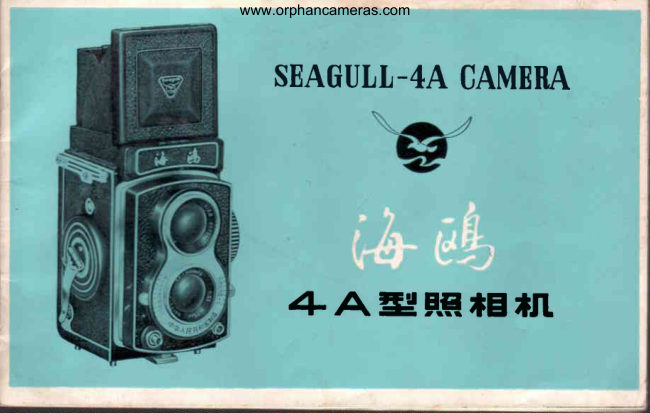
SEAGULL SERIES 4 User manual
User manual for SEAGULL SERIES 4. 31 pages in English. Read the original PDF, download or print a copy without registration.
31 pagesEnglish2.4 MB PDF

Loading your manual…Open PDF directly
Document details
- Brand
- Seagull
- Model / document
- SEAGULL SERIES 4
- Document type
- User manual
- Language
- English
- Pages
- 31
- File size
- 2.4 MB
- Category
- Film cameras
- Document date
- Not specified in catalog
Search available document text
Find a term, then jump to its page in the original PDF. Image-only pages may not be searchable; check the PDF for exact wording and diagrams.
Page 3 · Read text
r              . l V l E R                      .


                                                  Seagutl-4  series cameras consisting of types 4, 4A, 48  and 4C are  coupled  twin-lcns reflex
                                          cameras.   All  the takinglenses  ("HAIOU-31"    type)  of them  are 3-elcment 3-group typcfeatured
                                                 with  a maximum  relative  aperture  of  1:3.5.  The  rclative  aperture  of vicwing  lenses ol F  1:2.8
                                                              is for  types 4 and 4A, and  of F 1:3.5 for  typcs 48  and 4C.   Both taking and viewing lenses are
                                               featured  with  a focal  length  of 75 mm and  finishcd with  coating  to rcduce reflection.
                                           The  between-lens shurter  is provided  with  specds liom  1 to  1/300 sec. of nine  scttings pltrs
                                                B.  The  cameras are equipped  with  built-in  self-timer and  "X"   flash synchrolrizer.
                                            Type  4  is provided  with  a winding  knob  white  type 4A  with a winding  crank.  The mecha-
                                          nism  of  the  formcr   is interlocked  with  thc  film  counting  device whercas the  latter  with  both
                                                the shutter cocking and  the  film  counting  devices.  The  Seagull-4  serics calneras are capable of
                                                multi-exposing.  The  focusing  and  the  parallax  correcting  devices of type 4 and  typc4A   are
                                              interlocked in operation. A  roll  ol' 120 film  will  take 12 pictures of 6x 6 cm  (21'x2L")   tor  all
                                                 types.  Type  48  and  type 4C are provided  respectively  with  a' winding  knob and  a counting
                                                indication  red window.  A  roll  of  120 hlm  wilt  take  16 pictures of  6x4.5  cm  l2t"x2")   as
                                                 desired.  ln  addition  ro using 120 fitm,  type 4C  is also available  for  135 film  of size 24x36 mm
                                            by a special device  with  atr automatic  counter and a stopper.
                          www.orphancameras.com
View original page 3Page 6 · Read text
I  H&frRfil         Direct viewfinder frame        s   +frJfijffi*        Picture-taking lens
2 wF',#.           Viewfinder Cover            ro   'ttrllil,qt1fn    Shutter speed adjusting
3  "X'D{l16fffi'E   "X"   flash socket                  r r    'lut f[+           Shutter  lever
a  Blr*ffi)k         V i e win g le n s             12 &h+n          Winding knob
5  y6Elfjl5fr       Diaphragm setting lever       r3   &ffiffi*         Ring for strap
o H lHf,r-f'          Self-trmer lever            14,r7E6+fimffi     F ilm spool spr ing knob
7 tr+"n+h6        Locking bolt of the bacx cover  r5   ffiR+n          F ocusr ngknob
8  ,Fll&fx           Shutter release button         16   E**              Back cover
View original page 6Page 7 · Read text
Wtr#.fi*,ft ts )bl;trJRW{*+Tle fnlh&,  if m
^ fr" +ffi*tr'f'l  ffi.tltfi*,fi , tr#EPft tA                                           "
    Push insrde the safety lever 19 of the  locking disk
l8 and turn   it  in the direction "open"  as indicared by
the arrow to open the back cover.


    frwfrwffifibtE Ht&##  ffiurTsf[ #8" D)
E
      Fit the unsealed film  into the  lower chamber as            iI                                                 ' r
shown in figure and  fit the  bare spool Into the uPPer         l - l                                    -l
chamber in  like manner.
                           www.orphancameras.com
View original page 7Page 8 · Read text
.O

  #W# RF ffit! -)l,ifi  Bt# ffifi KH +,  FlF.ffiA# h W,                                      2rt ffi 20( &ftA 4 UEH+il p > ,ffi.RFs*,tffi)k&lier,J$f1"9 t
ttt+,F,.
     €'t fa#,  etfxfi  18t- "X" + nrtiJilris-€-RFilfttTrs
ffffi,. fLnfft#e,;i+i.*"
     ( Ef, ) 9i!!F,-a#ftt *'2, f*.+r1q $.^U"q ffiffi# .


     Slowly pull out thc prorf,clive paper of the roll and insert irs front
cnd  into rhc uider  slot ol  rhc barc spool.  Wind  the film windirre
 rrank 20 (or rotare tlre *irrdinc knob  l2)  until the lwo arrou.s on tlrc
protcrlive l)aper arc alignedsith rhe rcd locating index on rhe camcra.
     ('lose the back covcr. rurrr thc locking disk  l8  in rhe dircctiorr
"('losc'' rrrrril tlrc salt:tr'lcvcr 19 is lockcd.  Loading is now complcte<J.
    (Caution) Ilc strrc rhc lorkirrg hmk  is right in rhc gloove of camera.     Li.--
View original page 8Page 9 · Read text
mhftf

                     lK.
                   4 &.#htllt65ftfl&9t eEAr, ftll#E-lk=n,  EpEFi
                lk#H                                 "                            *-g:ik#                 4A 4.# H Ul,tA5 &.11Ltl,Ed  "              I'\'I-atfi#t&ffi FJtE
                   tt)+*EFl *Hrt',  teEeA&fl  &in.
                                  (trill   ffif,,H peKtr, #&t&-dr+trffi( *"frfr.+n)*.#,   ft
                       w.#RtsW,Ag[#r|J&#ffiL,t Jti+frtr#., ry
                   $&#"

                            Wind  the winding  crank  20 of  type 4A  clockwise  (or  rotate  the
                            rvinding knob 12 of type 4) until  the crank or knob stops.  The num-
                           ber "1"  appeared  in  the counter window  21 indicates the first frame.
                        The  camera   is now  ready  for  taking  pictures.
                            The  winding  mechanism   of  type  4  is interlocked   with  shutter
                          release butron   8.  The  winding  knob may  be  turned  for  the next
                          frame  only  when  the exposure  of  the  previous  one has been made.
                           The  winding  mechanism  of type 4A  is interlocked  with  shutter
                          cocking device.   After each film advancing,  the shutter release button
                         can be pressed only when  the winding  crank  is wound  reversely until
                                          rt stops.
                                 (Caution)   After  the  twelfth  picture  has been taken,  continue  to
                              turn  the winding  crank  (or winding  knob)  until  the protoctive  paper
                                 of  the  film  has been  rolled  up  to  the  take-up  spool .  You  may now
                        open  the back  cover and  take out  the  film.
www.orphancameras.comI
View original page 9Page 12 · Read text
4c&.tfrffirrs ffi#E-f,ftHiEH 13sEg€.
#fi HBgaftH-*, BE tfeHFgeffi;iil., &&^EF.h
EEAffi;ti:)krll.€tr28fFsH& * 2g. H#. rzoe#il'H
w th w H.#AtHt/rl: *[& #H, E# f#h w Hw.&+EtrLTsm #eEfit, -E&L5/\*?t&Vre, #tEHdF g0,fiH til
/rl-ft.
When you use type 4C with 135 film. two conventional l3S
cassettes arc necessary
Pull out the tilm end from tlre casserre.ind fasten it or the take-
up spool of tht' l>are cassctrc. The available sleeve 2g and connector
29 of the bare casserte should be put rcspcctively o. each end ,f its
shaft (as sh.'*'n i^ figure) bcfore fitting it inro the upper chamber,
then the cassctrc inro the lou'er charnbtr olr the spring plare in like
manner as uirh a roll of 120 film. Nloreover. rhc pcrforated holes
of the film should be c'rrcsporrdinglv fitred ro the teetlr of the rrans-
port spro<ket. Pur on rhe filrlr pressing plare and lock up thc ba<.k
cover. The lilm lras thus becn loaded.
ilView original page 12Page 13 · Read text
*.IFtEtt+h'fB€+B fi..HpEJJW,Epi+t# H  q*r*Eh                                                     "   Luil'1,     rEt+t-T            act r+h+B,3t, fi'IF.#dJ, -eF-li_-X,np6  ' +             )         1                    .
 g                 J l                                   \                       o

 Lfi*.ltiqif    lkff ,fi-  ret\*                                  fLftfi?,tEIllffitfrffi.,r:l.E-€tH--                                 "
9t(, f*--F A d fFh+n, ii#{fi r'r.-Arh##-fh,
     ( lt F ) /r 6 I i l,'ls'li+ *t#.trR.1i * 6Jt, t<.i # h tF-H € n i+                                                             "& ft. u'E *TH ra,  iI {9.6 _t-tt t \ Fft+3w + *. tt ffi i\,./r ;E                                                             "
    l{-rcffi.E.-tk,Jf if H dtl+htl:-t, I, F-ificff#Hfn,H,e#
ji., EEI )TIA,ra;t,  4x,t&#.

    Turn   tlte l*inding knob slou'lv and stop immediately  as soon
as a resistarrccis lclr.   Firsr of'all. prcss the automatic frlm stop knob
-11 before cverl' repctition of  tilm winding.
    The  nertlr' litred film should be rolled off rhree frames in suc-
<'ession.arrd the c()unrer windon'27 then be rotatcd until the red line
on   it  is aliqned  r*ith  thc  firsr  linc on  !he counring disk.  The
camera is non' rcadv for  taking J>icrures. Press the automatic film
rtop krr<lbeverv lirne af ter a picturc has been taken.  At rhe same time.
the <otrnlirrgclisk Jrrrshesforu.ard a division auromatically.
    (Caurion)  Ir is in tlre normal state thar the counting disk rorates
 rogcrlrer simulraneousll'u'ith film winding.  Once afrer  film advan-
 r ing is <ompk:ted.rhe film counrine is obtained according to the number
shou'n in  tlre countcr uirrdow.
    When the cornplere roll  is cxhausted. press rhe automatic  film
stop k.ob and u.ceasirrgly turn the windine knob unril the hlm rolls
offentirell . you may rhen open rhe back cover and take our the film.
                           www.orphancameras.comt2
View original page 13Page 14 · Read text
eRz\tErfiJt#ffH,&ryFfiE.
    T{ffi.ox 6 EX E$EFf, #+EK,*FL6EE  FIJffJR+,JapE
ffilfEJtH$ftH!rytrffiEt 48, 4c&tHdtr6 x 4.sEXEETfHF
EEMAFDWF'.L=#H.fi4.AH4, aCeffiffi trs & # rf
ryF E E M,EE T}WHLKN ft'{J,J*,lBfr.


    Push open  the direct  view-finder frame  as indicated  in  figure.
    Taking  6 x 6 cm pictures, the  lrame  seen on the ground glass
corresponds to what  will  appear on  the  film.
    Taking  6x4.5 cm picrures with type 48 or 4C, or using 135 film
with type 4C, the frame seen on the ground glass within  the two red
thick lines or  within  rhe red  rectangle would  appear on  the  film
respectively.
View original page 14Page 16 · Read text
48. 4C4ffifil 6x4.s trXElE ( ro tK ) r,f, iES|JHm€
ffJfrbrfr.fr,ffiRhfiE, tttr+FtEfttrEz\frt|rfiEt.ffi ry F.  ({ltl
rflEhfrrf E El,ItH t E itJWft +trfr.EJ* " )
    Taking  6x4.5  cm picrures with  type 48  or 4c.  you ane required
ro do  the focusing  first. and  then  carry  the  carnera  laterally  for
framing as shown  in  figure  in casc the object  photographed    is hbh
and narrow.  when  the camera is in such a position, the image shown
on the glass is reversed.


                              r5
View original page 16Page 17 · Read text
fiE#rfiRtfl ts , ^EWWF-LME#tJ{.J&ffibJfr,*frH ffi
                  Ff, EEHEPEIEE.

                            Turn  the focusing knobt5,  when  the image of the object shown
                       on  the ground  glass is sharply  defined,  the focusing  is done.


www.orphancameras.com16
View original page 17Page 18 · Read text
iERilE +, #*ffiAffi*AV"E_#,ffi+rrHqfH,E&Ezt
ffi*fi frifrdrwi<a,vttnEz,ffi.*eil,H a#8.
   H+8,  e{ril^f;afiETffi3Jtrfiz, ffi.*AEp*fi{r"


   In focusing,  the magnifier   will be helpful   in  observing  the sharp-
ness of the image  to be taken.   Press the  lock  button  32 downwards
with your  right  index  finger as indicated by the arrow,  the magnifier
 will  spring  up  automatically.
      After  the focusing  is done, press the  magnifier's  frame down  to
 its original  position,  the magnifier  will  be locked up  automatically.


                            17
View original page 18Page 20 · Read text
4 UF.rlffit1t/l,EiFifrfi E,  cftl H&r,\iEft ffl tfriFAtE
r     m*(ZilHEB)i**.fnElm, ttfitHtnfEHh2{AR, trH F8
        )r mrf EJii* #JFtxfrHtfi!  r.7e-2.2ex, &E -E E A fHH
       #Jfrh]#Lftffiffi#J.
         tHffi Fl+,itr tt F'i, )EElfi ,J.n[F A fi *.  tHffi rf )EH 4 {,
      brtF.fu)e,tltJFi fi^.

 ,            Proper diaphragm senings rhar will make the image  ol' the objecr
        appar  sharply in rhe 6lm can be obrained from rhe indicaror of deprh
          of 6eld of vicw ar the focusing knob.
           As showrr in figure thc objecr within  the range of  1.79 ro 2.T)
         rneters uill appear sharply in the film when objccr disrance is 2 meters
 I       and the diaphragm  selccted is F.  8.
            With focus set at a certain distance. the smaller the aperture. the
         greatcr rhe depth  of  field.
             With  apcrture  set at a certain  value. the farther away  rhe poilrr
          of focus, thc sreatcr rhc dcprh  of  field.
                                      r9
View original page 20Page 21 · Read text
-t
                 I
              S E T T I N G      T H E    = i H U T T E F ?     S P E E I )
                 I    ANtr)   THE   C]IAPHFIAGM     ANC'   COGI<INCi
               T H E    S H I J T T E R , .
              I


 E
   l  l -
   l  l -
   l
     -------
-_-5


                         Set the shuttt'r spced arljusrurg l<.ver 10 and diaphragrrr scning
                      lever.5  as  irrrlicatc<l bv  arrows.
www.orphancameras.com
View original page 21Page 22 · Read text
4. 48. 4C  elEttrl-l  itHtrfvfuK,Tffi.dJ&11-LltW.+
II, TFftNtrtEIfEffi.


     After speed setting, the shutrer  of rype  4, rype 48  or  typ€ 4C
should be cocked by  shutter cocking lever 11. When  this  is done,
picturetaking   is hereon possible.
                               21
View original page 22Page 23 · Read text
4. 48. 4C4.8-9K,RHLFf-*1+,WE)t, ifrE F_L
                 Fftn,  E-F_&ARnffifl, E1ACAF\J*WWX"
                4A
           RE )tlHbl, gt, Fi# #,H te m 34, e K z\ ffi )r-,fi f"tBJEAJF{il                                                                                          "                                                                           -d"fll.,fiftJ                            !t st ft ll iEX t F, & t' it,    it E F.&jm,          * ^wt JtF
                    *.


                      The shutter mechanism of type 4. type 48 or typ€ rc  is capable
                         of multi-e xposing. When a rcpeat exposure is needed.just cock the
                       shutter and press the release button repcatedly after each exposure.
                      The shutter mechanism of type 4A is also capable of multi-expo-
                        sing.  Aftcr each exposure, press the multi-exposing button 33, arrd
                    wind reverselythe winding crank 34 into tht' original position as indi-
                     cated by arrow, the shutter is cockedagain.  The procedrrresdescribed
                   abovc rnay be repeated as required.
www.orphancameras.com22
View original page 23Page 24 · Read text
ft tSznffi J.-t  ti,J+rtF^It. l-.'FF Ifr ttlIfx* " +Affift'I tF "JJi*tI lf,
fl{,  ff ffiULfgHij)EFt,Eti:[-.fliila-nf)'.
       t E t  ) rr,E:,Ha .t H f ir fi IP,W.+ fi Jj ti,J$r.F.tF,,t I ft+iriL(,|JLI+"


                                                                                                                -f
    Push  gcntlv   the  self-tirner  lcver  as  in<liratctl  bv  arrorr.       lre

self-tirner s  ill rtrn automatitally    lvlrt'rr shrrlter rek:ase l)utt()rt is pressed.
'f
   lre time  ,1elay  is  8- l2  se<onds.
     rCautioni  Never  Jrush tlre self-tilncr  lever  irr tltc  t'otttttt'r-< lo<k'rise
rlirc< liolr  trr harr<l af ter  it  is cocke<l k'st  tlre slrtrtter sltoultl be darnaqc<1.
View original page 24Page 25 · Read text
THE'X'FLASH   SYNCHRONIZER


   4 &RrtJKtfg+tLiEffiT " X" ( Agn7^-*.€.7I h])LffiV, &.A
fLtArf tr t1{! & H;frtr n hU,.6'FtJHD "
      ff ffi r.ttn K z-.+tr14)t fl ffi )lrfifi  " x " l,rl)Y.ifrE "
   tn*H'M" hl)tE#fi#r.t,  fllB"x" f,rl)ttfrB., {gRllitH
RH r/ro ?,&g.KE)riSH.


    The Seagull-4 series cameras are suitable for  "X''   flash photog-
raphy.   All  speeds may  bc used synchronously.
     Insert the plug of  flash urrit into "X"   flash socker as indicated
 in figure. When "M"  flash bulb  is used, a shutter spced of 1/30 sec.
or slower sirould be selected.
                                24                            www.orphancameras.com
View original page 25Page 26 · Read text
L E N S   H O O D   A N t r )   F I L T E R S


     ft ffifr )t F.ffi.wErFfit * xfr. ^*,fr  , ++friJ'EFIDl,b.il nrl
l&Jtffi94ffi,HW.F-gtfti fr r. 4ht{,il.:Jtt\ . )Xffi-Jtt*,+ W{*,ffi,H?f
H, P +.LxX, H€W.I6gttrffi   . Wtt lttY.Jt&l)t1Jt+X.VW,
frJtRft:X,44 L'{lPtf'f+"
   r&t+E':i HtlE€,ffiq UrtE +tr ++^ffi.Wt1'F;F,   il! fiEHln
qflHF!Z^r*"
   4 4.4,trjffifEtftHdffifr)tH.iF.€, ffi tl# & R -f *nt#.)r
M34x0.s rlffi,ry..-*"0rc€)Ktt €fr"


                                                                           a m u c h

                                                           Seagull-4
                                             C 36 mm-
                            25
View original page 26Page 30 · Read text
r P l P O T A N T     N O T E S

1       Read your     j n"sturction   manual  carefully,     particularly
        Page  23,  b:fore   using   lour  ne+r SE\G.lLL 4-A.
2          l.lever  p,rsir  self:-tiner     lever   in  cpunter-cloclq^/ise    d.irection
            .rfter   crcckirrg  shutter.

3        Flany n:lls      i:i  L20 film   will    stick   to  the  fifm  spool  after
          the  Last  !'r:.:posLrre.  After   expesrlrg  #L2 ,  sfpuld   the    f i lm
         arlvance  Leler  freeze,   don't   fore      it.   Use a dark  area'
        open  carrk)r,:: j:Eck  ard  release   fifm   frcm  spool  by hard.
        Then  crcnhiilr:e  cranking.
View original page 30Related documents and language editions


From the M. Butkus archive. Original publisher and archive notices are retained.
Check the model and edition against your equipment.
PDF verified 2026-10-10.