Film & darkroom
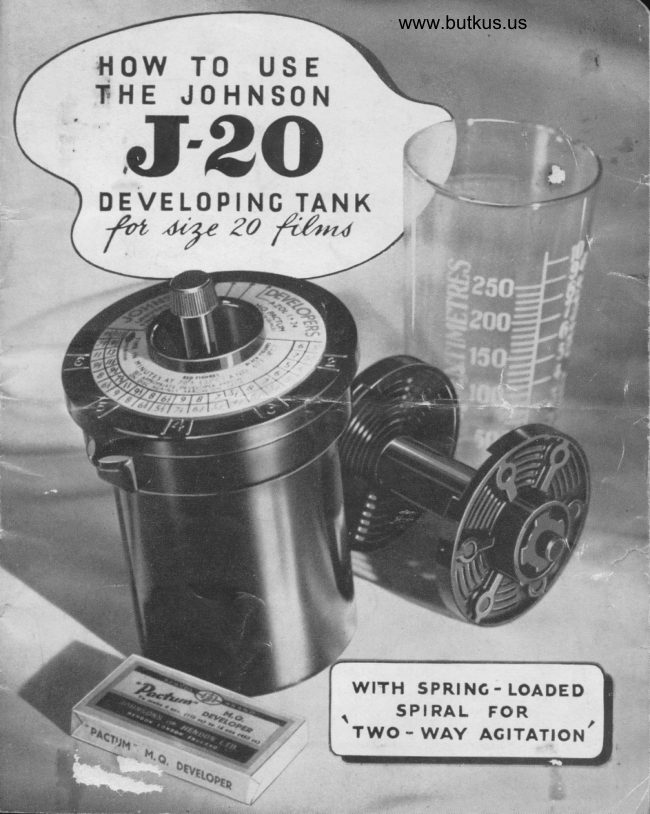
Johnson J-20 Developing Tank Developing J-20 film (assuming meaning 120 film) User manual
User manual for Johnson J-20 Developing Tank Developing J-20 film (assuming meaning 120 film). 17 pages in English. Read the original PDF, download or print a copy without registration.
17 pagesEnglish7.4 MB PDF
Loading your manual…Open PDF directly
Document details
- Brand
- Johnson
- Model / document
- Johnson J-20 Developing Tank Developing J-20 film (assuming meaning 120 film)
- Document type
- User manual
- Language
- English
- Pages
- 17
- File size
- 7.4 MB
- Category
- Film & darkroom
- Document date
- Not specified in catalog
Search available document text
Find a term, then jump to its page in the original PDF. Image-only pages may not be searchable; check the PDF for exact wording and diagrams.
Page 3 · Read text
\                                www.butkus.us
HOW TO USE THE JOHNSON
DAYLIGHT DEVELOPING TANK
 MODEL J.20
   WITH  . TWO.WAY AGITATION'
                            (Potent No.582268)
   The process of developing a film in this tank is simple
and can be carried out in daylight, but the actual loading of the
film must be done in the dark. Although a specially designed
dark-room is an advantage it is by no means essential. Any
room or cupboard that is perfectly dark will be quite
satisfactory but it is essential to see that not the faintest ray
of light is showing round the cracks of the door or window.
It is a good practice to shut yourself in your dark-room and
to wait for a minute ortwo ungil your eyes become accrrstomed
to the darkness before deciding that the roonr is safe. Minute
rays of light creeping in from unsuspecred chinks will be
quite sufficient to fog the film as it is being loaded.  lf you use
a dark-room lamp remember that panchromatic film, being
extra sensitive to red, will be fogged by a red dark-room
light. lt is safer to load the tank in total darkness. This
facility can be easily acquired by practising with an old length
of film and by carefully following the instructions in this
booklet.
    Never forget to put the tank lid on tightly (a slight turn
clockwise will lock it in position) before turning on the
light or taking the loaded tank into daylight.
   One big advantage of developing in a Johnson Tank is
that it is not necessary to develop the film immediately the
tank has been loaded. lt is often very convenient to load
the tank last thing at night, say on returning from an outing,
ready for development at the first opportunity. Provided the
lid is not removed the film will be perfectly safe.

                                              J
View original page 3Page 5 · Read text
www.butkus.us


      LOADING THE FTT.M
    This must be carried out in the dark. Remove the lid of
the tank and draw out the spiral film holder. (lt should be
noted here that the spiral film holder must be perfectly dry
before inserting a film. lf a film has just been developed in
the tank wipe every groove of the holder with a dry cloth,
otherwise the film may stick when being loaded). Unroll the
wrapping paper of the film until you come to the film itself.
lf there is a small piece of paper attached to the end of the
film, tear it off and throw it away.
     Before inserting the film into the groove, the leading end
of the film should be straightened out by bending the edge
backwards several times with the finger and thumb.
    Hold the spiral film holder in the left hand upside
down-that iS, with the spring loaded peg in the base
pointing upwards. Insert the end of the film into the front
groove of the spiral and feed it in by pushing the film forward.
 It will travel in a clockwise direction. lt is a very simple
View original page 5Page 6 · Read text
www.butkus.us
 matter to locate the start of the front groove in the dark
 by feeling for the wide slot on the outeiedge of the spiral.
     Having fed all the film into the holder tear off the
 wrapping paper and insert this end of the film into the back
                                             prevents the Itop (small groove which is blocked); rhis film unwinding during development.
    Turn the film holder over again and replace in the tank
 with the spring loaded peg downwards. Put on the lid and
 lock it in position by giving it a slight turn in a clockwise
 d irection.
    The tank can now be taken into the light.
     DEYELOPING THE FTI}I
     H.aving selected and prepared your developing solution
according.    the instructions given with the devei-oper (see             -toalso page 12), measu re our 10toz. (300 cc.). The exact rem per-
ature of the solution must now be taken, the mos; suitable
temperature being between
65" and 70' Fahr. This is very
important as it controls the
duration of developmenr. (A
feature of the J.20 tank is the
deep central tube into which
a thermometer can be inserted
for checking the temperature
of  the  solution during
development).
   To find the correct time
of development for any par-
ticular film refer to the leaflet
given with the developer or
to the table on page 11 of
this booklet.
View original page 6Page 7 · Read text
CATCULATOR DISC

                             This plastic disc, which fits
                    on to the lid of the J-20 tank,
                         provides a convenient method
                       for determining the correct
                           developing time for most of the
                          leading makes of roll film in
                       any one of five recommended
                        developers. The arrow on the
                            disc which refers to the devel-
                         oper in use should be set against                       1t
                        the arrow moulded on the lid
                           of the tank. Times of develop-
                      ment for films in groups 2, 3,
                        4, 5 and 6, cah be read off
                             against the moulded figures.
                           Having noted the time bY
pour the deveroper with a                       .J;,'i;Jil'l#,t;:';:'r"nf'f:!
possible through the hole in the centre of the lid, and insert
the stirring roC, hexagonal end first.

                                                                                                                                  -f
          AGITATTON
    Thorough and correct agitation of the solution is most                              !                                                                           )important in any spiral developing tank. There is necess-
arily only a limited amount of developing solution between
the coils of film and if this is not kept on the move patches
of irregular development may occur through local exhaustion
of the developer.
   On the other hand, continuous movement of the spiral
in one direction only must also be avoided since this would
View original page 7Page 8 · Read text
www.butkus.us
  result in streaks of over-devel-
 opment where the turbulence
 was greatest.
      This tank is provided with
 a  h igh ly efficient mechanism
 for agitating the solutions in
 that the. spiral film holder can
 be moved up and down as well
 as round and round. This new
 up and down movement forces
 the developer through the slots
 at either end of the hlm holder
 and results in very thorough
 circulation.
  ,   lTme.diately after pouring tne developer into the tank
 depress the stirring rod several
 times to dislodge any bubbles.
 During rhe cou-rse oi develop-
 ment agirate the film holder in
 the following manner.
     Press the stirring. rod down to rhe full extent and spin
the film holder fairly vigorously in an anti - clocl<wise
direction. Then release lhe pressure so that the film
 h.older rises again. Do this for about 10 seconds, occasion-
ally reversing the direction of rotation, and repeat the
procedure once every minute during development.
    wlrile this method of agitation has been thoroughly
tested and has been found io give exceilent results, "thL
user, ,^^y,.by experiment, find another technique thatequally satisfactory.                                                                        is
                                                        short ,  Yh..n u.sing a developer that only requires aceveloping time_ol ylen processing a Rlm it higher tem_
Peratures than 75" Fahrenheir agitate more freq"uently or
even continuously, always remembering to v"ry ti-'" motion
and direction of rotation.
View original page 8Page 10 · Read text
www.butkus.us


I
           RETIOVTNG THE FTLMI
              Holding the spiral in rhe left hand, as shown in the
            illustration, with      spring-loaded peg uppermosr, grip                            th:            the, leading end of the film in such a way'as ro give fc a
             slight outward cu rve. (Do not arrem pt to d raw ir ouith rough
          the slot into which ir was loaded as, being wet, ir wiil adhe're
           to the grooves and will require considerable force to remove
             in this way and may be damaged in the process). Then draw
View original page 10Page 11 · Read text
the film from the spiral as if it was being unwound from a
bobbin, allowing the spiral to revolve between the finger
and thumb. Attach a clip to each end to prevent the film
curling and hang to dry in a fairly warm room that is as
free from dust as possible.
        AN ADDED PRECAUTION
    After washing the film, but before drying, it is a good
practice to pass it through an Anti-Scratch solution to Pre-
vent the film surface being damaged during drying or
handling. To do this fill the tank with dilute Anti-Scratch
solution (see page 14), using the same quantity as developer.
Leave for five minutes after which the film should be given a               i
final wash for three minutes before drying.                    d
PREPARTNG FOR THE NEXT FII}I
    After use, the tank should be thoroughly washed and
carefully dried. This latter point is important as otherwise
the next film may stick in the guides of the spiral film holder
when treing loaded.
View original page 11Page 13 · Read text
RECOMMENDED DEYELOPERS
   One of the most popular and economical developers for
tank use is AZOL. In concentrated liquid form that only
requires diluting with wate r, AZOL produces negatives with                                                                                                                                   Ia fine grained, pure black image, free from stain. A booklet                                     I
                                                                                                                                 Jgiving time and temperature tables for four different strengths
of solution and a comprehensive  list of films with their grouP                    .i I
numbers is packed with every bottle.                            4
                                                                                                                                   I
    Johnson M-Q Packets (Pactums) provide another very              N
inexpensive method of development, one packet making
suffiiient solution to develop two size 20 films. The procedure         {
is simple. Dissolve the contents of one M-Q packet according
to the directions given with it in 16 oz. (450 cc.) of water.                                                              {tI
Pour into tank 10| oz. (300 cc.) of the solution leaving
5{ oz. in the measure. When the film has been developed                          It
pour the contents of the tank back into the measure and                     !
thenc.e to a storage bottle fbr futui"e use. (lt is a good Practice                              IrII
to strain the once used solution through a piece of cotton
wool placed in afunnel in order to remove any sediment that
could cause marks on the next film to be developed).
     This stock solution can be kept for several weeks in a cool,
dark place. When the second film is ready for development,
stand the bottle, with the cork loosened, in a bowl of warm
water until the solution reaches the correct temperature and
proceed as before, using 1S oz. of developer to process the
film. The time of development should be increased by 20o/o
for the second film and, when development is complete, the
developer in the tank and the remainder in tlre bottle should
be thrown away.
    Another very satisfactory developing solution is Johnson
Universal. This convenient, concentrated M-Q formula
contains appropriate proportions of Johnson 142, a developer
improver and 326 wetting agent. Universal only requires
diluting with water, full instructions come with every bottle.
                                         l2
View original page 13Page 14 · Read text
www.butkus.us
     FTNE GRAIN DEYELOPERS
             negatives are to b.e printed by enlarging, ir  is   _, ,_Y,h"n advisable ro use a developer. that will give'fine grlin-in the
 image and so ensure clean and sharp defi-nition in iire enlarged
 picture.. Any of the following are suitabre for use in the J"-20 tank : Johnson Fine Grain Developer, Johnson Meritol-Metol,
 Johnson Super Fine Grain, M.C.M. tOO Developer.
      All rhese developers are in powder form, packed in tins to make 20 oz. (570 cc.) of developing solution. Johnson
                                     Meritol-Metol is also
                                         supplied as a ready-to-
                                      use solution in 20 oz.
                                bottles. Complete
                              instructions are
                                   supplied with each
                                package with time
                         and temperature
                                           tables for all popr,iar
                                makes of film. Each
                                    20 ozs.of solution can
      www.butkus.us                   be used for develop-
                                      ing four or five siie
                                20 roll films.
           UNTTOL
     unitol is a new concentrated riquid fine grain developer.
one ounce of Unitol diluted with just        water to fillyour tank is used for one film and ii then"nouihdisiarded
    There is no filtering or mixing requrred. Because fresh
developer.is used for eiery firm o-ne cin be certain of the
same excellent result every time.
                                   have g_rain fine enough for'tzie, ^f"F,r,'y."s develope.d in Unitol   or 14 diameter enlargements, excellent shadow ?etail
without blocked-up highlights and.complete rreeaom-ri";iol:
    Available in 8 oz.1n f, 20 oz. bottlls.
                                        t3
View original page 14Page 15 · Read text
CAPITOT
  Capitol is an interesting new devel.opgt specially designed
                                                     speedto give increased film speed. Used with high
panc-hromatic roll films it increases their effective speed by
irp to 7o and in some cases enables a photoelectric exPosure
meter t6 be set as high as 42"B.S.
  By developing films in Capitol better results can be
obtiined than b/ using techniques such as "develoPm.ent to
                                                     prol.ongedfinality" which depend for their success on
deve16pment.  lt is based on an entirely. nery. principle and
gives ine maximum speed of which the film is capable
without producing excessive contrast.
  The developer is supplied as a concentrated. liquid which
is diluted with 4 or 7 parts of water. The instruction
leaflet wirh every bottle gives full working details includi-ng
developing times and the recomme-nded.sp-eed ratings for
most avaiEble roll films. A copy of this leaflet will be sent
frire on request.
        FIXERS AND HARDENERS
 .. PACTUM '' NEGATIVE STOP BATH
  A chrome alum stop bath and hardener for use immediately                                                          l
afterdevelopment.  ln packets to make 20o2. for repeated use.
ACID HYPO FIXING
  An easily dissolved white powder suppliedin 250 gram and-                        1
500gram tins, each with 2oz. measure lid. Dissolve 2oz. of
 pow?erin15oz.of water. Kept in awell stoppered bottle,this
quantity will fix 4 films after which it should be discarded-
,oHNSON-          FIX-SOL A concentrated liquid acid hardening fixing solution.
 Dilute with water 1*3 for films, 1*5 for PaPers. 10 oz. of
 diluted solution will fix 3 films.
 ,oHNSON-         FILM ANTI-SCRATCH   Hardens the film surface and renders it immune from
 scratches. 4oz. botd e makes 64o2. of solution, enough for
 16 films.
                                       l4
View original page 15Page 16 · Read text
\
                                        www.butkus.us

        foHNsoN UNIYERSAL
     ADIUSTABTE DEVETOPING TANK

            The J.20 Tank is designed exclusively for size 20 films. For
             all                                up            other sizes                                       to                                               size 16 (including                                                                  size                        of rollfilm                                                              20) therI          Universal                   Adjustable                         Tank                                                                                                                    is                               recommended.                                         is                                                    This                                                    tank

    I
  I          also fitted with the new 'Two-Way Agitation  ' movemenr
                                                                                                                    isII        as described elsewhere in this booklet. ln addition ir
         provided with a simplified loading action. The top secrion
          of the spiral is free to rotate about f  in. in either direction.
       The film is loaded in the normal way at the start, but can
       then be fed almost automatically into the spi'al by
          rotating the two halves in relation to each other "arlrilst
          applying alternating light pressure with the thumbs on the
         edges of the film. This
       new action, called 'Roto-
          feed,' is the solution to al  I
         loading troubles. The
        Universal Tank takes
        No. 16, No. 20, No. 27
          roll films,36-exposure
         lengths of 35 mm. film
         and approximately 60 ins.
          of 16 mm. film.


           Descr iptive booklet free
            on opplicotion.
            t5
View original page 16Page 17 · Read text
r
            JOHNSON
  THER]UIOMETER STIRRING ROD
                                    British Patent No. 494,266

       lN developing films the rate of development                           *          I  is entirely dependent on the temPerature
         of the solution. The Johnson Thermometer                                       ;D-*t
         Stirring Rod has been specially designed for
       use wiih the J-20 Developing Tank and the
                                                           a       Johnson Universal (Adjustable) Tank. lt is
          stirring rod with a'built-in thermometer and
        enablei the user to maintain a continuous
        check on the temPerature of his solution whilst
         giving the necessary agitation to the film.
           The bottom half of the instrument is made of
         black pl.rstic and fi,:s into the ::piral in exat:tly.the
                                                                                  is hollow,        same *oy tt the standard stirring rod.  lt
        howevei, with ample channels to allovrthe solution
                                                                                          is        ,o .on,.., the thermometer bulb. The top half
        a hollow transparenc plastic moulding through which,
                                                      and        the thermometer scale can be read. The top
       bottom halves can be unscrewed for cleaning or for
         replacing the thermometer.
      Ask your photogrophic deoler to show You
                  this most Procticol occessory

                                                         *
                HENDON LTD.       TOHNSONS of
          HENDON      LONDON       ENG LA N D.
                                                                               25MS t053rr
View original page 17Related documents and language editions
EssexPDF
ESSEX 35mm Daylight loading developing tank
User manual
22 pages · EnglishRead →
GafPDF
GAF Film Developing Tank
User manual
11 pages · EnglishRead →
Various brandsPDF
Johnson's 35mm Film Developing Tank
User manual
13 pages · EnglishRead →
YankeePDF
Yankee Film Developing Tank
User manual
7 pages · EnglishRead →
From the M. Butkus archive. Original publisher and archive notices are retained.
Check the model and edition against your equipment.
PDF verified 2026-10-10.