Film cameras
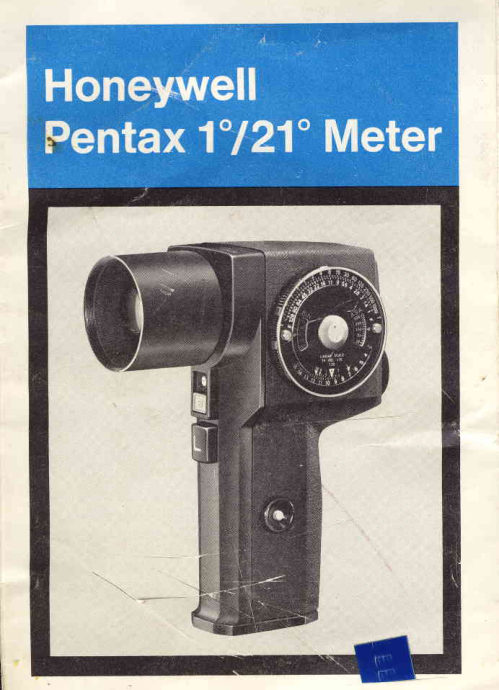
Pentax New scan of just the metering pages User manual
User manual for Pentax New scan of just the metering pages. 18 pages in English. Read the original PDF, download or print a copy without registration.
18 pagesEnglish1.4 MB PDF

Loading your manual…Open PDF directly
Document details
- Brand
- Pentax
- Model / document
- Pentax New scan of just the metering pages
- Document type
- User manual
- Language
- English
- Pages
- 18
- File size
- 1.4 MB
- Category
- Film cameras
- Document date
- Not specified in catalog
Search available document text
Find a term, then jump to its page in the original PDF. Image-only pages may not be searchable; check the PDF for exact wording and diagrams.
Page 4 · Read text
The10l21o Meter is extremelysimple to use. Nevertheless,you should read the in-
structions beforehand.For those in a hurry, a good start can be made by examining
the illustrationsidentifyingthe externalparts, and by following the ABC's of opera-
tion. A more thorough reading of this booklet should follow later.


                                                                                                                                                                                                                                                                                                                                                                                                                                                                                                                                                                                                                                                                             .  "   i   ;   .
               A short ABC of Exposure Readings                                       ;-:
                 with your Honeywell PentaxIol2l" Meter                                     t
A.  Set the ASA scaleto the correctfitm speedratingof the film you'reusing.
B.  Hold the meterin your right hand (with viewingocularcloseto your eye)and
    directmetertowardphotographicsubject.
c. Centerthe smallcircleon areaof primepictureinterest.Observeon the H scale
     of the viewingscreenthe light level(L.L.)numberat whichthe needlecomesto
     rest. lf the levelis less than 10 on the H scale and/or the needteis not de-
    {lected,then pressthe "L" buttondown and observethe L.L.on the low range*
    indicatedby L scale.
D. Set this observednumberbelowthe silverindexmarkon the metercalculator
    by turningthe knurledouterring.
E.  Selectthe shutterspeed and f/stop combinationdesired(from the two top
    scalesof the metercalculator)and transferthis datato your camera..

      xlmportant-Refer                            to Low Liqht phenomena-section  ib

@ 1966Honeywell,tnc., Printed in U.S.A.
View original page 4Page 5 · Read text
Honeyvuell   Pentax   1'/?-1o  cds
secti o n  clxposiLrFe  rrreten
    2,
               a. Dbsign-The  1o 121"meter is a
            rugged, portable,practicalexposure
            meter for on-location or in-studio
            use.The meter is light in weight and     An L.L. (Light Level) scale is lo-
                 is designedfor raPid,one-hand oP-    cated beneath the viewing screen
             eration.The changeoverfrom read'    below the circle in large black num-
             ing high to low levelsof light inten-    bers which can be easilYread, even
               sity is instantaneousand requires   under low levelsof brightnessof the
            no change of positionwhen holding    o b j e c t b e i n g v i e w e d o r P h o t o -
             the meter. The meter is essentially   graphed. The scale is essentiallY
             a single-lensreflex optical system,    self-illuminatedand will prove ad-
             consistingof an objectivelens and a    vantageous to PhotograPherswith
                reflex viewing system with a 1.5x eye-    a vision problem as well as to the
             piece or ocular.The viewing screen    a v e r a g e p h o t o g r a P h e rw o r k i n g i n
            covers a viewing angle o121"and in    dark locations.
              the center of the screen is a circle     The scales located on the meter
             definingthe 1o angle of acceptance   calculatorare engravedin three col-
               of the cadmium sulfide light sensi-    ors for good visibilitYand ease of
                tive element.                        reading.    18
                               www.orphancameras.com
View original page 5Page 6 · Read text
The external design of the 10 l21o
 meter is clean, contemporary, and
 functional.The hand grips its pistol
 shape in a mannerthat affords com-
 fortable ease of use. Eye-levelview-     The internal design characteris-
  i n g m a k e s s u b j e c t  l o c a t i o n a n d     tics assure long life through rugged
 metering           of a             fast-moving                         subject                                a    construction.                                          The                                                     basic chassis                                                                                         is                                                                                    I simple        task.          The                high range                                of the                             made from cast                                              aluminum                                                          covered
 meter will function with removal of    with a molded impact-resistantma-
 t h e  l e n s c a p . T h e  i n d e x f i n g e r i s     terial. The brackgts supporting the
automatically led to the ,,L,' button    e l e c t r o n i c c o m p o n e n t s a r e t h i c k
where low range readings can be    brass or steel fixed in position with
made quicklyand without fumbling.   brass screws. Both battery cases
R a i s i n g t h e  i n d e x f i n g e r a p p r o x i -   are spring loaded and of extra heavy
matelyllinch will bring it to the ,,B"    construction which will preventcon-
button which is used to check the    tact failure. Positive and negative
battery.All this can be accom plished    terminals of both compartments are
w i t h o u t m o v i n g t h e e y e f r o m  t h e     clearly marked to prevent improper
viewing screen.                    replacementof the batteries.
  At the base of the meter is a tripod     A l l e l e c t r o n i c c o m p o n e n t s , i . e . ,
socket which is also used for a neck    g a l v a n o m e t e r ,c a d m i u m - s u l p h i d e
or wrist strap providinga secure and     cell, and resistors, are of selected
easy method of carrying the meter.    quality elements.                                                                1 9  t                                                                                                                                                                               i .
                                                                                                                                           I i
View original page 6Page 8 · Read text
identification      of extennal   pants


       1) Objectivelens                    10)ASA scale
       2) Zero adjustmentscrew             11)Inbexfor ASA scale
       3) Battery checker button             12) Light-levelscale         'L'switch
      4)         buttonfor low light       13) Indexfor light level
      5) Adjustableeyepiece               14) Batteryhousing cover
      6) Shutter speed scale               15) Outer ring for matchinglight level
      7) Diaphragmscale                  16) Film-speedsetting plate
      8) DIN scale                                        17)Nipplefor turninginner disk
      9) Indexfor DIN scale

                                                                     21
View original page 8Page 9 · Read text
carriesvaluesfrom 3 to 10,and the
                                     high levelrange(H),abovethe line,
                                       carriesvaluesfrom 10to 18.In sub-
                                 dued light the (L) Low rangeof the
                                    scale is used.(lmPortant: This
                                          s c a l e s h o u l d n o t b e c o n f u s e d
       b. The Scales-The   1" 121"scales    with the EV or ExPosure value
      are designed with ranges of shutter   system used on some cameras
       s p e e d s , f / s t o P s a n d A S A   f i l m   and shutters.)The numberson the
     speeds above and below the limits    L. L. scalearea convenientseriesof
       of today's cameras,which is built-in   numbersexpressinglight intensity
      insurance that your meter will re-    or "light level" for the 10121"meter
    m a i n a h e a d o f o u r e v e r - g r o w i n g   only and cannotbe transPoseddi-
      technology.                           rectly to camerasor shutters with
       T h e e x p o s u r e c a l c u l a t o r o f  t h e    the EVSor LVS systems.TheremaY
      meter includes two movable rings.   be instanceswhen the values,be-
     The first scale located on the outer   cause of a certaincombinationof
       ring at the bottom of the calculator   the variablesof lightand f ilm speed
       (12) is the L.L. (Light Level), scale    of the {ilm you are using,would re-
      and is markedin numbers from 3 to    sult in the L. L. numberbeingthe
      1 8 . T h e s e c o r r e s P o n d t o  t h e L . L .   sameas the EVS number;however
       scale on the viewing screen. The    this would be purelycoincidental.
      low level range (L), below the line'
??
                             www.orphancameras.com
View original page 9Page 10 · Read text
The secondscale"T" locatedon    triangleas an aid to motion picture
 the outer ring at the top of the cal-   photographers,who maywishto use
 culator (6) shows shutter speeds   this as a point of departurein ob-
 from 4 minutesto 1l4OOOsecond.   tainingreadingsfor movieuse.1/30
 The silvernumbersare fractionsof   secondis the shutterspeedfor most
 a s e c o n d% , % , % . . . 1 1 4 0 0O0r.a n g e  16mm movie camerasoperatingat
numbers2,4 . .. 30arefull seconds.  16framesper second.(SeeSection
Orangenumberswith a smallm be-   8 for motionpicturedata).Interme-
side representfull minutes.1/b0   diate shutter speeds other than
secondis markedby a smallorange  ASAstandardspeedsare shown:


                                          40    20      l0     5     2.5    t.2    1.6        :      6                   40 50 1%Ml%M 2%M3ht
                             Shutter  speed Scale "T"-Time
                                 adjacentnumbersrepresentdouble
The DiaphragmScale ,,F" located   or halfthe amountof lightadmitted.
on the inner rotatingdisk (17),con-   Since f/numbersare fractions,the
tains lens diaphragmf /numbers   higherthe number,(actuallya de-
Irom t11to f 1128.Numbersmarked  nominator),the smallerthe aperture.
are ASA Standardf/stops and each   Otherintermediatestopsare shown
interval repres'entsa full stop, i.e.   on the followingscale.
                                                                                          l9     11    20    28    10    56    80      ll2


                D i a p h r a g m   S c a l e     , F ' - f     / n u m b e r s    o f    l e n s  d i a p h r a g m .
                                                       P3
View original page 10Page 11 · Read text
The inner rotating disk also has two    grees from 10to 11" is a logarithmic
       film speed scales.The orange scale    series, base 2, and designates the
      calibratedin ASA, the green in DlN.   same film sensitivitiesas the alter-
     The I ndicesfor the film speedscales    nate arithmetic series 6 to 6400.The
      as well as the L.L. scale are respec-    log seriesin degreesis called "film-
       tivelycoloredtriangles(9, 13 and 11)   speed values" to distinguish them
     on the innermostnon-rotatingdisk.   from the arithmetic "film speeds."
     The ASA film sPeedsare calibrated   The two series do not exactlYco-
               i n  t h e f a m i l i a r a r i t h m e t i c s e r i e s .         i n c i d e ; h o w e v e r , t h e c o n v e r s i o n
     These numbers again relate to {ull   shown  is sufficiently accurate for
       f/stop values which are an indica-    g e n e r a l u s e . N o t e : D o u b l i n g t h e
       tion of the f ilm sensitivity.The cali-   A S A   f i l m s P e e d P e r m i t s c l o s i n g
      brations on the ASA  Film SPeed   down 1 {/stop; halvingthe ASA film
      Scaleand the intermediatenumbers   speed requiresopening up 1 f /stop.
      indicated by marks between the en-    Addition or subtraction of 1 to an
      graved numbers are shown below.   ASA degree value is equivalentre-
     The new ASA film sPeedvaluesare    spectively to a decrease or an in-
      also shown. This series o{ ASA de-    crease of one f/stoP.


                                                          {0      80      160     320     640
                                          A S A  F i l m  S p e e d  S c a l e
24

                              www.orphancameras.com


                                                                                                                                                                                                                                                                               . - - - i : :             - , - . : t s               r l
View original page 11Page 12 · Read text
c. Reading the Meter                the 10 on the H (high) scafe, which
   1) Turn the inner rotating disk (16)   covers light levels 10 to 1g. lf the
 by means of the nipple (17),and set     light level of the subject is less than
 the film speed, ASA  or DlN, to its    10 and the needle does not move far
 respectiveindex (9 or 11).          enough to the right to reach 10 on
   2) Remove the lens cap and turn    the H scale, press the ,,L" switch
 the eyepieceto adjust it to your eye-    button. This places the meter in the sig ht.                                 second or low range indicated by
   3) The subject is selected and lo_    the "L" scafe. Numbers from B to 10
 cated within the 21oviewing angfe on      fall in this range. IMPORTANT,  do
 the screen. Note that the image is    not push the " L" button putting the
 erect and unreversed. The center    meter on the low range,  until you
 circle of the viewing screen covers    have determined that the tight levelis
an angle of 1o in which the meter's   below 10. lf the"L', switch button is
 Iight sensitive elements function.    depressed in bright light the needle
T h e s p e c i f i c a r e a t o b e m e t e r e d     will read off the sca/e and  this may
should be centered within the 10   damage the meter movement.
circle.                                           5) Observe the L.L. or light level
  4)With the removalof the lens cap   number from the position of the nee-
the 10l21o meter reads high light in-    dle on the scale.Move the outer ring
tensity. lf the area of subject within    (15), and match with the light level
the circle is sufficienfly bright the          i n d e x ( 1 3 ) ,t h e s a m e n u m b e r o b _
needle will then move to the right of    tained from the light level scale on
                                                           25
View original page 12Page 15 · Read text
e. Low Light Level Phenomena-
          1) Photoconductorconditioning-
    W h e n  t h e m e t e r i s t o b e u s e d t o
       read very low-level subject bright-
       ness, and the caP has been in Place
       on the meter, it is advantageousto     to some degree,dePendingon the
        "condition" the meter by viewingan    frequencyof use. ExPosureto a
        object of slightly greater brightness    brighterobjectfor a secondor two
        than the subject of interest.As long     will permitinstantaneousreadings.
       as the object is within the 1o circle,  One precautionis advised-expo-
        the dual-rangebutton does not need   sure of the Photoconductorto an
                t o b e d e p r e s s e d .O b v i o u s l Y ,i n a    extremelybright light will resultin
        studio situation,leavingthe cap off    over compensation,i.e.,when the
       betweenreadingswill keePthe me-   meteris redirectedto the low level
         ter conditioned.The advantage of    subject,the needlewill stoP at aP-
         this "conditioning" of the cadmium   proximatelyoneL.L'unithigher,and
         s u lf ide crystalis si m p ly a time-s aver'   then slowlY move to the left and
       becauseif the dual-rangebutton is   come to rest on the correctvalue.
        held down, a low level reading will   This maytakeas long as a minute.
        be reached without "conditioning"   The importanceof good judgment
           in about 2 to 3 minutes {or a meter   being used in choiceof an object
                                          is reduced    ject is thereforeobvious.I       whichhours. hasThe beentime constantcaPPed for several   only slightlybrighterthan the sub-
  2A
L  .                          www.orphancameras.com
View original page 15Page 16 · Read text
2) Dampening-Thetime constant
                                       for those phenomenaand speedof
                                 the needlemovementin general,as
                                    well as fluctuationsof the needlein
                               scanningsubjectsof variedbright-
                              ness levels,are functions of the
                            dampeningeffectof the individual
                                 meter.Thesevariationsareinherent
Example:1) Photoconductorcondi-   in any electronicinstrument.
tioning-Metercap on for t hour;     3) Drift-lf the needleis observed
time requiredto reach readingof    to drift,i.e.,theneedledoesnotcome
L.L. 3.5-3 minutes.                  to restwithina reasonableperiodof
  Conditioningby exposureto L.L.   time, providedthe light source is
6 valueobject-approximately1 sec-   constantand the meteris held in a
ond;timerequiredto reachreading   rigid, fixed position,batteryweak-
of L.L.3.5-approximately1 second.  ness is indicated.
                                                           29


                                               .--at:,-.))E -.r.:,
View original page 16Page 17 · Read text
f. Mechanics-replacing    batter-     batteries to fail eventually even with
        ies, etc.                             n o u s e , a n d t h e o u t p u t s l o w l y d e -
         1) Zero correction-The 10l21o me-    creases as the batteryages. The life
        ter will retain its accuracy with an    depends upon the qualityof the dry
       a b s o l u t e m i n i m u m o f a t t e n t i o n .    cell and how much it is used. The
      Should the needle ever not lie ex-      life expectancyis six months to one                                                                               t
        actly on the zero mark when at rest,    year for the 9V dry cell.
       zeroing is easily accomplished by      3) How to test batteries-The bat-
       turning the adjustment screw above    tery checker button (3) checks the
       the battery test button.                                        l i f e o f  t h e 9 V d r y b a t t e r y . L o o k
          2) Battery life and method of re-    through the viewfinder,and depress                       +       p l a c e m e n t - T h e 1 " / 2 1 " m e t e r  i s    the battery checker button.  lf the
      powered by two batteries-one 1.3   needle moves to the black mark be-
        volt mercury battery and one 9 volt   tween the f igures 7 and 8, the dry bat-
       dry cell. The mercury battery oper-    tery is still active.lf it does not move
       atesthe high range,"H,"and the dry    to this mark, replace the battery.
       c e l l o p e r a t e s t h e  l o w r a n g e , " L . "     The mercury battery usually lasts
      The life of the mercury battery is     for about a year.When it is depleted,
       very long at a uniform levelof output        t h e n e e d l e w i l l n o t m o v e r a p i d l y
        untilfailure.Lengthof life is depend-   against bright light. lt should usu-
       ent on frequencyof use,but it should     ally be replacedafter one year's use.
      be replaced after one year's use.   When replacing batteries, use the
                 I t  i s a c h a r a c t e r i s t i c o f d r y c e l l    correct replacement batteries.
30

                             www.orphancameras.com
View original page 17Related documents and language editions

PentaxPDF
Difference Data Sheet Honeywell Pentax 1 / 21 Spotmeter
User manual
5 pages · EnglishRead →
PentaxPDF
Pentax 1-21 : HOW TO USE THE METER
Reference guide
9 pages · EnglishRead →
PentaxPDF
Pentax Spotmeter circuit diagram
User manual
3 pages · EnglishRead →

PentaxPDF
on the Pentax 1% - 21% Spotmeter
User manual
104 pages · EnglishRead →
From the M. Butkus archive. Original publisher and archive notices are retained.
Check the model and edition against your equipment.
PDF verified 2026-10-10.