Historical reference
World's Fair 1934 Guide Book - PT. 2 Reference document
Reference document for World's Fair 1934 Guide Book - PT. 2. 48 pages in English. Read the original PDF, download or print a copy without registration.
48 pagesEnglish9.4 MB PDF
Loading your manual…Open PDF directly
Document details
- Brand
- M. Butkus collection
- Model / document
- World's Fair 1934 Guide Book - PT. 2
- Document type
- Reference document
- Language
- English
- Pages
- 48
- File size
- 9.4 MB
- Category
- Historical reference
- Document date
- Not specified in catalog
Search available document text
Find a term, then jump to its page in the original PDF. Image-only pages may not be searchable; check the PDF for exact wording and diagrams.
Page 1 · Read text
The National Parks
  A spouting geyser in action and an operating model of the crater
of Kilauea are in the exhibit of the National Parks, which includes
lighted dioramas of caves, glaciers and canyons in the Parks.
  Exhibits of large scale mining operations include a model of a
giant gold dredge scooping up the bottom of a jungle river.
  Niagara Falls, roaring over its rocky parapet, is shown in an
operating reproduction of the cataract which shows the appearance
of the crest of the falls at different periods as the water has cut its
way back since the discovery of America.
  The deep underground network  of  rivers and streams is  illus-
trated by a working reproduction of the drainage system from Wis-
consin, 250 miles north of Chicago, under the city and into Lake
Michigan.  The effect of past glacial eras in fertilizing soil is shown
by comparisons of glaciated and unglaciated areas. Glacial history
of the Great Lakes region, exhibited by light effects in a diorama,
shows how the outlet has been through various rivers before the
St. Lawrence.
                 MATHEMATICS
  From Geology we pass into the next section-this   is where we
entered the building. We are now in the section of Mathematics,
"Queen of the Sciences." Here is undertaken what never has been
attempted before in a popular exhibit-to   illustrate and explain the
concepts of abstract mathematics by moving object lessons.
   In a new set of Dr. Saul Pollock's celebrated mathematical models
we see forms of cubes, cones and ellipses change into other forms
and get a visual grip of their relations to each other.  Practical ap-
plications in everyday life are used as illustrations.
  Einstein's theory of relativity  is explained by a series of exhibits
understandable by the layman.  The Fourth Dimension is another
subject rendered intelligible by object lessons.


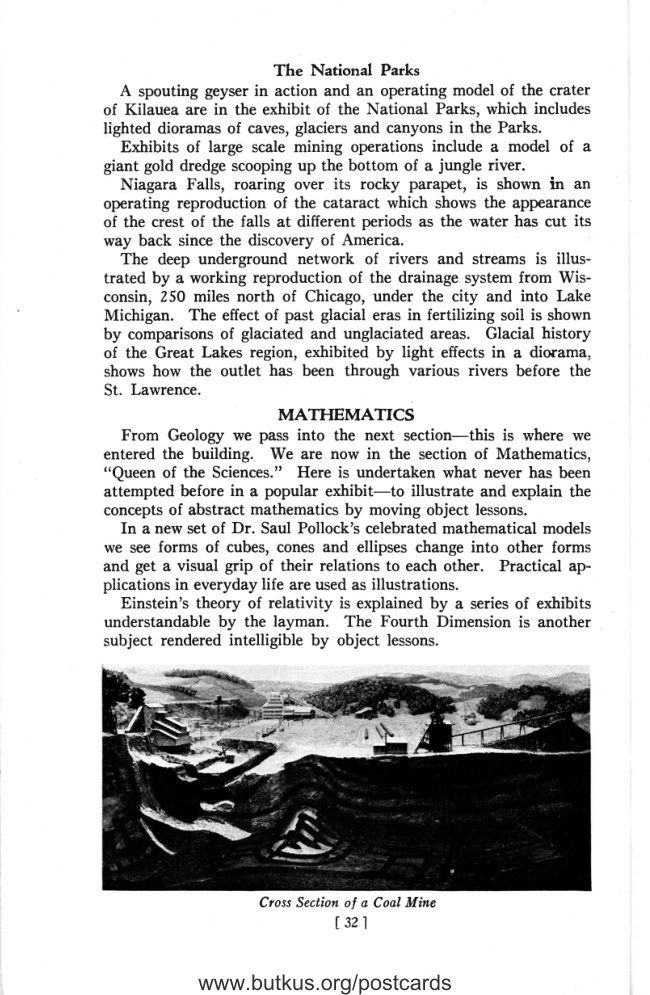
                     CrossSectionol a Coal Mine
                         tszl

         www.butkus.org/postcards
View original page 1Page 2 · Read text
The  perpetual mo-
 tion fallacy  is shown
 hy six models of fam-
 ous historical attempts
 a t p e r p e t u aml o t i o n
 machines. The  ma-
 chinesare made   to
 operateby hidden con-
 trivances to show how
 this has been done a
 number of times  f o r
 purposesof fratrd.
  How  impossibilities
 may  be  apparently
 proved true  is shown
 rvhen before your eyes
 it  is proved that two
equalsone and that
 two unequal lines are
equal. A new paradox
 is offered each week.
  You may  operate
 Galton's Quincunx, an
apparatusthat  looks
like a slot  machine


                                                                                                                                                                                                                                                                                                                                                  -Jgame. A mass of small                 *
steelballs roll  down    The Tree ol Knowledge,by John N orton
through intercepting pegs and  form  various   outlines  known  as
"probability curves."

                          Airplane  Tests
  On the balcony a "wind tunnel" shows on various airplane models
the application of the theory of aerodynamics.
  Stepping on a round platform mounted on ball bearings, you ma)'
experimentwith the theory of the conservation of rotational momen-
tum.  Holding  out a dumbbell in each hand as the platform  is
started slowly revolving, you may speed it up by lowering the dumb-
bells and slow it down again by raising the dumbbells, repeating the
processas often as you like, changing the speed without any addi-
tional force being applied, but simply by changing the angle of the
weights.
  Service of mathematics in the development of radio is shown by
historical exhibits of Marconi's original apparatus.
                 The Stratosphere Flight
  The stratosphereflight-with   which the Exposition was associatecl
                                                      t 3 3 l

             www.butkus.org/postcards
View original page 2Page 3 · Read text
last year-by  Lieut. CommanderT. G. W. Settle,U. S. N., and Major
chester L. Fordney, u. s. M.  c., is the subject of a specialexhibit,
the purpose of which is to shorv the usefulness to practical science   'theof    observations made in the record flight.  The instruments usecl
and the records made on the flight are shown and exprained.
  How mathematical principles are used in gun-fire, in navigation
by the position of the stars and in communication is sholvn here
by a united states Navy  e,xhibit. A gyroscopic compass in action
has "repeaters" in different parts of the floor showing at all times
the direction indicated by the main compass.
  From the main Mathematics Section we pass, now, to:

                     PHYSICS
   rn the Physics Section a series of exhibits show the generation
and control of power.
  The exhibits are divided'in  six groups: gases,sound, electricity,
radio, light and penetrating invisible rays.
  operating apparatus shows how the expansion of gases produces
the effects of refrigeration. A working model with magnified mole-
cules represented by steel balls shows how the internal pressure in
an automobile tire is due to incessant bombardment of the walls by
the moleculeswhich have the speedof rifle bullets.
  we see an operating steam engine with glass cylinders, showing
the working of the expanding steam. A drop of water four inches
in diameter illustrates why drops are globular and shows why their
shape in falling suggeststhe principles of "stream line" design.
  what sound is and how sound waves travel are shown by operat-
ing exhibits. we see a large tuning fork  vibrating slowly with a
wide stroke.  Amplification of the sound is shown by four tubes of
different length. we see the image of the vibrating flames within
the tubes reflectedby a rotating mirror.
  That sound is vibration and that the variety of sound is produced
by vibrations of different length is shown by a magnified image of
the sound-creating edge of a movie film. As the jaggecl line passes
we see that the broken light, which itself is a form of vibration, is
changed into sound by the vibration being transmitted to the dia-
phragm of a loud speaker and we see the light translated into words
and music.
  Fundamental principles of the electric dynamo, transformer and
motor are shown by simplified moving exhibits.
  The valve tube, heart of the radio set, is analyzed and explained
in detail by exhibits shorving the action of the filament, grid and
plate.
                                                       t 3 4 l

          www.butkus.org/postcards
View original page 3Page 4 · Read text
HaIl  ol Science, Tower and Court
                             Light  Rays
  Refraction, or bending of rays of  light by means of lenses is
shown,and we see how the lens forms an image, magnified or reduced.
We see illustrated that  light  is a vibration.  A magnified exhibit
showsthat the wave length of the vibration  is about twenty  mil-
lionths of an inch.   Different colors have different wave lengths.
Method of analyzing blended colors into separate wave lengths iden-
tifying the different colors is shown.
  The electron and ttre proton, buildirg  stones of  all atoms, were
discoveredby physicists. These most minute of all known divisions
of matter are invisible but  at speeds of 100 to 100,000 miles a
secondthey are called cathode, canal, alpha or beta rays and pro-
duceeffects which can be seen.
  Luminous effects of cathode and canal rays are shown in vacuum
tubes, also tracks of alpha rays from radium.  Exhibits show the
penetrating effects of X-r&yS, which are produced by cathode rays
striking other substances.
               THE GREAT  HALL
  From the Physics Section we now walk  into the Great Hall  of
the building.  The treatment of  this huge modern interior again
                         t3sl

              www.butkus.org/postcards
View original page 4Page 5 · Read text
calls on us to give a moment's thought to the decorative methods
of the new architecture. The hall  is 240 feet long, 60 feet wide
and with a ceiling 57 feet high.  The geometrical decoration of the
wall spaces illustrates the modern idea of having the ornament in
keeping with the function of the interior.
  Above the north doorway at the balcony level is one of the three
large mural decorations by John Norton.  What could be more mod-
ern and original in conception than the treatment of a "graph"  of
scientific information as a mural decoration.  "The Frequencies of
Electromagnetic Waves in Kilocycles per Second" is the title.   . At
the far end of the hall in a similar bay above the south entrance you
will  see a companion decoration, treated in  the same manner,
"Dimensions of Natural Objects in Miles."
  Framing the center door to the terrace and towering toward the
lofty  roof is another graphic decoration in scarlet and gold, "The
Tree of Knowledge."
  Emblazoned on the walls of the great hall as part  of the deco-
rative schemeare quotations which epitomize the thought of fourteen
great minds on the tlevelopment of the basic sciences. Besides these
quotations are nine axiomatic definitions.
                 The Clock of the Ages
  At your left, as you enter the great hall from this end, you look
back a moment at the history of this planet as it  is visualized in a
remarkable demonstration-"The  Clock of the Ages."  This is a ten-
foot dial representing the advancing geologic periods by compressing
two billion  years into one revolution of the clock hands in  four
minutes.  Mammals, the dominating  life  of  the present, do not
appear until almost the end of the revolution, and man is on the
stage only a few seconds.
   In the center of this end of the hall you see the gondola in which
Dr. Auguste Piccard made the first ascent of 54,000 feet into the
stratosphere.
  The Periodic Table of the Elements is in the center of the floor
at the south end.  In  this illuminated pedestal, surmounted by a
globe which shows their distribution, we see the ninety-three known
elements that composethe world of matter. We can see their atomic
relation to each other, and this gives the clew to their separation and
recombination into different substances,the principles of which we
may now watch demonstrated as in the active operations of the
chemical laboratory.
                   CHEMISTRY
  We are now in the Chemistry Section where we shall see demon-
started the science of the transformation of matter.
  A simple chemical changeby separation is shown by metallic mer-
cury being produced from mercuric oxide-a  red powder-by  heating
                                                       [ 3 6 ]

         www.butkus.org/postcards
View original page 5Page 6 · Read text
The Great Hall  in the HalI  ol Science
rn a quartz retort over an electric heater.  Silvery mercury drips
from the retort tube into a glass jar while the oxygen blows away,
presenceof the oxygen being shown by a smoldering wick bursting
into flame as the oxygen strikes it.
  An extensive series of actual chemical operations of this type is
shorvn,illustrating transformationsby separationand by combina-
                           lszl


              www.butkus.org/postcards
View original page 6Page 7 · Read text
tion.  Explanations by placards and by voice make each reaction
easily understandable.
  A ribbon of iron burns like paper becauseof a jet of oxygen. A
str'eamof liquid fire is causedby a jet of phosphorus forced through
a small orifice and instantly combining with the air. We see potas-
sium dripped into water and bursting into flame.  A number of
other illustrations show how the atoms of different elements rush to
combine with each other.  The exhibits show how chemical changes
are always accompanied by energy changes-heat  or  light  being
liberated or absorbed.
                    Furnaces at 340O" C.
  A battery  of electrical furnaces-the  principle of which  is the
same whether they are laboratory bench size or fifty-ton size-shows
the use of intense heat, up to 3,400" Centigrade, to induce chemical
combinations.  Nlelting lime and coke together to produce calcium
carbide is demonstrated. You may safely put your hand inside an
induction furnace in which a rod of iron  will blaze and drip  like
melting wax-but  your ring or wrist watch would melt off instantly.
  Extreme cold produced by the expansion of a gas is illustrated by
a series of demonstrations with  liquid  air.  The principle is shown
by air being admitted to a partial vacuum in a flask. A rainbow
in myriads of minute water drops shows the chill of the expanding air.
  Liquid  air is produced by air being compressetiat 3,000 pounds
to the square inch.  Suddenly released, it  chills to a pale bluish
liquid about the consistency of water and at a temperature of 317
degreesbelow zero.
  The demonstrator dips a stick into mercury and then into a flask
of liquid  air.  The mercury instantly f.reezeshard as steel, and he
will drive nails with  it.  He will plunge a rod of hot iron into the
liquid air and the iron will blaze up on account of the concentrated
oxygen. A burning stick of carbon plunged into liquid  air burns
incandescently. When the flask of liquid  air  is set on a cake of
ice the liquid  air boils fiercely on account of the comparative heat
of the ice.
  An elaborate working diorama of a model sulptrur mine shows
the mill and surface operations, the sulphur deposit 500 feet below
the surface and the method of melting the sulphur and bringing it up.

                          Colloid Chemisty
  Exhibits of colloid chemistry show the methods of purification of
water and air and of separation of gold from the ore.
  A colloid is a substance suspendedin another substance, the sus-
pended substance being so finely divided that   it  is invisible, will
not settle and cannot be removed by  filtration.
                                                       I 3 8 l

          www.butkus.org/postcards
View original page 7Page 8 · Read text
The Periodic Tabte ol the Elements
  Contaminatedwater is sholvnpurified by a solution of alum rvhich
 formsa jelly-like substanceand sinks, cariying the colloidal impuri-
 ties with  it.          Smoky air  is shorvn cleareclb)r passing it  betiveen                  -
 electrically charged plates.  The colloidal parii.l.,   6..o*.   elec-
 trically charged, cling to the plates and the air blows out pure.
  Gold ore is shorvn pulver ized, mixed rvith  rvater and  oil and
churnedinto foam. The base material sinks while the gold remains
colloidally suspendedin the froth which is skimmed off.
 A giant talking and gesturing robot, ten feet tall, with a trans-
parent digestive tract, is the dramatic feature of the exhibit of
physiologicalchemistry.  In a theatre at the end of the hall, the
robot gives a lecture on the chemistry of food and shows food pass-
ing through his own stomach and intistines, and being digested.
                                                        [ 3 e ]

                www.butkus.org/postcards
View original page 8Page 9 · Read text
BIOLOGY
  Before we enter the Biology Section, we see at this end of the
Great Hall a remarkable moving model showing how trees grow.  In
this moving exhibit we see a section of a basswood twig, magnified
to seven and one-half feet in diameter, representing a branch three
years old.  The twig adds a year of growth in seventy-five seconds,
becoming nine feet in diameter by the accretion of new material.
 We now enter the Biology Section, occupying the South Wing of
the main floor of the Hall of Science.
  At  the entrance of the section is one of the most unusual and
interesting scientific exhibits.   It  is the Microvivarium,  developed
by Dr. Georg Rommert.  Actual drops of water are the stage of this
exhibition.  High power microscopes look through the drops and
project on screensthe scenesgreatly enlarged, so that you may see
lhe ferocious, weird, incredible microscopic living  creatures, swim-
ming, eating, making love and fighting in their infinitesimal world.
  The Biology Section takes up the story of how life takes form-
from the primitive  cell to its highest evolution in man.  Magnified
cells and moving models demonstrate the principles of growth  in
animals and plants.
  Development of the human being from the cell is told in a series
of embryological exhibits.  Cages of healthy guinea pigs illustrate
variations through hereditY.
                   From Fish to Man
  Evolution of the human face-from   fish to man-is  shown by a
series of models in  the Paleontology exhibit.   Evolution  of  the
horse and other mammals and of the invertebrates also is shown by
completd models and comparative exhibits.
  A  life size model of a man shows the circulation of the blood by
means of a magnified heart pumping, the valves working and the
red blood flowing out through the arterial system while blue blood
is returned by the veins.
  The different characteristics that produce high or deep voices are
shown by moving models of the chest and throat.  The lungs move,
the ribs expand and the larynx vibrates.
  How plants grow is shown by u moving exhibit of the marriage
of plant  cells in a magnified dahlia stalk.  A  pollen grain from
another plant drops into the flower, moves down to the ovule and in
four stagesthe united cells produce a living seed containing a minia-
ture plant.
  That food elementsare produced in plants only in daylight is shown
by a moving exhibit of the cell structure of a corn stalk. Circulation
through the cells of oxygen, carbon-dioxide and water vapor is shown.
At night the plant gains size but food elementsare formed only under
sunlight by the natural complete influence of all the sun's rays.
                        r40l

          www.butkus.org/postcards
View original page 9Page 10 · Read text
The Alchemist's Laboratory
                    MEDICINE
  We now descendto the ground floor of the Hall of Science,to the
 sectionof Medicine.
  The display of the Medical Sciences visualizes the tremendous
 advancein the past century in the knowledge of the causes,detection,
 preventionand cure of human and animal diseases. Scientific medical
 institutions of England, France, Germany and Italy have cooperated
 rvith the American associations. Large additions made to the Medical
Sectionfor the Exposition of 1934 include:
  The Henry Ford Hospital of Detroit, Mich., shows oxygen therapy
 in the treatment of pneumonia, and the tannic acid treatment of
burns for diminution of pain and more plastic healing.
  Methods of medical evidence in crime detection are shown by the
medico-legalexhibit of the Institute of Medicine of Chicago.
  Water, heat and rest therapy are shown by the U. S. Government
exhibit from Hot Springs, Ark., National Park. The Chicago Roent-
genSociety has an exhibit of the X-ray, including a skiagraph of the
entire human body as revealed by the X-ray.
  Prevention of the transmission of diseasefrom animals to man and
the use of veterin ary science in food inspection is shown by  the
AmericanVeterinary Medical Association. Drills in resuscitation from
asphyxiation are shown by the Chicago Rapid Transit Company
medical department. Progress in knowledge of human reproduction
through the internal secretions and sex hormones are shown in an
exhibit by Yale University and St. Louis University.
                                                      [ 4 1 ]


             www.butkus.org/postcards
View original page 10Page 11 · Read text
Visitors may use the Teletac-
                                             tor, an instrument for the edu-
                                     cation of the deaf by vibrations
                                 which change frequency a n d
                               a m p I i t u d e correspondingto
                               sounds produced by speech.

                                 The Transparent Man
                                          In the Medical Section are a
                             number of the most remarkable
                                      exhibits ever prepared by scien-
                                              tists. Outstandingly spectacular
                                              is the Transparent Man.  This
                                          life-size figure  is one of only
                                two in the world.  It  is from the
                               Deutsches Hygiene Museum in
                            Germany and is an example of
                                    the  patient  labor  of German
                                   science. The figure has a skin
                                        of transparent cellon.  All  the
                                organs of the body are in place
                             and are illuminated  in  turn,
                               showing their size and position.
                             You walk around the figure and
                                   look through it as if you were
                               possessedof X-ray eyes.
        The Transparent Man          The  transparent man  is a
                            handsome figure in the classic
attitude of a suppliant like the statue of the young Antinous.  The
gradual lighting up of its interior is a spectacleof singular dramatic
power as it reveals the organism that  is inside every human body.
Elsewhere moving models of parts of the body may be operated by
the visitor showing the action of joints, operation of the breathing
apparatus, circulation of the blood, the larynx in different states and
horizontal sections of the body, are shown in a life-size model in
eight parts.
                     The Embryos
  A most fascinating exhibit  is that of the various stages of the
human embryo, shown by the Loyola Medical School of Chicago.
This exhibit attracted so much attention last year that  it has been
given greatly increased space. The display includes an exhibit of
actual cross sectionsof human bodies.
  The works of Louis Pasteur, pioneer of bacteriology, and of Robert
Koch, who discovered the tubercle bacillus, are shown in commemo-
rative exhibits.
                                                                     l 42l

          www.butkus.org/postcards
View original page 11Page 12 · Read text
An extensiveexhibit of work in bacteriology, and tropical diseases
      of man and animals is that of the great Wellcome Research Institu-
      tion of London. The institution shows models of the floating labora-
      tory presented to the Sudan government on the Nile and of the
     mobilelaboratory given the British War office during the World War.
      Progressof hospitals in the past century in America is shown by
     the American College of Surgeons. The American Medical Associa-
      tion uses dioramas, mechanical displays and transparencies to show
     the evolution of medica\ care. The American pharmaceutical Asso-
      ciation illustrates the evolution  of medicine dispensing from an
     old-time pharmacy to actual demonstrations of modern prescription
    compounding,assays and chemical tests.
       History of blood transfusion is shown by the use of actual instru-
    ments in the exhibit of the Cleveland clinic  Foundation.  physio-
      logical relations of the thyroid, pituitary, suprarenal and sex glands
     are shown by specimens,models and charts.
      The development of abdominal surgery and work on the treatment
      of pernicious anaemia are among other subjects of exhibits of the
    SimpsonMemorial Institute  for Medical Research of the Universitv
     of Michigan.
      Motion pictures, wax models, transparent photographs and charts
     are used by the Mayo Foundation to illustrate work on goiter, dis-
I    electriceasesofthermometerthe digestiveenablestract visitorsand of tothetakenervousthe temperaturesystem. Aof largetheir
    handsand a tremometer enables them to test their nerve steadiness.
                   Work  for  Crippled  Children
       Rehabilitation of the crippled child is the subject of the university
     of Chicago exhibit.  Motion pictures show results of work on acute
      infantile paralysis.  Models and photographs illustrate the possi-
      bilities of work on the spine.
       Bright's diseaseis illustrated by specimensof organs and the rela-
     tions between kidney disease and acute infections are shown by
    Marquette University and i\{ilwaukee County Hospital.
     The American urological Association presents an exhibit on dis-
    easesof the urinary tract.
      Questions and answers on maternal hygiene are shown by the
    ChicagoMedical, Dental and Allied Service women's Association.
     The  fight  against  tuberculosis is  portrayed by  the Chicago
    Municipal Tuberculosis Sanitarium and the Chicago Tuberculosis
     Institute.
      care of the teeth and the progress of dental science are shown
    by the chicago centennial Dental congress. Motion pictures, oper-
     ating models, specimens,charts and transparenciesare used to show
    methods of treatment and the relation of the teeth to the general
     health.
                               f-+s1

                 www.butkus.org/postcards
View original page 12Page 13 · Read text
Relation of focal infections to systemic diseasesis the subject of
the exhibit of the University of Illinois and the Illinois Department
of Public Health.
  The University of Wisconsin presents the history of the pioneer
work on gastric digestion, result of the observation 100 years ago
of Alexis St. Martin, whose digestive operations were visible as a
result of a gunshot wound.
  Northwestern University exhibits a collection of rare old prints
of early medical subjects and a library of rare medical works.

         SCIENTIFIC  COMMERCIAL  EXHIBITS
  We have seen, now, a virtually complete survey of the progress
of medical science.
  On this-the  ground floor of the Hall of Science-you may look
next at an extensive series of collateral exhibits by scientific manu-
facturers.
  You see in a copper-lined welding pit  the operations of welding
and cutting steel with the oxy-acetylene blow torch.
   In a tank of hydrochloric acid a steel wire is shown being eaten
away while an alloy wire is unaffected. A special steel lathe tool,
heated red hot, is shown in a moving extribit, cutting down a steel
casting hour after hour without losing hardness.
   Irradiation of milk to increase its vitamin D content is shown on
a revolving stage.  Exhibits show uses of sun ray lamps and uses
of acetylene gas for farm and home power and illumination.
                            A  model apartment  sitting
                                room, bathroom and  kitchen
                                     illustrates wall panels, tiled
                                          floors, doors, ceilings, and win-
                             dows made of an unbreakable,
                                       glass-like by-product of natural
                               g&S,unaffected by heat or cold.
                               The space of the exhibit  is
                                     air-cooled by apparatus shown
                                           in operation.
                                   Another  manufacturing  ex-
                                            hibit  is a large working model
                                        of a plant making phosphoric
                                    acid products. Molten material
                                 pours from  the blast furnace
                              and the other departments of
                                    the extensive plant are in oper-
           Mechonical  Heort              ation.  The   exhibit  includes
 illustrations of uses of the products in cooking, fireproofing and
building.
                             l44 l


          www.butkus.org/postcards
View original page 13Page 14 · Read text
The story of a cen-
 tury's progress in eye-
 sight protection and
 correctionis told in an
 optical exhibit. A sec-
 tion of the display is
 devoted to protection
 o f w o r k e r s '   e y e s
 againstindustrial haz-
 a r d s.  Operation of
 grinding Iensesfor op-
 tical and scientific uses
 are  demonstratedin
 anotherexhibit.
  Advancementin am-
 ateur and professional
 photography is shown
 by exhibitsof cameras,
 lensesfor use under all
 kinds of  light  condi-
 tions, prints and mo-                              Modernistic Statue Grouf in Hall ol Science tion picture equipment.                  by l.ouise Lentz
  contra,,,.,,,*'iil' #i#ll.T;.?ji':ff:ll,  shopandthe
modern pharmacy is shown.  There are a number of exhibits of
drugsand chemical products, including foods for infants and special
 invalid foods.
  Advancing use of milk products is subject of a special exhibit.
  A remarkable enlarged reproduction in colored sculpture relief of
the celebratedpainting, "The Doctor," by Luke Fildes, R. A.,  is
shownby one exhibitor.
  Rare precious metals, palladium, rhodium and others, methods of
electroplating,uses of gold for dental and other purposes, are shown.
  Sun lamps are displayed in a darkened booth  to show their
fluorescenteffects. Uses of other special ray lamps for individual
and group treatment are shown.
  Microphone apparatus for the aid of the deaf is shown and demon-
strated. There is an exhibit of surgical instruments, and one of
mattresses. E mbroidered silk shoes, of the kind worn by Queen
Elizabeth, brocade knee boots, African  sandals, Polynesian and
Chineseshoes are among the curiosities of footwear shown in an
exhibit of scientific shoes and foot ailment correctives.
  Methods of floor, furniture and automobile polishing are exhibited.
There is also an exhibit of fire prevention equipment.
                         t4sl

              www.butkus.org/postcards
View original page 14Page 15 · Read text
OUTDOOR  SCIENCE THEATRE
      IN THE COURT OF THE HALL  OF SCIENCE
  From the great open court between the wings of the Hall  of
Science,10,000 persons at a time may witness the performance of
seeming miracles on the stage of the Science Theatre.  The stage
is at the open end of the court with its back toward the lagoon.
  The  different "acts" show invisible rays and other mysterious
powers in action, performing apparently impossible feats of magic.
Wireless telephony will  repeat from  the stage conversations and
interviews from airplanes and from distant parts of the world.
  The science theatre acts are planned on an educational basis and
the principles involved are explained.
              ARCTURUS  BEACON
  As the seasonadvanced last year  it was sometimes difficult even
for the huge observatory telescopesto pick up the rays of the star
Arcturus in  its position in the brilliant part of the evening skies in


                            The SzrlzssVillage
                                                   t 46l

          www.butkus.org/postcards
View original page 15Page 16 · Read text
time for the star's rays to be used to turn on the lights of the Exposi-            'fhis    tion.      year the rays of Arcturus will light the Exposition Beacon&
.';' in the court of the Hall of science every evening at twilight.
    The Be'acon is a great torch flaming from the top of an orna-
   mental pillar.  A powerful reflecting telescopeon the terrace of the
    Hall of Sciencepicks up the ray, which has been traveling 40 light
   years from Arcturus, and this ray, amplified, lights the Beacon.
     Restaurants in the Hall  of Science:
     xTriangle Restaurant in North Wing.  Also grill.
     *Century Grill in North Wing.  Also lunch counter.
     xDrug store in North wing.  Lunch counter and table service.#
     tswISS VILLAGE.  A typical Swiss mountain village, nestling#ffi'l    at the foot of the Alps, populated with native Swiss at their work,
   sportsand amusements. The buildings are reproductions of charac-
    teristic parts of the older portion of Berne, capital of Switzerland.
   Plaster casts of exteriors are used to give exactnessto the houses
   and chalets. St. Bernard dogs, Alpine guides, watch makers, swiss
   lace makers and cheesemakers are seen. A group of yodelers and
   Swissmaidens give entertainment in the village square with native
   songsand folk dances. Background of the village is an Alpine scene
    of rugged peaks and valleys.
     *Swissrestaurant, ala carte, indoor and outdoor tables. Also grill.
   Floor show and dancing by guests.
    18TH STREET BRIDGE  EITTRANCE,  over Illinois central
   tracksand from Columbus Drive.  Pay parking space. Taxi stand.
     Exposition bus stop.

     GENERAL EXHIBITS GROUP
   GENERAL EXHrBrrs   BUTLDII{G.  This great buitding, 98s
   feet long, was designed by Harvey wiley  corbett.  The floor space
    of the two stories is more than  five acres. In  each of  its  four
   pavilionsyou will find striking mural paintings of the modern school.
    The General Exhibits Building was planned to  tell the story of
  many and varied industries.
   New ideas of arrangement and use of striking modern furniture
",I   areseenin twelve different sleeping rooms, completely equipped ancl
ffi ready for use, as planned by twelve modern interior decorators.
     Demonstration is given of the  operation of machinery which   !
   fashions24,000 steel mattress springs in an hour.
     Up-to-date factory floor layouts are used in a demonstration of the
   useof lift-trucks and portable elevators.$#
                               l47 l$

                 www.butkus.org/postcards
View original page 16Page 17 · Read text
General Erhibits  Building

                               Oil Exhibits
  Automobile engines, with part of the cylinder walls and housings
cut away to show the moving parts, are a central feature of a dem-
onstration of the oil industry.  Reproduction of a giant vacuum oil
still  is shown.
   In  this exhibit you may seat yourself in an airplane pilot's seat
or in a racing automobile driver's seat while a moving picture flows
before your eyes as if you were driving the machine.
  "Mechanical Wonderland"  is a series of more than 200 working
models showing how the combinations of wheels, eccentrics, gears
and levers are developed into complex automatic movements.
  Heavy engineeringequipment, electrical machinery, pumps, valves,
and light and heavy scales are in an exhibit of machinery for big
jobs.
   Air conditioning equipment for homes, offices and industrial uses
are the subject of an exhibit, which includes oil-burning installations
for heating.
   In this section of the building we find exhibits of coal transporta-
tion, power belting, plumbing eqtripment, motor lubrication, modern
g&S,oil, water and gasoline meters. Progressof the canning industrl'
is shown in many types of containers. There is an exhibit of sewing
machines. Modern bars for home and cafe service are in an exhibit
which includes home and club billiard tables.
                                                       t 4 8 l

        www.butkus.org/postcards
View original page 17Page 19 · Read text
.   l

                    Gutenberg's Print Shop
   In  the world's  first  print shop, that  of Johannes Gutenberg, of
Mainz, Germany, in 1438, you see a reconstruction of Gutenberg's
own press. You may see in use, casting type, some of his original
molds. You  will see fine hand printing jobs of pages done on the
antique equipment and with Gutenberg's type.
  The  first printed book pa8e, that of the so-called 42-line Bible,
is in the exhibit.  Printers, in mediaeval costume, work in the shop
and pull proofs on the ancient hand press.
   In the exhibit is a facsimile of the original Gutenberg Bibles and
reproductions,made by copying Gutenberg'stype, of the "Calendar
of the Turks," the first printed circular, done by Gutenberg's shop
in 1453.
  Associated with the Gutenberg print shop you see an exhibit of
fine presswork and book binding of the present day.
   In an exhibit of rare books bound by hand you  will  find "Die
Niebelunge," & masterpiece of the artistry and workmanship of this
craft.  With  it is a display of beautiful products of fine book making.,
Artist book binders are seen at work, binding and decoratingbooks,
hand-tooling French, Levant and Morocco leather.
  Encyclopedias,text books, magazines,French and European pub-
Iications, and sets of books for  children, are among exhibits of
publishers.
  Paper nails that can be driven into hard wood supply a nail that
is a non-conductor of electricity.
  Household uses of paper are demonstrated in the House of Paper,
in a kitchen which is a model of conveniences.
  Photographsby distinguished amateurs and professionalsare seen
in a Salon exhibition with an historical display of early cameras.
  Modern rug weaving is demonstratedon a huge jacquard loom,
9 by 12 feet, at work on a modern Oriental rug.
  Porcelain enamel products and their various uses are shown in a
cooperativeexhibit of the industry.
                      BusinessMachines
  How the enormous routine of book-keeping, correspondenceand
office systems is carried on by modern businessis shown by business
machines.
  You see machines that tabulate, sort and file.  They can auto-
matically sort out any group of cards from a  file of hundreds of
thousands in  a few minutes.  Books and records are kept by
machinery.  Intricate  tasks that would require thousands of eyes
and fingers are rattled off at dizzy speed.
  Cash registers of different capacities are exhibited.
   Electrical dictating machines,office and home safes,rubber stamps,
inks and pastes,magazinepencils and other office suppli^  '-.-.  their
exhibits.
                        tsol

          www.butkus.org/postcards
View original page 19Page 20 · Read text
Education by mail
is the subject of an
exhibit.
  In the Home Work
Shop clever workers
are making pieces of
earlyAmerican furni-
ture,starting with
t h ep l a i nl u m b e r .
You may watch them
making ship models,
modelairplanes, toys
and smoking stands.
  Safety devices that
foil hold-ups of  of-
ficesor banks  are
shownin an exhibit
of safes. Slow open-
ing combinationlocks
are connectedwith
silentelectric alarms.
Office protection de-    A Tower  ol the General Exhibits  Building
vices,safe keeping for files and records, and home safes are shown.

                    Diamond Mine
  tA South African diamond mine in operation, with native laborers,
is seen in the $5,000,000 extribit of the cooperating diamond and
jewelryinterests. Thirty tons of diamond-bearing blue clay from the
Kimberley mines were brought from South Africa  for the mining
demonstration. You have the illusion of descending 1,500 feet to
the workings where the Kaffirs are toiling.  You see the clay brought
up on elevators and the diamonds recovered on the grease tables. A
compound,in which the South African native workers live, is back-
groundfor the diamond pit.
  Cutting and polishing of diamonds is shown in a reproduction
of a sectionof Amsterdam, Holland.
  In the display of famous gems is the t28.5 carats Tiffany Diamond
and the 42 carats perfect blue diamond, formerly one of the jewels
of Emperor Maximilian of Mexico.
  In other exhibits, modern costume and other jewelry are shown.
  Evolution of clock and watch making in the past 400 years is
told in an exhibit  in rvhich working models illustrate the various
improvements. A talking moving picture theatre, seating forty, tells
the story of the watch.
                              tsll

              www.butkus.org/postcards
View original page 20Page 21 · Read text
Present day scientific
                                    method of  taking   t h e
                                       standard time from the
                                            stars is explainedby lec-
                                               turers, illustrated by the
                                        instruments used for the
                                       purpose.
                                          Automatic Machine
                                      Makes Tubes
                                 A long range of  glit-
                                             tering apparatus making
                                  and   filling toothpaste
                                        tubes shows the tubes
                                              starting as metal slugs,
                                          the size of a nickel. You
          The Ent,peror's Diamond           see how  the slugs are
                                stampedout into lono
tubes and the small ends threaded to take the screw cap. The tubes
are filled with paste and printed in  brilliant  colors by automatic
process. A mechanical robot explains the operations.
  There are exhibits of textiles and women's wear and of trunks and
travel equipment.
  Horv shirts and house dressesare made is explained in an exhibit
that is a factory unit.  Twenty girls, in neat uniforms, are running
high-speedpower serving machines around a semi-circle that gives
you an opportunity to watch each at her job.
  Breeding of  silver foxes for  their valuable furs  is shown in a
moving picture. You see the foxes born in captivity in early spring
and then transported to 10,000 acres of virgin forest.
   In a setting of natural forest background is an exhibit of the furs
in their different color phases. A revolving stage sholvs,on one side,
foxes in the lvoods, and, on the other side, a fashion show of furs
worn lvith various costumes.
  Four hundred figurines show the progress of women's ideas of
costume from past ages up to now.  Forty-four countries are rep-
resented. Among the figurines famous women of different times are
represented,each dressedas she lvas in life.
  A  glass engraver, at work  cutting designs, delicate ornament.
monograms and other decorations on crystal glasslvare,is seen in
an exhibit of American glassware.
  Names of  all the exhibitors in the General Exhibits Group will
be found in the complete list at the end of the Guide Book.
  *Cafeteria in Pavilion 2. No alcoholic drinks.
  Exposition bus stop.
                          tszl

         www.butkus.org/postcards
View original page 21Related documents and language editions
M. Butkus collectionPDF
World's Fair 1934 Guide Book - PT. 3
Reference document
41 pages · EnglishRead →
M. Butkus collectionPDF
World's Fair 1934 Guide Book - PT. 4
Reference document
43 pages · EnglishRead →

M. Butkus collectionPDF
World's Fair 1934 Guide Book - PT. 5
Reference document
34 pages · EnglishRead →

M. Butkus collectionPDF
World's Fair 1934 Guide Book - PT. 1
Reference document
40 pages · Not specifiedRead →
From the M. Butkus archive. Original publisher and archive notices are retained.
Check the model and edition against your equipment.
PDF verified 2026-10-10.