Historical reference
World's Fair 1934 Guide Book - PT. 3 Reference document
Reference document for World's Fair 1934 Guide Book - PT. 3. 41 pages in English. Read the original PDF, download or print a copy without registration.
41 pagesEnglish7.8 MB PDF
Loading your manual…Open PDF directly
Document details
- Brand
- M. Butkus collection
- Model / document
- World's Fair 1934 Guide Book - PT. 3
- Document type
- Reference document
- Language
- English
- Pages
- 41
- File size
- 7.8 MB
- Category
- Historical reference
- Document date
- Not specified in catalog
Search available document text
Find a term, then jump to its page in the original PDF. Image-only pages may not be searchable; check the PDF for exact wording and diagrams.
Page 1 · Read text
Crinre Detection
   Finger-printing is a leading feature of the exhibit of the Bureatt
of Investigation-American  equivalent of Scotland Yard.  Apparatus
used by the expert is shown. Changing figures like those on a giant
speedometershow finger prints being added to the files in Wash-
                                    ington  at an average rate  of
                                2,200 daily. An expert from the
                                department  is  taking  finger
                                        prints at a desk.
                              Opium layouts, pipes, scales,
                               lamps and the ingenious ways
                              dope peddlers and addicts have
                                    of concealingthe drug  are
                             shown by the Bureau of Nar-
                                       cotics.
                           How animals and birds carry
                                 diseasesto humanity  is shown
                                by  the Public Health  Service.
                                Rats -  endemic typhus fever;
                                   parrots -   psittacosis; rabbits,
                               woodchucks,chipmunks, grouse
                                 --Rocky  Mountain s p o t t e d
                                       fever;  these are some of  the
                                    offenders.
                            A modern 140-ton coin press,
                                stamping every kind  of  coin
                                 issued by the U. S., is shown
                                by the Bureau of the Mint,  in
                                comparison with a hand screw
                                 press used to make our  first
                                    coins. The Bureau of Engrav-
                                     ing and Printing  exhibits the
                                     old hand press and the modern
                                    electricalunit which prints
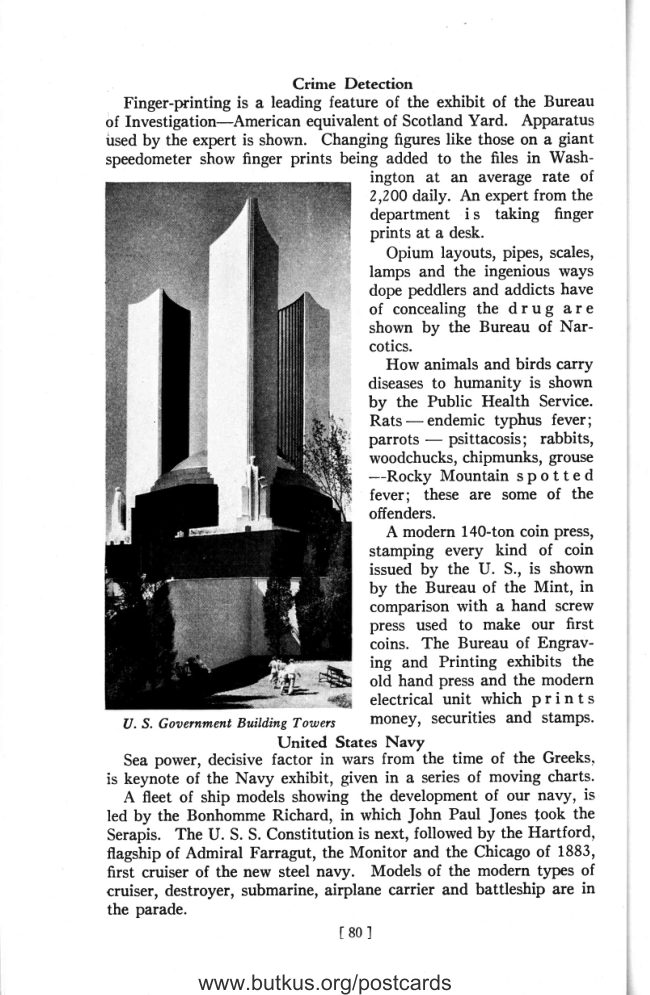
  U. S. GoaernmentBuilding Towers   money, securities and stamps.
                      United  States Navy
  Sea power, decisive factor in wars from the time of the Greeks.
is keynote of the Navy exhibit, given in a series of moving charts.
  A fleet of ship models showing the development of our navy, is
led by the Bonhomme Richard, in which John Paul Jones fook the
Serapis. The {J. S. S. Constitution is next, followed by the Hartford,
flagship of Admiral Farragut, the Monitor and the Chicago of 1883,
first cruiser of the new steel navy.  Models of the modern types of
cruiser, destroyer, submarine, airplane carrier and battleship are in
the parade.
                                                       t 8 0 l

         www.butkus.org/postcards
View original page 1Page 2 · Read text
*   Transparent photographs and moving pictures show battle prac-
   tice and airplane maneuvers, life  of cadets at Annapolis, and the$
 " trainingof,Navy recruits.
    Commanding items of the Marine Corps exhibit are a stand of
 'dl; flags famous in  the annals of the corps and a case of  citations
   receivedby the Marines during the Great War.
    Marine Corps operations around the world are shown by a relief
 $ mapand moving pictures showing the Marines at their job in Haiti,
 ,i#s China,Nicaragua, Cuba and other scenesof action.
   A diorama of a typical seaport in the Lighthouse Service exhibit
  showsthe navigational aids in use by day and night.  A series of$  lighthouselensesincludes the earliest type of bullseye lense, and thel{*qlatesttype Fresnel lense with  its concentric prisms.
 *   Lights turned on and off by photo-electric cells mark the highest
   efficiencyof the Iight beacon,but we are shown a still greater advance
   -radio beacons by which under any conditions of  light, darkness
   or fog the shipmaster can get his exact position.
                     Counting  the Population:$
$theAtUnitedthe CensusStatesBureauis at thespacemomentwe seewejustarewhatstandingthe populationthere.   It  ofis
  registeredon a giant dial which shows one added everv thirty-seven
  seconds. There is a birth every fourteen secondsand a death every
  twenty-threeseconds. One immigrant arrives every fourteen minutes
  and one emigrant leaves the country every five minutes.
,{1 A flowing stream, stocked with fish, is in the back of the Fisheries
  Bureau exhibit.  At  either end of the stream are devices enabling
   fish to get over dams to spawn in a stream's head waters.
,j: A museum of working models that inventors have submitted to the
  Patent Office includes models of reapers, harvesters, potato diggers,
  a railroad locomotive-date  July 29, 1837, cannon and machine guns.
.*  Among framed copies of patents issued are "T.  A. Edison, No."'?00,521,         Feb. 19, 1878, Phonograph,or Speaking Machine."  "T.
  A. Edison,No. 223,898,Jan. 27, 1880, Electric Lamp."
    With paintings, motion pictures and working models the Bureau r
 " of Mines demonstrates its work in making mining safer and more
  efficient.
    Safety at sea is the theme of the exhibit of the Bureau of Naviga-
  tion and Steamboat Inspection.  Life preservers, fire extinguishers
  and model life boats are shown.
    Charts, pictures and maps in the exhibit of the Bureau of Foreign
  and Domestic Commerce show how economic data are collected and
  interpreted for the benefit of American business.
 r"   Keepinga flying ."ft'.d'ilf #ff**gnars       is iuustratedin
  the Department of Commerce aeronautics exhibit.  The visitor may
                                                    t 8 t 1
 ::'!tf
.*.Lr                www.butkus.org/postcards
View original page 2Page 3 · Read text
On the Stairsof the U. S. Building
manipulate a model plane on a theoretical air lane.
  A revolving airways beacon of 1,900,000 candlepower swings its
overpowering ray.  Weather reports are continually coming in on a
teletypewriter. There are two casesof model planes.
  The Coast and Geodetic Survey illustrates its work by a diorama
of a harbor in which the Survey is carrying on fifteen different chart-
ing operations.
  At the end of the last hall we find the Bureau of Standards. Here
are operations of  interest to everybody.  Different types of sole
leather are tested for wear resistanceagainst a revolving grindstone.
Paint is tested for resistance to deterioration caused by water and
light. Two model automobiles, mounted in a wind tunnel, demon-
strate the amount of power wasted in overcoming wind resistance.
        STATES BTJILDING
  STATES BUILDING.   This great quadrangle, enclosing the Court
of States, composesa series of exhibit halls in which are seen the
exhibits which various states of the United States have sent to the
Exposition.  Also in the quadrangle is the exhibit of the Republic
of Greeceand a French exhibit.
  The Court of States is the scene of outdoor meetings, band con-
certs and ceremonies.
  Arizona, California,  Florida, Georgia, Illinois,  Missouri, New
Mexico, Ohio, Oregon, South Dakota, Tennessee,Washington and
the city of Chicago are in the states' exhibits in which the displays
of Puerto Rico and the Virgin Islands are included.
                             l82 l

         www.butkus.org/postcards
View original page 3Page 4 · Read text
In  the Florida  Exhibit

                     ANIZONA
  An adobe trading post, typical of the old Southwest, is the domi-
nating feature of the Arizona exhibit.  Here, against a background
of rugs, potterv and baskets, novelties of copper and silver, petrified
wood and cactus curios, Indian craftsmen are seen at work. A silver-
smith hammers his metal into a setting for a blue turquoise. A potter
moulds his clay into bowls and vases. A rug maker and a basket
weaver demonstrate their skill, and a real singing cowboy completes
the picture.
  Burnished copper ceiling shows Arizona's principal mineral.  An
eight-foot band of the same material circles the walls.  In  this band
are set 36 transparenciesof the scenic beauties of the state. On the
upper portions of the walls are seven murals portraying Arizona's
history, painted by Lon Megargee.
  Outside, at the rear of the exhibit hall, is a desert garden, where
36 varieties of cactus may be seen growing in a desert setting.

                    CALIFORNIA
  "Redwood Grove," center of the California exhibit, is approached
through a twelve-foot arch through a redwood log.  Between the
redwood trunks of the grove are murals of California history and
dioramas of summer and winter sports.
  Through another redwood trunk you go into the Spanish court
where twenty-eight foot windows of one of the buildings reveal a
diorama of Los Angeles. An amazing display of  fruit  is  in the
foreground.
  A  little  further on is another huge diorama-of  San Francisco,
showing the Golden Gate and Oakland bridges. The redwood and
the pine associationshave halls showing uses of  their woods.  In
every available spaceis a diorama or an exhibit of fruit products.
                                                       [ 8 3 ]

               www.butkus.org/postcards                                                                                                       >i.l
View original page 4Page 5 · Read text
In T he Court ol States

                     FLORIDA
  A  Spanish court  is here, its blue sky crossed by a  flight  of
white ibis.
  Dioramas of scenic spots, 15th centurv cannon, mission bells
treasure chests and barnacle incrusted anchor from  St. Augustine
lead to a display of strange fruits.  Papaya, like cantaloupe except
that papayas grow on trees; Chinese star fruit, with shiny pink shells
like shrimp; mangoes; white seporte, like crab apples; avocadoes
and long green and white striped Chinese squash.
   In a garden adjoining the indoor exhibit are dozens of different
kinds of palms; lilies float on a lily pool; orchids grgw on old trees
and stumps just as they do in the Everglades. A pair of tame pink
ibis are allowed the run of the garden.
  With the better known citrus fruits:  grapefruit, oranges, lemons
and limes, is seen the calamondin, which is about the size of a lime.
has a skin like a tangerine and is more acid than a lemon.
                 GEORGIA
  Mocking birds singing amid the pink blossomsof a Georgia peach
orchard greet the visitor to the exhibit of this state. From the rear,
in a realistic cotton field, a quartette of darkies is heard singing old
negro spirituals.
  The first gold mined and minted in the United States is part of an
exhibit of marbles, clays and minerals. A display of farm products
includes a gigantic stalk of cotton, containing 7 LO perfect bolls.
  University of Georgia, Wesleyan College, the Georgia School of
Technology and the Martha Berry school for mountain boys and
girls cooperate in an educational exhibit.
                    ts+1

         www.butkus.org/postcards
View original page 5Page 6 · Read text
F.
   Paintings of Warm Springs sholv ttrrehome of President Roosevelt                !Hfl
 and the patients' pool.  Other exhibits include a display of wild turkeys and other game, models of the Indian mounds at Macon,          [i'
 demonstrationsof paper-making from Georgia pines and a display of                 Ii'
  textiles and other manufactured products of the state.                                        lt;
                         ILLINOIS
    Illinois has taken one of the large halls and entrances for a display
 of mineral, agricultural and industrial  wealth, as well as its  less
 commercialactivities in the fields of public welfare and education.
   Exhibits of the University of Illinois occupy a large part  of the
 space. A model of the university has for background a group of
 renderingsand plans from the university's school of architecture. The
 school of engineering and the mathematical and chemical depart-
 mentsare represented,along with some of the less technical phases
 of university life.
                     MISSOURI
   The Missouri exhibit is set in a grove of slender tree trunks that
 g0 up to the two-story ceiling on which leaves are painted. The old
 timesare brought back by a few sectionsof old "worm fence" beside
 a running stream. Near  it is a Taney County pioneer log cabin.
   Painting of a simple cabin illustrates Missouri's  first settlement
  in 1700. The first state capitol at Jefferson City  is background for
 a river-front scene of slaves, overseersand merchants.
   Behind an antlered stag are views of woods and parks and a poster
 giving the game laws. A cavern with authentic stalactite and stalag-
 mite formations is part of an exhibit of minerals and mining.
   Bronze figures of Tom Sawyer and Huckleberry Finn adorn a
 niche devoted to Mark Twain.  A portrait of Eugene Field, born in
 St. Louis in 1850, hangs above a stanzafrom "Little Boy Blue." A
 bust of Dr.  A. T.  Sill, who founded osteopathy at  Kirksville,  is
 shorvn.                                                        ffff
           TTork of the Mississippi Valley Committee:                                               $r
:  Work of the Mississippi Valley Committee is shown in an exhibit
 sponsoredby the Department of the Interior of the U. S. Government.               ,
                    NEY/ MEXICO
                                                            F  A crude adobe dwelling, typical Pueblo Indian adobe, is at one
                                        At                            exhibit hall.                                    one                                        end of                                                       the house side of the New Mexico                                                          a             [$l                 hay rack-shelters                                                                with                                 an                                            old                                         Spanish                                           wagon tapaste-overhead
 woodenwheels, a wooden plow, ox yoke and other crude implements.
   Inside, a Navajo woman weaves rugs on a hand loom; a Pueblo
 womanfashions pottery, and a Navajo silversmith moulds the metal
 rvith his crude tools.
  A two-story modern dwelling at the end of the hall shows how
                         tssl

                www.butkus.org/postcards
View original page 6Page 7 · Read text
A Meeting in the Court ol States
architects have made use of the Pueblo style of building.   In  a
natural display of lava-rock, potash deposits and white sands, cacti,
chimisa brush and bunch grass are growing.
  On the floor in the center of the hall a Navajo sand painter drib-
bles the naturally colored sands through his fingers to create Indian
pictures.  There is a display of prehistoric Indian  relics and of
swords, side arms and spurs worn by the Spanish conquistadors.
                      OHIO
  The state's history is the subject of the Ohio exhibit. The entrance
and halt are surrounded with mural paintings and you may study
them seated at ease on long walnut settles.
  On the back of each settle, in front and behind, is lettered a terse
paragraph from Ohio's story.  La Salle took possessionin the name
of France in  1682.  Celeron de Bienville buried  six lead plates
declaring "renewal of possession"along the Ohio and Miami rivers
in 17 49. The Underground Railroad.  Simon Kenton forced six
times to run the gauntlet by the lndians.
    [f.  S. Grant was born near Sandusky, O.  Six other Ohio pres-
idents whose busts look down on you went to the White House from
this state. They are James A. Garfield, Rutherford B. Hayes, Ben-
jamin Harrison, William McKinley, William Howard Taft and War-
ren G. Harding.
                  OREGON
  Scenic beauties of the Columbia River Highway are a background
of the Oregon exhibit.  The state's great lumber and fisheries in-
dustries and its fruit production are shown in a seriesof displays and
                                                       t 8 6 l

         www.butkus.org/postcards
View original page 7Page 8 · Read text
"ffi


     mural decorations which stress the appeal of Oregon to the tourist
      traveler, the homeseekerand the investor.
                   PUERTO RICO
       Native palms separate the government and commercial exhibits in
      hall occupied by Puerto Rico, which is decorated in Spanish style.
      In the governmental section the agricultural progress of the island isl*shown by exhibits of sugar cane, tobacco, coffee and native fruits
    1:                 :  and vegetables.  Educational progress and  the development of          , .  !
   .t1ii,:lr   sanitation and disease control are illustrated.  The construction of
 d[9;trf   roads, power plants, public buildings and communications under
    government supervision is shown.
       Cigar makers demonstrate the manufacture of Puerto Rican cigars
    amid a display of linen suits, straw hats, citrus fruits, mahogany
 ,$i  furniture, baskets, pottery and other native products.  Lingerie and
  ';:, table linens display the fine needlework and drawn work for which
 r1i: Puerto Rican women are famed
       *Native coffeeand fresh cocoanut milk are served by Puerto Rican
      girls. A native orchestra wilt play native tunes.$
                  SOUTH DAKOTA
        '  j:[i'    Across the rear of the South Dakota exhibit a cyclorama takes us
    on a swift trip about the state.  Peaceful farm and water scenesare
  .    in contrast with the rugged scenery of the Bad Lands and the Black
      ll'tt   Hills.
   ,ir,   South Dakota's mining activities are representedby a L}-foot slab
               marble and a display of minerals and semi-precious  F':.?ta:.  of polished'Early-day
     stones.           placer mining is shown by a diorama.
     A model of Mount Rushmore shows the progress of the work on
     the gigantic memorial that Gutzon Borglum  is carving into  the
    mountain side. Sportsmen will be interested in the extensive exhibit
     of heads of deer, mountain sheep,buffalo, elk, and antelope. Game
     birds and fish are displayed and buffalo and animal hides are tacked
     to the walls.
                     TENNESSEE
     Smoky Mountain and other scenes of beauty and grandeur in
    Eastern Tennesseeare shown in the staters picturesque exhibit. Of
     great interest at this time is the development shown as the result of
  ,$1: the operations of  the Tennessee Valley  Authority   in  its power
  &t  projects, new communities and creation of a new industrial and agri-
     cultural region.
                    WASHINGTON
     The Washington exhibit  is devoted largely to a display of the
     state's many natural  attractions.
     A specially lighted diorama of Rainier National Park, showing
   Emmons Glacier, largest in the united States, is a prominent feature.
                               lszl

                  www.butkus.org/postcards
View original page 8Page 9 · Read text
Seattle, Tacoma, Spokane,Walla Walla, the Yakima and Wenatchee
valleys are some of the subjects of murals done in enlarged colored
photographs.
  A relief map shows Puget Sound, the Olympic Peninsula and the
CascadeRange. There is a model of the Grand Coulee Dam in the
Columbia River Canvon, first unit of a 2,000,000horse-powerproj-
ect on which the government is spending $63,000,000.
  A  fir timber 28 f.eet long, 3l   f.eet r,videand 2l   feet high is dis-
played in an exhibit  of Washington's most important  industry,
lumber.  Specimensof ores illustrate the mineral wealth of the state.
                     \T/EST VIRGINIA
   All wood-panelledin woods grown in the state is the West Virginia
hall. The floor is red oak. Lower half of the walls is dark walnut and
upper half Butternut or white-walnut. The ceiling is maple and chest-
nut. Dioramas show the scenic beauties of the Blue Ridge.  First
battle of the Revolutionary War, fought at what is now Point Pleas-
ant, W. Va., in 1774, is a mural subject. Another is the first land
battle of the Civil War at Philippi in 1861.
                   VIRGIN  ISLANDS
  A house made of cocoanut leaves is set in a tropical garden in the
center of the Virgin Islands exhibit.  Palm trees twenty feet high,
pineapples and other native plants growing along the banks of a
blue pool reproduce a typical island scene. Wall maps and mural
paintings give further views of these Caribbean islands that are the
latest additions to Uncle Sam's insular possesions.
  The reed work for which the isiands are noted is demonstrated by
native girls who weave the reeds into mats and baskets as we watch.
Linens and lingerie show the fine needle work of the native women.
Cigars, rums and cordials and liqueurs are shown with an exhibit of
juices of native fruits, the pineapple, wild orange and guanabana,
which has a flavor somewhat like that  of a peach or apricot. are
displayed.
  Inthepavlionu,J*Xtll"ilJffinf;f13*.,,y,cosmetics,tex-
tiles, laces,silks and other products of France.
  French champagnes,wines and liqueurs are displayed in quantity
and variety. There is an historical collection of French publications
and a large exhibit of modern books and magazines.
  Paintings by French masters are shown in a display that includes
work of contemporary artists.  There is a collection of tapestries and
an exhibit of modern and antique furniture.
  *Armenonville restaurant.  Indoor and outdoor tables.  Table
d'hote and a la carte.  Orchestra and dancing by guests, afternoon
and evening.  Floor shows occasionally.  Minimum  charge after
6 P . M .
                                                              [ 8 8 ]

          www.butkus.org/postcards
View original page 9Page 10 · Read text
Seattle, Tacoma, Spokane,Walla Walla, the Yakima and Wenatchee
valleys are some of the subjects of murals done in enlarged colored
photographs.
  A relief map shows Puget Sound, the Olympic Peninsula and the
CascadeRange. There is a model of the Grand Coulee Dam in the
Columbia River Canvon, first unit of a 2,000,000horse-powerproj-
ect on which the government is spending $63,000,000.
  A  fir timber 28 feet long, 3/z  feet wide and 2l   feet high is dis-
played in an exhibit  of Washington's most important  industry,
lumber.  Specimensof ores illustrate the mineral wealth of the state.
                   TT/EST VIRGINIA
   All wood-panelledin woods grown in the state is the West Virginia
hall. The floor is red oak. Lower half of the walls is dark walnut and
upper half Butternut or white-walnut. The ceiling is maple and chest-
nut. Dioramas show the scenic beauties of the Blue Ridge. First
battle of the Revolutionary War, fought at what is now Point Pleas-
ant, W. Va., in 1774, is a mural subject. Another is the first land
battle of the Civil War at Philippi in 1861.
                   VIRGIN  ISI,ANDS
  A house made of cocoanut leaves is set in a tropical garden in the
center of the Virgin Islands exhibit.  Palm trees twenty feet high,
pineapples and other native plants growing along the banks of a
blue pool reproduce a typical island scene. Wall maps and mural
paintings give further views of these Caribbean islands that are the
latest additions to Uncle Sam's insular possesions.
  The reed work for which the islands are noted is demonstrated by
native girls who weave the reeds into mats and baskets as we watch.
Linens and lingerie show the fine needle work of the native women.
Cigars, rums and cordials and liqueurs are shown with an exhibit of
juices of native fruits, the pineapple, wild orange and guanabana,
which has a flavor somewhat like that  of a peach or apricot. are
displayed.
                PAVILION  FRANCAIS
   In the Pavilion Francais are displayed the jewelry, cosmetics,tex-
tiles, laces, silks and other products of France
  French champagnes,wines and liqueurs are displayed in quantity
and variety.  There is an historical collection of French publications
and a large exhibit of modern books and magazines.
  Paintings by French masters are shown in a display that includes
work of contemporary artists.  There is a collection of tapestries and
an exhibit of modern and antique furniture.
  *Armenonville  restaurant.  Indoor and outdoor tables.  Table
d'hote and a la carte. Orchestra and dancing by guests, afternoon
and evening.  Floor shows occasionally. Minimum  charge after
6 P . M .
                                                              [ 8 8 ]

          www.butkus.org/postcards
View original page 10Page 11 · Read text
The Armour Bu,ildfug
               REPUBLIC OF GREECE
  The story of a century of progress in Greece is the theme of the
 exhibit sponsored by the Republic of Greece. Paintings, statues,
 photographs,models and dioramas show the development of  the
 countrv. The hall is decoratedin classical fashion.
  A commercial exhibit of Greek products includes silks, Grecian
 marbles,olives and olive oil, figs and raisins, brandies and wines,
 Greektobaccosand cigarettes.
  xGreek restaurant. Indoor and outdoor tables, table d'hote and
 a la carte service. Also grill and lunch counter. Orchestra, dancing
 by guests and floor show.

  chicagocivicc.,',.ftHt3fffff"Llr3",,n.  cityorchicaso
 at the Exposition, is primarily a rest spot, equipped with comfort-
able chairs, and u'ith attendants who will give information about
Chicago. Historical pictures on the walls and movies of the work of
the city in education, parks and playgrounds, health and other fields
are the exhibits.
                 PARK EXHIBIT
  Adjoining the lounge is an extensive exhibit of the handicraft
activitiescarried on in the park centersof the ChicagoPark System.
l\'Iodelairplanesand kites, ship models and other work of the juve-
nile and adult classesis displayed and there is a demonstrationof
horvinstruction is given.
   * Walgreen Restaurant. Soda fountain, lunch counter and table
service.
  Note: At the time of going to press the list of exhibiting States
was incomplete.Later edition rvill contain full list.
  SOCIAL AGENCIES: Two cabins, one occupiedby the Boys'
Clubs of America; the other by the Girl Scouts, Campfire Girls,
Y\ ICA and Girls' Clubs. Here are displayed samplesof handirvork
                                                      [ 8 e ]

               www.butkus.org/postcards
View original page 11Page 12 · Read text
Hiram  Walker  Exhibit  and Canadian  Club Cafe
and groups may be seen at work at indoor and outdoor activities.
  EAST SKY RIDE TOWER.  Island end of the Sky Ride.  Obser-
vation platform and cars may be boarded here, the same as from
the West Tower.
              Army, Navy and Marine Corps Area
   IJ. S. ARMY, NAVY AND MARINE  CORPS. Composite camp
of details of 100 sailors, 100 marines and 100 infantrymen, an army
and a marine band, and smaller details from other branches of the
 [f. S. Military  service are encampedhere throughout the Exposition.
They participate in parades, furnish escort for distinguished visitors
and give frequent band concerts.
  *SCHLTTZ CALIFORNIA  GARDEN.   Restaurant, a la carte.
Indoor dining room and outdoor tables.  Orchestra.
  SCIENCE BRIDGE.  Crossing the lagoon at 16th street.
              ARMOUR  EXHIBIT
  ARMOUR:   South from Science Bridge over the South Lagoon.
The pier includes a circular  restaurant, an open plaza and three
large exhibit halls.
  A  large mechanical map in  the center of  the  first  hall  of the
building  illustrates how Armour and Company products are dis-
tributed in the United States.  In the second hall, exhibits of by-
products show how residue materials, long considered waste, are
utilized for many valuable products. Third hall is a home economics
exhibit of the various kinds and uses of fresh and prepared meats.
New processes in  handling meat, particularly  refrigeration, are
shown.  Giant murals cover the walls of each of the three halls.
  At the south end of the building is the solarium restaurant with a
view of the lagoon.  Beyond the glass circle of the restaurant, an
open plaza extends over the water, with  chairs and benches and a
boat landing.
  *Restaurant features Armour products.
                                                       I e 0 ]

          www.butkus.org/postcards
View original page 12Page 13 · Read text
HIRAM  WALKER  EXHIBIT
  WALKER  EXHIBIT:    Like a gigantic dragon fly resting on the
 surface of the water, this terraced pier extendi norihwest fiom the
 center of Science Bridge into the North Lagoon. Here is housed
 the display of Hiram Walker & Sons. Model of a modern distillery
 shows all the processesin whiskey manufacture from raw grain to
 packagedproduct. An historical display gives the history of inis art.  *CANADIAN            CLUB CAFE occupiesthe first floor of the 350-foor
 pier with a brilliant modernistic restaurant, and dancing floor. Well
known orchestrasfurnish music afternoon and evening fir up-to-date
 floor shows and dancing by guests.  Outdoor terraces abo'u. the
Iagoon have tables and chairs.
       FIALL OF SOCIAL SCIENCE
  HALL OF SOCIAL SCIENCE.  Entrance to this building is ap-
propriately at end of Science Bridge from  the Hall  of Science
to the Island.  Above the entrance you see four ^pylons decorated
with symbolic figures inspired by Hindu mythology. L.o Friedlander
is the sculptor.  The figures from  left 1o rig[iL' - -represent:-r-         Fire--Y'
Light, Darkness and Stoim.
  The struggle of knowledge to bring order to social life is the theme
of the exhibits in the Hall of Social Science.
  "A City Dump" of the presentday is an illustration of the records -
that civilizations leave for future ages. Here, in the cross section
of the dump, you may see a horse-shoe,a high-boned corset, oil


        W est Entrance  to  the  Hall   ol  Socinl Science
                                                t e l l

               www.butkus.org/postcards
View original page 13Page 14 · Read text
lamps, an old typewriter, solid flatirons, cast-iron statuettes, high-
buttoned women's shoes,a phonograph horn, an old Ford radiator
a broken cuspidor, old radio vacuum tubes.
  A reproduction of a Cro-Magnon cave in France, with the draw-
ings and carvings left on the walls by the cave men, shows a further-
back record of early culture. Reproduction of three ages of Indian
mound-buildersin America is shown by a crosssection from a mound
with skeletonsburied at different levels. A relief map of the United
States shows different aboriginal ways of life.
  Development of intelligence is shown by an exhibit beginning with
comparative skulls of great apes and primitive men. Growth studies
of the brain show changes in its size and power. A mural painting
shows the population increase in three racial groups and the chances
of each in length of life.
  Two American family groups show the transition from the home
industries unit to the modern family.  A long automobile in front
of a de luxe apartment house is contrasted with a family group in
a country door-yard.  Children in an elaborate nursery are con-
trasted with a pioneer family  in a log house. Empty fashionable
church is contrasted with a full old-time meeting house. Crowded
movie theatre with a kissing scene on the screen is contrasted with
a simple home dance. We see steel mill laborers contrasted with a
farm group at the barnyard chores.
   In  the education section comparative models show a log school
house, a highly developed modern public school, an old-fashioned
one-building academy and a modern university.  Vocational educa-
tion,  special functions  of  the  public  school, technical  training,


                       The "City Dump"
                          tozl

          www.butkus.org/postcards
View original page 14Page 15 · Read text
Sculptu,res Oaer North  Entrance  Hall  ol  Social Science

athletics, and special teaching of crippled and handicapped children
are shown in a seriesof transparencies. Statistics of the diffusion of
education and of its cost and value complete the story.
  A demonstration school, with pupils assignedfrom Chicago high
schoolsand eighth grades will be given an eight weeks' course in
social sciences. The afternoons will be devoted to  field work  in
the Exposition.  The school sessionswill be broadcast daily over
NBC.
  Americanization results are depicted in dioramas.  Progress of
labor is shown by another series. We see the worker taking any
job he can Bet, labor organi zation, strikes, women and children
taking the men's places and finally the replacementof skilled hand-
work by automatic machinery.  President Roosevelt's"New Deal"
is illustrated by a seriesof dramatic dioramas.
  Use of the short ballot, to give closer control of elected represen-
tatives,is illustrated.
  A statistical chart of 100 years of social legislation,copies of old
inhuman larvs and an illustrated community-planning map introduce
exhibitsI                                          '  e   . of social work in which 98 organizations cooperated.
  Pauperizing alms-giving is illustrated by an Elizabethan lord and
his lady giving coins to a beggar at a church door. A more modern
"Lady Bountifiil" handing a basket of food to a starving family  irl
next.  Contrasting exhibits show modern case-work with the idea
of preserving the rvorker's morale.  Diorama of an old almshouse
yard with children, aged paupers and insane casesherded together
is background for an exhibit of scientific separation and humane
care.
  Work of the Red Cross, social settlements,adjustment of immi-
grants and the efforts of the Urban League for the welfare of hegroes
are shown. The abolition of crime-breedingslums, installation of
                                                       I e 3 ]

              www.butkus.org/postcards
View original page 15Page 16 · Read text
factory recreation grounds, clinics, visiting nurses, health education
and hospital social service are illustrated.
  The  If. S. Department of Labor shows advance in legislation and
other work for the welfare of employed women and children.  Con-
trast of the old and modern farm home is shown by the U.  S.
Department of Agriculture.
  Special research at the World's Fair to establish standards of the
American type is being done by the Harvard Anthropometric Labora-
tory. Many thousands of visitors to the exhibit have been weighed,
measured, tested and questioned. Electric card sorting machinery
classifies the records almost instantaneously. You may stop and
have your record taken.
  Co-operative business, insurance, home-loans and philanthropies
are shown by  elaborate exhibits, moving pictures and dioramas.
Lions International has a reception room.
  College women are representedby the exhibits of Smith, Radcliffe
and Monticello Colleges. The Women's College Board, representing
Barnard, Bryn Mawr, Connecticut, Elmira, Goucher, Lake Erie, Mil-
waukee-Downer,Mills, Mt. Holyoke, Pembroke, Radcliffe, Randolph-
Macon, Rockford, Simmons, Smith, Sweet Brier, Trinity,  Vassar,
Wellesley, Wells and Western colleges, has a reception room and
information headquarters.


                       Entrance  to Western Union Hall
                       le4J

          www.butkus.org/postcards
View original page 16Page 17 · Read text
The Illinois Federation of women's Clubs maintains a reception
 lounge in which entertainments will be given.
  An  extensive series of commercial educational exhibits in  the
 Social ScienceSectionincludes a book store and exhibits of publishers
 of  encyclopedias, dictionaries, text books, general literature and
 children's libraries.
       ELECTRICAL  BUILDING
  ELECTRTCAL GRouP.  Between the Hall of Social science on
 the north and the Electrical Building on the south, stands Western
 union Hall.  The entire three-unit structure was designed by Ray-
 mond Hood.
   Electrical development during the last century has made a vast
 change in the lives of men.  Exhibits epitomize the story  of a
 century of electrical progress.

               \VESTERN UNION  HALL
  WESTERI\I UNION HALL.  Above the entrance, an heroic fig-
 ure of Electrical Communication rises from a dynamo to symboliie the conquest of rime  and space.  rnside, the many exhibits turn       ff
 this symbol to  fact by  demonstrating the world-wide spread of
 today's electrical communication.
   Relics and reproductions of formerly used instruments lead us
 from the inventions of Henry in 1829, and Morse in 1g35, through
a century of telegraphic history to the high-speedlandline and cable
apparatus now in use.  other displays show the extent of telegraph
and cable service around the globe.
  How a messagefrom London is repeated in New york  with less
than a second's delay, is shown by two printing machines separated
by a drawing of the ocean. As the operator in ,,London" piesses a
key, the signal is printed automatically on tape in the ,,New york',
machine. The landline operator types  it on the keyboard of an
automatic telegraph printer, and a similar machine simultaneouslv
prints the letters in the city  to which the message supposedly is
addressed.
                       ffiuminated Answers
   Visitors may touch a button before an illuminated map and see
their own city  light  flash on while a dial  tells the telegraph rate
from Chicago.
  A "Magic Answer Board" replies to the questions the great ma-
jority  of people wish to ask.  Touch a button at the queition and
the answer appears with  illustrations on an illuminated screen.
   visitors may open or ground the circuit in a model of the messen-
ger call box system, which demonstrateshow the calls go through in
                       Ies]
                www.butkus.org/postcards
View original page 17Page 19 · Read text
The Electrical Building  at  Ni,ght
 spite of these impairments to the wires. A  relief map shows the
 cable routes across the mountains and valleys of the ocean bottom.
   Transmitting eight messagessimultaneously over a single wire is
 illustrated by colored electric lights moving across an eighteen-foot
 rvall chart- The processis explained by a complete multiplex send-
 ing and receiving unit displayed in operation at the base oi the map.
  What happenswhen lightning strikes a telegraph line is shown itt
 a working model. When electrical flashesstrike miniature telegraph
 rvires,a protector diverts the electricity to the ground, safeguurAing
 the wires and insuring uninterrupted service.
  How master clocks electrically synchr onize more than 100,00C
 clocks, is shown. The simplex lutomatic  printer, used in branch
 telegraphofficesand by large businesses,is displayed and explained.
                News and Stock Ticker
   Latest news happenings in all parts of the world are brought to
 visitors via a bulletin ticker.  There is also a teleregisterautomatic
 quotation board, operated during market hours from New york.
As rapidly as sales are reported on the New York Stock Exchatrge,
operators touch keys in a central office, causing metal discs 1o
revolve on the teleregisterboard, which shows the opening, high and
last prices of each stock.
  Automatic  fire alarms, sprinkler supervision, watchman super-
vision and burglar alarms demonstratedin this exhibit, are actuilly
hooked up and on the job, protecting the grounds and buildings of
the Expos!tion.
           THE ELECTRICAL BUILDING
  THE ELECTRICAL  BUILDING,  with its court, affords one of
the most effectiveafter-dark views in the Exposition. A background
of seven towering cascadesof blue gaseoustubing symbolizes the
sourceof hydro-electric power. Beams from a horieshoe of search-
                                                                     l e T l

              www.butkus.org/postcards
View original page 19Page 20 · Read text
lights on the roof meet and cross directly above the electric fountain
in the center of the cowt, which is lighted from within.
  We enter the Electrical  Building  from  the lagoon through  the
Water Gate, two pylons whose Aztec figures are symbolic of Light and
Sound.
           RADIOS AND PHONOGRAPHS
   In a large hall on our left, a score of devices explaining the mys-
teries of sound transmission and reproduction, are shown with a
display of phonographs and radios.
  How music can be translated into colors is demonstrated by the
color organ, which lets us see, as well as hear, a musical program.
Constructed on the combined principles of modern psychology and
electronics, this novel machine feeds our eyes colors that affect our
emotions in the same way as does the accompanying music.
  When the music is grave, melancholy and solemn, the colors are
blue, violet and purple.  Yellow, orange and red accompany the
more lively, exciting and passionate strains.  The intensity of the
music regulates that of the colors, light notes being accompanied by
pastel shades and loud, deep notes by vivid, brilliant hues.
  Another kind  of translating is done by the cathode ray oscillo-
graph, which turns the sound of our voices into thin, wavering beams
of  light.  Amateur  radio equipment, which we can operate,  is
exhibited.
                       Recording Studios
  There are two recording studios where visitors may make records
                                                 of their voices to mail
                                     home. There are dem-
                                             onstrations o f  sound
                                     camerasand projection
                                         equipment;
                              How radio  saves
                                          lives   at sea is the
                                     theme of  a  dramatic
                                          diorama.  Playlets are
                                        performed in a theatre.
                                  A manufacturing
                                           unit   illustratesthe
                                      making of phonograph
                                          records from the mas-
                                                    ter matrices to the fin-
                                          ished pressings, ready
                                                    for  use. A  miniature
                                           tube factory turns out
                                    more than 2,500 radio
           Miracles While You Watch           tubes daily.
                          tesl

          www.butkus.org/postcards
View original page 20Page 21 · Read text
A g i a n t v a c u u m
cleanerin operation is
the next display. Girls
makingtoast  on an
electric  toaster offer
samples.
  Movies and station-
ary displays show how
metal fabrics are used
in the manufacture of
tires, lamps, bottle cov-
e r i n g s a n d  o t h e r
articles.
   In a small theatre a
chemist performs ex-
periments to show the
strength, elasticity and
other properties of the
various form of rubber.
As he works, he tells
where rubber is found,
how   it   is  harvested,
transported and trans-
formed into thousands
of articles for our dailv
use.                               The Robot Entertains
  On a nearby counter a metal ring leaps into the air and retnains
suspended without any  visible support.  The secret is explained
when an attendant turns off the electric current and the ring  falls
to the table. You can push a plunger into a solenoid cell, but you
can't pull  it out again-until  the current is shut off.

                      Theatre of Science
  A  miracle show of late developments of science, explained in
languagewe can all understand, is staged in a theatre. The voice
of the atom is heard through a loud speaker when a Geiger counter
detects the presence of  radio-active materials.  The stroboscope
makes whirling objects seem to stand still so their motion can be
studied.
  An incandescent lamp  is lighted without wire connections,and
metal wool is made to glow and burn out by  the inductotherm.
Lamps are "shot on" by the light gun.
  Moving along the aisle we find lecturers performing experiments
in pure science which have led to  the development of  practical
                        Iee]

               www.butkus.org/postcards
View original page 21Related documents and language editions
M. Butkus collectionPDF
World's Fair 1934 Guide Book - PT. 2
Reference document
48 pages · EnglishRead →
M. Butkus collectionPDF
World's Fair 1934 Guide Book - PT. 4
Reference document
43 pages · EnglishRead →
M. Butkus collectionPDF
World's Fair 1934 Guide Book - PT. 5
Reference document
34 pages · EnglishRead →
M. Butkus collectionPDF
World's Fair 1934 Guide Book - PT. 1
Reference document
40 pages · Not specifiedRead →
From the M. Butkus archive. Original publisher and archive notices are retained.
Check the model and edition against your equipment.
PDF verified 2026-10-10.