Sewing catalogs & reference
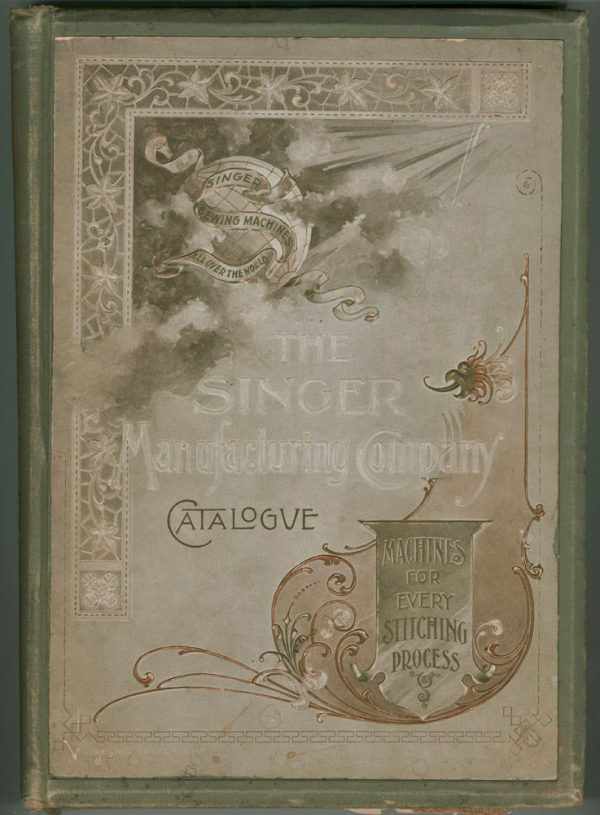
1896 Singer Sewing Machine Catalog — Product catalog
Product catalog for 1896 Singer Sewing Machine Catalog. 254 pages in English. Read the original PDF, download or print a copy without registration.
254 pagesEnglish66.1 MB PDF
Loading your manual…Open PDF directly
Document details
- Brand
- Singer
- Model / document
- 1896 Singer Sewing Machine Catalog
- Document type
- Product catalog
- Language
- English
- Pages
- 254
- File size
- 66.1 MB
- Category
- Sewing catalogs & reference
- Document date
- Published 1896
Search available document text
Find a term, then jump to its page in the original PDF. Image-only pages may not be searchable; check the PDF for exact wording and diagrams.
Page 1 · Read text
SINGE


     EWING MACHI


    ALL OVER THE


    IGER


ATALOGVE

                     MACHINESFOR

                 EVERY

                   SILICHING

                     PROCESS
View original page 1Page 7 · Read text
CATALOGUE
                OF
SINGER SEWING-MACHINES,

                 ILLUSTRATING

 THEIR CONSTRUCTION,
           THEIR VARIETY,
                      AND
      THEIR SPECIAL USES BY
              :MANUFACTURERS.


                        HESINGESFANFG.GO.


        THE SINGER MANUFACTURING CO.,

                         EXECUTIVE OFFICES,
                  149 BROADWAY, NEW YORK.

                           BRANCH OFFICES EVERYWHERE
View original page 7Page 8 · Read text
ENTERED ACCONDING TO ACT OF CONGRESS. IN THF WEAR 1806, BY

    THE SINGER MANUFACTURING COMPANY,


IN THE OFFICE OF THE LIBRAKIAN OF CONGRESS, AT WASHINGTON.
View original page 8Page 9 · Read text
THE SINGER SEWING-MACHINE FACTORY AT ELIZABETHPORT. N.1. U S.


         FOUNDRY AND ) FORCE SHOPS ADJOININGCENTRAL
View original page 9Page 10 · Read text
THE SINGER SEWING-MACHINE FACTORY AT ELIZABETHPORT, N. J.. U. S. A.


                                                  FRONT.
View original page 10Page 11 · Read text
THE SINGER SEWING-MACHINE FACTORY AT ELIZABETHPORT.


         At Elizabethport, N. J. in the suburban district of the city of New York, Is situated

 one of the factories of one of the largest industrial establishments in the world The

 SingeR ManufacturiNg Co. Although located in such close proximity to a crowded

 metropolis the surroundings are pastoral and gulet, conducive to the good morals and ex-

 cellent discipline generally prevalling among the thousands of men and women employed

here. The ground occupied by the Singer Manufacturing Company's plant at this point

 has an area of about 50 acres with a water frontage on Newark Bay of about 1,600 feet,

 and a building frontage about a mile in length; 1,090 feet of this is five stories in height,

 500 feet is three stories and the remainder is one and two stories. The entire factory

 contains 18 acres of floor-space, filled with material and machinery. and forming a

 veritable hive of industry for thousands of operatives employed in the manufacture of

sewing-machines. The five-story main buildings shown in the illustration have a ground

  area of 230 x 60 feet fronting the park and 800 x 50 feet on the side street. The buildings

fronting on the tracks of the Central Railroad of New Jersey are 1,750 feet long and

 comprise the Foundry Department and Forging Shops. The illustrations fail to adequately

  represent the great extent of this plant because the buildings are so arranged as to surround

  and enclose, except on the water front, the land used for factory purposes.The entire

  block of land adjoining the north-west side of the main building has been transformed into a

  beautiful park by the Singer Manufacturing Company. to whom It belongs, and who keep it


  in perfect condition for the benefit of the public.
View original page 11Page 12 · Read text
'THE SINGER SEWING-MACHINE FACTORY AT ELIZABETHPORT. N. J.. U. S. A


                      VIEW IN FOUNDRY READY TO bOr
View original page 12Page 13 · Read text
THE FOUNDRY.


       The Singer Manufacturing Co. are makers of Sewing-Machines in the truest sense,

 because everything entering into the finished machine begins its evolution in their works

 from the crude material; iron in the " pig." steel in the bar, the rod, or the ingot, brass in


 the sheet, lumber in the log.


         The operations at Elizabethport not only include all the vast detail which this state-

ment implies, but the distinctive feature that most impresses a visitor to this hive of industry

 is the originality of the special tools and processes in use, many of them invented by ingen-

  lous employees at these works.

         Beginning with the foundry: There are four cupola furnaces in blast, consuming

 daily about 12,000 pounds of coal and 14,000 pounds of coke, melting more than 100

  tons of various kinds of pig-iron, properly blended to form absolutely flawless castings.

 The casting room of this foundry has a floor space of about two and one-half acres, the

 vlews presented showing but a small part of this area.

       Here the arm and bed of the machine, its stand and the pulleys and balance wheels

 are formed from the molten iron. The vlew on the opposite page shows the moulds laid

 out ready to receive the liquid metal. The view on the next page shows the preparation

 of the moulds in hydraulic presses and a car loaded with castings in the foreground.

         The facilities for preparing the moulds and turning out work rapidly are of the most

 approved type, as indeed they must be to keep up a dally output exceeding 60,000 pleces of

 all sizes. These include, not only the great variety required for the many different classes

 of Singer Sewing-Machines, but aiso those for tool construction and repairs. Some of the

  pleces are so small that 100 of them weigh less than one pound; single castings are made

here weighing 14.000 pounds.
View original page 13Page 14 · Read text
THE SINGER SEWING-MACHINE FACTORY AT ELIZABETHPORT, N. J.. U. S. A.


                      VIEW IN FOUNDRY- EMPTYING THE MOULDS
View original page 14Page 15 · Read text
THE FOUNDRY_ CONTINUED.


       That the foundry practice at these works exemplifles the most advanced state of

the art in all its details. is well attested by its products, which have achleved a world-wide


reputation for strength and fineness.
       After the castings are removed from the moulds they are taken to the Rumbling
Room, 50 feet wide and 200 feet in length, where they are tumbled about in revolving

barrels in company with other castings of a form especially intended to produce movement

and friction, thus wearing off all sand and roughness.
     Many of the castings are taken directly from the Rumbling Room to the Foundry

 Drilling Department, where automatic drilling machines specially devised for the purpose,

bore the holes required for the insertion of bolt. screw or pin. All the holes in each plece

are bored at once so they are always exact and in precisely the same relative position

on each part
       Everything of cast iron pertaining to the stand, is japanned and finished here,

 ready for " setting up." a process which will be shown later.

         All other parts are collected in great bins in the Stock Room, thence to be dis-
                 Each bin bears a card which constantly shows the number of tributed as required.

 pleces it contains.
         All the labor expended thus far has been on the ground floor. The processes to

 which the products of the foundry are next subjected, involve more intricate manipulation,

 performed in many Departments, on various floors.

      The distribution to these points is effected by means of a network of railway, con-

 necting all the buildings on the plant, over which five locomotives are constantly running.
View original page 15Page 16 · Read text
THE SINGER SEWING-MACHINE FACTORY AT ELIZABETHPORT, N. J.. U. S. A.


                           THE WHEEL DEPARTMENT.
View original page 16Page 17 · Read text
THE WHEEL DEPARTMENT.


        The large and varied assortments of wheels and pulleys used on the different classes

 of machines are taken from the Foundry to the Wheel Department, where they are bored

for the admission of the shaft, and otherwise finished.

       The illustration of this Depariment shows a forest of belts and a mass of

 machinery, but the extent to which these machines have been made automatic in their

action is beyond the power of the camera to depict.

        The boring and reaming of the hole, and the turning and facing of the hub are

 successive operations done by the same machine, which stops automatically when the

 wheel is finished, all these operations being thus performed with the most perfect and

 uniform accuracy.

         Each wheel is then revolved on a shaft of the exact size on which it is to run and is


 tested in several ways to ascertain that it fits perfectly, runs true and is in precise balance.
View original page 17Page 18 · Read text
THE SINGER SEWING-MACHINE FACTORY AT ELIZABETHPORT, N. J., U. S. A.


           VIEW IN FORGING DEPARTMENT-THE HAMMER SHOP
View original page 18Page 19 · Read text
FORGING.


         Since the days of Tubal Cain, the worker at the forge has furnished the theme for

 song and story; the excellence of his work still greatly depends on that manual skill and

 unerring judgment acquired only by experience based on natural aptitude. These are the

 essentials to successful forging. Good blacksmiths are born, not made; modern mechani-

 cal appliances only supplement and enlarge their sphere of action.

         In the Forging Department of The Singer Manufacturing Co., the forge, the steam

  hammer, the die and press are each brought into play to form the great number of sewing-

 machine parts requiring great strength in small compass. Every branch of the blacksmith's

  art is practised here, this being a base of supply of wrought, pressed and finished stock used

in other Departments that are engaged in finishing and fitting its products.
       The pattern boards in this Department now contain nearly 1.000 different shapes of
 forged pieces and 1,500 parts that are formed in as many different dies either by a falling
 hammer, by pressure, or by dies: some of these parts measure but four one-thousandths
of an inch in thickness. Masses of iron up to 8 inches in thickness are often heated and
 hammered here for special purposes.
       Here are made all the drip pans and similar sheet-metal work for use in connection
 with the sewing-machine.
View original page 19Page 20 · Read text
THE SINGER SEWING- MACHINE FACTORY AT ELIZABETHPORT. N. J.. U. S. A.


                 VIEW IN FORGING DEPARTMENT--THE BLACKSMITH SHOP.
View original page 20Page 21 · Read text
FORGING_ CONTINUED.


        For drop-forging there are 18 hammers, ranging from 40 pounds in weight to one

 weighing 1,800 pounds and having a fall of 7 feet. There are four trip-hammers and a

large number of presses. About two million pounds of iron, steel and brass are used in

 this Department annually and a large number of skilled workmen are steadily employed.
 The illustrations only show the Hammer Shop and the Blacksmith's Shop.  Other

 divisions of the Department comprise the manufacture of all the steel dies used for drop-

  forging and pressed work, the Press Room, the Stock Room and also a machine shop for


  general repairs.

        The work of these divisions not only includes the delicate manipulation required

  to make the steel dies by which most intricate forms are instantly shaped to the utmost

 exactness, by a single stroke, but here are made the great hammers through the weight of

  which the heaviest masses of iron are wrought, welded and molded. Repairs of all sorts

 are also executed here, including those for the railway rolling stock and the fixed plant.

       The blacksmith is the universal mender and tinker: he must, through the cunning

  of his brain and the strength of his arm, be ready to shape anything and everything of iron.

  He must be skilled in all the diverse processes of tempering and annealing metals so as to

  secure the exact degree of elasticity and hardness best adapting the part to its purpose.
View original page 21Page 22 · Read text
'THE SINGER SEWING-MACHINE FACTORY AT ELIZABETHPORT. N. J.. U. S. A


                        VIRTUE SCREW DEPARTSENT
View original page 22Page 23 · Read text
SCREW MAKING. M


       The making of machine screws has been confined to comparatively crude means

 until recent years, most of them having been produced by hand through the use of tap and

die or by lathe. These methods were utterly unsuited to a system requiring absolute unt-


 formity from year to year, in each part produced.

       The product of the Machine-Screw Department of ThE SingER MANUFAcTUrING

 Co. would require the labor of several thousand skilled mechanics, were it not for the

wonderfully ingenious machines constantly engaged in absorbing wire rod and discharging a

 variety of screws, rollers, pins, bushings and bolts in all sorts of shapes and in myrlad sizes.

         The extent of this variety is indicated by the fact that the list already includes 833

 different kinds of screws, some of them so small that 100 weigh but eleven-sixteenths of

 an ounce, while there are others weighing nearly one pound each. The thread on some of

 the smallest screws has 100 turns to the inch; it is so fine that its shape can hardly be

 distinguished by the naked eye. There are rolls having diameters ranging from that of

 a needle up to that carrying the cable for the power carpet sewer.
       The illustration indicates graphically the crowded condition of this Department,
 which occuples about 40,000 square feet of floor space and employs about 300 men.
       The machinery Is largely automatic and here the specialization is again prominent
  that has previously been noted. These machines are fitted to perform their work in vari-
  ous ways peculiar to this establishment, using special appliances of unusual efficiency, that

  were invented by its employees.
       The solid cutters for shaping, threading and cutting-off, secure greatest ease of
  action and the most exact uniformity of shape, however irregular it may be, Each kind of
 screw, bolt, stud, etc.. has its distinctive number In a catalogue that is circulated all over
 the world; each must fit its appointed place in a Singer machine. wherever It may be.

  To absolutely insure this, nothing is left to chance; every one of the 250,000 pleces pro-

  duced daily by this Department is gauged to test its perfect accuracy.
View original page 23Page 25 · Read text
HARDENING AND TEMPERING.


        The hardening processes through which the parts of a Singer machine pass, are the

best in the world, and are, in some respects, peculiar to the practice of ThE SingeR ManU-

• FACTURING Co.

         Illustration No. I on the opposite page shows a battery of ovens containing screws,

  rollers, etc.. which are being removed, after exposure to high temperature, carried at

 uniform intensity. The term of exposure varies from two to twelve hours, accord-

  ing to the size of the parts and the uses for which they are intended. The parts are

  packed with crushed bone in iron boxes, shown in the foreground: after remaining in the

  ovens a sufficient time they are dropped into a bath of oil contained in the tanks shown.

        The furnaces are charged twice in 24 hours and are of various kinds, as best


  adapted to the treatment required by the various parts.

           Illustration No. 2 presents a view of a set of furnaces of another form in which the

  heat is obtained from gas, the parts treated being mostly needles and springs.

         Everything passed through the Hardening Department is literally purified by fire,

  oil and water, the various applications of these agencies being governed by the latest


   discoveries in metallurgical science and the art of tempering.

          The best evidence of their excellence is found in the superior wearing quallties of


   all the parts in a SiNcer sewing-machine.
View original page 25Page 26 · Read text
THE SINGER SEWING-MACHINE FACTORY AT ELIZABETHPORT, N. J.. U. S. A.


                         VIEW IN MILLING DEPARTMENT
View original page 26Related documents and language editions
SingerPDF
1800s Singer Sewing Machine Catalog
Product catalog
36 pages · EnglishRead →
SingerPDF
1910 Singer Sewing Machine Catalog - Australiasia
Product catalog
20 pages · EnglishRead →
SingerPDF
1912 Singer Sewing Machine Catalog
Product catalog
242 pages · EnglishRead →
SingerPDF
1924 Singer Sewing Machine Catalog
Product catalog
319 pages · EnglishRead →
SingerPDF
1926 Singer Sewing Machine Catalog
Product catalog
12 pages · EnglishRead →
SingerPDF
Singer Student Handbook
Reference guide
66 pages · EnglishRead →
SingerPDF
Singer's Sewing Skills Reference Book
Reference guide
60 pages · EnglishRead →
From the ISMACS International. Original publisher and archive notices are retained.
Check the model and edition against your equipment.
PDF verified 2026-10-11.