Film cameras
Sinar - Advantages of yaw-free camera User manual
User manual for Sinar - Advantages of yaw-free camera. 5 pages in English. Read the original PDF, download or print a copy without registration.
5 pagesEnglish2.6 MB PDF
Loading your manual…Open PDF directly
Document details
- Brand
- Sinar
- Model / document
- Sinar - Advantages of yaw-free camera
- Document type
- User manual
- Language
- English
- Pages
- 5
- File size
- 2.6 MB
- Category
- Film cameras
- Document date
- Not specified in catalog
Search available document text
Find a term, then jump to its page in the original PDF. Image-only pages may not be searchable; check the PDF for exact wording and diagrams.
Page 1 · Read text
www.butkus.us
lnfo 22          stnar

The advantages of the yaw-free view camera
by Jost J. Marchesi                                                                          effects of the vertical as well as the hori-
                                                                                    zontal swing and  tilt axes. At this point
Different publications - even reputable                                    even experienced view camera opei'-
ones - tend to mean different things                                                 ators lose control.
when they write about yaw in a view
camera. We have to look to specialised                                  The procedure is completely different
patent literature for a clear definition of                                                with the SINAR p, SINAR c and SINAR  f
yaw or freedom from yaw in view cam-                                        which have yaw-free swings. Here the
era movements.                                                              design ensures that the standards do
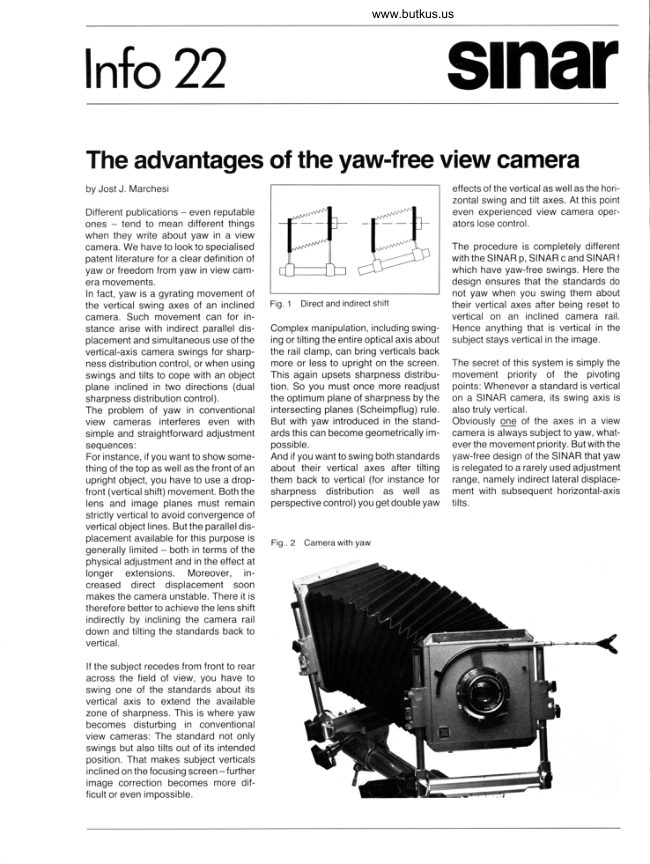
In fact, yaw is a gyrating movement of                                         not yaw when you swing them aboutthe vertical swing axes of an inclined     Fig.ffiF1  Direct and indirect shift                their vertical axes after being reset to
camera. Such movement can for in-                                                vertical on an inclined camera  rail.
stance arise with indirect parallel dis-   Complex manipulation, including swing-   Hence anything that is vertical in the
placement and simultaneous use of the    ing or tilting the entire optical axis about   subject stays vertical in the image.
vertical-axis camera swings for sharp-    the rail clamp, can bring verticals back
ness distribution control, or when using   more or less to upright on the screen.   The secret of this system is simply the
swings and tilts to cope with an object    This again upsets sharpness distribu-  movement priority of the pivoting
plane inclined in two directions (dual     tion. So you must once more readjust    points: Whenever a standard is vertical
sharpness distribution control).             the optimum plane of sharpness by the  on a SINAR camera, its swing axis is
The problem of yaw in conventional    intersecting planes (Scheimpflug) rule.   also truly vertical.
view cameras interferes even with    But with yaw introduced in the stand-   Obviously one of the axes in a view
simple and straightforward adjustment    ards this can become geometrically im-  camera is always subject to yaw, what-
sequences:                                  possible.                                 ever the movement priority. But with the
For instance,  if you want to show some-   And  if you want to swing both standards   yaw-free design of the SINAR that yaw
thing of the top as well as the front of an   about their vertical axes after tilting    is relegated to a rarely used adjustment
upright object, you have to use a drop-   them back to vertical (for instance for   range, namely indirect lateral displace-
front (verticalshift) movement. Both the   sharpness distribution as well as  ment with subsequent horizontal-axis
lens and image planes must remain    perspective control) you get double yaw     tilts.
strictly vertical to avoid convergence of
vertical object lines. But the parallel dis-
placement available for this purpose is    Fig..2 Camera with yaw
generally limited - both in terms of the
physical adjustment and in the effect at
longer extensions. Moreover, in-
creased direct displacement soon
makes the camera unstable. There it is
therefore better to achieve the lens shift
indirectly by inclining the camera rail
down and tilting the standards back to
vertical.

 lf the subject recedes from front to rear
across the field of view, you have to
swing one of the standards about its
vertical axis to extend the available
zone of sharpness. This is where yaw
becomes disturbing in conventional
view cameras: The standard not only
swings but also tilts out of its intended
position. That makes subject verticals
inclined on the focusing screen - further
image correction becomes more dif-
ficult or even impossible.
View original page 1Page 3 · Read text
Forthe ultimate image.$nar


Fig. 3  Double yaw on swinging both stand-
        ards (shown dotted)

Fig. 4 Camera with yaw{ree swings -->


Gonfusion over the Scheimpflug rule
One long-standing misconception over    plane and image plane must intersect in  The model demonstrations of Figs. 5
the Scheimpflug rule is that for uniform    a porn!. In fact, this rule only holds when   and 6 show that the planes can inter-
sharpness over an inclined plane the   these optical planes intersect com-   sect strictly only with a camera that has
extensions of the subject plane, lens     pletelv in a line. not a point.              yaw-free swings, never with yaw.


                                   Fig.5 Yaw-free camera: The planes inter-     Fig. 6 Camera with yaw:There is no com-
                                                      sect in a common line                           plete line of intersection
View original page 3Page 4 · Read text
www.butkus.us
                              For the ultimate image.srnar


The practical effect

A camera with yaw-free swings allows
much simpler, more precise and more
predictable adjustment than an older                                                      Fig.7
type.
Of course,  if you want to use a view
camera merely for its bigger image size
and are prepared to forego its move-
ment scope by keeping  all adjustments
centred and stopping down to f/64, you
willnot benefit much from acamerawith
yaw-f ree swings, either.
But for top-class results you must have           Fig. 8                                            Fig. 10
a yaw-free camera - quite apart from
the setting-up time you save.
To show the difference in operation,
here is a sequence of steps for a simple
product shot: Three small boxes are to
be shown in approximately equal size
from the front and above, with slightly
exaggerated  perspective.
                                                              Fig. 9                                             Fig. 11Fig.7 shows the first adjustment step -
which is the same for both camera sys-
tems. The photographer  first selects the
viewpoint according to perspective and
other requirements. The substantial
                                                                                                                                                                                                    Digitally signed by Mike Butkusdownward view reouired calls for in-                                                                   DN: cn=Mike Butkus, o=Butkus camera manuals,direct parallel displacement. That is to      Mike Butkus  ou=butkus.org,Date: 2021.09.19email=mike@butkus.org,12:39:49 -04'00'       c=US
say, the base rail of the camera is in-
clined downwards and the lens and
image standards  tilted back to vertical.
With the SINAR p, SINAR c or SINAR  f                                                   Fig.12
with their yaw-free swings the rest of the
adjustment takes just a few seconds.
The next step as shown in Fig. 8 is a
swing of the image standard about the
vertical axis to correct horizontal con-
verging lines for perspective control. In
the absence of yaw the verticals remain
                                 onvertical - nor does the image shift
the screen.                                                                                               Fig. 13
Finally sharpness distribution is pre-
cisely controlled with the SINAR  tilt
scales. To avoid further perspective ad-
justments this is achieved by transfer-
ring the rear swing to the vertical axis of
the lens standard.
This automatically meets the Scheim-
pflug condition by making the optical
planes intersect in a common line. All                                                   Fig.14
you then have to do is to select the best
focusing point and aperture on the
SINAR depth of field scale to obtain the
required depth of field at right angles to
View original page 4Page 5 · Read text
Forthe ultimate image.slnar


                                  9    Fig. 11 shows how the image now ap-   This trial was made with a top-classthe subject plane. That is all - Fig.
shows the final result with the lens at    pears on the screen. The sideways shift   camera and top-quality lens. Even after
il22.                                has brought  it very near to the edge of  many years of practice in handling
The same adjustment - with the same    the lens's field which leaves no room for  cameras with yawing movements the
lens -  is considerably more cumber-     further sharpness distribution control by   photographer did not manage to main-
some and less reliable  if the camera   a swing of the lens standard (again dis-    tain the perspective unchanged, nor did
swings are subject to yaw. After the    placing the angle of field).              he achieve the same quality that the in-
basic adjustment (Fig. 7) the image   The shot was made with a Schneider   experienced photographer got at the
standard is swung about the vertical   Symmar-S lens of a 70" angle. Even    first attempt with the yaw-free camera.
axis to correct perspective. At this point    with the yaw of the camera this kept the  And for reasonable sharpness the
the standard yaws away  f rom its vertical   image reasonably within the lens's   photographer had to stop down by one
position, the verticals  tilt in the image    angle. But with a lens of only 50o cover-   whole stop more. In macro shots this al-
and the subject has shifted to the edge   age (for instance an Apo-Ronar), the   ready sacrifices some overall sharp-
of the focusing screen as shown in    job would just have been possible with a   ness through  diff raction.
Fig. 10.                                      yaw-f ree camera but - as just explained    Similar simple subject setups -  but
The practiced photographer will now    - not with one subject to yaw.              equally difficult to handle with a camera
                                                                                                                                          ofswing the whole camera by releasing    Next we have to try to obtain overall   subject to yawing swings - canthe railclamp and rotating the base rail   sharpness by swinging the lens stand-   course arise in every photographic
untilthe verticals are vertical again.       ard. lf the extensions of the camera   field. Thus everyday architectural
However, this does not yet centre the   planes intersect in one point (by the   photography frequently involves per-
image. An attempt was made here to do   misunderstood Scheimpflug rule) you   spective correction of converging lines
so by horizontal displacement of the    get the image shown in Fig. 12. Only the   with simultaneous upward inclination of
image standard to the right - for which    central matchbox is really sharp. The   the camera to provide an indirect rising
the adjustment range was not quite suf-    reason is obvious: As a swing about the   front movement.
ficient. To avoid further complications    vertical axis causes both standards to
by lateral indirect displacement,  the   yaw, there can be only a point of inter-
photographer simply moved the whole    section, not a common  line. That makes
camera to the right on the studio stand    overall sharpness distribution control
arm. That of course is one of the most    impossible. With much experience you
basic errors, for a shift of viewpoint also   might just manage to readjust the  SINAR LTD SCHAFFHAUSEN
modifies the perspective. But it is not   planes (Fig. 13) so that on stopping   CH-8245 Feu erthalen/Switze   rl and
the last fiddle of this job.  . .             down to tl32the picture is nearly sharp   Telephone (053) 5 45 27 I 4 Bg 21
                                                (Fis. 1a).                            Telex76740


O Copyright 1982 by SINAR LTD SCHAFFHAUSEN,  including  all translations                                                                             Printed in Switzerland, August 1982
                                                                                                                                                              183.8218.40.02o e
View original page 5Related documents and language editions

SinarPDF
SINAR
User manual
29 pages · EnglishRead →
SinarPDF
Sinar Camera
User manual
20 pages · EnglishRead →

SinarPDF
Sinar Code booklet - 1981
Product booklet
24 pages · EnglishRead →
SinarPDF
Sinar Copal Shutter
User manual
10 pages · EnglishRead →
SinarPDF
Sinar F
User manual
18 pages · EnglishRead →
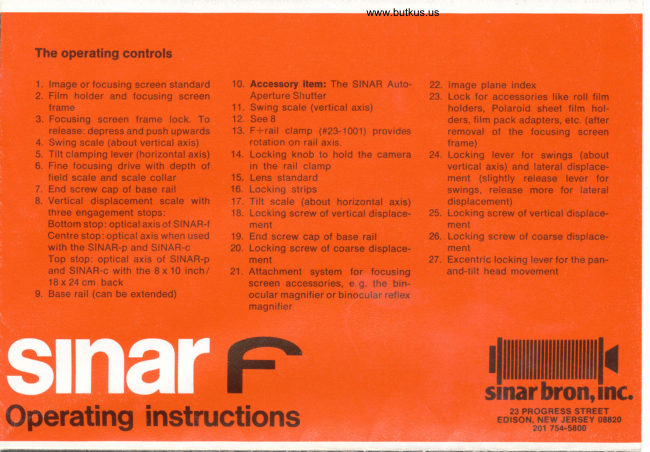
SinarPDF
Sinar F Operating Instructions Color
User manual
8 pages · EnglishRead →

SinarPDF
Sinar P
User manual
59 pages · EnglishRead →
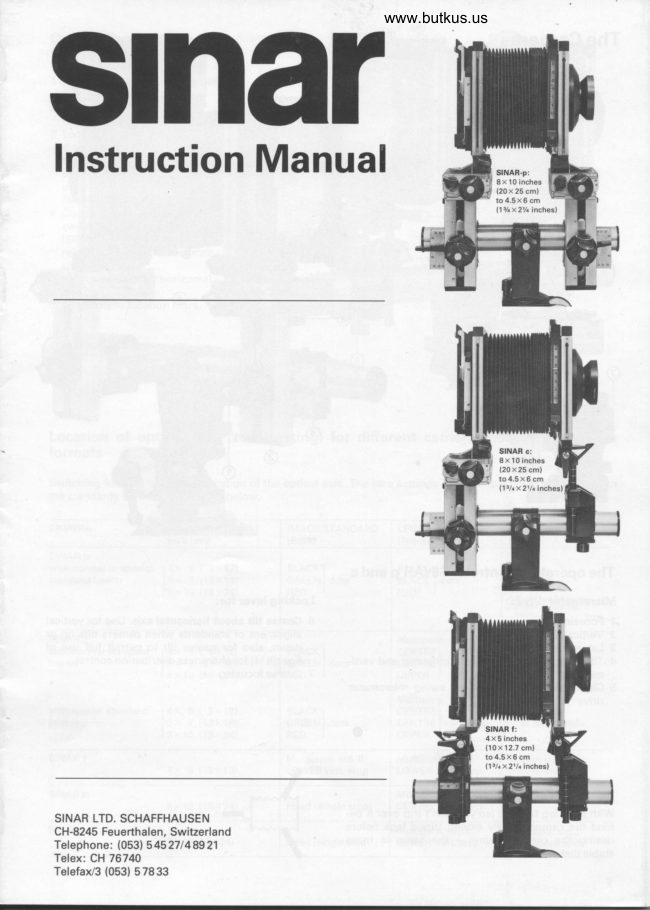
SinarPDF
Sinar P / Sinar C / Sinar F
User manual
13 pages · EnglishRead →
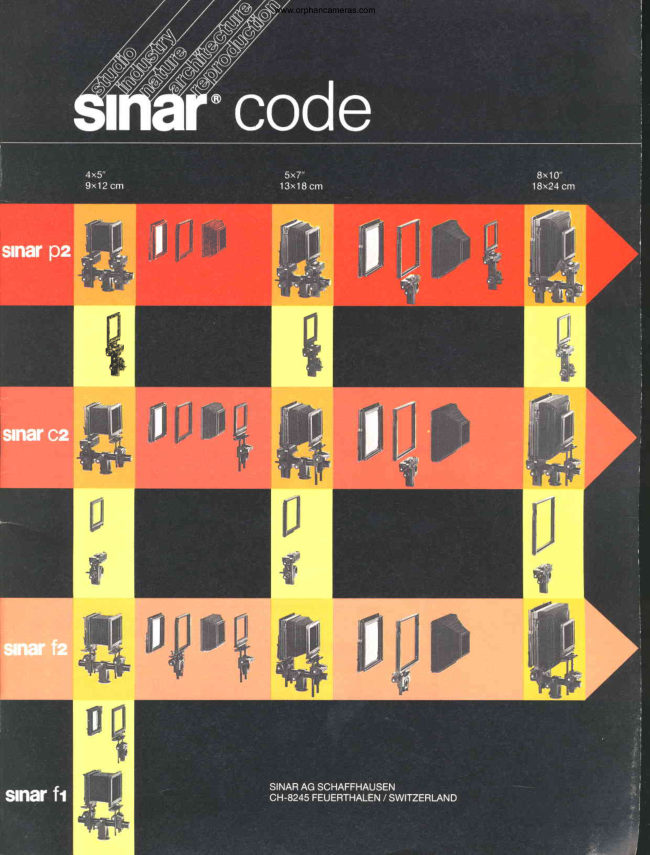
SinarPDF
Sinar Code Booklet
Product booklet
27 pages · Not specifiedRead →
From the M. Butkus archive. Original publisher and archive notices are retained.
Check the model and edition against your equipment.
PDF verified 2026-10-10.