Film cameras
Voigtlander Bessa - model 2 User manual
User manual for Voigtlander Bessa - model 2. 13 pages in English. Read the original PDF, download or print a copy without registration.
13 pagesEnglish2.9 MB PDF
Loading your manual…Open PDF directly
Document details
- Brand
- Voigtländer
- Model / document
- Voigtlander Bessa - model 2
- Document type
- User manual
- Language
- English
- Pages
- 13
- File size
- 2.9 MB
- Category
- Film cameras
- Document date
- Not specified in catalog
Search available document text
Find a term, then jump to its page in the original PDF. Image-only pages may not be searchable; check the PDF for exact wording and diagrams.
Page 4 · Read text
www.orphancameras.com


      t
      I
   I
    ::


        i


               Zr/q"x 3r/a,t,
 RANGEFIIIDER

                 M(lllET 2 BESSA
#


  VOIGTLANDER& s0N    F0u
View original page 4Page 5 · Read text
www.orphancameras.com


  , *


    The new 2Yq*3r/+ Rangefi.nder Bessa
Model  2  is the  fulfillment   of  every ama'
tcur  photographer's  drearn    a camera
possessingevery single refi.nement essential
for perfect photography,  yet of such sens'
ible destgn that  the external shape alone
proves that a camera with a coupled range-
finder' can still be very compact and light.
    Every part from the rangefinder  (#1;
to the trigger shutter release (#2),  is built
into  this streamlined camera.

      Perfect   focusing     is   sirnplicity      itself
with   the   built-in   rangefinder   (combined
range-viewfinder).      Looking    through       it,
you   will   see  a  yellowish    circle    in  the
center   of  a  clearly    outlined    viewfinder
image.  A  double   outline   of  the  subject
will  be seen  in  the  circle  as long  as the
distance   is  incorrectly    set. A  turn   of  the
focusing knob  (#3),  and  in a  jifiy  the two
images  coincide,   setting  the  distance  auto.
 matically   for maximum   sharpness.
View original page 5Page 6 · Read text
www.orphancameras.com


                                       * t ,


    An   innovation    in  the  Bessa   is'  its
unique  construction,   the  result  of  genera-
tions of practical  experience.    ft  is cleverly
designed, so that  the  controls  are located
 right  at the  fingertips.
    Two  fingers  are used  for  focusitg   -
the  eye  checks  the  rangefinder   and  the
index  finger  rests on  the  shutter  release.
The  camera   is  firrrrly  held  in  both  hands
ready  for  use,  while   critical  focusing   of
the  subject    is  followed   through   every
movement,  so that the picture  can be taken
at just  the proper  instant.
    S h u t t e r   s p e e d s  c a n  b e    i n s t a n t l y
changed by a slight  twist  of the  outer  rim,
while  the lens stops are changed by a mere
flick  of the  indicator.

    Fast lens speed permits   excellent
pictures under  normal  indoor  lighting  con-
ditions  and even theatre  and  night  photo-
graphs,  without   resortins   to  the  use  of  a
flash-gun
View original page 6Page 7 · Read text
www.orphancameras.com


                                                                                                                                                          Digitally signed by mike
                                                                                                                           butkus
                                                                                                                    DN: cn=mike butkus,                        mike       o=orphancameras, ou=29,
                                                                                                                             email=mike@butkus.org,
                                                                                                            c=US
                                                                                                                                        2017.10.14 17:45:00                         butkus Date:-04'00'


     Shuttr:r speeds rarrge from one secnxt,l
to  l/400th,   in  addition   to  bulh.     [f  the
photographer   wishes  to  appear   in  the
photograph,   it  is merely  necessary to ad-
just  the  delaved  action   slrutt er  release
(#5 ) .  Between  operation   of  the  release
and  the  opening   of  the  shutter'. about
twelve seconds will  elap       tirne enoush
to take one's place in the sroup.

    The Compur  Bapid  shutter has btrilt-
in  flash  synchr onization,  too.   Practically
every  popular   flash  gun  manufacturer
markets a model  suitable  for use rvith the
Elessa. The  fratterv case and re fleetor  al'e
attached  to  the  camera  lrv means  of  a
bracket;   the  connecting  cord   is  sim p l''
plugged  into  the  couplins  on the  shutter.
and the camera  is ready  for  action.

    A  soeliet  for  use with  a flexible  wire
release   is  provid-ed  directlv  above  the
trigger  release  (#4\.  This  is threaded  to
accommodate the standard conrpur relr:ASi'.
available  in  variolrs sizes.
View original page 7Page 8 · Read text
www.orphancameras.com


                                               1 tXtiilt;::
                                                                                              I #t,, ! S-tt;;


                                                                                 '|+1,#
                                                                                                                        {'tt^4                w'


    The  depth   of  field  from    .  .  . to   .  .  .
ffur  b€  instardv    rcad   for  any  aperture,
orl  the  conv€nir:rrt  seale  lo""icd    in  the
la:rye foeusing lirrob  (#7). Engraved on the
inner'  fi>red circ le  ( +g )   it  a small  triangle
which  scr\res to  indicate  the  distance  in
feet  to  wlrich  the  canlera has  lrr:en set.
Bel.ow thc  small  triangle  are var:ious lens
openirg-s   f t'ot1 each  of  which  1  pair  of
lirr,r,rs( #9 ) pro ject to the rotating  f.irrg indi-
catin g  the   exten t   of  depth   o f   field.
Ilxuntple:  Distarrce set at 15 feet rvitlr lens
opening  f3.6^  t h e depth  of  fielcl extcn rls
from  12 fect  to 20 feet rvhile  at f22, the
tleptlr  of  field reaches fronr B  f eet to    i n-
finity, and -co on.

    A n  u l l o b s e r ' e r l , s . ? l p . h o t e ' l ) l o v i r r g
"ZONE''     f or:usirrg ver\- o fl en  r".,,lts    i rr a
surprisinglv  finc picturr'.  Trvo svnlllol..  iul
inverted trianele (#10)  anrl a circle  (rI  t)
r:tched on  the  outer.  r-otatin s  knol)  are
Irrough!  into use for  this  plca-"trralrle pa-s-
tinre. The  triangle  is used as a distanee
ytJing  fol  elose u'ork  bet\yeen  roughly
I  feet arrd 15 feet. and the eircle for  irrb-
jects-bevond  l5 fcet. This p.actiee requires
good Iightinq corrditions"with lens set at fll.
View original page 8Page 9 · Read text
www.orphancameras.com


     Voigtlander    optical    etl ui pnrent  was
 well  known  when  photography  was   still
 in  its infancye because the very  first lenses
 designed  for  photographic  purposes were
 Voigtlander  lenses.
     The  Skopar,  composed  of  four   ele-
 ments, combines the utmost sharpness with
 particularly   great  resolvitg   power.     ft   is
 the most popular  Voigtlander   lens, afrord'
 irg  remarkably   high  performance   at  a
 moderate  priee.
     The difference  in eonstruction  between
 the  Heliar  and the Skopar  is reflected  in                       '*:x:  T,'ff"I;'ff;nluHJljIil":Tn:
 construction   demands  a v e r y  d i f f i c u l t
 mountitg   whieh,    it   itself,  is an expensive
 item.
     To  sum  up,  the  Skopar  more  than
 answers  the  requirements   of  the  average
 amateur,   while   the   lfeliar    is  the  lens
 "p",   excelle nce"  for  the    f astidious  and
 critical  worker.  Both  lenses are coated for
 even  greater  effieiency.
View original page 9Page 10 · Read text
www.orphancameras.com


                          )n  is another  feature.
                        (#L4)  is pressed and
                        erected  -  the  trigger
                             lverly  concealed  under
                          'ges                           as  if  by  magi,c -
 a dorvnward  motion  on the baseLo""d;  and
 presto the camera  is ready  for  action.
      closing    tl_r" camera  requires  a  rlight'on
 pressure  o n  the  release  catch  located
 the  baseboai'd, and  the  front  folds  back
 quickly  and  s6. ilv.

    Two  sockets  (*tZ)   ancr (#i3)   for  the
 use of a tripod  and flash gun, or even both.
 are located for  the utmost convenienee.
     The  built-in   rangefinder  operates  just
 as effectively-  wlth  the  camera  closed,  ;;l
when  opened  the  lens  \^rilr be  adcuratelvJ set at  the  proper  distanee.
    The body  is covered  with  sleek, blaok
g-enuine leather,  topped  off by a rich  satin
ehrome   fini-"h-  resuitittg    in      extremelv
handsome  looking  instrument.",'   Sttr";;i
lighg        !h"  Bessa ean very  conveniently   b;
earied   in  the  poeket.
View original page 10Page 12 · Read text
www.orphancameras.com


            voigtlander      filters are available  in
        fuoth  light  and medium  yellow.   Focar   at'
       tachments  open  up  the  field  oI  close-up
      photography.  The   (*f   ) Focar  permits
       working   at distances from  1?" to 32", while
        the  @Z)  can be used  for  closc'ups from
        12"  to  L7".  The  Voigtlander  sunshade  is
       a particularly   useful  accessorye se.ring  to
         lrold back extraneous raYS.

                                                          '                     Model2     2r/4x3Y4RangefinderBessa

     *RFS               with Color-SkoPar   f3'5 lens    '
     *RFH              with  Color-Heliar   f3'5 lens    '
      Ev ere a d yCa rrY in g Case  o     '       '  o
      37mm. Yellow  filter  light  or medium
      37mm. Focar  lens, #I  or #2    '       '       '
        3 7 m m . S u n s h a d e .      .  o    .  o  o     '
      xCode     RFS  f or camera with SkoPar lens
            Desi,gnati,onz RFH    for  camera^  with   Heliar   lens


,t
View original page 12Related documents and language editions

VoigtländerPDF
VOIGTLANDER BESSA L - RE-RELEASE BOOKLET
Product booklet
5 pages · EnglishRead →

VoigtländerPDF
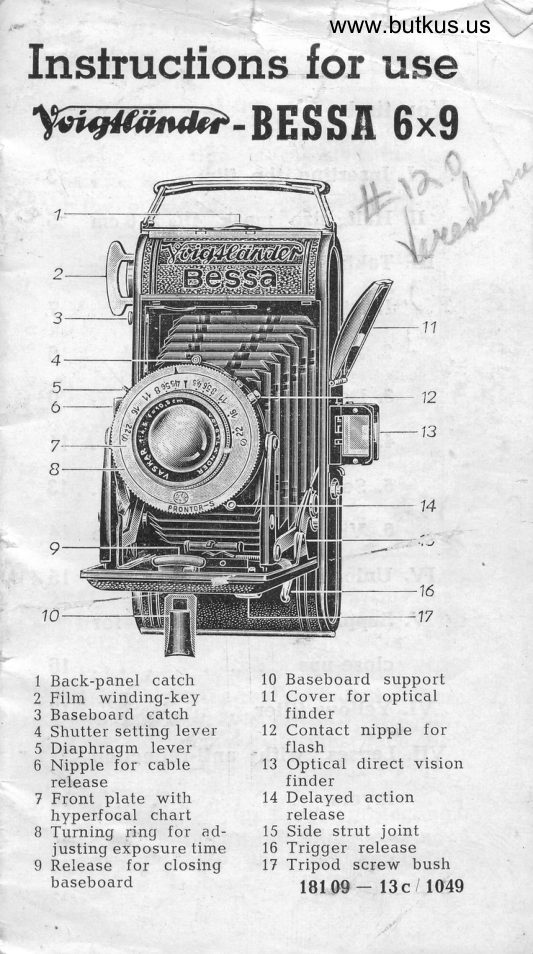
Voigtlander BESSA 6X9
User manual
20 pages · EnglishRead →
VoigtländerPDF
Voigtlander BESSA 6x9 - another
User manual
19 pages · EnglishRead →
VoigtländerPDF
Voigtlander Bessa 6X6
User manual
5 pages · EnglishRead →
VoigtländerPDF
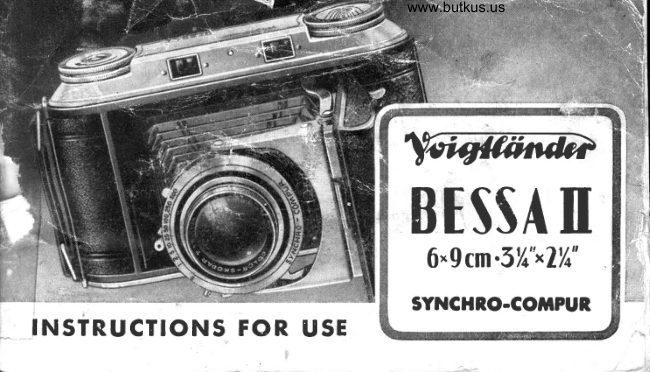
Voigtlander Bessa II
User manual
30 pages · EnglishRead →
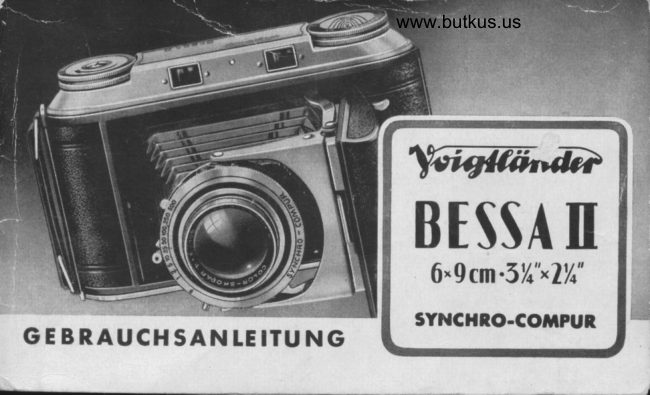
VoigtländerPDF
Voigtlander BESSA II 6x9 Gebrauchsanleitung
User manual
33 pages · GermanRead →

VoigtländerPDF
Voigtlander Klein-Bessa
User manual
25 pages · GermanRead →
VoigtländerPDF
Voigtländer BESSA-R2A / BESSA-R3A
User manual
97 pages · GermanRead →
VoigtländerPDF
another Voigtlander Klein-Bessa - Gebrauchsanleitung
User manual
24 pages · GermanRead →
VoigtländerPDF
Voigtlander BESSA-R2M, R3M
User manual
23 pages · German, SpanishRead →

VoigtländerPDF
Voigtlander BESSA - T
User manual
110 pages · German, Spanish, ItalianRead →

VoigtländerPDF
Voigtlander BESSA R2S / R2C
User manual
23 pages · German, Spanish, ItalianRead →
From the M. Butkus archive. Original publisher and archive notices are retained.
Check the model and edition against your equipment.
PDF verified 2026-10-10.