Lenses & filters
Lens Guide - General (1960s) Product booklet
Product booklet for Lens Guide - General (1960s). 97 pages in English. Read the original PDF, download or print a copy without registration.
97 pagesEnglish6.0 MB PDF
Loading your manual…Open PDF directly
Document details
- Brand
- Various brands
- Model / document
- Lens Guide - General (1960s)
- Document type
- Product booklet
- Language
- English
- Pages
- 97
- File size
- 6.0 MB
- Category
- Lenses & filters
- Document date
- Not specified in catalog
Search available document text
Find a term, then jump to its page in the original PDF. Image-only pages may not be searchable; check the PDF for exact wording and diagrams.
Page 3 · Read text
CONTENTS


                         Page                             Page
lfhat  arc interchangeable         What about convetters and
    lenses?                5      zooms?               35
                             What are converter lenses? 35
Will yottr cantera take other       How does the monocular
    lenses?               10      work?               38
  Limits on lens changing    11    What about fixedlens
                                    converters?               4l  The shutter plays its part   12
                             What is a zoom lens?     42
What lensesdo             15  How to chooseyow lens     45
  What is focal length?      15     Will  it fit your camera?   45
  Wide-angle lenses        16    What about quality ?      46
  Long-focus lenses        18     Are cheaper lenses any
  What dofnumbers mean? 19      good?               48
  What affects depth of field? 20    What do resolutioo tests
                              show?               50
                               The common-seilFDo yoa need enother lens?   23                                  approach              52 How long is practicable?  23
  Long-shot perspective     24   Handling the long-focus lens  56
  The air is not clear       26   How to hold it           56
  Long-range focusing      27    Take care with focusing    59
  Do you prefer the wide-                     . . . and with shooting     60    angle ?             28                                          Will a filter help?         62  What are the weak spots?  29                          How to "stop" moving
  Choosing your focal length 32       objects               63
  Whicb wide angle?      32      fs zoom technique different? 6,4
  Which long focus?       33   When is the zoom most
  Mirror  lenses          34       useful ?               66
  The choicc is personal    34    Do thefnrrmbers change? 68
                    3

                        www.orphancameras.com
                                                                     -;nk*4*;,^.       -
View original page 3Page 5 · Read text
WHAT ARE
    INTERCHANGEABLE LENSES?
  Most cameras are originally bought with just the one
lens-the so-calledstandardor nonnal lens. This is the lens
that is intendedto havethe angleof view and to provide the
perspective*that is normally associatedwith the human
eye. Thus, the picture taken with this lens will usually
presentthe scenemore or lessas the eye seesit.
  There are, however, other lenses. Some take a much
wider view of the scenein front of the camera and are
known as wide-angle or short-focus lenses.Others take a
narrower view-like  the telescope-and some of these can
"see" into the very far distance.These are the long-focus
or telephotolenses.
    It is therefore possibleto adapt a single camera to take
a very wide view in a confined space, such as in small
rooms or narrow streets,or to take a very long view so as
to present distant objects on an enlarged scale, such as
architecturaldetail, ships off the coast, etc.
  There are intermediate possibilities. The moderately
long-focuslens, for example,is useful where a large image
is required but it is inadvisableor impracticableto approach
the subject too closely.The wide-anglelens can be used to
presentbroad panoramas.
  The modern 35 mm. camera, particutarly the single-lens-

pERspBcrrvr. The perspective of a group of objects is their  relative
grouping and sizes as they appear to the eye or camera viewing them.
Photographic Optics, by Arthur  Cox.
                    5

                       www.orphancameras.com
                                                             ;-               --*i;-:;          .     , r..d*&bg*&p,-                   "X 1  *'*  "               !
View original page 5Page 7 · Read text
SCOPE OF LENSES


The camera with  full interchange-
able-lens  facilities   is  extremely
versatile,  particularly    if   it   is  a
single-lens  reflex.    lt  can  use  a
range of three  or four short-focuslensesand long-focus lenses giving NN   NN
images up  to  about  20 times  as
large  as  those   of  the  standard
lens.
Additionally,   such  cameras  can
use many  attachmentr   such  as
extension  tubes  or  bellows   for
close-range work   or  microscope
ldaptors   to  enable them  to  Pro--
vide  much-magnified   images  of
very small subiects.


                         www.orphancameras.com
View original page 7Page 8 · Read text
reflex* t1pe, is well suited to the attachment of various
lensesand this facility has done much to extend the range
of photographicsubjectsavailableto the ordinary amateur.
There are additional lensesfor other types of camera,too,
but these are comparatively few in number. The general
principlesremain the samebut this book is written primarily
with the 35 mm. user in mind.
  The camera with only one lens is an incomplete instru-
ment. It  is like a man with defective eyesight.There are
complete worlds beyond its vision.  It  can rarely deal
satisfactorily with the picturesque scenesin the narrow
streetsof the quaint little villages still to be found in many
parts of the world.
    It often finds modern buildings too tall to be brought
into the field of view.
    It is not at its best with head and shoulder portraits or
even with shots of children, where the close approach it
calls for can be distracting.
  Despite the possibility of subsequentenlargementof the
image in printing, it can rarely presenthigh-quality repro-
ductions of distant objectsor of small objectssuch as birds
and the smaller animals.
  The popularity  of colour slides even rules out the
practicability of subsequentenlargementof the image. The
ambitious colour photographersoon discoversthe limita-
tions of the camerawith only one lens. To him, the ability
to changehis lens to take in more or less of the scenein
front of him is invaluable.
  Nevertheless,we must temper our enthusiasm.It  is so
easyto squandermoney on lenseswe shall rarely, if ever,
use after the fust flush of excitementhas died. And  it is
so easy to forget that some lenses,particularly the really
big ones,are rather difficult to use.

STNGLELENSREFLEx.The camera lens itself  also forms  the  finder
image. A mirror  inside the camera body reflects the image on the
           you       whilescreen               view                                      it. When                           you shoot,                                          the                                                mirror                                                                   flies out                                                                    of the                                                                                 ltf .way and         the              lens                  records                                            directly                           the scene                                      on                                                 the  film.                                                        Successful
35 mm. Photography,by Andrew Matheson.
                 E
                                                          I
View original page 8Page 9 · Read text
It is the purpose of this book, in part at least, to make
       known the disadvantages,as well as the advantages,of
         extra lenses.As the advantagesare so readily apparentand
        are not infrequently overstated,we may seemin the early
        stagesto use a disproportionate amount of spacestating
         the disadvantages.But that  is better than allowing the
        reader to believe that the fish-eye lens, for example, will
         give a normal picture over its extremelywide angle; or that
         the really long focus lens can presenta pin-sharp image of
        a distant object when held in the hand.
        Some readers, in fact, must be disillusioned from the
           start, becausenot all camerascan be fitted with additional
         lenses.Theseare the owners of fixed-lenscamerasand we
          shall deal with them first.

 tt
W.  t #
, l+'.t#
l'lrs.-lw Itr


 i*


                               www.orphancameras.com

                                                                                                  i:.;:{J;       ;   :}:;r-.-'::      *.
View original page 9Page 10 · Read text
WILL YOIJR CAMERA
      TAKE OTHER LENSES?

   It is not uncommon for a photographicdealerto be asked
to supply telephotolensesor wide-anglelensesfor fixed-lens
cameras.This is impossible. You cannot have full  inter-
changeablelens facilities unlessthe lens on your camerais
readily detachable.Wide-angleand telephoto (often more
correctly called long-focus)lensesare complete lensesin
themselvesand are designedto replacethe so-callednormal
or standard lens. But the normal lens on the fixed-lens
camera cannot be removed. That is the first principle of
lens interchangeability.
  The only way in which the perforrnanceof the fixed lens
can be altered is by attaching other lensesto it. In this way
a limited wide-angleor long-focuseffect can be obtained.
This is a compromisesolution and too much shouldnot be
expectedof the results.
   All inexpensivecamerasare fixed-lenstypes but there are
also many of thesecamerasin the more expensivecategory.
Whatever their price, however, they are designed to be
used with the one lens only. No guaranteeof performance
can attachto any attempt to extend their range.
  There is, however,a group of camerasin which the front
part of the lens can be removed and replacedby another
part which gives either wide-angleor long-focus facilities.
This is a more satisfactoryaffangementthan the attachment
of extra elementsbut the quality of the results is not
likely to be as high as that obtainable by replacing the
whole lens with a specially designed lens of the focal
                        t0
View original page 10Page 11 · Read text
length* required. The extent to which the focal length of the
lens can be altered by this method is also limited  to about
four times the standard focal length.
  The real interchangeable-lens camera is the camera from
which the lens can be easily and quickly removed. The lens
can then be replaced by one of shorter focus (wide angle)
or longer focus, as the occasion demands.
   In  theory,  the degree of  interchangeability  with  this
type of camera is unlimited.  Wide-angle lenses are in fact
available which photograph over an angle of 180 degrees.
The range of long-focus lenses is limited only by practical
considerations  of  size and bulk and the  fall-off  in  light
strength as  it covers the increasing distance to the back
of the camera.

Limits  on  lent  changing
   In practiceo there are other limitations. The interchange-
able-lens camera comes in two forms-the   reflex and the
non-reflex.
  The  single-lens reflex now so popular  in  the 35 mm.
range uses its lens both  for viewing and focusing and for
taking the picture. The scene in front  of the lens is reflected
by a mirror  inside the camera on to a viewing screen on
top  of the camera. The image on  this screen is viewed
through a magnifying lens or lenses via a pentaprism or
mirror arrangement which presents the image right way up
and right way round.
  Thus, in theory at least, any lens can be used on this
type of camera. In  practice, lenses made for one camera
will  rarely  fit any other camera, except by means of an
adaptor, because there has been no  atternpt by camera
manufacturers  to  standardize  lens  mounting  methods,
Even when a lens can be fitted by means of an adaptor.

FocAL LENGTH.The distance from the centre of the lens to either the
object or the image when the rays on the other side of the lens are
parallel  is the focal length of the lens. Camera Techniques,by H.  J.
Walls.
                                                       l l

                      www.orphancameras.com
                             #;,    ;,*r;****".:,iu:...-. ,.:.i                     i..   ;-a,fg,:"-.i....       .-::    -J       :i
View original page 11Page 12 · Read text
it is po-ssiblethat such refinementsas automatic diaphragmr
 control may not work satisfactorily and, unlessthe adaftor
 is accuratelyand carefully made, the lens may not be ible
 to focus distant scenes.This can also arise when trying to
 fit a lens from a non-reflexcamerato a reflex. The liod! of
 the non-reflex camera is usually shallower than the reirex,
 and its lensesare in correspondinglylonger barrels.
  The non-reflex camerais more limited-than the reflex in
 its use of interchangeablelenses.It doesnot view the scene
 through its taking lens, so it needsa separateviewfinding
 arran^gemen!f9r each lens. It can have interchangeable
 viewfinders,* indicator  lines or changing fields In  its
 viewfindel:            9r  lt  lryght .have a "zoom"- or  turret-type
 "universal" finder. Focusing, too, may need special atfen-
 tion. This type               camera often has arangefinder coupled               _of
 to its lens but the rangefinderrarely-oncoupleswith lensesof
longer than 135mm. focal length    th-e 35 mm. camera
 (less than three times normal). So focusing with longer-be
lenseshas to be estimated or a reflex housing has to
 fitted to turn the camera into a reflex.
The shuttpr playc lte pC
  Both reflex and non-reflexcamerasvary in their shutter*
arrangementsand  this, too,  affects the degree of lens
interchangeability.

AUTOMATTCDTAPHRACM.YOU Setthe aperture you require and . . . from
then on everythlne is aut-omaticullessysu have to cliange the aperture.
You-press the shutter releaseand the iris closesto the pre-set a-perture
!o- take the pictu-reand immediately opens up again to focus the next.
How to choose the camera You Need,by w.b.  Emanuel and konard
Gaunt.
vrEwFrNDERs,orjust   filders,  re{lylgve   a dual function. They must
tell us towards what point the axis of the lens is directed and ho* much
of the scene in front  of the camera is included in the picture. camera
Techniques,by H. J. Walls.
sHUTruR.This is a.p.recision-mechanism which accurately regulates
lbe time dpring wl,rich-the light may p:rss through the leni on-to the
film. In other words, it contiols the exposure tine. The netina wiy,
by O. R. Croy.
                        t2
View original page 12Page 13 · Read text
REFLEX AND RANGEFINDER


The light-path to the viewfinder
 image(top) is a complex one in
 lhe  rGflex camenN.  lt  passes
 through the  taking  lens  to  a
 mirror in the camera body.
Thence,it ls reflected upwards to
 I prirm or  mirror arrangemenC
which presentr the image at the
cycpiece right wry up rnd  right
way round.
In the non-reflex camemn vlcw-
finderand taking lens are separate
optical systoms. Consequently,
their  vicwpoints   .rE   rlighrly
3apsritad and, at clorc range, thir
canprovide en Ineccurete vicw of
thc rubjcct.
Thc vicwftnder   built   lnto  thc
crmera giver the angle of vicw of
thc standard lcnr. Whcn  other
lengcsare used, another view-
finder must be  fitted  or  Ghs
original viewfinder must bc cap-
rble of edaptation ro the changed
rngloof view of thc lens.
Thc body of thc reflex camera has
to rccommodate e mirror.  lC is
consogu.ntlydeeper than that of
ths non-rcflex  (middle). This  is
why lensesof non-reflex Gamenat
cannot be used on reflex cemeras
ucept  for clorc-ups. The cxten-
don between lens and film would
bc too great  for  morc  distant
photognphy.
Focusingby rcflcx screcn and by
nngefinder (bottom) are basically
differencThe reflex screen image
is blurred when the lens is not
focusedproperly and sharp when
it ir. Thc nngcfindcr image shows
r displacemcnt of one kind  or
another when  the  lenl  is not
focurcd properly end e  singlc,
clcrr imr3c whcn  it  ir.
                           t3

                           www.orphancameras.com
                                                       -  *t  **;,,  tt',.t,:; i: i;i*,,
View original page 13Page 14 · Read text
Most  35 mm.  single-Iens reflexes have  focal-plane
           shutters. This is a shutter, usually consisting of a pair of
         moving blinds, situated immediately in front of the film
        and thus allowing lenses to be changed regardless of
         whether the camerais loaded or not.
          The other common shutter type is the diaphragm shutter
           -also known variously as leaf shutter, blade shutter and
         between-lensshutter. This is a circular arrangement of
           thin metal leaves opening from the centre outwards and
        one of its names derives from the fact that  it  is usually
         contained within the lens. This type of shutter raises
         problems of  its own and three methods of overcoming
        them have beendevised.
         One is to permit a limited range of interchangeability
         by providing the lens with interchangeablefront elements.
         The secondmethodis to make the whole lens detachable
         by fitting the camerawith a protectiveblind which can be
        moved in front of the film while lensesare changed.This
        method has beenusedboth in 35 mm. and larger cameras.
        The drawback,of course,is that each lens has to have its
       own shutterand is, therefore,unnecessarilyexpenslve.
         The third method is to place the shutter entirely behind
          the lens.This is not an easystructural solution and it also
           calls for a larger shutter,which is apt to becomelessefficient
          with increasingsize.
         So much for the tlpes of camerathat can take a variety
           of lenses.It is now time to consider the lensesthemselves
            in more detail.


IrtH
ilt                                t4
View original page 14Page 15 · Read text
t#       WHAT LENSES DO

        The Focal Encyclopedia  of Photography  defines a lens
      as an "optical  device for forming an image of an object".
            It goes on to say a great deal more and the article  is well
       worth reading if you want a fuller description than we need
      glve_now. For the moment we are concerned only with
       the fact that the lens forms an image of the scene in front
        of it and the size of that image and the amount of the scene
        that  it covers depends, other things being equal, on the
       construction of the lens.

      Vhat  b local  length?
        Every lens has a particular  focal length. The normal  or
      standard lens generally has a focal length roughly equivalent
       to the diagonal of the image area it  is intended to cover.
      Thus, the standard lens for a 35 mm. camera has a focal
      length of about 50 mm. or 2in.
       The  focal  length  of a lens  is the distance between a
       certain point within the lens and the image formed behind
      the lens of a distant (near infinity*) subject. In the camera, it
        is the distance between the lens and the film when the lens
        is set to its infinity focusing mark.
           All camera lenses bend the light rays entering them so
      as to bring them to a focus in the required plane. It  is the

       rNFrNrry.A position on the focusing scale of a camera lens. . . . The lens
         ryt tg this position . .-. receivesa sharp image of very distant objects.
       Focal Encyclopedia of Photography.
                                 l5

                              www.orphancameras.com
                -";--a-.: i.ir,
View original page 15Page 16 · Read text
extent of this bending which governs the focal length of
the lens and thus its angle of view. The standard 50 mm.
lens for a 35 mm. c{rmerahas an angle of view of about
46 degrees.

Videqtgle    lentcr
  Lenses that bend the light rays more acutely have a
shorter focal length and a wider angle of view. The most
popular wide-anglelens for the 35 mm. cameraused to be
the 35 mm. but this lens now often tendsto be regardedas
almost a standardtype, with the 28 mm. and 24 mm. as
reasonablywide angle.
  Most of theselensesnow haveto be of invertedtelephoto
design,meaning that their back focus is longer than their
focal length, in order to allow the mirror movementof the
reflex camera.Also, the wider the angle, the more compli-
cated the construction and the higher the price for a lens
capableof providing good quality images.Inexpensive,very
wide angle lensesare rarely a good buy becausethey are
likely to provide distorted imageswith poor definition and
illumination at the edges.
  Tvith some older camerasand some specialistlenses,the
reflex mirror may have to be locked up so as not to foul the
back of the lens. Naturally, reflex viewing and focusing
facilities are then lost.
  A separateviewfinder has to be used and the lens must
be focusedby guessand scale.This rarely posesproblems,
however, becausesuch short fosus lenses give immense
depth of       in normal shooting and quite major focusing         !eld*inaccuraciescan passunnoticed.
  The ultimate in wide-anglelensesis the fish-eye-so-called
becauseof the monstrouslybulbous appearanceof its front

DEprH oF FIETD.While anything at the exact focused distance will be
reproduced sharpest on  the  film,  the  definition  deteriorates only
gradually in front  of and behind this distance. Over a certain range
of focusing distances-the  depth of field-this  unsharpness is still too
small to be noticeable.I*ica  and l*icaflex  Way,by Andrew Matheson.
                      t6


                                                                                             -:  j;
                                                                                .:,.:" ::,;.:ai,;t:,                  i
View original page 16Page 17 · Read text
FOCAL LENGTH


When a normal  lens is focused on
r very distant  subject   (top),  the
distance  between    the   optical
centre of the lens and the  film  is
ths focal length  of the lens. With
lenses of  standard   focal  length,
this distance is also roughly  equal
to the diagonal of the image area.
Not  all lenses follow   this  prin-
ciple. The  wide-angle   lens,  for
example, may call for a very  short
toparation between  the  film  and
the  rear  element   of  the  lens
(middle).
In the reflex camera (bottom),  this
teparation could be so small as to
preclude the  use  of  a swinging
mirror. Many  wide-angle  lenses
rre  therefore  made  with   this
$paration  (the back focus) great-
or thln  the  focal  length   of  the
hns, so that  the  mirror   can  still
bo used. This  is the  retrofocus   or
invsrtcd  telephoto   construction.
                       r7

                             www.orphancameras.com
View original page 17Page 18 · Read text
element.There are two main types, the one taking in 180
         degreesall round and so giving a circular image on the
            film, the other placing the image frame inside the circular
        image patch and so taking in 180 degreeson the diagonal
         dimension only. Neither can provide an undistorted image
            in the sensethat straight lines offthe lensaxis becomecurved
        and distances between points around the perimeter are
         compressed.Theselensesare usedfor effector in very con-
          fined spaceswhere no other lens could obtain the picture
          required.In the latter casethe picture needscareful interpre-
           tation.
          Long-foeut lenses
            At the other end of the scalethere are lenseswhich bend
          the light less than the normal lens. They have a narrower
         angle of view and a longer focal length. This, of course,
        means that a greater distanceis required betweenthe lens
        and the film (the back focus). Long-focuslensesfor 35 mm.
        cameras are therefore generally mounted at the end of
          long barrels to provide the necessaryextension from the
        camera body. That tends to make long-focus lensesrather
           bulky.
         A reduction in the physical length of the long-focus
          lens can be achievedby constructing it in such a way that
          the back focus is /ess than the focal length (the opposite
           principle to the retrofocuslens); a lens so made is called a
          telephoto lens. There is a tendencyto call all long-focus
         lensestelephoto lensesbut the true telephoto is of this
          special construction-not   that  there  is any  essential
          differencein its handling or performance.
          The telephoto construction frequently simplifies the
         problem of producing a long-focus lens that can satis-
           factorily be hand held. Long-focus lenses for 35 mm.
        camerashave focal lengths ranging from about 80 mm. to
         1,000mm. but it is rarely possibleto use a lens of greater
         than about 135mm. focal length without a tripod, unless
            just getting the picture is of more importance than its
            quality.
ilf;                         18
lllu
View original page 18Page 19 · Read text
The image formed by a lens varies in size directly with
 the focal length of the lens.Thus a 200 mm. lens forms an
imageof a given object four times greaterthan that formed
by a 50 mm. lens usedfrom the sameviewpoint. Naturally,
sincethe image is projected on to the same film area, the
long-focuslens takes in less of the scenein front of the
camerathan the short-focuslens.
  In other words, the shorter focus lens takes in more of
the scenebut on a reduced scale. The longer-focus lens
takesin lessof the scenebut on an increasedscale.
  One other thing should be evident. Equipped with the
normal lens, you can reproduce exactly the effect of the
longer-focus lens simply by enlarging a portion of the
image,but you cannot produce the effect of the wide-angle
lens-except on a twodimensional subject(seepage 28).-

Vlwt do f.numbers rnean?
  There is another characteristicbesidesfocal length that
is generallyused to describea lens. This is the maximum
aperture.*The apertureof a lens is definedby the opening
in an iris-type diaphragm located within the [ens. Thii
diaphragmcan be openedor closedto allow more or less
light to passthrough the [ens.Its openingand closing are
infinitely variable but it has various fixed openingsdesciibed
by a seriesofy'numbers.
  Thesenumbersrun in the seriest.4, 2, 2.8.,4,5.6, 8, 11,
16, 22, 32, 45, etc. The smallerthe number, the larger the
apertureand thus the more light the lens transmits in a
given time. On lensesfor 35 mm. cameras,the minimum
aperture(greatestnumber) rarely exceedsf 22 and is more
oftenf 16. The maximum aperturemay not be on the stan-
dard scale.It may bef 1.9or 1.5,for example.On long-focus
lensqs,it may bef 3.5,f 5,f 6.3.
  The maximum aperture of standard lenses is quite

ApERruRE.The hole which lets the light through the lens.  . . the size
of-this hole_expresgedas a fraction of the focal length. How Photography
Works, by H. J. Walls.
                    19

                       www.orphancameras.com
                                                                                                       ..;;d*:,"!Nr            ..  .:ar:;                                                              i--.     .    ..   ,...
View original page 19Page 20 · Read text
frequentlyf 2.8 or f 2 andf 1.4 is by no mearrsuncommoll.
These repiesent fairly large apertures but, naturally, the
larger the aperture, the larger the front glasq.
  The size of the front glass limits the maximum aperture.
This is becausethe fnumber  is an expressionof the focal
length of the lens divided by the diameter of the light beam
entering the lens and passingthrough the aper{ure._Thus,a
50 m-.-,f 1.4 lens would need a front glasswith a diameter
of at least 36 mm. or 1$ in. That is practicable.But a
400 mm. f l.4lens woulilneed a front glassnearly l2in.
across. That is not practicable. So the longer the focal
lengtl  of the lens, the smaller the maximum aperture is
likely to be.

VLa, aftecb dtprt  of flelil?  'We     mentioned on page 16 that wide-angle lenses give
immense depth of  field. This is a subject that is often
misunderstood.
  Depth of field is the term used to describethe distance
betweenthe nearestpoint to the camera and the furthest
point from  it at which the lens, at any particular _aperture
and distance setting, will produce an acceptably sharp
image. Those words "acceptably sharp".goJerq the whole
concept. Before depth of field can be calculated,-there has
to be-an arbitraryruling  about what is and what is not
acceptablysharp.
  Nb corirpletely satisfactorily ruling can be made unless
all final piints are made at exactly the same degree of
enlargementand are viewed from exacfly the samedistance
or, what amountsto the samething, final prinls are viewed
from a distanceproportionate to the degreeof enlargement.
  In practice, tfis never happens,so it must be understood
at the outset that all depth of field calculations are in the
nature of a compromiseunlessthey relate to onc particular
application of one particular lens. They_ar-e_usefulto supply
acomparison betweenthe depth provided-by on_elens and
anothe] of different focal length. As indications of the actual
                      20
View original page 20Page 21 · Read text
DEPTH OF FIELD

                                                          ilxrliiilii;'i:'ffi               **ffi
                      g-*t+ffi
                ffi
       ffi
                                                                                                                                                                                                 ':'i:'i?.'ji.;'ii.'.1'ii:       j.-.'.1':


Depth of field depends,  in  prac-
tice, on focal length, aperture  and
shooting  distance.  The  50 mm.
lens (left), for  example,  may -pro-
vide  adequate  sharpness  from
about 3 ft. 3 in. to 4 tt.9  in, when
focused on 4 ft.  at an aperture  of
f 4. At    f   I I,  the  depth  of  field
might  stretch  from  3 ft.  to  6 ft.
at the same focused distance.
As the shooting distance increases
to  l0 ft.  the 50 mm.  lens might
cover from  7  tt. 6 in.  to  15 ft.  at
f 4 rnd  5 ft.  6 in.  to  the  far  dis-
a n c e a t f l l .
The 135 mm.  lens  (right)  gives
Yery  little  depth  even  at    f   ll
when  focused  on  5 ft.  Even  at
l0 ft. the  depth  of  field may  not
bc more  than  about  2 ft-  overall.

                               2l

                           www.orphancameras.com
View original page 21Page 22 · Read text
depth                in practiceof any particular lens, they must be        -of!e.ld viewedwith reservations.
   However, in practice, the extent of the depth of field
 varies with:
  1.  Focal length.
 2.  Aperture.
 3.  Shooting distance.
   Other things being^equal,-th,e greater the focal length,  -, the lesspe jgnJb of field; the larger the aperture,the iesi
 the d-epthof fiel_d;the closerthe camerato the subject,the
 lessthe depth of field.
             grven aperture and shooting distance,the  .Thus, ?t-a
 wide-anglelens givesgreaterdepth of field than the normal
 or longer-focuslens.                           fact, ai most generalphotography                       -In
 is carried out at medium aperturesant distati.rs oF rj  ri.
 or more, the wide-anglele_nsproducesan imagewhich, even
 at considerabledegrees.ofenlargement,-always is ind'istinguishably
 rlru.rpin all planes.This is not      an advantige as we
 shall seewhen we considerthe use oi the variouslenses.


                  22

.::iii).,,,..:.,;;"'i';"
View original page 22Page 23 · Read text
DO YOU NEED
         AT.{OTHERI-ENS?
 When you buy your camera, it is usually fitted with a
standard lens. If you are like most other camera users'
you will soon begin to think that you_ought-tohave another
iens-and you will probably think first of the long-f.ocgs.
  The long-focuslens has a fascinationall its own. It is the
fascinationof beingable to take "close-ups"from a distance,
of being able to produce clear pictures of something the
eye-  cannot seeso clearlY.
  Many photographersare reluctant to go really close to
their subject-to  make themselves and  their camera
conspicuous.They like to photograp! people but are a
little- apprehensiveof the reactions of possibly- unwilling
subject3.The long-focus lens overcomesthis_problem and,
of cburse,the reallylong lensenablesthe timid photographer
to shoot from almost out of sight of his subject.
  Others have more genuine uses for long-focus lenses.
These ate  the  spectalists-photographers of  various
sportingactivities,o-fbirds and other wild life, of inaccessible
aichitectural detail, etc. But even these uses are limited.
Many  bird  photographers, in  fact, work  from  hides
relatively cloie to their subject and use lenses of only
moderately long focal length. Sports photographersuse
long-focuslensesonly when really necessary.
How loog h practiuble?
  The averagephotographer (and the averageamateur in
particular) should think very carefully before buying an
                      23

                        www.orphancameras.com
                                                        .:a.,,;;.;:ril       -                  ;.-ir-t:t*;ii;i+a':r   ^*-*. -.   .. ;          '
View original page 23Page 24 · Read text
exceptionally lo_ng-focgs_lens-and  that generally means
 anything over about 135mm. in focal length. Let us con-
 sider what the use of a lens of very long focll length entails.
   First, it is safeto say that no lens of more tnan 135mm.
 ean easily.behand-held.There are one or two with which,
 after considerablepractice, it might be possibleto produce
 acceptablysharp results. To guaianteefust-class results, it
 is-necessaryto use a really efficient tripod and a cable
 release.With really long lenses(say600mm. upwards)even
 that rlay not be enough. Ground tremors, vfrnd, etc. can
 be quite enough to set up vibrations in the camera held
 by a singlemounting.
  _Here,of course,we are talking of perfection or, at least,
 of results comparablewith those given by the'standard
 lens-.rf you use-the long-focuslens for vitaf shotsthat just
could not be obtained any other way, then perhaps some
imperfection is acceptable.
  Camera shake*.                               all you have to watch. The very                           !sl't
long-focus lens yields very little depth of  field, even at
comparativgly long range. If you use it at relatively close
gngg simply               avoid a close approach to the subjdct, the               -todeptf of field                be so shallo'i' as to make the pi6ture             -gayrequired virtually impossible.

Long-shot pcrcpectioe
  The distant view-pointis not always an advantageeither.
Viewpoint controls perspective. Pictures taken- from a
distant viewpoint. are ne-arly always-   easily recognizable,
whether taken with a long-focus lens oi  presJnted ai
enlargementsfrom part of-a  negative. The- background
looms large. There appears to be little or no sepiration

cAMERASHAKE.Blur                           -is often caused, n-ot by movement of the subject,but by. movement of the camera ai the time of exposuie.  . : d;iti
rggggni?ble characteristics of camera shalg  . . . are' an equal dagre6
of blurring. qrf.all gprtg of-the picture, and frequentry the ippearance
gf  t*,o  slightly*displaced and somewhat unstrari  ima&i.  Focal
Encyclopedia of P lw t ograp hy.
                    24


                                                                                           ....,--,;le.:i"...::
View original page 24Related documents and language editions
AiresPDF
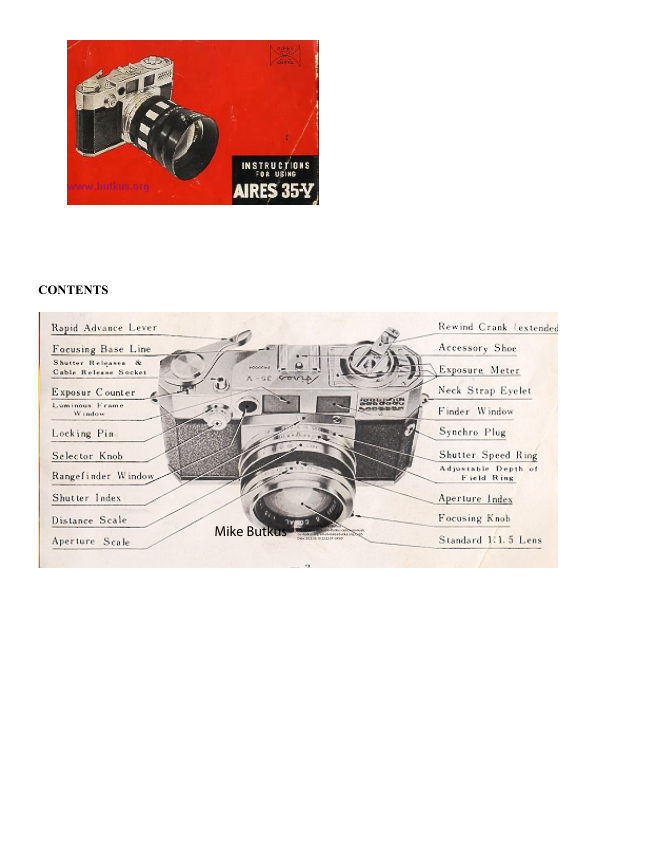
AIRES 35-V lenses
User manual
15 pages · EnglishRead →
AccuraPDF
Accura Zoom Duplivar Slide / negative duplicator
User manual
11 pages · EnglishRead →
EdnalitePDF
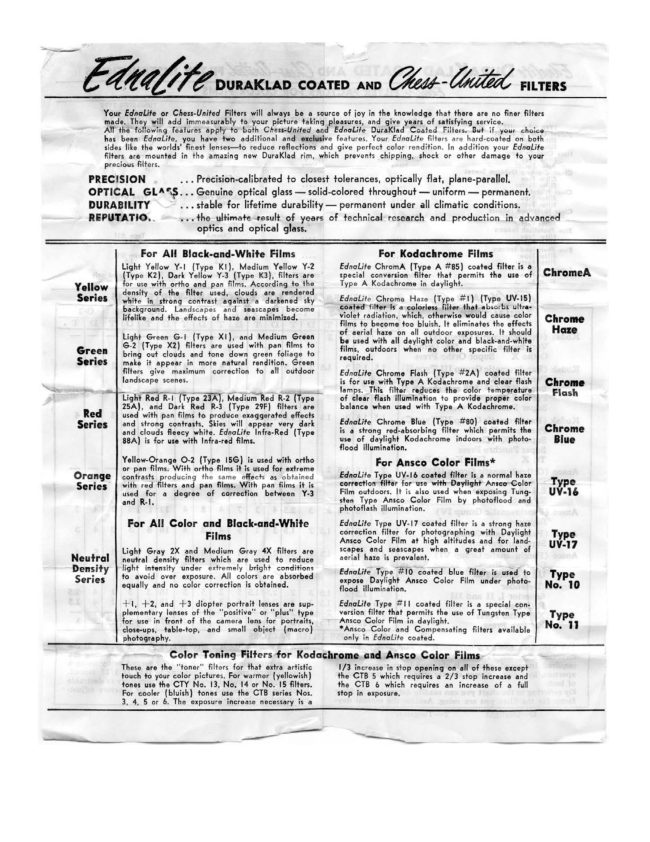
Ednalite filters flier
Product booklet
2 pages · EnglishRead →
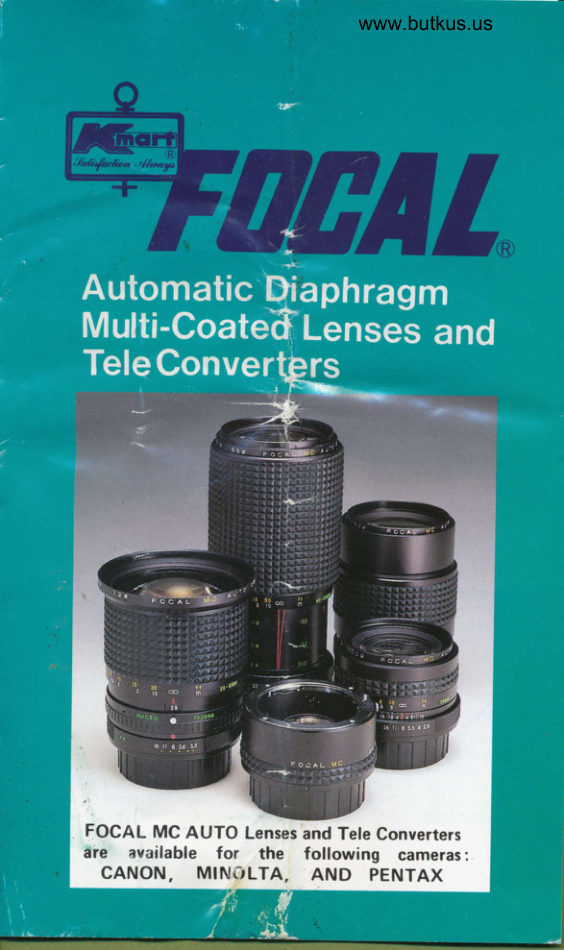
FocalPDF
Focal auto diaphragm lensesand tele-extenders
User manual
11 pages · EnglishRead →
Various brandsPDF
JC Penny Lens instructions
User manual
8 pages · EnglishRead →

KonicaPDF
Konica Autoreflex A lenses
User manual
66 pages · EnglishRead →
MinoltaPDF
Minolta Maxxum zoom lenses
User manual
20 pages · EnglishRead →
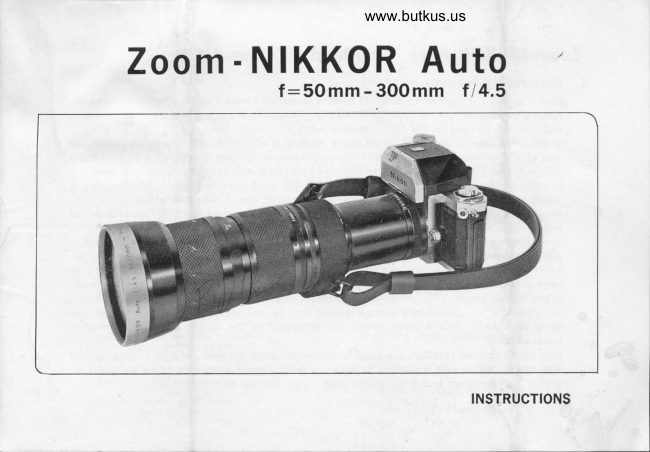
NikonPDF
Nikon 50-300
User manual
9 pages · EnglishRead →
Zeiss IkonPDF
Pantar lenses for Zeiss Ikon
Product booklet
17 pages · EnglishRead →
PentaxPDF
Pentax 645 lenses - '89
User manual
32 pages · EnglishRead →
PentaxPDF
Pentax 67 Interchangeable Lenses
User manual
30 pages · EnglishRead →
PentaxPDF
Pentax SMC Pentax A lenses
User manual
46 pages · EnglishRead →
From the M. Butkus Camera Manual Library. Original publisher and archive notices are retained.
Check the model and edition against your equipment.
PDF verified 2026-10-10.