Flashes & lighting
Polaroid 3000 Wink Flash User manual
User manual for Polaroid 3000 Wink Flash. 13 pages in English. Read the original PDF, download or print a copy without registration.
13 pagesEnglish7.9 MB PDF
Loading your manual…Open PDF directly
Document details
- Brand
- Polaroid
- Model / document
- Polaroid 3000 Wink Flash
- Document type
- User manual
- Language
- English
- Pages
- 13
- File size
- 7.9 MB
- Category
- Flashes & lighting
- Document date
- Not specified in catalog
Search available document text
Find a term, then jump to its page in the original PDF. Image-only pages may not be searchable; check the PDF for exact wording and diagrams.
Page 3 · Read text
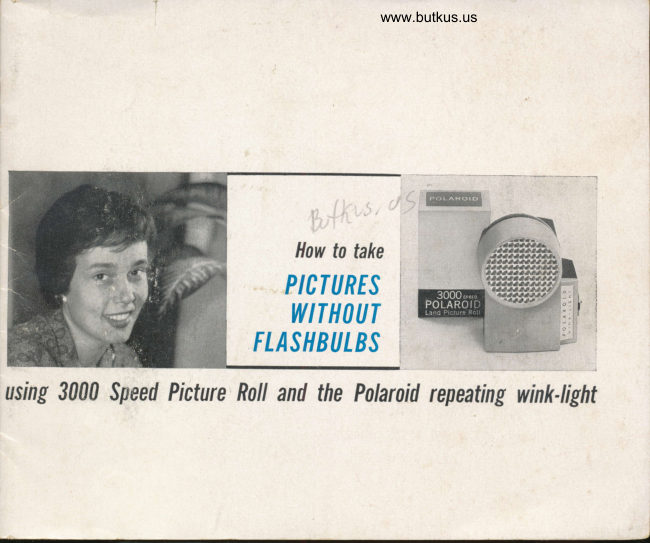
With the development of 3000
 Speed Polaroid Land Picture Roll,
  picture-taking indoors has become
     as effortless and economical as
  making snapshots in the sunshine.
     This folder tells how to get the
 most from this remarkable picture
roll and its companion development,
            the Polaroid winkJight.
View original page 3Page 4 · Read text
www.butkus.us
                     WHAT DOES 3(}O() SPEED FILM MEAN?
                                              It means that you need only 1/15th the light that 200
                                  speed film requires to get a good picture. A floor or table
                              Iamp is bright enough to produce pictures with this film.
                             Of course, as your subject moves away from the lamp,
                                    the amount of light drops off rapidly, and at some point
                                       additional light is needed to make a good picture. That is
                                      the function of the Polaroid wink-light.
Taken with 3000 speed film alone
                    WHAT IS THE WINK-LIGHT?
                                            It is a compact repeating "fillJight" that erases the
                                  dark shadows that would otherwise be present in pictures
                                       lighted by floor or table lamps. Its light output is balanced
                               to normal living-room lighting so that it doesn't over-
                              power the existing room lights, yet adds just enough to
                                    brighten dark shadows. It is powered by a small battery
                                  that will make over a thousand winks before it needs
                               replacement.
                                                                                                                           l;          t   !With 3000 speed film and wink.light                                                                                    i
                  HOW DO YOU USE THEM?
                                      Just clip the wink-light to your camera, set the shutter
                                  to EV 11 (or No. 2 in cameras using the original number-
                                     ing system), turn on all the lights in the room, and take
                                       pictures. When you are making an extreme close-up
                                \th to 4 feet   you will want to use EV 12 (No. 3) -to                               avoid overexposing.-      Otherwise, EV 11 (No. 2) should
                                 prove just about right for all pictures up to the limit of
                                     the wink-light's range. (Note: When attaching the Model
                               252 wink-light to Series 95 cameras, clip the winkJight
                              to the eamera, then tighten the wheel on the wink-
                                        light elip.)
                                                                                                             3
View original page 4Page 5 · Read text
PICTURES AT NIGHT
  The lamps in your living room can help you produce
some of the most charming pictures you've ever taken,
if you use them appropriately. You needn't move
them around or rearrange your furniture. The wink-
Iight removes the guess-work from lamp-lighted pictures.
But it is wise to place your subject in the best position
possible to heighten picture interest.
  The pictures at the right show an ideal situation.
The subject is about two feet from a lamp located some-
what above the head. This placement provides the
interesting top and side-lighting that you see, and
the wink-light  fills in the rest. Obviously, the further the
subject is from the lamp, the less its effect will be on the           placement
picture. Try not to let it be further than necessary.                                   for pictures like this
  One other point is worth watching: don't place the
subject so close to a bright lamp that the subject is
completely washed out. This may happen if the sub-
ject is much closer than one foot from a lamp, or if the
lamp is quite bright (150 watts or more) with a very
transparent shade.
  Rooms lighted with ceiling fixtures make for wonder-
ful pictures if the ceiling light is bright enough.
WHAT lS THE BEST DISTANCE? As in any picture, the
best distance is the closest you can possibly get and still
include all you want in the picture. Pictures of people are
best between four and eight feet, because beyond this
distance the size of the face in the picture becomes so
small that much of the interesting detail is lost. The

4
View original page 5
Page 6 · Read text
www.butkus.us

                             winkJight is designed to work in this range. At distances
                                greater than 8 feet it loses effectiveness rapidly.
                               This does not mean that you cannot take pictures with
                          3000 Speed Picture Roll beyond this distance, because
                               frequently you can. It all depends on the amount of light
                                   Digitally signed by mike butkus   in the room and the exposure range of your Polaroid
                           DN: cn=mike butkus,mike           o=orphancameras, ou=29,     Land Camera. Some models have EV 11 (No. 2) as their
                             email=mike@butkus.org, c=US                               Date: 2018.07.22 12:14:00      lowest number. Others have EV 10 (No. 1). The Model
                                   -04'00'butkus               110A goes as low as EV 8 for hand-held snapshots. If
                           your camera goes to EV 10 or EV 9, you can use these
                         numbers and get more distance. Much beyond 10 feet
                            the wink-light will have little effect on shadows.
                              In general, you will take the best pictures if you stay
                             within an 8 foot range. For the occasional picture that
                           simply can't be composed in this distance, you can use
                             the auxiliary flash attachment described on page 6.
                    D0 | HAVE T0 FOCUS? Yes, you do, just as you would
                            for any outdoor or flash picture. Careful focusing  is
                                particularly desirable for indoor pictures with the wink-
                                 light, because you usually use the largest lens opening
                           and hence obtain minimum depth-of-field.
                   N0 LIGHT AT ALL? If there just isn't any light, or it's so
                      dim that reading is uncomfortable, you can still take
                               pictures up to 6 feet away, using the wink-light alone as
                            the source of light. In this case, the wink-light is acting
                              as a flashgun and the picture will be rather flatly lighted.
                       You may also notice an outline shadow around the subject
                          which is not particularly pleasing, but which is unavoid-
                              able when there are no other lights helping the picture.
View original page 6Page 7 · Read text
EXTREME SITUATIIINS


  Each wink-light is furnished with a tiny plug-in flash
receptacle and reflector that lets you take regular flash
pictures, in situations where the room light or wink-
Iight is not sufficient. The bulb used in the flasher is the
AG-l, smallest and least expensive flashbulb made. The
flasher plugs into the wink-light ease, and the electrical
energy for firing the bulb comes from the wink-light.
    (If from time to time you use the slower Polaroid Pola-
Pan 200 or 400 Land Picture Roll and wish to take flash
pictures with the wink-light and flasher, set the shutter
one number lower than that suggested in the flash guide
packed with the 200 or 400 speed film.)
BOUNCE FLASH Use bounce flash whenever possible. The
reflector of the flash swivels around the bulb and aims
its light upwards for either horizontal or vertical format
bounce flash pictures, or straight ahead for direct-flash
pictures. Bounce is preferred because it gives a soft, inter-
esting light and makes distance-guessing almost unneces-
sary. In general, if there is a light-colored ceiling not over
12 feet high, you can take pictures up to 20 feet away
with bounce flash. Higher or darker ceilings limit the dis-
tance. A very low (7 foot) white ceiling also limits the
 distance because the light can't scatter enough.

 6
View original page 7Page 8 · Read text
www.butkus.us


  On the back of the winkJight is a rough guide for
bounce flash settings which suggests that you use EV 14
(No. 5) for distances from 10 to 15 feet. You may find
it necessary to go one or two numbers lower if the
ceiling is high or not white. If the distance you want to
cover is too great, or the ceiling not suitable, you must
use direct flash, as described below.
BOUNCE FLASH AT CLOSER DISTANCES Although you
will probably prefer the convenience of the winkJight
for most of your indoor pictures, there is a quality that
comes from bounce lighting that is very pleasing, and
you may wish to try it from time to time for close-up and
medium-range pictures. Bounce flash pictures have great
clarity and depth, and are independent of any room
lighting. Although ceiling height and color may require a
change of one or two numbers up or down, try EV 15
(No. 6) for 3l  f.eet to 10 feet.
DIRECT FLASH In situations where the distance is too
great for bounce flash, or the ceiling is unsuitable, turn
the reflector to the straight-ahead position and take a
direct flash picture. The guide on the back of the wink-
light shows shutter settings for the distances over which  ,
direct flash is likely to be required.

                                                             7
View original page 8Page 9 · Read text
PICTURES BY DAY


  One of the wonderful things about the 3000 Speed Pic-
ture Roll is that it lets you use the camera indoors all day
Iong. It is so unusual to think of taking pictures indoors
during the day that you'IIhave to keep reminding yourself
that it is now possible. If you do, you can take some
wonderful shots.
  The lighting indoors will range all the way from bril-
liant sunlight  (if your subject is sitting in a sunbeam near
a window) to near-darkness (the corner of a room on a
dark day). Obviously a certain amount of judgment is
needed to get perfect pictures over this range.
  You can use the winkJight for all indoor daytime
pictures, no matter how bright the room is. If the room
is quite bright, the wink-light won't affect the pictures.
But if the light is questionable, the wink-light will
always guarantee a good picture (in the 6 or 7 foot range).
 I
View original page 9
Page 10 · Read text
www.butkus.us


  For best results, use an exposure meter. The best meter
to use is the new Polaroid Model 625, which is designed
 for 3000 speed film. It has enormous sensitivity, and yet
 it indicates on a single scale, without boosters, baffies or
adjustments, the EV (or shutter setting) number needed
for any picture from the darkest corner to brilliant out-
door sunshine. Complete instructions for indoor pictures
are furnished with this meter.
    If you don't have this meter, you can use earlier Pola-
roid exposure meters, but they will stop reading at a
point far short of the range of 3000 speed film. However,
they are useful if your subject is within 3 or 4 feet of a
window. You can set the film-speed dial at 200 (or "A")
and then add four numbers to the number the meter
reads. For greatest accuraey, use close-up (3 inches or so)
readings of the side of the subject's face nearest to you.
lF YOU DON'T OWN A METER, or the meter you have has
limited sensitivity, you can guess at the exposure with
this rule-of-thumb:  if it is a bright day outside, start with
EV 13 (No. 4), providing your subject is not in direct
sunlight and is about 5 feet from a window. Subtract one
number for each additional 3 feet you move from the
window. If the day is overcast, subtract still another
number. And if it is a dark, grey day, subtract another.
  These suggestions must obviously be quite general,
and you may find that a second picture is needed to get
the correct exposure. Remember that to LIGHTEN the
pictures, you use a LOWER number (just think of L-L).
View original page 10Page 11 · Read text
M[lllEL II OA                                              There is no winkJight avail-
                                                                     able for the origi.nal Model
  The Pathfinder is an ideal instrument for the 3000        110 Land' Catnera (discon-                                                                   tinued in 1956).Speed Picture RoIl. Its big lens adds enormously to                                                  The flash contacts on thethe range of the film and lets you take pictures at unbe-         shutter of this camera arelievably low light levels. Also, the distance over which         not rugged enough to handle
you can work with the winkJight is considerably in-        the current requirements of
creased, 15 feet or more with the lens wide open (f/4.7).         the wink-light. As with the                                                                            lVlodel 110A, however, the
SHUTTER SETTINGS FOR M0DEI 1l0A Use the 'rM" flash       added aperture and shutter
setting and 1/30th second for most pictures, and then        speedpossiblerangea wideof thevariety110 makeofeontrol the EV setting with the aperture-control knob.        indoor available light pic-
                                                                       3000 speed film.If you need more exposure than EV 9rZ (the lowest         tures with
obtainable at l/30th second), go to L/Llth or even 1/8th
second. Do not try to hand-hold the camera at L/4th
second or below unless you are extremely steady or can
rest the camera on a firm support. If you wish to use the
built-in self-timer (10 seeond delay), set the shutter to
L/Llth, rather than 1/30th second.
SPECIAI EFFECTS WITH M0DEt 1l0A You'll be able to
use unusual lighting with the Pathfinder, and for
many pictures you may not want or need the wink-light.
Frequently you'll find that at EV 8% (I/Llth a.t t/4.7)
the ioom lights alone will give beautiful pictures. Pictures
tike the one at the right are particularly charming beeause
atl of. the light comes from the tiny candle flame. Outdoors
you'll be able to take pictures in the early evening when
it'r lit"."lly too d.ark to read. A Polaroid 625 Meter is
especially reeommended to help you get the most out of
the Pathfinder in every circumstance.

t0
View original page 11Page 12 · Read text
www.butkus.us

                                      tlUTD(l(lR PICTURES

                           Because of the extraordinary sensitivity of 8000 speed.
                           film it needs added protection against overexposure and
                              light leaks in bright sunlight.
\:iU                      5           Fortunately, it's no trick to adapt your camera to use      /3 , :/
                        the 3000 Speed Picture Roll outdoors. Each winkJight
                       has packed with it the tight seals that are necessary.
                     They take only a moment to fit to your camera. Follow
                             instructions for attaching carefully. (Note: cameras having
                     a serial number prefaced with "L" have been internally
                             light-sealed at the factory, and no additional seals are
                         needed. Check your camera serial number.)
                         In addition to the light seals, your wink-light comes
                         with a light-reducing filter that fits over the front of any
                           Polaroid Land Camera and cuts the exposure down for
                        outdoor daylight pictures. This is a "four-stop" filter
                         (one "stop" equals one EV number) and, in effect, it
                          converts 3000 speed to 200 speed. Thus, with the 4-S
                         Light Reducer in place, you use exactly the same shutter
                      numbers you would use with a 200 speed film.
                       At the point where the pictures are too dark with the
                                 filter in place, remove it, add 3 numbers to the former
                             setting, and take beautiful pictures in light that would
                      have been too dim for the 200 speed film. As it grows
                        even darker, use lower and lower numbers until you run
                         out of light. And, of course, remember to set your meter
                             scale to 3000 whenever the light-reducer is not used.
                                                                                                        ll
View original page 12Page 13 · Read text
DAYLIGHT PRECAUTIONS Keep the 4-S Light Reducer in
place over the lens at all times when the light is bright,
even when the camera is closed (except for the Model
110A). The filter adds additional light-sealing protection
for the lens and shutter. When you pull the tab to
develop a picture, be sure your body shades the tab-
slot of the camera, Do not leave the camera unpro-
tect'ed in the bright sun for longer than necessary.
IMP0RTANCE 0F RECHARGE TIME The winkJight bulb
gets its energy from a condenser which is charged by'the
battery. It takes at least 10 seconds after flashing. to
recharge fully, and as the battery ages, it takes a little
longer. Charging begins the moment you attaeh the
winkJight to the eamera, and thereafter, immediately
after each wink. To be safe, allow 15 seconds for charg-
ing after attaching the wink-light, and between winks.
HOW LONG l,TlLL THE BATTERY LAST? For 1000 or
more flashes, or for about one year, whichever comes first.       Important: Never mount the
Although the winkJight should continue to-flash long        ',vink-light and Model 440
after a year or 1000 flashes, the light output will begin to       Photoelectric Shutter on the
drop, and your pictures will start-coming out darker.       camera at the same time. This                                                                  places a short circuit acrossA replacement battery is available from your dealer and       the battery, which wili be ex-a new bulb is included so that both can be replaced       hausted in a few hours.
at +;he same time. Instructions are included.


                    "Polaroid" and "PolaPan"@  Polaroid wink-light Patent No. D-184,849     Printed in U.S.A.
View original page 13Related documents and language editions
PolaroidPDF
POLAROID 220
User manual
37 pages · EnglishRead →
PolaroidPDF
POLAROID 350
User manual
53 pages · EnglishRead →
PolaroidPDF
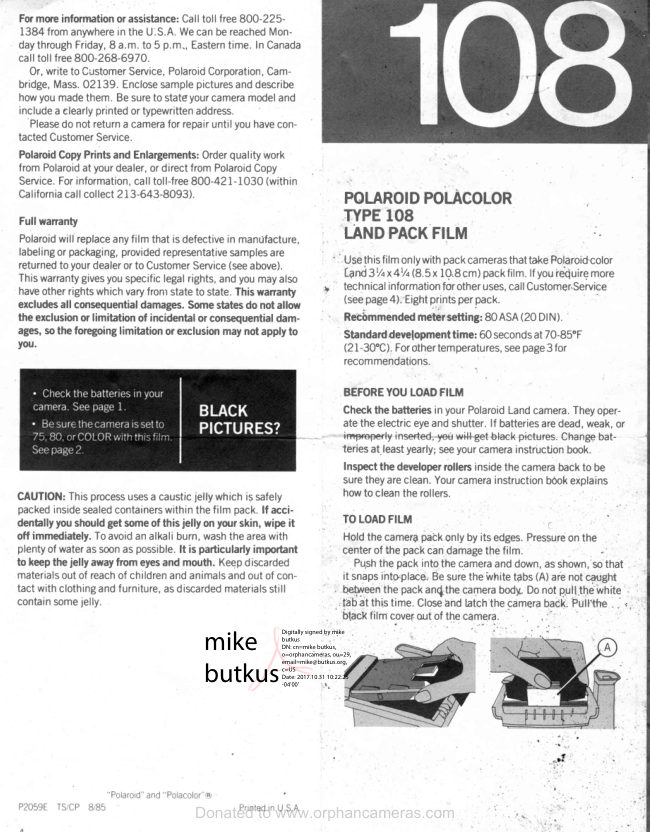
Polaroid 108 film information
User manual
5 pages · EnglishRead →
PolaroidPDF
Polaroid 110A
User manual
30 pages · EnglishRead →
PolaroidPDF
Polaroid 125
User manual
23 pages · EnglishRead →
PolaroidPDF
Polaroid 135
User manual
25 pages · EnglishRead →
PolaroidPDF
Polaroid 210
User manual
27 pages · EnglishRead →
PolaroidPDF
Polaroid 215
User manual
25 pages · EnglishRead →
PolaroidPDF
Polaroid 225
User manual
29 pages · EnglishRead →
PolaroidPDF
Polaroid 230
User manual
28 pages · EnglishRead →
PolaroidPDF
Polaroid 240
User manual
27 pages · EnglishRead →
PolaroidPDF
Polaroid 315
User manual
50 pages · EnglishRead →
From the M. Butkus archive. Original publisher and archive notices are retained.
Check the model and edition against your equipment.
PDF verified 2026-10-10.