Lenses & filters
Vivitar Lens Specs User manual
User manual for Vivitar Lens Specs. 45 pages in German. Read the original PDF, download or print a copy without registration.
45 pagesGerman1.9 MB PDF
Loading your manual…Open PDF directly
Document details
- Brand
- Vivitar
- Model / document
- Vivitar Lens Specs
- Document type
- User manual
- Language
- German
- Pages
- 45
- File size
- 1.9 MB
- Category
- Lenses & filters
- Document date
- Not specified in catalog
Search available document text
Find a term, then jump to its page in the original PDF. Image-only pages may not be searchable; check the PDF for exact wording and diagrams.
Page 1 · Read text
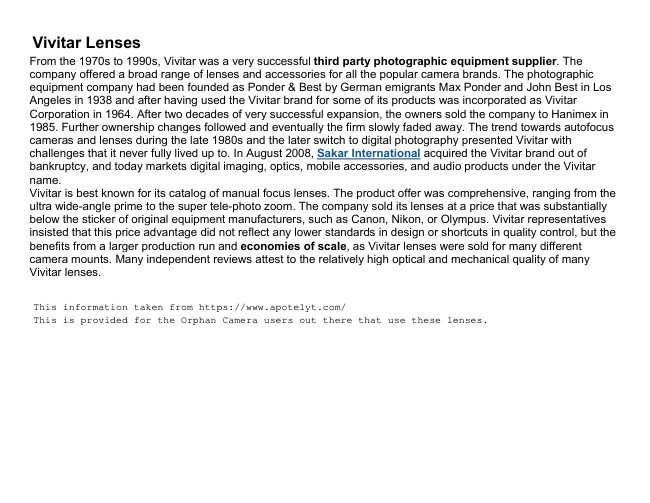
Vivitar Lenses
From the 1970s to 1990s, Vivitar was a very successful third party photographic equipment supplier. The
company offered a broad range of lenses and accessories for all the popular camera brands. The photographic
equipment company had been founded as Ponder & Best by German emigrants Max Ponder and John Best in Los
Angeles in 1938 and after having used the Vivitar brand for some of its products was incorporated as Vivitar
Corporation in 1964. After two decades of very successful expansion, the owners sold the company to Hanimex in
1985. Further ownership changes followed and eventually the firm slowly faded away. The trend towards autofocus
cameras and lenses during the late 1980s and the later switch to digital photography presented Vivitar with
challenges that it never fully lived up to. In August 2008, Sakar International acquired the Vivitar brand out of
bankruptcy, and today markets digital imaging, optics, mobile accessories, and audio products under the Vivitar
name.
Vivitar is best known for its catalog of manual focus lenses. The product offer was comprehensive, ranging from the
ultra wide-angle prime to the super tele-photo zoom. The company sold its lenses at a price that was substantially
below the sticker of original equipment manufacturers, such as Canon, Nikon, or Olympus. Vivitar representatives
insisted that this price advantage did not reflect any lower standards in design or shortcuts in quality control, but the
benefits from a larger production run and economies of scale, as Vivitar lenses were sold for many different
camera mounts. Many independent reviews attest to the relatively high optical and mechanical quality of many
Vivitar lenses.


 This information taken from https://www.apotelyt.com/
 This is provided for the Orphan Camera users out there that use these lenses.
View original page 1
Page 3 · Read text
Vivitar Series 1 90-180mm Flat Field[cameraquest.com]
Manufacturer identification
     Serial number       Lens producer
           09 or 9                      Cosina
             13                  Schneider Kreuznach
             22                      Kino/Kiron
             25                  Ozone Optical
             28                    Komine
             32                    Makinon
             33                    Asanuma
             37                       Tokina
             42                   Eugen Bauer
             44                      Perkin Elmer
             47                      Chinon
             51                  Tokyo Trading
             56                   Kyoe Shoji
             61                    Samyang
             75                     Hoya
             77                       Kobori
             81                           Polar

During the period from 1970 to 1990, Vivitar used a serial number system that makes it possible to identify the manufacturer of
the lens. The first two digits indicate the company that designed and produced the optic according to Vivitar's specifications.
For example, a serial number starting with "28" suggests that the lens was manufactured by Komine, and "37" points to an optic
from Tokina. After 1990, this numbering system was no longer strictly adhered to.
Similar to Soligor – its East Coast competitor – Vivitar did not engage in the manufacturing of most of its products,
but generally commissioned its lenses from Japan-based producers. The company collaborated with a number
of different optics manufacturers, including Cosina, Komine, Kiron, and Tokina. Perhaps as a side-effect of this
collaboration, some very similar lenses to the Vivitar designs were also sold under other branding.
In the early 1970s, Vivitar launched the first lenses of its acclaimed Series 1 line. These optics offered outstanding
specifications and superior image quality. They were competing with the professional lens offers of the main camera
brands at a price that – although not cheap – was accessible to amateurs. Indeed, the Series 1 lenses received
favorable reviews, established Vivitar as a high quality third party vendor, and in some cases, such as the 70-
210mm macro-focusing zoom or the 90mm f/2.5 "Bokina", even achieved cult status among enthusiast
photographers. These professional grade lenses continue to perform well on modern digital cameras. They can be
mounted directly on Nikon and Pentax DSLR, while adapters exist to use them on Canon and mirrorless cameras
(Fujifilm, Olympus, Panasonic, Sony).
View original page 3Page 4 · Read text
The table below lists the specifications of most Vivitar lenses. Many optics were produced over the years in several
different varieties. For example, Robin Parmar lists no fewer than 38 versions of the Vivitar 28mm wide-angle
prime across different mounts, f-speed, filter size, and filter rim inscription. Some of these varieties are very rare and
little is known about the lenses and their specifications. As a result, the adjacent compendium remains incomplete,
but will get more comprehensive as additional information on some of the more exotic Vivitars becomes available.
View original page 4
Page 14 · Read text
Vivitar
28mm      Tokina   TX   MF   58   2.5 x 2.3 in  9.7 oz 20-40 check
f/2.8 (E58)


Vivitar
28mm    Samyang  Fixed  MF   52   2.6 x 1.5 in  9.5 oz 20-40 check
f/2.8 (E52)
View original page 14
Page 17 · Read text
Vivitar
28-70mm   Kobori   Fixed  MF   52   2.4 x 3.0 in 12.3 oz 20-40 check
f/3.5-4.8


Vivitar
28-85mm   Kobori   Fixed  MF   62   2.5 x 3.7 in 17.5 oz 20-40 check
f/3.5-4.5
View original page 17
Page 18 · Read text
Vivitar
Series 1
            Cosina   Fixed  MF   67   2.8 x 4.4 in 24.0 oz 25-75 check
28-90mm
f/2.8-3.5


Vivitar
Series 1
            Cosina   Fixed  MF   67   2.8 x 4.1 in 21.9 oz 25-75 check
28-105mm
f/2.8-3.8
View original page 18Page 19 · Read text
Vivitar
28-200mm  Kobori   Fixed  MF   72   3.0 x 4.6 in 23.5 oz 20-50 check
f/3.5-5.3


Vivitar
35-70mm  Komine  Fixed  MF   55   2.6 x 2.8 in 13.1 oz 20-50 check
f/2.8-3.8
View original page 19
Page 20 · Read text
Vivitar
35-70mm  Komine  Fixed  MF   58   2.5 x 3.0 in 15.9 oz 20-50 check
f/3.5


Vivitar
35-70mm   Cosina   Fixed  MF   52   2.5 x 2.6 in 11.3 oz 20-40 check
f/3.5-4.8
View original page 20
Page 21 · Read text
Vivitar
Series 1
            Kiron   Fixed  MF   72   3.2 x 3.6 in 27.0 oz 30-90 check
35-85mm
f/2.8


Vivitar
35-105mm  Kobori   Fixed  MF   55   2.5 x 3.7 in 18.1 oz 20-40 check
f/3.2-4
View original page 21Page 23 · Read text
Vivitar
70-150mm
f/3.8        Kino    Fixed  MF   52   2.5 x 3.9 in 15.3 oz 20-40 check
Macro
Focusing


Vivitar
70-150mm
f/3.8        Kino    Fixed  MF   52   2.4 x 4.4 in 19.4 oz 20-40 check
Close-
Focusing
View original page 23
Page 27 · Read text
Vivitar
Series 1
70-210mm   Kino    Fixed  MF   67   3.1 x 6.1 in 31.0 oz 20-50 check
f/3.5
(Kino)


Vivitar
Series 1
70-210mm  Tokina   Fixed  MF   62   2.8 x 5.5 in 25.0 oz 20-50 check
f/3.5
(Tokina)
View original page 27
Page 28 · Read text
Vivitar
70-210mm  Cosina   Fixed  MF   52   2.5 x 4.0 in 15.9 oz 20-40 check
f/4.5-5.6


Vivitar
70-300mm  Kobori   Fixed  MF   55   2.5 x 4.3 in 17.5 oz 20-40 check
f/4.2-5.8
View original page 28
Page 29 · Read text
Vivitar
75-205mm  Kiron   Fixed  MF   58   2.6 x 6.0 in 25.9 oz 20-40 check
f/3.8


Vivitar
75-300mm  Kiron   Fixed  MF   58   2.4 x 4.8 in 19.2 oz 20-40 check
f/4.5-5.6
View original page 29
Page 31 · Read text
Vivitar
80-200mm
           Kobori   Fixed  MF   55   2.8 x 5.8 in 24.9 oz 20-40 check
f/4.5
(Kino)


Vivitar
80-200mm
           Kobori   Fixed  MF   55   2.5 x 5.0 in 21.2 oz 20-40 check
f/4.5
(Kobori)
View original page 31Page 44 · Read text
Vivitar FAQ
Which Vivitar lenses are suitable for Canon EOS?
Canon radically changed its lens attachment system in the mid-1980s when switching from the FD to the EF/EOS mount.
Manual focus Vivitar lenses will be available in FD mount, while autofocus lenses will use the EF mount. There are adapters to
use FD mount lenses on EOS cameras, but since the flange-focal distance on the EF/EOS mount is longer than on the FD
mount, the lenses will not focus to infinity, unless the adapter contains a lens element. The latter might slightly degrade image
quality. However, there are adapters to use Nikon or Olympus lenses, which have a relatively long flange to focal distance, on
EOS cameras. Hence, the Nikon or Olymus-version of a manual focus Vivitar lens could be adapted to an EOS camera and
maintain inifinty focus ability. In any case, there is no aperture control, so that the lens would need to be operated in stop-down
mode.
Do Vivitar lenses fit Nikon digital cameras?
Nikon provides good backward compatibility, so that legacy Vivitar lenses in Nikon mount can often be used on modern
cameras. However, some limitations apply. In particular, legacy F-mount lenses can be mounted on all cameras, but only the
higher end Nikon bodies will meter with them (with other Nikon bodies, the lenses have to be used in stop-down mode). See
the FAQ section of the Nikon lens compendium or this dpreview article for information on particular camera-lens
combinations.
Where can I find good Vivitar lens reviews?
Some lab-reviews of Vivitar lenses with MTF data can be found at photodo.com. Also, Ken Rockwell reviewed the popular
70-210mm Series 1 zoom and the 1.4/85mm prime on his site.
Are all versions of the Series 1 70-210mm zoom held in equal esteem?
The 70-210mm Series 1 zoom was produced in several versions over the years. The three early varieties of the lens, the fixed
f/3.5 aperture zooms by Kiron and Tokina, as well as the 2.8-4/70-210mm by Komine provide the highest optical quality. The
later f/2.8-4 version by Cosina do not reach the same standard.
Why is the Vivitar Series 1 90mm f/2.5 macro lens sometimes referred to as "Bokina"?
This Tokina-manufactured macro lens provides a particularly pleasing bokeh. The optic is very sharp, while the transition to
ouf-of-focus elements is seamless, smooth and dreamlike, to the extent that the lens earned its own nickname from enthusiast
photographers – Bokina.
Do all Series 1 lenses provide superior imaging performance?
The fast manual focus lenses within the Series 1 line tend to be very good optically and mechanically. The slower (f/4.5-5.6)
lenses and the autofocus versions are less distinguished.
 Further Reading
View original page 44
Page 45 · Read text
Steve Rainwater provides a very nice historical account of the genesis of the first Vivitar Series 1 lens, while Boggy has made
a collection of instruction manuals for Vivitar lenses available on his website. Moreover, if you are looking for bargains among
third party legacy lenses, you might also want to check out the compendiums of, respectively, Soligor and Tamron Adaptall
lenses. If, however, you are willing to spend a little more, you might well be interested in the Leica R-lens catalog, which
contains some truly exceptional optics that can be adapted to and used with a variety of camera mounts.
View original page 45
Related documents and language editions
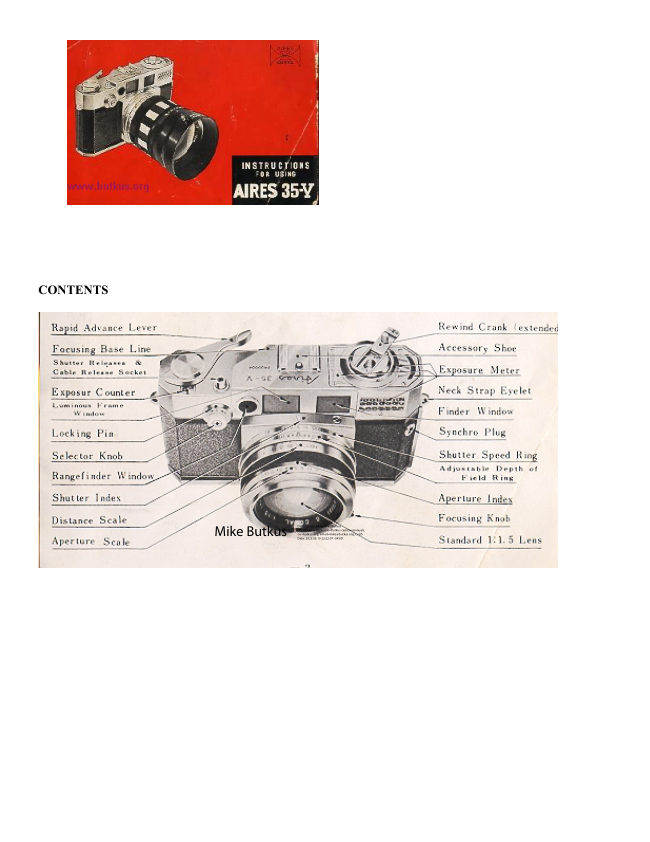
AiresPDF
AIRES 35-V lenses
User manual
15 pages · EnglishRead →
AccuraPDF
Accura Zoom Duplivar Slide / negative duplicator
User manual
11 pages · EnglishRead →
EdnalitePDF
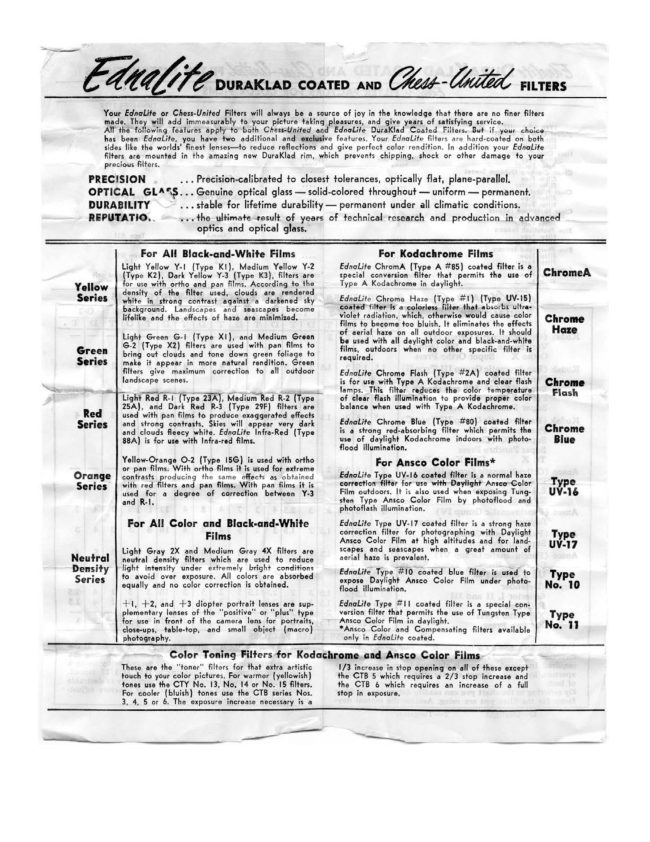
Ednalite filters flier
Product booklet
2 pages · EnglishRead →
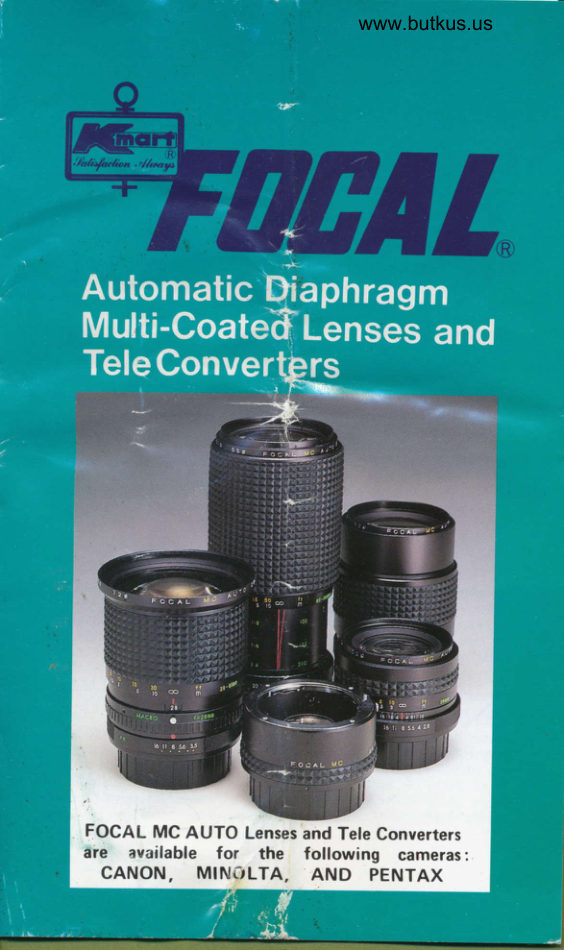
FocalPDF
Focal auto diaphragm lensesand tele-extenders
User manual
11 pages · EnglishRead →
Various brandsPDF
JC Penny Lens instructions
User manual
8 pages · EnglishRead →

KonicaPDF
Konica Autoreflex A lenses
User manual
66 pages · EnglishRead →

Various brandsPDF
Lens Guide - General (1960s)
Product booklet
97 pages · EnglishRead →
MinoltaPDF
Minolta Maxxum zoom lenses
User manual
20 pages · EnglishRead →
NikonPDF
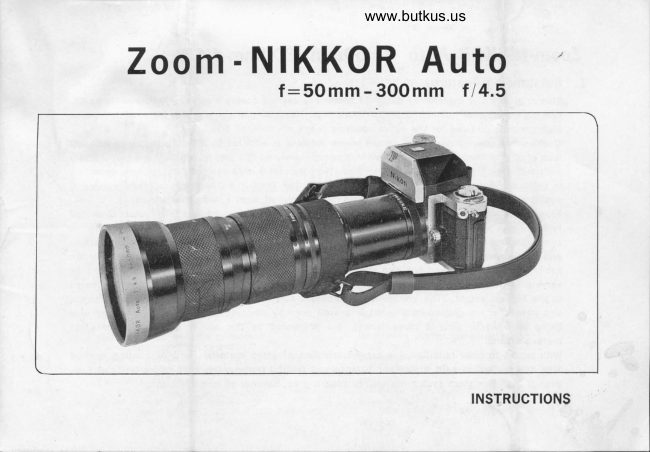
Nikon 50-300
User manual
9 pages · EnglishRead →
Zeiss IkonPDF
Pantar lenses for Zeiss Ikon
Product booklet
17 pages · EnglishRead →
PentaxPDF
Pentax 645 lenses - '89
User manual
32 pages · EnglishRead →

PentaxPDF
Pentax 67 Interchangeable Lenses
User manual
30 pages · EnglishRead →
From the M. Butkus archive. Original publisher and archive notices are retained.
Check the model and edition against your equipment.
PDF verified 2026-10-10.